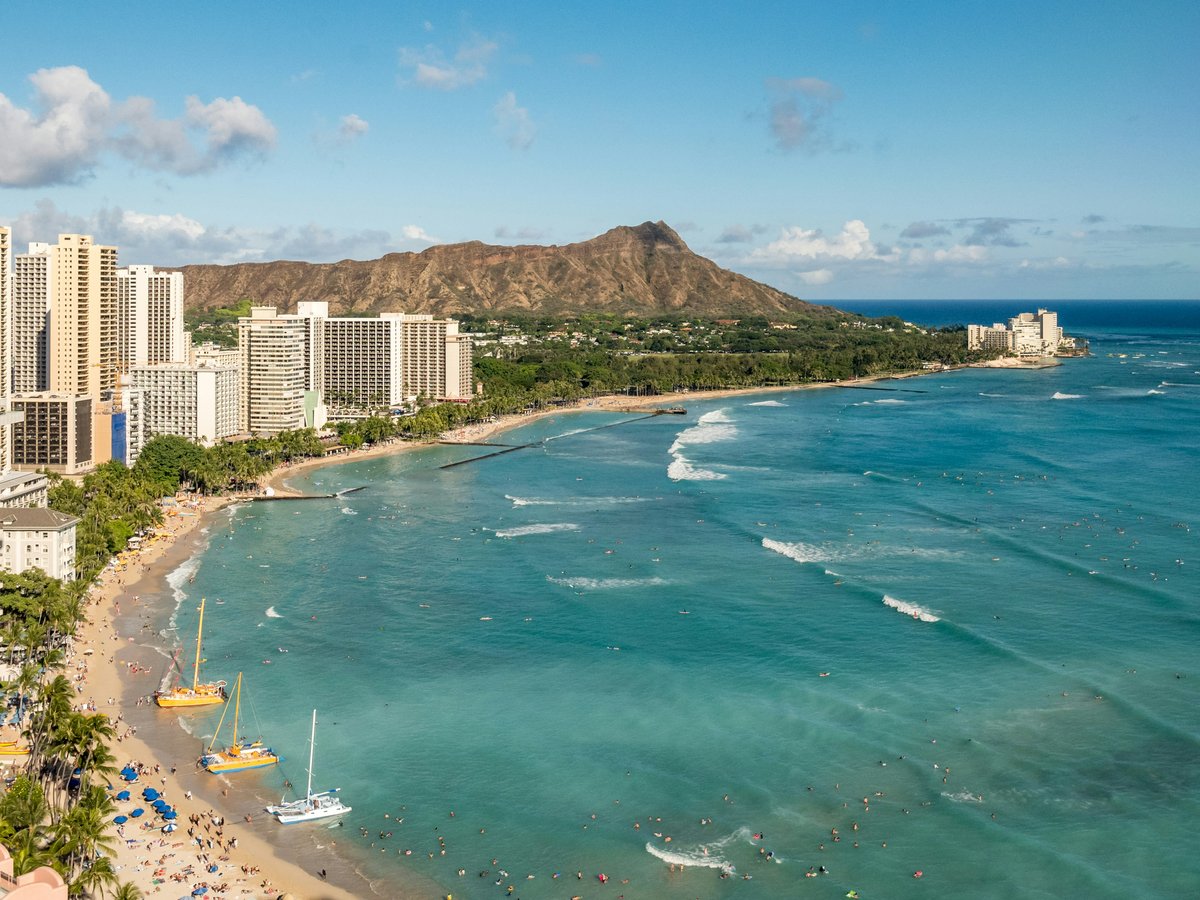
Stay in Honolulu in February
63 hotels in the Trip.com pool for Honolulu, from US$27 a night.
Opens Trip.com on Fri 5 Feb to Sun 7 Feb 2027; change the dates there.
February in Honolulu sits right in the middle of peak tourist season, and you'll feel it the moment you try to book a Waikiki hotel. Mainland visitors escaping sub-zero winters flood Oahu from December through March, and February is no exception. That said, there's a reason they all come. Daytime temperatures hover around 25°C (78°F), the trade winds keep 73% humidity from feeling oppressive, and humpback whales are migrating through the channel between Oahu and Molokai in serious numbers. February is still technically wet season, but it tends to be drier than both January and December, averaging about 44mm of rain spread across 7 days. Most of those showers blow through in 20 to 30 minutes.
The city has a different energy this month. Chinese New Year celebrations take over parts of Chinatown with lion dances and firecrackers along Maunakea Street. The Punahou Carnival sets up on the Punahou School campus in Makiki with rides and malasada stands. On the North Shore, winter swells still push 15-to-25-foot faces at Pipeline and Sunset Beach, the last stretch of serious big-wave season before the ocean calms in April. Ocean temperatures sit around 24°C (75°F), warm enough for long swims without thinking twice.
To be fair, February is not the month for bargain hunters or solitude seekers. If you want half-empty beaches and shoulder-season hotel rates, September and October are your window. But if you're arriving from somewhere cold and want reliable warmth, whale encounters off Makapu'u Point, and the full-tilt energy of peak-season Honolulu without the holiday madness of late December, February is a solid pick. Sunset arrives by about 6:20pm, earlier than you might expect at 21°N latitude.
Why visit in February
- Humpback whale season peaks from January through March, with February offering some of the highest concentration of pods in the Oahu-Molokai channel. You can spot spouts from Makapu'u Point Lookout without spending a dollar.
- February averages 44mm of rain compared to 71mm in January and 72mm in December, making it the driest month of the wet season and the most reliable for outdoor plans.
- North Shore big-wave season still delivers 15-to-25-foot swells at Pipeline and Sunset Beach. The final Eddie Aikau-eligible windows often fall in February.
- Chinese New Year celebrations bring lion dances, firecrackers, and food stalls to Chinatown, centered around Maunakea Street and the Chinatown Cultural Plaza.
Worth knowing
- Peak-season hotel rates across Waikiki and Ko Olina run 30-50% above the September-October baseline, and flight prices from the West Coast reach annual highs.
- Waikiki Beach, Hanauma Bay, and Diamond Head trail are at their most crowded. Hanauma Bay reservations fill within minutes of opening.
- Still the wet season. Brief afternoon showers are common, and the Ko'olau mountains can trap clouds over windward neighborhoods like Kailua for hours.
- Sunset arrives around 6:20pm, roughly 90 minutes earlier than July, cutting short late-afternoon beach time.
Best for
Think twice if
February brings Honolulu's mildest wet-season conditions. The average high reaches 25.3°C (78°F) with lows around 19.7°C (67°F) after dark. Expect about 44mm of rain spread across roughly 7 days, typically as brief trade-wind showers that blow through in 20 to 30 minutes rather than all-day downpours. The Ko'olau mountains tend to catch most of the moisture on the windward side, so leeward Waikiki and Ala Moana often stay dry while Kailua and Kaneohe get passing clouds. Mornings are usually clear, with clouds building by mid-afternoon. The trade winds keep 73% humidity feeling comfortable rather than sticky. Ocean temperature sits around 24°C (75°F), warm enough for extended time in the water without a wetsuit.
Seasonal caution
- North Shore winter swells generate powerful shore break and dangerous rip currents at beaches like Sunset Beach and Banzai Pipeline. These are not swimming beaches in February. Obey lifeguard warnings and red-flag closures.
- The UV index in Honolulu reaches 8 to 10 even on partly cloudy February days. The trade winds mask the intensity of sun exposure, and most visitor sunburns happen on overcast days when people skip sunscreen.
Year-round climate
Averages from the last 5 years.
| Month | Avg high (°C) | Avg low (°C) | Rainfall (mm) |
|---|---|---|---|
| Jan | 26 | 20 | 71 |
| Feb | 25 | 20 | 44 |
| Mar | 26 | 20 | 58 |
| Apr | 26 | 21 | 59 |
| May | 27 | 22 | 60 |
| Jun | 28 | 23 | 17 |
| Jul | 29 | 23 | 18 |
| Aug | 29 | 23 | 25 |
| Sep | 29 | 23 | 19 |
| Oct | 29 | 23 | 28 |
| Nov | 28 | 22 | 31 |
| Dec | 26 | 21 | 72 |
Holidays and festivals in February
Public holidays
- Lincoln's Birthday(Lincoln's Birthday)12 February 2027
- Presidents Day(Washington's Birthday)15 February 2027
Best things to do in February
Whale watching from Makapu'u Point Lookout
natureThe 1.6km paved trail at Makapu'u Point rises about 150 meters above sea level, giving you a direct line of sight into the Oahu-Molokai channel. Humpback whales breach, slap tails, and blow spouts close enough to see without binoculars on good days. The lookout bench at the summit is the best free seat in Honolulu for whale season.
February sits at the peak of humpback migration, with an estimated 10,000 whales in Hawaiian waters. Sighting frequency is among the highest of any month.Booking tipNo reservation needed. Arrive before 8am on weekends to get parking in the small lot at the trailhead. Weekday mornings are far less crowded.
Watch big-wave surfing on the North Shore
spectator_sportPipeline and Sunset Beach produce 15-to-25-foot faces in February. You stand on the sand at Ehukai Beach Park, close enough to feel the rumble of the waves hitting the reef. The smell of salt and coconut sunscreen, the crack of a lip throwing over, the roar from the crowd when someone pulls into a barrel. It's free and it's a spectacle.
February is the tail end of the North Shore big-wave window. By late March the swells drop off. The Eddie Aikau invitational, which requires 40-foot faces, has its last viable windows in February.Booking tipDrive out early. The Kamehameha Highway backs up past Haleiwa by 9am on big swell days. Check surf reports the night before.
Explore Chinatown during Chinese New Year
culturalMaunakea Street fills with lion dance troupes, the pop and smoke of firecrackers, and food vendors selling everything from roast duck to turnip cake. The Chinatown Cultural Plaza hosts performances. The narrow streets smell like incense, roasted pork, and fresh leis from the lei stands on Beretania Street.
Chinese New Year falls in late January or February depending on the lunar calendar. Honolulu's Chinatown has celebrated since the 1800s, one of the oldest continuous observances in the US.Booking tipNo tickets needed. The main celebrations happen over a weekend. Street parking in Chinatown is limited, so take TheBus Route 2 from Waikiki.
Snorkel at Hanauma Bay
water_sportThe protected bay sits inside a volcanic crater on Oahu's southeast coast. Visibility in February typically reaches 10-15 meters, and the water temperature of 24°C (75°F) means you can stay in for an hour without getting cold. Parrotfish, humuhumunukunukuapua'a (reef triggerfish), and green sea turtles are regulars in the shallows.
February's relatively calm south-shore conditions and warm water make for comfortable snorkeling. The bay is closed Mondays and Tuesdays for reef recovery, concentrating visitors on the remaining 5 days.Booking tipOnline reservations are required and open at 7am HST two days in advance. Set an alarm. Slots fill within minutes during peak season.
Hike Diamond Head (Le'ahi)
hikingThe 1.3km trail climbs 170 meters through a former military fortification to a summit with 360-degree views of Waikiki, Koko Head, and the Pacific. February's 25°C temperatures and trade winds make the climb more comfortable than summer months, when the interior of the crater traps heat above 32°C.
Cooler February temperatures make the exposed, shadeless trail significantly more bearable. The lower sun angle in winter also gives better light for photos from the summit.Booking tipReservations are required. Book online through the Hawaii DLNR portal. Early morning slots before 8am have the shortest wait at the tunnel sections.
KCC Farmers Market
foodKapiolani Community College hosts this Saturday morning market at the base of Diamond Head. Local farmers sell Kau oranges, lilikoi, apple bananas, and fresh honey. Food stalls serve poke bowls, grilled mahi-mahi, and fresh coconut water. The smell of grilling meat and ripe fruit carries across the parking lot.
February is peak season for Kau oranges and lilikoi, both winter crops. The market runs year-round, but the February produce selection is among the best.Booking tipArrive by 8am. The most popular vendors sell out of seasonal produce by 9:30am. Bring cash for the smaller farm stalls.
Sunset sail off Waikiki
water_sportCatamarans depart from Waikiki Beach in the late afternoon, heading west along the coast toward the Waianae Range. February sunsets paint the sky in orange and pink against the silhouette of Diamond Head. If you're lucky, you might spot a humpback whale breach from the boat. The wind is cool on your face at 24°C with the trade winds adding a chill on the water.
February's earlier sunset time of 6:20pm means the sail fits neatly into a late afternoon. Whale sightings from the water are a genuine possibility this month.Booking tipBook at least 3-4 days ahead during peak season. Several operators launch directly from the sand at Waikiki, so you can compare options by walking the beach.
Visit 'Iolani Palace
culturalThe only royal palace on US soil, built in 1882 for King Kalakaua. The interior has been restored with period furniture, royal portraits, and the crown jewels. Guided docent tours take about 60 minutes and cover the overthrow of Queen Lili'uokalani in 1893. The grounds include a massive banyan tree and the former barracks of the Royal Guard.
February's mild weather makes walking the palace grounds and the surrounding Capitol District comfortable. It's also a good rainy-day backup, since the tour is indoors.Booking tipBook the guided tour online in advance. Self-guided audio tours are also available. Closed Sundays and Mondays.
What to eat in February
In season: fruit
Lilikoi (passion fruit)
Winter crop peaks in January through March. Look for fresh lilikoi at the KCC Farmers Market on Saturday mornings, where vendors sell them whole or as lilikoi butter, a tangy-sweet spread that locals put on everything from toast to shave ice.
Kau oranges
These Big Island-grown navel oranges reach Honolulu farmers markets in winter. Smaller and less uniform than mainland supermarket oranges, with an intense sweetness that comes from volcanic soil. The season typically runs December through March.
On menus now
Saimin
Hawaii's comfort noodle soup, a dish born from plantation-era Japanese, Chinese, and Filipino cooking. Thin wheat noodles in a dashi-based broth with char siu, kamaboko fish cake, and green onions. It hits differently on a 19°C February evening with the trade winds blowing. Palace Saimin in Kalihi has served it since 1946.
Oxtail soup
A local comfort staple with roots in Hawaiian-Chinese cooking. Slow-braised oxtail in a clear, star anise-scented broth, served with rice and a dish of mustard-soy dipping sauce. Kapahulu Avenue has a few long-running spots that draw steady lines on cool February mornings. The broth has a rich, beefy warmth that locals have been ordering for decades.
Haupia
Coconut milk pudding set firm enough to cut into squares. It shows up at nearly every potluck and local gathering. February's cooler evenings make the cold, slightly sweet blocks of haupia a good finish after a heavy plate lunch. You'll find it at bakeries and supermarkets across Honolulu, often right next to the butter mochi.
Festival food
Malasadas
Portuguese-style fried dough, rolled in sugar while still hot. They're available year-round at Leonard's Bakery on Kapahulu Avenue, but February brings the Punahou Carnival, where thousands of malasadas are made fresh in the school's on-site fryers. The carnival versions, slightly irregular and dusted in cinnamon sugar, have a cult following.
Regular events in February
Punahou Carnival
Annual 2-day carnival on the Punahou School campus in Makiki, running since 1932. Rides, games, and the famous malasada booth draw thousands. Proceeds fund student financial aid.
First weekend in FebruaryChinese New Year celebrations in ChinatownFree
Lion dances, firecrackers, food vendors, and cultural performances along Maunakea Street and at the Chinatown Cultural Plaza. Honolulu's celebration dates to the 1800s.
Late January or February, depending on the lunar calendarGreat Aloha Run
An 8.15-mile fun run from Aloha Tower to Aloha Stadium, drawing around 20,000 participants. The route passes through downtown Honolulu and along the harbor.
Presidents' Day weekend, mid-FebruaryHonolulu Festival (preview events)Free
While the main Honolulu Festival falls in March, preview cultural performances and exhibits sometimes begin in late February at the Hawaii Convention Center and Waikiki.
Late FebruaryBest places this February
Makapu'u Point Lookout
natureBest free whale-watching spot on Oahu. The paved 1.6km trail climbs to a lighthouse viewpoint directly above the Oahu-Molokai channel, where humpbacks migrate in February.
East HonoluluBanzai Pipeline (Ehukai Beach Park)
beachGround zero for big-wave surfing. In February, 15-to-25-foot swells break over the shallow reef. Spectators watch from the beach, sometimes close enough to feel the spray.
North ShoreChinatown and Maunakea Street
culturalHonolulu's oldest commercial district. Lei stands, dim sum restaurants, art galleries, and the Chinatown Cultural Plaza. Comes alive during Chinese New Year in February.
ChinatownHanauma Bay Nature Preserve
natureVolcanic crater bay with protected reef and clear water. February visibility reaches 10-15 meters. Reservations required, closed Mondays and Tuesdays.
East HonoluluAla Moana Beach Park
beachA 40-hectare park with a protected lagoon, calmer and less crowded than Waikiki Beach. Locals come for evening picnics and sunset views toward the Waianae coast. The water is shallow and warm.
Ala MoanaKCC Farmers Market at Kapiolani Community College
foodSaturday morning market at the base of Diamond Head. Peak-season lilikoi, Kau oranges, local honey, poke, and grilled fish. One of the best food markets on Oahu.
Kaimuki'Iolani Palace
culturalThe 1882 royal palace of King Kalakaua, the only royal palace on US soil. Docent-led tours cover Hawaiian monarchy history and the 1893 overthrow. Worth a visit on a cloudy morning.
Downtown HonoluluNorth Shore Haleiwa Town
townA small surf town with shave ice shops, boutiques, and galleries. February brings big-wave energy to the area, and the town fills with surf photographers and winter residents.
North Shore
Your packing checklist
Tick items off as you pack. Your progress saves in this browser.
All packed — have a great trip.
Insider tips
The windward side of Oahu, particularly Kailua and Kaneohe, gets noticeably more rain than Waikiki in February. If it's gray in Kailua, drive 15 minutes through the Pali tunnel to the leeward side, where it's likely dry and sunny.
Hanauma Bay's online reservation system opens at 7am HST, two days before your visit. Set a phone alarm. If you miss the window, check for cancellations after 3pm the day before.
The North Shore gets serious traffic on big-swell weekends. Leave Waikiki before 7am to beat the backup on Kamehameha Highway past Haleiwa.
Skip the tourist-oriented luaus in Waikiki if you want a better food experience. The plate lunch trucks along Kamehameha Highway on the North Shore serve better kalua pork and lau lau at a fraction of the cost.
Sunset from Ala Moana Beach Park faces almost due west in February, with the Waianae Range silhouetted against the sky. It's less crowded than the Waikiki sunset spots and has free parking.
TheBus Route 22 runs from Waikiki to Hanauma Bay. It's slower than driving, but it eliminates the parking problem entirely. The ride takes about 30 minutes.
Avoid these mistakes
- Underestimating the North Shore surf. February waves at Pipeline and Sunset Beach are powerful enough to kill. These beaches have strong rip currents and shallow reef. Swim only at lifeguard-staffed south shore beaches if you're not an experienced ocean swimmer.
- Skipping sunscreen on overcast days. The UV index in Honolulu hits 8-10 even under cloud cover. The trade winds cool your skin and mask the burn until it's too late. Most visitor sunburns happen on partly cloudy days.
- Booking Hanauma Bay without understanding the reservation system. Walk-ups are not accepted. You need an online reservation, and they fill within minutes of the 7am release. Plan ahead or you won't get in.
- Renting a car for Waikiki-only stays. Waikiki hotel parking runs high nightly rates, and traffic on the H-1 freeway is heavy during rush hours. TheBus covers Waikiki, Diamond Head, and Hanauma Bay. Rent a car only for North Shore or windward-side day trips.
- Expecting warm evenings for outdoor dining. February nights drop to 19°C (67°F) with wind chill from the trades. Waterfront restaurants feel cooler still. Bring a layer if you have dinner reservations after sunset.
Practical tips for February
Book Waikiki accommodations 6-8 weeks ahead for mid-range options. February is peak season, and last-minute availability skews toward the high end. Hanauma Bay reservations open at 7am HST two days in advance. Diamond Head requires a separate online reservation through the Hawaii DLNR portal. Rental cars are in high demand, so book before your flight. If you're planning a North Shore day trip, go on a weekday to avoid weekend traffic. TheBus is reliable for getting between Waikiki, Ala Moana, Diamond Head, and Hanauma Bay without a car. Whale-watching boat tours sell out days ahead in February, so book early. Reef-safe sunscreen is legally required statewide, and stores near the beach charge premium prices, so bring your own.
FAQ
Is February a good time to visit Honolulu?
February is a good but not perfect time. You get peak whale-watching season, warm 25°C days, and North Shore big-wave surfing. The trade-off is peak-season pricing on hotels and flights, crowded beaches at Waikiki and Hanauma Bay, and occasional brief rain showers. If you're coming from a cold climate and want guaranteed warmth, it's a strong choice. If you want value or solitude, September and October are better.
How warm is the ocean in Honolulu in February?
Ocean temperature around Oahu in February sits at roughly 24°C (75°F). That's warm enough for extended snorkeling and swimming without a wetsuit. Most visitors find it comfortable for 45-60 minutes in the water without feeling cold. The south shore beaches like Waikiki and Ala Moana tend to feel slightly warmer than the windward side.
Does it rain a lot in Honolulu in February?
February averages about 44mm of rain over roughly 7 days, making it the driest month of the wet season. Rain typically arrives as brief trade-wind showers lasting 20-30 minutes, often in the afternoon. The leeward side of Oahu, including Waikiki and Ala Moana, tends to stay drier than the windward neighborhoods of Kailua and Kaneohe, where the Ko'olau mountains trap moisture.
Can you see whales from shore in Honolulu in February?
Yes. February is one of the peak months for humpback whale sightings. Makapu'u Point Lookout on Oahu's southeast coast is the best free vantage point, with whales visible 1-2km offshore in the Oahu-Molokai channel. You can often see spouts, breaches, and tail slaps without binoculars, though binoculars make the experience considerably better.
Is Waikiki Beach very crowded in February?
Yes. February is peak tourist season in Honolulu, and Waikiki Beach is at its most crowded. The sand fills up by mid-morning on weekends. If you want a less packed beach experience, try Ala Moana Beach Park, which is a 10-minute drive west of Waikiki and popular with locals rather than tourists. The water there is calmer, too.
Things to Do in Honolulu in February
 Free cancellation
 Oahu: Full or Half Day Grand Circle Island Tour
Day trip: free cancellation.
via Viator Free cancellation
 Oahu Majestic Circle Island Tour with Waimea Falls and Byodo Inn
Outdoor experience: 9 hours, free cancellation.
via Viator Free cancellation
 Pearl Harbor Remembered Tour
Day trip: 7 hours, free cancellation.
via Viator Free cancellation
 Pearl Harbor USS Arizona Memorial Tour from Waikiki
Day trip: 4 hours, free cancellation.
via Viator Free cancellation
 Oahu Circle Island Snorkeling Tour: Dole, Pali Lookout & More
Outdoor experience: free cancellation.
via Viator Free cancellation
 Oahu Small-Group Circle Island Tour with Turtle Snorkeling
Outdoor experience: 8 hours, free cancellation.
via ViatorFind a flight to Honolulu
Live fares to Honolulu appear here once cookies are accepted.
Last verified by automated review (v1.7.2) on . What is automated review?