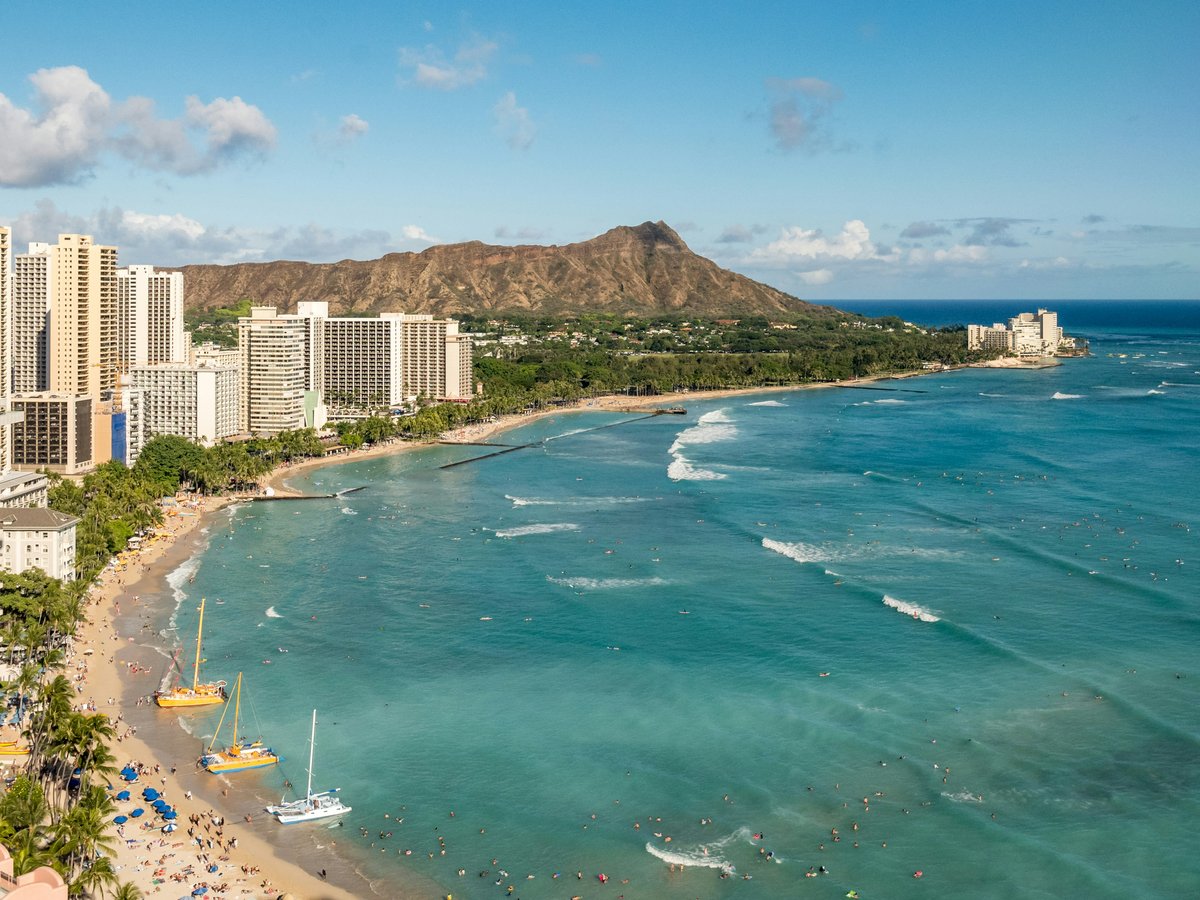
Stay in Honolulu in January
63 hotels in the Trip.com pool for Honolulu, from US$27 a night.
Opens Trip.com on Fri 1 Jan to Sun 3 Jan 2027; change the dates there.
January is the most expensive month to visit Honolulu, and it is also the wettest. Those two facts coexist because the demand has nothing to do with local conditions. Mainland Americans escaping subzero wind chills in Chicago, Minneapolis, and Boston fill Waikiki hotels to near capacity from New Year's Day through the end of the month. Room rates along Kalakaua Avenue commonly run 40-60% above what you would pay in September. The average high reaches about 25.5°C (78°F), with lows near 19.8°C (68°F), and roughly 71mm of rain falls across 10 days. By any global standard, that is pleasant. By Honolulu's own calendar, it is the coolest and dampest stretch of the year.
That said, January has one draw that no other month delivers as well. Humpback whales reach peak numbers in Hawaiian waters by mid-January, and pods are visible without binoculars from Makapuu Point Lookout on O'ahu's eastern shore. The whale migration spans November through April, but January and February concentrate the largest groups. The PGA Tour's Sony Open fills Waialae Country Club in the Kahala neighborhood during the second week of the month, practice rounds are free to attend, and the North Shore's winter swells produce 6-9 meter (20-30 foot) waves at Pipeline and Sunset Beach that draw spectators by the thousands.
The trade-off is straightforward. You will pay peak rates, share Hanauma Bay with more snorkelers, and encounter brief but regular rain showers. Ocean water temperature holds at about 24°C (75°F), comfortable for extended time in the water. If you can absorb the pricing, January in Honolulu delivers warm ocean swimming, the best whale watching window, and hiking temperatures at Diamond Head and Manoa Falls that feel 4°C cooler than the summer peak. If you are flexible on dates, September and October offer nearly identical beaches at significantly lower cost.
Why visit in January
- Humpback whale watching reaches peak season by mid-January, with pods visible from shore at Makapuu Point Lookout and regular boat departures from Kewalo Basin Harbor
- Daytime temperatures around 25.5°C (78°F) make for comfortable hiking at Diamond Head State Monument and Manoa Falls, well below the 29°C (84°F) summer heat
- Ocean water stays near 24°C (75°F), warm enough for extended snorkeling sessions at Hanauma Bay Nature Preserve
- North Shore winter swells create world-class spectating at Pipeline and Sunset Beach, with waves reaching 6-9 meters (20-30 feet)
- The Sony Open at Waialae Country Club offers free practice-round viewing in the second week of January
Worth knowing
- Peak-season hotel rates in Waikiki run 40-60% above the September or October average, making January the priciest month to book on O'ahu
- January receives roughly 71mm of rain across about 10 days, the highest monthly rainfall of the year alongside December's 72mm
- Popular sites like Hanauma Bay and the Pearl Harbor National Memorial hit daily visitor caps by mid-morning on weekends, requiring advance booking or very early arrival
- North Shore beaches close to swimming when surf advisories are posted, which happens frequently in January due to large winter swells
Best for
Think twice if
January is Honolulu's coolest and wettest month, though the numbers might surprise anyone coming from a continental winter. Average highs reach 25.5°C (78°F) and lows dip to 19.8°C (68°F). Roughly 71mm of rain falls across about 10 days. Most showers on the south shore around Waikiki tend to be brief, often clearing in 15-20 minutes. Humidity sits at 77%, most noticeable in the early morning before trade winds pick up. The windward side of O'ahu around Kailua and Kane'ohe gets noticeably more rain than the leeward coast where most visitors stay. Morning showers move through, skies typically clear by midday, and another round might arrive in the late afternoon. The sun still delivers 6-8 hours of direct light on most days.
Seasonal caution
- North Shore surf regularly exceeds 4-6 meters (15-20 feet) in January, triggering beach closures and strong current advisories at Sunset Beach, Pipeline, and Waimea Bay. Check the NOAA surf forecast before heading to any north-facing beach.
- Flash flood advisories occasionally affect valley trails like Manoa Falls after sustained rainfall. The trail can become slippery and muddy, and the Honolulu Fire Department rescues hikers from flooded stream crossings several times each winter.
Year-round climate
Averages from the last 5 years.
| Month | Avg high (°C) | Avg low (°C) | Rainfall (mm) |
|---|---|---|---|
| Jan | 26 | 20 | 71 |
| Feb | 25 | 20 | 44 |
| Mar | 26 | 20 | 58 |
| Apr | 26 | 21 | 59 |
| May | 27 | 22 | 60 |
| Jun | 28 | 23 | 17 |
| Jul | 29 | 23 | 18 |
| Aug | 29 | 23 | 25 |
| Sep | 29 | 23 | 19 |
| Oct | 29 | 23 | 28 |
| Nov | 28 | 22 | 31 |
| Dec | 26 | 21 | 72 |
Holidays and festivals in January
Public holidays
- New Year's Day(New Year's Day)1 January 2027
- Martin Luther King, Jr. Day(Martin Luther King, Jr. Day)18 January 2027
Best things to do in January
Whale watching from Makapuu Point Lookout
natureThe 1.6 km paved Makapuu Point Lighthouse Trail on O'ahu's eastern tip gives an elevated view over the Kaiwi Channel, where humpback whales breach, spout, and slap tails from mid-December through April. Binoculars help, but the whales are often close enough to see with the naked eye.
Mid-January marks the peak of humpback whale congregation in Hawaiian waters, with the largest pod density of the year between Maui and O'ahu.Booking tipArrive before 08:00 to get parking at the trailhead lot, which fills quickly on weekends.
Watching big wave surfing on the North Shore
spectator sportPipeline, Sunset Beach, and Waimea Bay on O'ahu's North Shore host the world's most famous winter swells. Waves reach 6-9 meters (20-30 feet) on the biggest days, and spectators line Kamehameha Highway to watch from the sand. The atmosphere is electric on overhead days.
January consistently produces the largest and most frequent North Pacific swells, making it the prime month for big wave spectating.Booking tipDrive up early or take TheBus Route 52 from Ala Moana Center. Parking along Kamehameha Highway fills by 09:00 on big swell days.
Snorkeling at Hanauma Bay Nature Preserve
water sportsThe protected bay on O'ahu's southeast coast holds over 400 species of fish in a shallow reef system. Visibility in January typically ranges from 6-15 meters depending on recent rainfall. The water at 24°C (75°F) is comfortable without a wetsuit.
January's 25°C (78°F) air temperature makes the walk down to the bay and the time between snorkel sessions pleasant, unlike the hotter summer months when the exposed hillside bakes.Booking tipReservations are required through the Hanauma Bay online system. Book at least 2 days in advance, as January slots fill fast.
Hiking Diamond Head State Monument
hikingThe 1.3 km trail to the 232-meter summit of Le'ahi (Diamond Head) passes through a World War II-era tunnel and fire control station before opening to a 360-degree panorama of Waikiki, Koko Head, and the Waianae Range. The hike takes 45-90 minutes round trip.
January's average high of 25.5°C (78°F) is 3-4°C cooler than summer, making the exposed switchbacks and concrete stairs significantly more comfortable.Booking tipReservations are required. The first entry slot at 06:00 offers the coolest temperatures and thinnest crowds.
Visiting Pearl Harbor National Memorial
historyThe USS Arizona Memorial sits above the sunken battleship in Pearl Harbor, accessible by a short boat ride from the visitor center. The museum, film, and memorial experience runs about 75 minutes. The adjacent USS Missouri and USS Bowfin are separate ticketed sites.
January includes the tail end of heightened interest following the December 7 commemoration. The visitor center's exhibits are recently refreshed each year for the anniversary period.Booking tipFree timed-entry tickets for the USS Arizona Memorial release online 60 days in advance and sell out immediately for January dates. Check for same-day walk-up availability starting at 07:00.
Exploring the KCC Farmers Market
foodThe Saturday morning market at Kapiolani Community College near Diamond Head draws 30-40 vendors selling local produce, plate lunches, baked goods, and Hawaiian honey. It runs from 07:30 to 11:00 and is one of the best places to taste seasonal citrus, fresh poi, and local coffee.
January brings peak citrus season with Hawaiian tangerines, Meyer lemons, and calamansi from local farms on display.Booking tipNo booking needed. Arrive by 08:00 for the best selection before popular items sell out.
Attending the Sony Open at Waialae Country Club
spectator sportThe PGA Tour makes its first full-field stop of the year at Waialae Country Club in Kahala. The course sits between Diamond Head and the Waialae coastline, and the gallery atmosphere is noticeably more relaxed than mainland tour stops. Practice rounds are free.
The Sony Open is held in the second week of January each year, one of Honolulu's signature annual sporting events.Booking tipPractice round days (Monday through Wednesday) are free and offer closer player access than tournament rounds.
What to eat in January
In season: fruit
Citrus and tangerines
Hawaiian-grown tangerines, Meyer lemons, and calamansi peak during winter months. The KCC Farmers Market at Kapiolani Community College on Saturday mornings is the best place to find them, along with local jams and marmalades made from the same harvest.
On menus now
Saimin
Honolulu's signature noodle soup, a local adaptation with dashi broth, thin wheat noodles, char siu, and kamaboko. January's cooler evenings around 20°C (68°F) make this the peak comfort-food month. Palace Saimin in Kalihi has served the same recipe since 1946.
Oxtail soup
A comfort staple of Honolulu's local food scene, oxtail soup with ginger, star anise, and mustard greens is a cooler-weather favorite. Asahi Grill on King Street and Kapahulu Grill are two spots that have served it for decades.
Festival food
Ozoni
Japanese New Year mochi soup is a January tradition in Honolulu's large Japanese-American community. Restaurants in Kaimuki and along King Street in Mo'ili'ili serve their own versions through the first two weeks of the month, each with a family-recipe broth and soft pounded rice cakes.
Mochi
Freshly pounded rice cakes appear at mochitsuki events throughout O'ahu in late December and early January. Nisshodo Candy Store in Kalihi is one of the few commercial producers still using traditional methods, and their butter mochi and chi chi dango sell out quickly in the first week of January.
Regular events in January
Sony Open in Hawaii
PGA Tour event at Waialae Country Club in Kahala, with free practice rounds early in the week and a four-day tournament Thursday through Sunday.
Second week of JanuaryChinese New Year celebrations in ChinatownFree
Honolulu's Chinatown along Maunakea Street and Hotel Street hosts lion dances, firecrackers, and food vendors in the weeks leading up to and following Lunar New Year. In years when Chinese New Year falls in January, the festivities are at full scale.
Late January or early February, depending on the lunar calendarMartin Luther King Jr. Day celebrationsFree
State holiday on the third Monday of January. Honolulu hosts a commemorative march from Magic Island at Ala Moana Beach Park, along with community events and free museum admission at select sites.
Third Monday of JanuaryMochitsuki (rice pounding) eventsFree
Japanese-American cultural organizations and Buddhist temples across O'ahu hold communal mochi-pounding ceremonies in late December and early January, open to visitors who want to participate in the tradition.
Late December through early JanuaryBest places this January
Makapuu Point Lookout
natureElevated viewpoint on O'ahu's eastern tip, accessed by a paved 1.6 km trail. January's peak whale season makes this the best spot on the island for shore-based humpback watching without a boat tour.
WaimanaloNorth Shore (Pipeline, Sunset Beach, Waimea Bay)
beachThe 11 km stretch of coast between Haleiwa and Turtle Bay produces the biggest waves in the Northern Hemisphere each winter. January swells regularly reach 6-9 meters. Swimming is closed on big days, but the spectating is unmatched.
North ShoreHanauma Bay Nature Preserve
natureProtected marine bay with over 400 fish species. January water temperature sits at 24°C (75°F). The bay limits daily visitors, so advance reservations are required.
Hawaii KaiDiamond Head State Monument
hikingIconic volcanic crater hike with a 232-meter summit overlooking Waikiki and the Pacific. January's cooler temperatures make the exposed trail significantly more comfortable than summer visits.
KapahuluPearl Harbor National Memorial
historyHome to the USS Arizona Memorial, USS Missouri, USS Bowfin, and the Pacific Aviation Museum. January falls just after the December 7 anniversary period, and the site remains heavily visited through the winter.
Pearl HarborHonolulu Chinatown
cultureBlocks of food markets, art galleries, and lei stands along Maunakea Street and Hotel Street. January often brings early Lunar New Year preparations, with lion dance rehearsals and vendor stalls stocking ceremonial oranges and sweets.
DowntownAla Moana Beach Park
beachWide sandy beach and reef-protected swimming area between Waikiki and downtown. Less crowded than Waikiki on weekday mornings, and the adjacent Ala Moana Center provides shelter during passing rain showers.
Ala MoanaManoa Falls Trail
hikingA 2.6 km round-trip trail through tropical rainforest to a 46-meter waterfall in the back of Manoa Valley. January rain keeps the falls flowing strong, but the trail can be muddy. Flash flood advisories are possible after heavy rainfall.
Manoa
Your packing checklist
Tick items off as you pack. Your progress saves in this browser.
All packed — have a great trip.
Insider tips
The windward side of O'ahu around Kailua and Kane'ohe gets roughly twice the January rainfall of Waikiki on the leeward coast. If it is raining at your hotel, driving 15 minutes toward the south or west coast often finds dry skies.
Hanauma Bay releases a small number of same-day reservations online each morning at 07:00 HST. If your preferred date was sold out, check right at that window for cancellations.
The walk-up line at Pearl Harbor's visitor center sometimes yields same-day USS Arizona Memorial tickets by 07:00, but this is not guaranteed in January. The 60-day advance online booking is far more reliable.
Palace Saimin in Kalihi has been open since 1946 and closes early. Go for lunch, not dinner. The original location still has counter seating and the same recipe.
For whale watching without a boat, the Makapuu Lighthouse Trail is better than the more-hyped Diamond Head summit. The trail puts you directly above the Kaiwi Channel migration corridor, and the whales pass much closer to shore here.
TheBus Route 52 runs from Ala Moana Center to Haleiwa on the North Shore. The ride takes about 90 minutes each way but avoids the parking chaos along Kamehameha Highway on big swell days.
Avoid these mistakes
- Underestimating North Shore ocean conditions. The same beaches that are calm enough for families in summer produce life-threatening currents and shorebreak in January. Never turn your back to the waves, and stay out of the water when red flag warnings are posted.
- Driving to the North Shore without checking surf reports first. On flat days, the big wave beaches are unremarkable. On overhead days, the drive is worth it but parking vanishes by mid-morning.
- Assuming Waikiki rain means island-wide rain. O'ahu's microclimates vary dramatically over short distances. A shower in Waikiki might mean blue sky in Kapolei, 25 minutes west.
- Skipping advance bookings for Hanauma Bay and Pearl Harbor. Both sites cap daily visitors, and January is one of the two busiest months. Showing up without a reservation means you likely will not get in.
- Packing only shorts and tank tops. January evenings with trade winds at 19-20°C (66-68°F) feel chilly after a day in the sun, especially near the water. One light layer avoids a rushed purchase at an ABC Store.
Practical tips for January
Book Hanauma Bay snorkeling reservations and Pearl Harbor USS Arizona Memorial tickets 60 days in advance. Both reach capacity daily in January. Hotel rates peak from late December through the end of January, driven by mainland holiday travel. Consider booking accommodations in neighborhoods outside Waikiki, such as Kailua or the North Shore, where rates tend to be lower during peak season. Rental cars are in high demand. Reserve at least 3-4 weeks ahead. TheBus system covers most visitor destinations on O'ahu for a flat fare, making it a practical alternative for North Shore day trips when parking is scarce. Reef-safe sunscreen is required by Hawaii state law. Bring your own, as convenience store options near the beach tend to have limited selection. Pack a light rain jacket rather than relying on umbrellas. January showers pass quickly but can soak you on an exposed trail.
FAQ
Is January a good time to visit Honolulu?
January is a good time if you prioritize whale watching, comfortable hiking weather around 25°C (78°F), and big wave spectating on the North Shore. The trade-off is peak-season pricing, with hotel rates 40-60% above the annual average, and more rain than any other month at roughly 71mm across 10 days. September and October offer similar beach conditions at significantly lower cost.
Can you swim at Waikiki Beach in January?
Waikiki Beach faces south and is protected by an offshore reef, so it remains calm and swimmable year-round, including January. Ocean temperature holds near 24°C (75°F). The North Shore is a different story. Winter swells close many north-facing beaches to swimming, but Waikiki is unaffected by those conditions.
How often does it rain in Honolulu in January?
Roughly 10 of 31 days see measurable rainfall. Most showers on the south shore around Waikiki are brief, often 15-20 minutes, and skies tend to clear by midday. The windward side around Kailua and Kane'ohe receives noticeably more rain. It rarely rains all day across the entire island.
Do you need a car in Honolulu in January?
A car is helpful for North Shore trips, Hanauma Bay, and the Makapuu Lighthouse Trail, but Waikiki is walkable and TheBus covers most visitor destinations. Route 52 reaches the North Shore in about 90 minutes from Ala Moana Center, which avoids parking issues on big swell days. Rental cars are in high demand in January, so book several weeks ahead.
When is the best time to see whales in Honolulu?
Humpback whales are present from November through April, but mid-January through March sees the highest concentration. Makapuu Point Lookout on O'ahu's eastern shore is the best free vantage point. Boat tours depart from Kewalo Basin Harbor and offer closer encounters, though shore sightings without binoculars are common on good days.
Things to Do in Honolulu in January
 Free cancellation
 Oahu: Full or Half Day Grand Circle Island Tour
Day trip: free cancellation.
via Viator Free cancellation
 Oahu Majestic Circle Island Tour with Waimea Falls and Byodo Inn
Outdoor experience: 9 hours, free cancellation.
via Viator Free cancellation
 Pearl Harbor Remembered Tour
Day trip: 7 hours, free cancellation.
via Viator Free cancellation
 Pearl Harbor USS Arizona Memorial Tour from Waikiki
Day trip: 4 hours, free cancellation.
via Viator Free cancellation
 Oahu Circle Island Snorkeling Tour: Dole, Pali Lookout & More
Outdoor experience: free cancellation.
via Viator Free cancellation
 Oahu Small-Group Circle Island Tour with Turtle Snorkeling
Outdoor experience: 8 hours, free cancellation.
via ViatorFind a flight to Honolulu
Live fares to Honolulu appear here once cookies are accepted.
Last verified by automated review (v1.7.2) on . What is automated review?