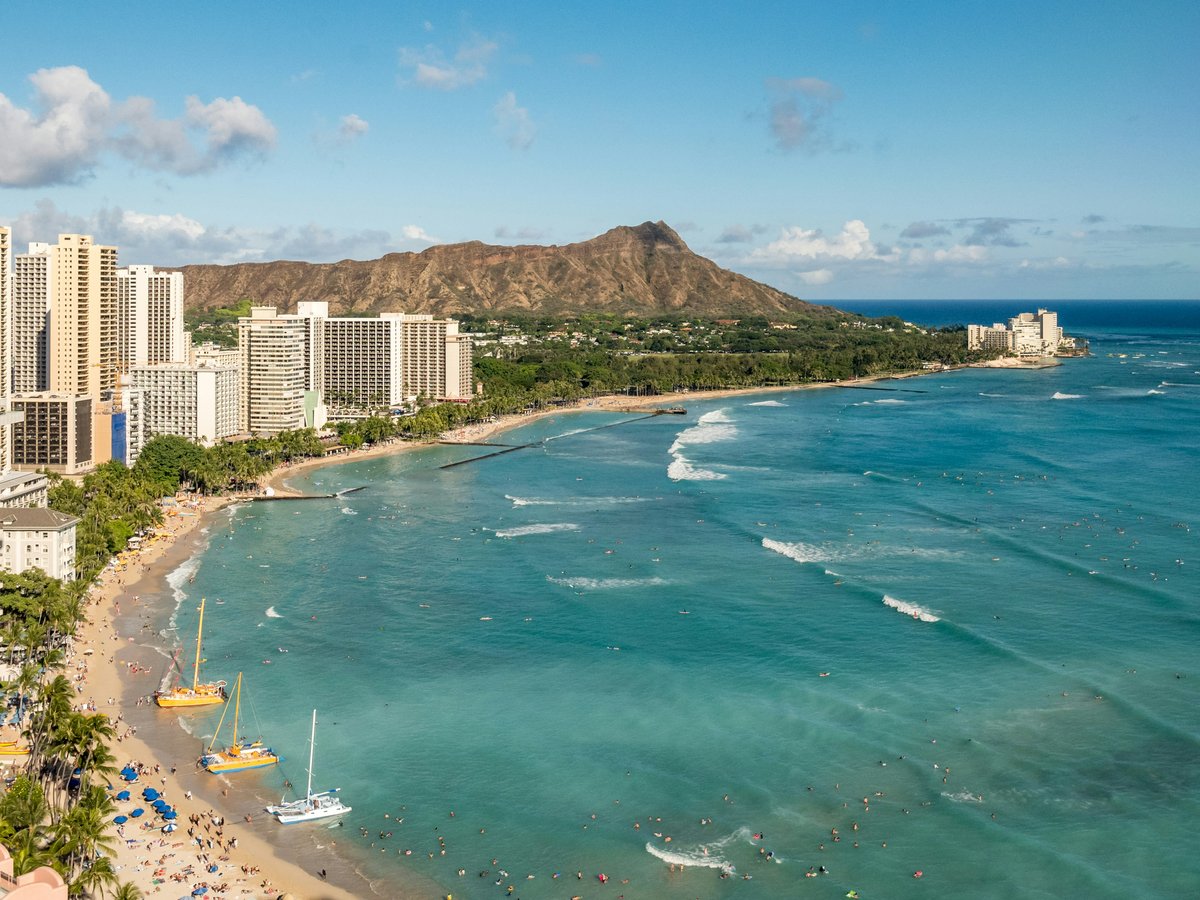
Honolulu stretches along the southern coast of O'ahu for roughly 10 miles, pinned between the Ko'olau mountain range and the Pacific. The city reads west to east in layers. Downtown and Chinatown sit near the harbor, built on the old commercial core from the 1800s. Waikiki occupies a narrow strip of reclaimed land about 3 miles southeast. Between them, neighborhoods like Ala Moana and Kaka'ako have shifted from industrial warehouses to condos and restaurants over the past 15 years. Head inland and you climb into residential valleys, Manoa and Nu'uanu, where the temperature drops a few degrees and the rain picks up noticeably. East of Diamond Head, the pace slows through Kahala and into the bedroom communities along the H-1 corridor. Most visitors plant themselves in Waikiki, but staying even a mile outside it changes the trip entirely. The bus system, called TheBus, runs over 100 routes islandwide, and a single ride costs $3. Worth noting, the city's new Skyline rail currently runs 11 miles from East Kapolei to Aloha Stadium, with downtown stations expected to open in phases through 2031.
Neighborhoods
-
Waikiki
A 1.5-square-mile strip packed with roughly 25,000 hotel rooms, where the smell of coconut sunscreen and plumeria hangs in the humid air from morning to midnight. Kalakaua Avenue hums with foot traffic past luxury retail and ABC Stores spaced every 200 feet. The beach itself is narrower than most people expect, maybe 50 feet wide in places, and the sand was barged in from Manhattan Beach and Papohaku on Moloka'i starting in the 1920s. High-rises block the afternoon sun on the makai side of Kuhio Avenue by around 3pm. It is loud, it is crowded, and the sunsets from the seawall near the Kapahulu Groin are still genuinely good.
- Best for
- First-time visitors, couples who want walkable nightlife, and anyone comfortable with tourist density in exchange for convenience
- Key streets
- Kalakaua Avenue for the beachfront strip, Kuhio Avenue for budget eats and ramen shops like Marukame Udon (expect a 20-minute line by 11:30am), and Lewers Street for the bar scene around Duke's and the Moana Surfrider. The east end near Kapahulu Avenue is where Waikiki starts to feel like an actual neighborhood.
-
Kaka'ako
A former industrial zone between Ala Moana and downtown that has been mid-transformation since the 2010s. Salt at Our Kaka'ako, a development anchored around 685 Auahi Street, brought farm-to-table restaurants and boutiques into old warehouse spaces. The neighborhood still has stretches of empty lots and construction cranes next to finished condo towers that sell units starting around $700,000. Murals from the annual POW! WOW! Hawaii festival cover walls on Cooke Street and Pohukaina Street. The concrete holds heat, and shade is sparse at midday. It feels half-built in an honest way.
- Best for
- Foodies and design-minded travelers in their 20s-40s who want walkable restaurants without the Waikiki markup, and who don't mind a neighborhood that's still finding its identity
- Key streets
- Auahi Street is the commercial spine. Cooke Street has the mural concentration and leads down to the Waterfront Park. Keawe Street hosts the Saturday farmers market (KCC gets the attention, but this one is less crowded). Ala Moana Boulevard runs along the south edge toward Ala Moana Beach Park.
-
Chinatown
Honolulu's Chinatown covers about 15 blocks between Nu'uanu Stream and the harbor, and it is the oldest Chinatown in the United States, dating to the 1850s. The buildings are mostly 2-3 story walk-ups with iron railings and faded signage in Chinese, Vietnamese, and Filipino. Oxtail soup shops open by 6am. The smell of incense from Kuan Yin Temple on Vineyard Boulevard mixes with raw fish from the open-air Oahu Market on North King Street. Art galleries have moved into former lei shops on Nu'uanu Avenue, and the neighborhood is noisier and grittier than most tourist areas. Some blocks can feel rough after dark, particularly around River Street.
- Best for
- Travelers who like eating adventurously on a budget, gallery-hoppers, and anyone who wants to see a working neighborhood rather than a curated one
- Key streets
- Hotel Street is the main east-west artery and has the densest cluster of bars and galleries, including The ARTS at Marks Garage. Nu'uanu Avenue heading mauka has shops and the monthly First Friday art walk. North King Street and Maunakea Street have the traditional markets and lei stands where strands of tuberose and pikake start around $8.
-
Ala Moana
Ala Moana sits between Waikiki and Kaka'ako, dominated by the 2.4-million-square-foot Ala Moana Center, the largest open-air shopping mall in the world. The neighborhood splits into the mall side, which is polished and air-conditioned, and Ala Moana Beach Park across the boulevard, a 100-acre stretch of sand where local families set up canopy tents by 7am on weekends. The park's Magic Island peninsula at the east end has calm water and a wide lawn that fills up for Friday night fireworks from the Hilton. Residential towers along Kapiolani Boulevard house a mix of local families and long-term visitors. It is quieter than Waikiki at night, with less bar culture and more condo living.
- Best for
- Families with kids who want a calm beach, shoppers, and repeat visitors who already know Waikiki and want a residential base within walking distance
- Key streets
- Ala Moana Boulevard runs the length of the neighborhood along the ocean side. Kapiolani Boulevard parallels it one block mauka with local restaurants and services. Piikoi Street and Keeaumoku Street have a concentration of Japanese and Korean restaurants, ramen spots, and yakiniku grills.
-
Manoa
A residential valley about 3 miles inland from Waikiki, where the University of Hawai'i's flagship campus of 19,000 students sits at the valley's mouth. The road narrows as you drive mauka on Manoa Road, and the houses shift from postwar bungalows to older plantation-style homes with corrugated roofs and overgrown gardens. It rains here almost every afternoon, a light, warm drizzle that locals call 'Manoa mist.' The air smells like wet earth and ginger. Manoa Falls Trail, a 1.6-mile round trip, starts at the end of the road and draws steady foot traffic. The valley feels notably cooler than the coast, often 5-7 degrees lower by mid-afternoon.
- Best for
- Hikers, University visitors, and travelers who want a quiet, green, residential base and don't mind being a 15-minute drive or 25-minute bus ride (Route 5) from the beach
- Key streets
- University Avenue connects the valley to the coast and has the student-oriented restaurants and cafes. Manoa Road runs up the valley floor. East Manoa Road and Woodlawn Drive loop through the quieter residential sections where you'll find some of the valley's oldest homes.
-
Kaimuki
A low-rise neighborhood on the slopes below Diamond Head, centered on Waialae Avenue between 6th and 12th Avenues. The buildings top out at 2 stories due to a height restriction that has been in place since the 1960s, which keeps the sky visible in a way that most of urban Honolulu cannot match. The restaurant scene has grown steadily since around 2015, with spots like Mud Hen Water (modern Hawaiian, plates around $18-28) and Town (farm-to-table, closed Sundays) drawing diners from across the island. Parking is tight by 6pm on weekends. The residential streets heading mauka have small single-family homes from the 1940s-50s with plumeria trees dropping flowers onto the sidewalk.
- Best for
- Food-focused travelers who want to eat where locals eat, couples looking for walkable dining without the Waikiki scene, and anyone who appreciates a neighborhood that still feels like a town rather than a resort
- Key streets
- Waialae Avenue is the main strip with the restaurant and cafe concentration. 12th Avenue has a pocket of spots including 12th Ave Grill (known for their kim chee fried rice). Harding Avenue near the movie theater has a more local, errand-running feel. Monsarrat Avenue on the Waikiki side leads toward Diamond Head and has its own cluster of cafes.
-
Kahala
Kahala sits east of Diamond Head along Kahala Avenue, where houses routinely sell above $3 million and the lots are large enough for real gardens. The neighborhood's anchor is The Kahala Hotel and Resort, originally built in 1964, which sits on a quiet beach away from the Waikiki strip. The pace here is noticeably slower. You'll hear mynah birds more than traffic. Kahala Mall at 4211 Waialae Avenue is a mid-range shopping center that locals use for everyday errands, a contrast to Ala Moana's tourist draw. The beach at Waialae Beach Park is rocky but uncrowded, and the shallow reef pools trap small fish that kids like to spot.
- Best for
- Travelers wanting a luxury resort experience without Waikiki's density, families willing to pay more for quiet, and anyone who prefers a residential atmosphere to a strip of high-rises
- Key streets
- Kahala Avenue runs through the heart of the residential area toward the hotel. Waialae Avenue at the neighborhood's north edge has the mall and local services. Hunakai Street and Elepaio Street wind through the residential core where you can walk under monkeypod and banyan canopy.
-
Downtown Honolulu
The financial and government district centered around Bishop Street and South King Street, where glass office towers from the 1970s-80s stand blocks away from Iolani Palace, the only royal palace on American soil, completed in 1882. The streets clear out after 5pm on weekdays, giving the area a ghost-town quality at night. During the day, the lunch rush fills spots like Downbeat Diner on Hotel Street and the plate lunch trucks on Ala Moana Boulevard. The Hawaii State Capitol, designed by Belt Lemmon and Lo in 1969, has an open-air design where rain falls into a central reflecting pool. Washington Place, the governor's residence on Beretania Street, sits behind a wrought-iron fence on a street loud with bus traffic.
- Best for
- History-focused visitors, architecture enthusiasts, and business travelers, though most leisure visitors will pass through rather than stay here
- Key streets
- Bishop Street is the financial spine. South King Street runs past Iolani Palace, the State Capitol, and the Judiciary History Center. Merchant Street has some of the oldest commercial buildings in Honolulu, dating to the 1850s-1870s. Queen Street connects downtown to the waterfront at Pier 2.
FAQ
Is it worth staying outside Waikiki for a first visit to Honolulu?
It depends on what you want from the trip. Waikiki puts you within walking distance of the beach, restaurants, and nightlife, and the bus connections to the rest of the island leave from Kuhio Avenue. That said, a rental car and a base in Kaimuki or Kaka'ako saves $50-100 per night on hotels while keeping you 10-15 minutes from the sand. You lose the walkable-beach convenience but gain a more residential feel and better restaurant options at lower prices. For a first trip under 5 days, Waikiki's convenience likely wins. For a week or longer, branching out tends to feel less repetitive.
How do Honolulu's neighborhoods connect, and do I need a car?
TheBus covers most of the neighborhoods mentioned here, and a single ride is $3 with free transfers within 2.5 hours. Route 2 connects Waikiki to downtown and Kaimuki. Route 19 runs along the coast. Route 5 heads up into Manoa Valley. That said, getting to the North Shore or windward side without a car takes 90-plus minutes each way on the bus. For a Waikiki-based trip focused on the south shore, you can manage without a car. If you plan to explore the full island, renting for 2-3 days (typically $60-90 per day) fills in the gaps the bus cannot cover efficiently.
Which Honolulu neighborhood has the best food scene?
Kaimuki currently has the densest concentration of well-regarded restaurants within walking distance along Waialae Avenue. Mud Hen Water, Town, and 12th Ave Grill all sit within a few blocks of each other. Chinatown wins on budget and variety, with pho, dim sum, and plate lunches under $12. Kaka'ako's Salt complex has the newer openings and more polished spaces. Waikiki has volume but higher prices and more chains. For a dedicated food trip, staying in Kaimuki or Kaka'ako and making day trips to Chinatown tends to cover the most ground without repeating meals.
What are the safest neighborhoods for families with young children?
Ala Moana Beach Park has the calmest water on the south shore due to the outer reef, and the grassy areas give kids room to run. Kahala is residential and quiet with low traffic. Waikiki is safe but crowded, and the surf at the main beach can surprise parents who aren't watching for the shorebreak on high-swell days (common in summer, south swells from May through September). Manoa is peaceful but lacks beach access. For families, Ala Moana or Kahala as a base with day trips to Waikiki tends to work well, especially with kids under 6.
When is the best time of year to visit Honolulu, and does it vary by neighborhood?
Honolulu's temperature stays between 75 and 88 degrees year-round. The drier months run from April through October. Winter (November through March) brings more rain, particularly in the valleys. Manoa gets roughly 160 inches of rain per year, while Waikiki, 3 miles away, gets about 20 inches. If you are staying in Manoa or Nu'uanu, expect afternoon showers even in summer. The south shore beaches, including Waikiki and Ala Moana, see their biggest surf from May through September. Hotel rates in Waikiki peak during December through March and drop noticeably in September and October, when rooms that run $350 per night in winter might fall to $220.
Last verified by automated review (v1.7.2) on . What is automated review?