How do I get around Honolulu?
TheBus and a HOLO card handle most of Oahu for $3 per ride. Uber or Lyft fill the gaps, typically $25-35 from Daniel K. Inouye International Airport to Waikiki. The Skyline rail connects western suburbs to the Aloha Stadium area but doesn't reach Waikiki yet. Walking works within Waikiki's flat 2-mile grid. Skip the rental car unless you're heading to the North Shore.
Book the connection
One search across trains, buses & flights: live times and prices for Honolulu.
TheBus covers more of Oahu than most first-timers expect. Route 8 runs Waikiki to Ala Moana Center every 10-15 minutes throughout the day. Route 20 gets you from Kuhio Avenue to the Pearl Harbor Visitor Center in about 50 minutes. A single ride costs $3 on a HOLO card, which you can pick up at ABC Stores across Waikiki for a $2 card fee and load from there. The day pass is $7.50 and pays for itself by ride three. Buses are air-conditioned, and you'll appreciate that after 8 minutes at an unsheltered stop on Kapahulu Avenue where the asphalt radiates heat through your sandals at 28°C. Service does drop off after about 10 PM, and weekend frequency on windward-side routes falls to every 30-45 minutes. For Pearl Harbor, downtown, Chinatown, and Kailua during the day, TheBus is the right first choice. For a midnight return from Kakaʻako, it's Uber.
Uber and Lyft both operate across Oahu and work the same as the mainland. Airport to Waikiki typically runs $25-35 depending on H-1 freeway traffic. Waikiki to Pearl Harbor costs about $18-25. Worth noting that ride prices tend to climb on Friday evenings and after events at the Blaisdell Center. Rental cars make sense for day trips outside the city. The North Shore is about 45 minutes from Waikiki via H-1 and H-2, and the windward coast loop through Kailua and Lāʻie is a full-day drive with no practical bus alternative for the whole route. Inside Waikiki, a rental is a liability. Hotel valet parking at the Hyatt Regency or the Sheraton runs $40-55 per night. Street parking near Kalākaua Avenue maxes at 3 hours and fills by 9 AM. If your trip is Waikiki plus one day excursion, rent for that single day from the agencies at Daniel K. Inouye International Airport and return the car the same evening.
Honolulu's Skyline rail has been under construction since 2011. Costs have risen past $12 billion. The operating segment currently runs from East Kapolei through Waipahu to the Pearl Highlands area, but it stops well short of downtown or Waikiki. Until the line extends to Ala Moana Center, most visitors won't find it useful. The Waikiki Trolley is a separate hop-on/hop-off tourist service with 1-day passes running $25-49, and it stops at Diamond Head, Ala Moana, and Chinatown. It's overpriced next to TheBus Route 8, which covers similar ground for $3. Biki, the city's bikeshare, has roughly 130 stations and charges $4.50 for a 30-minute ride. It works well along the flat stretch from Ala Moana Beach Park to Diamond Head. Mind you, bike lanes on Oahu are patchy. Kalākaua Avenue has no protected lane, and mid-morning traffic gets uncomfortably close.
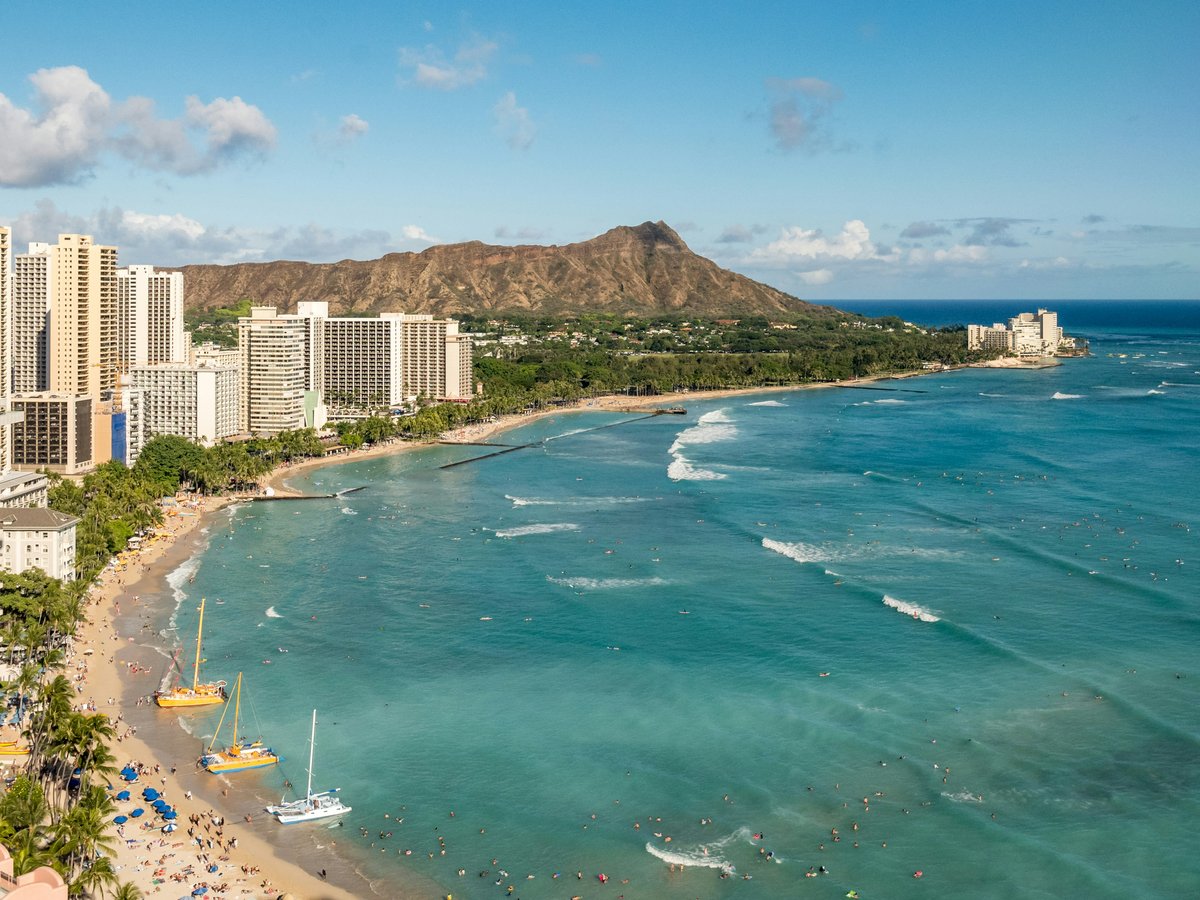
Waikiki is a flat grid about 2 miles long and 4 blocks deep, pressed between the Ala Wai Canal and the ocean. You can walk from the Hilton Hawaiian Village on the west end to Kapiʻolani Park and the Honolulu Zoo on the east in about 35 minutes along Kalākaua Avenue. Coconut sunscreen hangs in the warm air along the beachfront, and slack-key guitar drifts from the lobby of the Royal Hawaiian. Outside Waikiki, the walkability drops off hard. Ala Moana to Chinatown is about 2 miles with limited shade and heavy traffic along Ala Moana Boulevard. The Diamond Head trailhead sits a 20-minute uphill walk from the nearest bus stop on Diamond Head Road. A $3 TheBus ride or a $10-15 Uber covers those mid-distance gaps without the sunburn.
On-the-ground: metro available · ride-hail apps work.
Primary modes of transit
- TheBus
- Uber / Lyft
- Walking
- Rental car
- Biki bikeshare
- Skyline rail
- Waikiki Trolley
Honolulu's network by the timetable
Read from the published timetables, not from memory: 2 operators, 94 routes and 2,533 stops within 18 km of the centre.
- Operators, by routes here
- TheBus (93)
- Skyline (1)
- Routes by mode
- 93 Bus
- 1 Metro
- Weekday service
- 03:04 to 28:14 (04:14 the next morning)
- Fares in the timetable
- not published
- Timetables valid
- 2026-08-09 to 2026-12-05
Read 2026-09-14, version (2608_v5_BusRail_MERGED_Landlines), from one feed:
- TheBus (the operator's own local feed, Mobility Database source 2350). Licence: not stated in the catalog; the agency's terms apply.
Ready to book the connection?
Compare trains, buses & flights to and around Honolulu on Omio: live times & prices in one search.
Compare on Omio →More transport questions
How do I get from the airport to Honolulu?
From Daniel K. Inouye International Airport (HNL), take an Uber or Lyft to Waikiki for $25-40, about 25 minutes without traffic. The pickup zone is on the ground level of the parking garage, not curbside. TheBus Route 19 or 20 runs to Waikiki for $3.00 but bans full-size luggage. Taxis from the median cost $40-55.
Full answerHow do I get to Honolulu?
Daniel K. Inouye International Airport (HNL), 15 km northwest of Waikiki, handles all commercial flights to Honolulu. Nonstop service runs 5-6 hours from the US West Coast on Hawaiian, United, Delta, Alaska, and American. From the East Coast, expect 10-11 hours nonstop or one-stop connections. Round-trip fares from the mainland typically run $350-900 depending on season and origin.
Full answerWhat are the best day trips from Honolulu?
North Shore's Haleiwa, 50 km from Waikiki, works as a full-day loop with Kamehameha Highway shrimp trucks and winter surf at Pipeline. Kailua's Lanikai Beach, 20 km east, is the quieter pick for couples. Kualoa Ranch runs film-location tours at $55 per person. Hanauma Bay requires a $25 reservation for its volcanic-crater reef.
Full answerLast verified by automated review (v1.7.2) on . What is automated review?