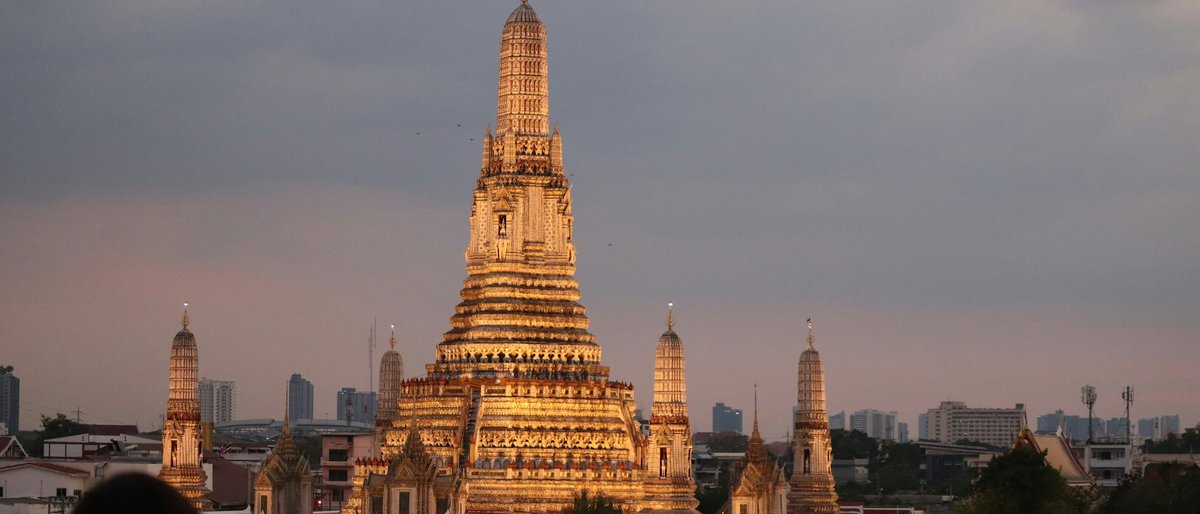
Stay in Bangkok in March
78 hotels in the Trip.com pool for Bangkok, from US$8 a night.
Opens Trip.com on Fri 5 Mar to Sun 7 Mar 2027; change the dates there.
March in Bangkok means heat. The comfortable window from November through February has closed, and daily highs now average 33.5°C (92°F) with lows that rarely dip below 25.8°C (78°F). Humidity hovers around 72%, so even a short walk along the Chao Phraya promenade near Tha Maharaj pier at dawn leaves your shirt clinging. The real weather story is the air. Smoke from agricultural burning across Chiang Mai, Chiang Rai, and the central plains provinces drifts into the Bangkok basin through March, and on still mornings the skyline above Rattanakosin Island fades behind a grey-white wash. Rainfall stays low at 59mm over roughly 9 days, mostly brief afternoon showers that clear within half an hour.
March has genuine advantages if you time things right. The Grand Palace, built in 1782, is noticeably more navigable than in January, when peak-season crowds fill the courtyards by mid-morning. Hotels along Sukhumvit between Asok and Phrom Phong, and in the Silom financial district near Chong Nonsi BTS, tend to drop rates 15-25% from peak. The opening of mango season brings early Namdokmai and Ok Rong varieties to the fruit carts lining Yaowarat Road in Chinatown. Bangkok's rooftop bars, from the Vertigo at Banyan Tree on Sathorn to the river-facing terraces along Charoen Krung, hit a sweet spot where evening skies stay clear but the high-season rush has moved on. At roughly 33 THB to the dollar, shoulder-season pricing means your budget stretches further than it would in the cool months.
Why visit in March
- Shoulder-season pricing brings meaningful savings on hotels and flights compared to the November-February peak, with properties along Sukhumvit Soi 11 through Soi 55 (Thonglor) dropping midweek rates 15-25% from their December highs.
- Dry-season conditions hold, with far less rain than any month from May through October, keeping outdoor itineraries through the Rattanakosin temple circuit and the Thonburi canal network reliable.
- Early mango season opens at markets like Or Tor Kor near Chatuchak and Khlong Toei wet market, with quality Namdokmai fruit and hot-season dishes like khao chae appearing on restaurant menus from Bo.lan to Supanniga Eating Room.
- Major sights from Wat Pho to Jim Thompson House operate at noticeably lower capacity than peak season, and restaurants along Charoen Krung's creative district that need reservations in December often have walk-in tables.
Worth knowing
- Smoke from agricultural burning in the northern and central provinces degrades air quality across the Chao Phraya basin on some March days, with PM2.5 readings occasionally reaching levels the Thai Pollution Control Department classifies as unhealthy for sensitive groups.
- The humidity amplifies the heat well beyond what the thermometer suggests, making midday outdoor walks through exposed areas like the Sanam Luang ceremonial ground or the Chatuchak market's uncovered aisles genuinely draining.
- No trip-defining festivals anchor March in Bangkok the way Songkran defines April or Loy Krathong defines November, though National Muay Thai Day on March 17 draws fight fans to Rajadamnern Stadium.
Best for
Think twice if
March marks the shift from Bangkok's cool season into the hot season, and your body notices the difference the moment you step out of Suvarnabhumi's air-conditioned arrivals hall. Mornings start warm, with the air along the Chao Phraya already thick with moisture by 7 a.m. By midday, heat radiates off the elevated BTS track structures above Phaya Thai Road and the concrete plazas of Siam Paragon, and shade offers minimal relief. Afternoon downpours tend to hit the hardest over the eastern suburbs near Bang Na and Lat Krabang, though they sweep through the old city too, clearing the air for an hour before the humidity settles back. The real discomfort factor is the moisture in the air. It slows sweat evaporation, so walking from Hua Lamphong station to Yaowarat Road, a distance of maybe 700 meters, leaves you soaked. Evenings bring reprieve after dark, which is why Bangkok's outdoor food markets along Ratchawat and the soi stalls of Ari tilt heavily toward post-sunset hours during the hot season.
Seasonal caution
- PM2.5 levels can reach the unhealthy-for-sensitive-groups threshold during still-air days in March as agricultural smoke accumulates over the Chao Phraya valley. Check IQAir or the Thai PCD app each morning and pivot to indoor plans at the Bangkok National Museum or BACC when readings spike above 100.
- The heat index, factoring in humidity, regularly pushes perceived temperatures to 38-40°C (100-104°F) during midday hours along exposed corridors like Ratchadamnoen Avenue and the Grand Palace perimeter. Limit outdoor exposure between 11 a.m. and 3 p.m. and carry water at all times.
Year-round climate
Averages from the last 5 years.
| Month | Avg high (°C) | Avg low (°C) | Rainfall (mm) |
|---|---|---|---|
| Jan | 32 | 22 | 12 |
| Feb | 33 | 24 | 54 |
| Mar | 34 | 26 | 59 |
| Apr | 34 | 27 | 88 |
| May | 33 | 26 | 199 |
| Jun | 33 | 26 | 163 |
| Jul | 31 | 26 | 255 |
| Aug | 32 | 25 | 222 |
| Sep | 31 | 25 | 339 |
| Oct | 31 | 24 | 233 |
| Nov | 31 | 24 | 108 |
| Dec | 32 | 23 | 14 |
Best things to do in March
Early-morning Lumphini Park walk
outdoorsLumphini Park covers 58 hectares of green space between the Silom and Sathorn districts, bounded by Rama IV Road to the south and Wireless Road to the east. The ponds, old-growth rain trees, and resident monitor lizards, some reaching 2 meters long, create an atmosphere worlds apart from the surrounding concrete. A pre-7:30 a.m. lap around the main pond, starting from the MRT Silom entrance gate, feels remarkably cooler than the same route by 9. You'll share the path with tai chi groups near the Chinese pavilion and joggers circling the 2.5-kilometer loop.
March mornings start warm but remain the last bearable outdoor exercise window before April eliminates even the dawn reprieve.Chatuchak Weekend Market
shoppingMore than 15,000 stalls spread across 27 acres in 27 numbered sections, making this the largest market in Thailand. The narrow aisles in the antique section (Section 1 and 26) and the ceramics rows trap heat and smell of old wood and incense. In March you can still spend 3-4 hours browsing the clothing, homeware, and art sections without the experience becoming an endurance test. The coconut ice cream vendors near the clock tower are a reliable cooling station.
The last comfortable month for extended browsing before the April-May heat turns the uncovered aisles into ovens.Booking tipArrive before 10 a.m. on Saturday via BTS Mo Chit or MRT Chatuchak Park for the fullest stall selection. Heat drives some vendors to close early by mid-afternoon.
Muay Thai at Rajadamnern Stadium
sportsBangkok's oldest Muay Thai venue, open since 1945 on Ratchadamnoen Nok Avenue near the Khao San area, hosts bouts several evenings a week. The atmosphere is loud, hot, and close. Gamblers shout odds in rapid Thai from the upper decks while fighters circle under fluorescent lights, and the scent of liniment cuts through the warm air. Around March 17, the National Muay Thai Day card typically features commemorative fights honoring Nai Khanom Tom, the legendary fighter whose story anchors the holiday.
National Muay Thai Day on March 17 brings special commemorative bouts and cultural exhibitions to Bangkok's premier ring.Booking tipBook ringside seats through the stadium box office on Ratchadamnoen Nok Avenue at least a week ahead for the March 17 card. Regular fight nights on Mondays and Wednesdays are easier to walk into, with tickets from 1,000-2,000 THB.
Evening Yaowarat food crawl
foodBangkok's Chinatown, centered on Yaowarat Road between Hua Lamphong and the Odeon Circle roundabout, transforms after dark into a dense corridor of open-air wok stations, grilled-seafood stands, and dessert carts. Charcoal smoke hangs in the warm air, oyster omelets sizzle on flat griddles at the T&K Seafood corner, and Teochew orders echo between the neon signs that give the street its signature red glow. March evenings, with temperatures settling into the upper 20s Celsius after sunset, keep the outdoor eating comfortable along the 1.5-kilometer strip.
Evening temperatures remain cool enough for open-air eating, unlike monsoon months when downpours scatter street vendors mid-service.Wat Arun at sunrise
sightseeingWat Arun's 82-meter central prang, covered in thousands of Chinese porcelain fragments and colored glass that catch early light, has stood on the Thonburi bank of the Chao Phraya since the Ayutthaya period. Cross by ferry from Tha Tien pier before 7 a.m. and you'll have the temple grounds largely to yourself. The morning sun hits the ceramic surface from the east, and the cool Chao Phraya breeze off the water makes the steep climb up the prang's narrow steps bearable. The 100 THB admission starts at 8 a.m., but the grounds open earlier.
Fewer tourists than peak season and generally clear morning skies before the day's haze builds. Pre-monsoon light tends to be particularly clean in early March.Booking tipNo reservation needed. The cross-river ferry from Tha Tien pier on the Rattanakosin side runs from 6 a.m. for 4 THB.
Rooftop drinks at sunset
nightlifeBangkok's rooftop bar scene ranks among the densest in Southeast Asia, with venues stacked along the Chao Phraya Riverside and across the Sukhumvit-Sathorn skyline. In March, dry-season clarity means clean sunset views over the spires of Wat Arun and the Mahanakhon tower's pixelated silhouette without the monsoon-season cloud cover that limits visibility from June onward. The breeze 30 floors up on the Lebua State Tower terrace or the Octave rooftop at Marriott Sukhumvit feels 5-6°C cooler than street level.
Clear dry-season skies for sunset views combined with noticeably fewer tourists competing for tables compared to December and January.Booking tipWeeknight visits rarely need reservations in March. Friday and Saturday tables at river-view spots like Sala Rattanakosin tend to fill by 6 p.m.
Bang Krachao bicycle tour
outdoorsBangkok's 'green lung,' a 16-square-kilometer peninsula of jungle, orchards, and elevated walkways in a bend of the Chao Phraya in Samut Prakan province. The area feels like rural Thailand despite sitting 15 minutes from the BTS. Rent bikes at the pier after crossing by long-tail boat from the Klong Toei side for 10 THB. The scent of frangipani and cooking fires from the orchard houses follows you along the raised concrete paths, and the Sri Nakhon Khuean Khan Park at the peninsula's center has shaded rest stops with cold drinks.
Low rainfall keeps the dirt paths and wooden boardwalks dry and rideable. Monsoon rains from May onward turn sections muddy and occasionally impassable.Booking tipGo on a weekday morning to avoid the weekend cycling groups that crowd the narrow paths. Bike rental at the Klong Toei pier crossing runs 80-100 THB for the day.
What to eat in March
In season: fruit
Namdokmai Mango
The first Namdokmai mangoes of the hot season reach Bangkok's fruit stalls in March, from the large bins at Or Tor Kor market near Chatuchak to the cart vendors along Phra Athit Road in Banglamphu. Smaller and slightly firmer than the April peak-harvest fruit, these early mangoes carry a sharper, more concentrated sweetness. The Ok Rong variety, rounder with a tangier edge, arrives around the same time.
Khanun (Jackfruit)
Thai jackfruit peaks from March through May. The ripe yellow pods have a dense, chewy texture and a sweetness somewhere between banana and pineapple, with a fragrance strong enough that you'll smell the vendor's cart before you see it. Pre-cut portions sell in plastic bags for 30-50 THB at street stalls throughout Pratunam and the Saphan Khwai neighborhood.
On menus now
Khao Chae
Originally a Mon dish adopted by the Thai royal court, khao chae appears on select restaurant menus from March through May. Rice is soaked in jasmine-flower water, served cold in a ceramic bowl alongside elaborately prepared side dishes including stuffed peppers, sweetened shredded pork, and fried shrimp paste balls. The version at Krua Apsorn near Samsen Road requires hours of preparation. This is not street food. Expect to pay 250-400 THB at a sit-down restaurant.
Som Tam Mamuang
Green mango salad peaks as the mango harvest opens. Unripe fruit is pounded in a clay mortar with dried shrimp, palm sugar, fish sauce, and chilies for a sharper, lighter take on the standard papaya som tam. The crunch of the raw mango adds a firm, tart texture the papaya version lacks. Street vendors along Silom Soi 20 and the Convent Road lunch strip sell it for 40-60 THB.
What to drink
Nam Manao
Fresh-pressed lime juice over cracked ice, served with either rock salt or sugar syrup depending on the vendor. As March temperatures build, the salty-sour version at 15-25 THB becomes a constant companion at food courts from MBK Center to the stalls ringing Victory Monument.
Regular events in March
National Muay Thai DayFree
Thailand commemorates the legend of Nai Khanom Tom with Muay Thai exhibitions and commemorative bouts at Rajadamnern Stadium on Ratchadamnoen Nok Avenue and Lumpinee Boxing Stadium at Ram Intra. Cultural demonstrations and fighter parades fill the area around the National Stadium BTS stop.
March 17National Elephant Day (Wan Chang Thai)Free
A national observance honoring the Thai elephant, with ceremonies and educational exhibitions. The Dusit Zoo grounds and the Royal Elephant National Museum on U-Thong Nai Road typically host cultural displays tied to the event.
March 13Makha Bucha DayFree
One of Thailand's three principal Buddhist holidays, marking the day 1,250 disciples gathered spontaneously before the Buddha. Temples across Bangkok hold evening candlelit Wien Thien processions, with the largest at Wat Benchamabophit (the Marble Temple) on Si Ayutthaya Road. A nationwide 24-hour alcohol sales ban is enforced. The date shifts with the lunar calendar and falls in late February or early March depending on the year.
Late February to early March (full moon of the 3rd lunar month)Best places this March
Bangkok National Museum
museumThailand's largest museum, established in 1874 on Na Phra That Road, holds collections spanning the Sukhothai, Ayutthaya, and Rattanakosin periods across dozens of galleries. The air-conditioned halls make it a practical retreat on high-heat or high-pollution March days. The building itself, a former palace of the Vice King Wang Na, is worth the visit for its architecture alone. Free English-language guided tours run on Thursdays and Saturdays at 9:30 a.m. Admission is 200 THB.
RattanakosinSanam Luang
public spaceThe ceremonial field adjacent to the Grand Palace has served as Bangkok's traditional kite-flying ground since the 1920s. March winds mark the start of kite season, and on weekends you'll see both traditional Thai chula and pakpao fighting kites alongside modern sport designs. The open 30-acre field also offers one of the few unobstructed views of the Wat Phra Kaew spires and is a 5-minute walk from the Thammasat University end of the Phra Chan ferry pier.
RattanakosinBanglamphu
neighborhoodThe neighborhood surrounding Khaosan Road, a street dating to 1892, has a quieter rhythm in March than during peak season. The side streets off Soi Rambuttri smell of pad thai from the corner wok stations, and the canal-side stretch along Phra Sumen Road, running past the 18th-century Phra Sumen Fort, sees fewer tour groups. Guesthouses lining Phra Athit Road tend to lower rates, and the evening banana-roti vendors set up with less competition for sidewalk space.
BanglamphuDusit Palace complex
palaceThe European-influenced royal compound, commissioned by King Chulalongkorn in 1899, sits north of the old city in a tree-lined district that runs noticeably cooler than the commercial center around Siam. The Ananta Samakhom Throne Hall's Italian Renaissance dome, designed by Italian architects Mario Tamagno and Annibale Rigotti, and the surrounding gardens provide a calmer cultural visit than the temple circuit to the south. The Vimanmek Mansion, a three-story golden teak structure, is currently closed for renovation but the exterior and grounds remain visitable.
DusitAri neighborhood
neighborhoodBangkok's cafe and independent-restaurant district, accessible via BTS Ari station on the Sukhumvit Line, draws younger Bangkok professionals to spots like Porcupine Cafe and Amatissimo on the tree-lined Soi Ari 1. The air-conditioned cafes make practical cooling-off bases between outdoor excursions, and the quiet residential soi off Phahonyothin Road are walkable without the sensory density of the tourist districts. The weekend brunch scene here runs strong, with tables at some spots filling by 10 a.m.
AriPak Khlong Talat (flower market)
marketBangkok's largest flower market operates through the night along Chak Phet Road near Memorial Bridge, with peak activity from 4 to 6 a.m. as truck deliveries arrive from the rose farms in Nakhon Pathom and the orchid growers in Kanchanaburi. In March, those pre-dawn hours are the coolest part of the day. The scent of jasmine garlands, marigolds, and Thai orchids is thick enough to taste, and the stall lighting casts the wet concrete floors in warm amber. The market sits a 10-minute walk south of Wat Pho.
RattanakosinBangkok Art and Culture Centre (BACC)
museumThe BACC at the Pathumwan intersection, directly connected to BTS National Stadium station, is a free-admission contemporary art space spread across 9 floors of spiraling galleries. March exhibitions rotate regularly, and the building's aggressive air conditioning makes it one of the best midday heat escapes in the Siam shopping district. The ground-floor cafe terrace overlooks the intersection's organized chaos.
PathumwanCharoen Krung Creative District
neighborhoodThe stretch of Charoen Krung Road between Soi 28 and Soi 36, Bangkok's oldest paved road dating to 1864, has become a corridor of galleries, design studios, and third-wave coffee shops housed in converted Sino-Portuguese shophouses. The Warehouse 30 complex, a repurposed set of 1940s WWII-era warehouses, anchors the area with rotating art exhibitions and a shaded courtyard. March foot traffic is lighter than peak season, and the narrow soi feel less claustrophobic in the heat.
Bang Rak
Your packing checklist
Tick items off as you pack. Your progress saves in this browser.
All packed — have a great trip.
Insider tips
Download the IQAir app before arriving in March. On mornings when PM2.5 readings spike above 100 at the Rattanakosin monitoring station, reroute your plan to indoor sites like the BACC or the Jim Thompson House Museum on Rama I Road rather than spending 4 hours walking temple circuits in polluted air.
The Saen Saep canal boat runs from the Pratunam pier near Platinum Fashion Mall through to Phan Fa Lilat pier near the Golden Mount for under 20 THB. It is faster than a taxi during March afternoon traffic and connects several major sightseeing clusters. The boats are old, loud, and splash canal water at passengers near the bow. Sit in the middle.
Or Tor Kor market, next to Chatuchak at BTS Kamphaeng Phet station exit 3, sells the same seasonal fruits as tourist-oriented stalls on Khaosan Road but at roughly half the price, with strict Ministry of Agriculture quality grading. The early Namdokmai mangoes in March run 80-120 THB per kilo here versus 200+ THB at tourist spots.
Bangkok's BTS and MRT systems are air-conditioned to around 20°C, which in March means a 15°C temperature swing every time you step on or off at an open-air platform like BTS Saphan Taksin or National Stadium. The constant shift from sweating outdoors to shivering indoors triggers headaches in some people. A light layer in your bag prevents it.
The Talat Noi neighborhood between Hua Lamphong and the river hides some of Bangkok's best street art, old Teochew shrines, and quiet cafes in converted shophouses, all within walking distance of Chinatown. March foot traffic in these narrow soi is minimal compared to the Yaowarat main drag, and the buildings provide shade most of the day.
If Makha Bucha Day falls in March, the candlelit Wien Thien procession at Wat Benchamabophit (the Marble Temple) on Si Ayutthaya Road draws fewer tourists than the Wat Phra Kaew ceremony but feels more intimate. Arrive by 7 p.m. to find a spot.
Avoid these mistakes
- Scheduling a full day of outdoor temple-hopping along the Rattanakosin circuit between 11 a.m. and 3 p.m. The heat index during those hours regularly exceeds 38°C in the exposed courtyards of Wat Pho and the Grand Palace, and the grounds offer almost no shade. Visit before 9 a.m. or after 4 p.m. and spend the midday hours at the BACC, Siam Paragon, or the Bangkok National Museum.
- Ignoring air quality when planning outdoor days. March is the worst dry-season month for PM2.5 in the Bangkok metropolitan area, and spending an entire day walking from Sanam Luang through Rattanakosin to the Golden Mount on a haze day leaves some travelers with sore throats and headaches by evening. Check the IQAir or Thai PCD forecast each morning.
- Assuming March falls in the 'cool season' because it is outside the monsoon. March temperatures are higher than most monsoon months, and the absence of cooling rain makes the heat on exposed streets like Ratchadamnoen Avenue feel more relentless, not less.
- Taking a metered taxi from Suvarnabhumi Airport without confirming the driver will use the meter. March heat makes the 30-40 minute ride miserable without air conditioning, and some drivers at the airport queue try to negotiate flat rates of 500-700 THB for a trip that meters at 250-350 THB plus tolls. The Airport Rail Link to Phaya Thai BTS station costs 45 THB and avoids the issue entirely.
Practical tips for March
Most temples close their grounds to new visitors by 4:30 or 5 p.m., but the hour before closing in March tends to be the sweet spot at sites like Wat Arun and Wat Pho because the light softens and the tour buses have left. The BTS Skytrain runs from 5:15 a.m. to midnight on the Sukhumvit and Silom lines, which matters because the city's outdoor life tilts heavily toward post-sunset hours during the hot season. Thai SIM cards from AIS or TrueMove are available at counters in Suvarnabhumi's arrivals hall on floor 2 and include generous data packages starting at 299 THB for 8 days. Book spa treatments at places like Health Land on Sathorn and cooking classes at Silom Thai Cooking School at least 3-4 days ahead, since the better operators still fill up on weekends despite the lower overall tourist volume. If Makha Bucha Day falls in March that year, the associated 24-hour alcohol restriction catches tourists off guard. Bars, restaurants, and convenience stores cannot sell alcohol for the full day, so plan your evening around that possibility. The Grab ride-hailing app is more reliable than street taxis in March, especially for short trips from Silom to Chinatown or between BTS stations, when some cabbies refuse fares during afternoon heat.
FAQ
Is March a good time to visit Bangkok?
March is a fair time to visit. You avoid the peak-season crowds that pack the Grand Palace courtyards and the Chatuchak aisles from November through February, and hotel rates along Sukhumvit and Silom drop 15-25%. Rain is minimal at 59mm for the month. The trade-off is heat that feels more oppressive than the thermometer suggests, and air quality that dips on some days due to smoke drifting south from agricultural burning in Chiang Mai and the central provinces. If you can shift your trip to December or January, you'll have noticeably cooler mornings and cleaner skies over the Rattanakosin skyline. But March still works if you plan around the heat, sticking to early mornings at temples and spending midday hours in air-conditioned spaces like the BACC or Terminal 21.
What is the weather like in Bangkok in March?
Hot and sticky. Highs sit in the low-to-mid 30s Celsius (low 90s Fahrenheit) and overnight lows barely drop below the mid-20s, even in the riverside Thonburi neighborhoods where breezes off the Chao Phraya offer slight relief. Humidity stays in the low 70s. Rain arrives as brief afternoon bursts on roughly a third of the month's days, rarely lasting more than 30 minutes, often hitting hardest over the eastern suburbs near Bang Na before sweeping into the city center. The bigger concern is air quality, as smoke from agricultural burning sometimes settles over the city and reduces visibility from rooftop venues along Sathorn and the Riverside.
Is Bangkok crowded in March?
Moderately. The peak tourist season runs from November through February, and by March the European and East Asian tour groups have thinned considerably at major sites like Wat Pho and the Grand Palace. The Khaosan Road guesthouses lower their rates, popular restaurants along Charoen Krung's creative district are easier to book, and the BTS feels noticeably less packed during morning rush. March is quieter than December but busier than the deep monsoon months of July through September when some smaller guesthouses in Banglamphu drop to half occupancy.
What should I pack for Bangkok in March?
Lightweight, breathable clothing in cotton or linen. Quick-dry shirts handle the sweat better than standard cotton on a 4-hour walk through Chatuchak or the Yaowarat food corridor. Bring a light layer for heavily air-conditioned interiors at malls like Siam Paragon and on the BTS, where temperatures can drop 15°C below the street. A compact umbrella handles the brief afternoon showers. High-SPF sunscreen is non-negotiable, with the UV index reaching 10-11 at midday. Pack a PM2.5-rated mask if you have any respiratory sensitivity, as the haze from northern agricultural burning settles over the city on still March mornings.
Is the air quality bad in Bangkok in March?
It can be. March is typically the worst dry-season month for air quality in the Bangkok metropolitan area. Smoke from crop burning in provinces like Chiang Rai, Phayao, and the central plains drifts south into the Chao Phraya basin, and PM2.5 levels at monitoring stations around Din Daeng and Rattanakosin occasionally reach ranges flagged by the Thai Pollution Control Department. Some days are perfectly clear, with the temple spires sharp against blue sky from the Tha Maharaj waterfront. Others show a visible haze that dims the skyline from rooftop bars on Sathorn. The IQAir app gives real-time station-by-station readings to check each morning.
Things to Do in Bangkok in March

Bangkok Private Highlights Tour with Local Guide
City tour: 8 hours.
via Viator Free cancellation
 Half-Day Floating Market and Railway Market Tour from Bangkok
Day trip: free cancellation.
via Viator Free cancellation
 Bangkok: Floating Market and Train Market Experience
Day trip: 8.5 hours, free cancellation.
via Viator Free cancellation
 Experience Real Bangkok by Bike
City tour: 3 hours, free cancellation.
via Viator Free cancellation
 Hidden Bangkok Longtail Boat Tour to Big Buddha&Canal Life 2hrs
Cruise: 2 hours, free cancellation.
via Viator Free cancellation
 UNESCO's Ayutthaya Historical Park: Full-Day Tour from Bangkok
Day trip: 11.5 hours, free cancellation.
via ViatorFind a flight to Bangkok
Live fares to Bangkok appear here once cookies are accepted.
Last verified by automated review (v1.7.2) on . What is automated review?