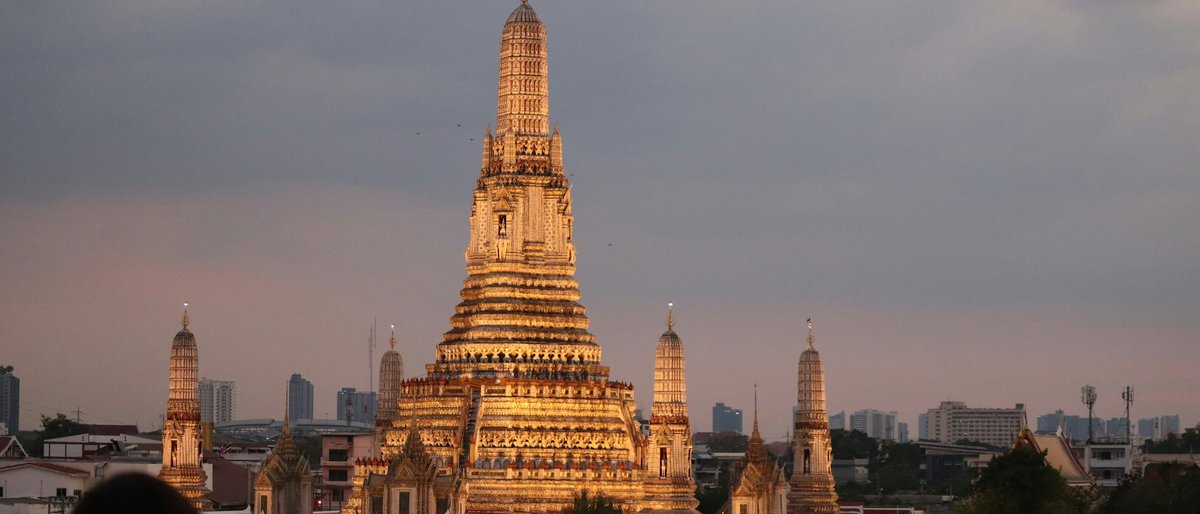
Stay in Bangkok in August
78 hotels in the Trip.com pool for Bangkok, from US$8 a night.
Opens Trip.com on Fri 6 Aug to Sun 8 Aug 2027; change the dates there.
August in Bangkok means monsoon. Expect 222mm of rainfall across roughly 26 days, with downpours typically arriving between 14:00 and 16:00 and lasting 30 to 90 minutes. The streets flood, traffic on Silom Road stalls, and the rain hammers on tin awnings hard enough to drown out conversation. Temperatures sit around 31.8°C (89°F) by day and 25.4°C (78°F) at night, milder than the 34°C peaks of March and April, but the 81% humidity makes everything feel heavier. Your glasses fog the moment you step out of a BTS station, and your shirt clings within 2 minutes of walking.
That said, August is not September, which dumps 339mm and holds the title of Bangkok's wettest month. Mornings are often bright, giving you 4 to 5 solid hours for temples and markets before the clouds build. Chatuchak Weekend Market sees noticeably thinner crowds on both Saturday and Sunday. The Grand Palace, the official royal residence since 1782, still draws visitors, but the queues along Na Phra Lan Road move faster than they would in December or January. Hotels across Sukhumvit and the Silom area tend to drop rates to some of the lowest of the year.
The city is deep into Khao Phansa, the Buddhist Lent period that began in July and runs through October. Monks at Wat Pho and Wat Saket keep stricter retreat schedules. August 12 is Queen Sirikit's Birthday, a national holiday that doubles as Thai Mother's Day. Government buildings and malls along Ratchadamri Road light up in blue, and many Thai families gather for meals and temple visits at neighborhood wats.
Why visit in August
- Hotel rates across Sukhumvit and the Silom district drop to annual lows. Low occupancy means walk-in upgrades are common at larger properties.
- Attractions across Rattanakosin feel spacious. Temple visits are unhurried without the peak-season crowds of December and January.
- Thailand's tropical fruit harvest peaks in August. Wholesale markets overflow with seasonal varieties at their cheapest annual prices.
- Evening temperatures drop several degrees after each afternoon downpour, making post-sunset walks through Yaowarat and along the Chao Phraya comfortable.
Worth knowing
- Rain arrives nearly every day in August. Afternoon downpours can flood lower Sukhumvit sois within minutes, gridlocking traffic and stranding pedestrians.
- Persistent humidity makes midday walking uncomfortable and slows drying of clothes and shoes. Moving between air-conditioned interiors and the outdoor heat fogs camera lenses and phone screens.
- Mosquito activity rises during the monsoon. Standing water from afternoon flooding creates breeding conditions across the city, particularly near canals in Thonburi and along the Khlong Saen Saep corridor.
Best for
Think twice if
Bangkok's wet season runs strong through August. Mornings typically start warm and hazy, with cloud cover thickening by 12:00. The rain comes hard and fast in the afternoon, and low-lying streets can flood within minutes in areas near Lat Phrao and Din Daeng. Once the downpour passes, the evening air carries the scent of wet pavement and jasmine from garland vendors near Pak Khlong Talat flower market. Bangkok rarely sees all-day rain in August. The dominant pattern is 3 to 4 hours of sun, a concentrated burst of 1 to 2 hours, then clearing.
Seasonal caution
- Flash flooding in low-lying sois after sustained downpours. Areas near lower Sukhumvit, Lat Phrao, and Din Daeng can flood knee-deep within 30 minutes. Check drainage conditions before booking ground-floor accommodation.
- Mosquito breeding increases with standing water from daily rain. Apply DEET-based repellent, especially near canals in Thonburi and older neighborhoods around Phra Nakhon.
Year-round climate
Averages from the last 5 years.
| Month | Avg high (°C) | Avg low (°C) | Rainfall (mm) |
|---|---|---|---|
| Jan | 32 | 22 | 12 |
| Feb | 33 | 24 | 54 |
| Mar | 34 | 26 | 59 |
| Apr | 34 | 27 | 88 |
| May | 33 | 26 | 199 |
| Jun | 33 | 26 | 163 |
| Jul | 31 | 26 | 255 |
| Aug | 32 | 25 | 222 |
| Sep | 31 | 25 | 339 |
| Oct | 31 | 24 | 233 |
| Nov | 31 | 24 | 108 |
| Dec | 32 | 23 | 14 |
Holidays and festivals in August
Public holidays
- The Queen Mother's Birthday(วันเฉลิมพระชนมพรรษาพระพันปีหลวง)12 August 2027
Best things to do in August
Rattanakosin morning temple circuit
cultureWalk the temple circuit starting at the Grand Palace, continuing to Wat Pho for the 46-metre reclining Buddha, then crossing the Chao Phraya by ferry to Wat Arun, which has stood on the Thonburi bank since 1656. The full route takes 4 to 5 hours at a comfortable pace.
Morning skies tend to stay clear through 11:00. Peak-season queues are absent, and the temples feel spacious enough to appreciate architectural details without being shuffled past.Booking tipNo booking needed. Arrive at the Grand Palace gates by 08:30 when they open.
Thonburi khlong boat tour
sightseeingHire a longtail boat from Tha Tien pier to explore the canal network threading through Thonburi's residential neighborhoods. The route passes stilted houses, small temples, and orchid farms that most visitors never see from Bangkok's main streets.
Monsoon water levels open narrower side canals that run too shallow to navigate during the December-to-March dry season. The wet-season greenery along the banks is at its thickest.Booking tipNegotiate the route and price at the pier before departure. Weekday mornings see less boat traffic on the canals.
Thai cooking class with seasonal ingredients
food and cultureJoin a half-day Thai cooking class that starts with a guided market tour to select ingredients. Most classes cover 4 to 5 dishes, including curry paste from scratch, a stir-fry, and a soup.
Seasonal fruit like mangosteen and longkong adds variety to the market-shopping portion of the class. August group sizes shrink, so instruction is more hands-on.Booking tipBook 2 to 3 days ahead for weekend classes. Weekday classes often have same-day availability in August.
Bangkok National Museum
cultureSoutheast Asia's largest collection of Thai art and antiquities, housed in a former palace complex near Sanam Luang. Founded in 1874, the collection spans the Sukhothai, Ayutthaya, and Rattanakosin periods, with an emphasis on Buddhist sculpture and royal regalia.
An air-conditioned afternoon refuge when the rain hits. Far fewer visitors in August than during peak tourist months, so you can spend time with individual pieces.Yaowarat evening food crawl
foodWalk the length of Yaowarat Road after dark, stopping at street stalls for grilled seafood, ba mee (egg noodles), and kuay jab (rolled rice noodle soup). The side sois hide smaller vendors specializing in single dishes perfected over decades.
Afternoon rain typically clears by 18:00 or 19:00, and the post-rain air carries the smell of charcoal and garlic from stalls firing up. During Hungry Ghost Festival weeks, additional food offerings and Chinese opera stages appear along the road.Dawn walk at Lumphini Park
natureBangkok's central green space covers 57 hectares in the Silom-Sathorn corridor. The park has walking paths, a boating lake, and a resident population of monitor lizards that can reach 2 metres in length.
The park reaches its most lush state during the monsoon. Monitor lizards are especially active in warm, wet conditions. The dawn hour before 07:00 is the coolest window of the day.Thai spa afternoon during the rain window
wellnessBook a 2-to-3-hour Thai massage and herbal compress session at one of the spas in the Silom or Sukhumvit areas. Traditional Thai massage at the Wat Pho training school is another option with shorter wait times than in peak season.
The predictable afternoon rain window between 14:00 and 16:00 creates natural downtime for a long spa session. Walk-in availability is better than during the November-to-February tourist peak.What to eat in August
In season: fruit
Mangosteen
August falls in the heart of Thailand's mangosteen season, which runs May through September. The thick purple rind splits to reveal translucent white segments with a sweet-sour balance that peaks when the fruit is freshest. Any Bangkok wet market will have them in abundance.
Longkong
Longkong clusters appear at Bangkok markets from August onward, running through October. The small, translucent fruit grows in grape-like bunches and has a delicate sweetness with a slight citrus edge. Peel them like tiny oranges. Or Tor Kor Market near Chatuchak carries premium-grade specimens.
Rambutan
Thailand's rambutan season runs May through September, and August fruit tends to be plump with high sugar content. The hairy red shell opens to a sweet, slightly floral flesh that looks like a peeled grape.
Durian
August marks the tail end of Thailand's main durian season, which peaks in May and June. Late-season fruit from Chanthaburi province, the country's largest growing region about 250km southeast of Bangkok, still arrives at city markets, though selection narrows as the month progresses.
On menus now
Tom Yum Goong
Locals gravitate toward hot, sour soups during the rainy months. Tom yum goong made with fresh river prawns, lemongrass, galangal, and makrut lime feels like a natural match for cooler post-rain evenings. Restaurants along Charoen Krung Road in Bangrak serve some of the city's most well-regarded versions.
Regular events in August
Queen Sirikit's Birthday (Thai Mother's Day)Free
National holiday honoring Queen Sirikit. Government offices and banks close. Buildings across central Bangkok display blue lighting and portraits. Many Thai families visit temples and present jasmine garlands to their mothers. Public celebrations take place at Sanam Luang and along Ratchadamnoen Avenue.
August 12Hungry Ghost Festival (Yaowarat)Free
Bangkok's Chinese community in Yaowarat (Chinatown) observes the Hungry Ghost Festival with joss paper burning, food offerings on sidewalk altars, and occasional Chinese opera performances on temporary stages. The festival's dates shift with the Chinese lunar calendar, typically landing in late August or early September.
Late August to early September (varies by lunar calendar)Best places this August
Chatuchak Weekend Market
marketOver 15,000 stalls spread across 35 acres. August crowds are noticeably thinner than in the cool season, and the covered sections protect from afternoon rain. Sections 2 through 4 (clothing) and 25 through 27 (home decor) are mostly indoors.
ChatuchakBangkok Art and Culture Centre (BACC)
museumA 9-story contemporary art space at the Siam BTS intersection, with free-admission galleries rotating Thai and international exhibitions. Independent bookshops and small galleries occupy every floor. A strong option when the afternoon rain starts.
SiamJim Thompson House
museumA museum assembled from 6 traditional Thai teak houses on a khlong bank near Siam. The collection of Southeast Asian art and silk spans centuries. The main galleries are air-conditioned, and the surrounding garden turns lush during the monsoon.
SiamSanam Luang
landmarkThe ceremonial field beside the Grand Palace takes on a different character during the monsoon. The grass is green rather than its dry-season brown, and on clear August weekday afternoons you might have the open field largely to yourself.
RattanakosinKhaosan Road
neighborhoodLaid out in 1892, Bangkok's backpacker corridor is notably quieter in August than its peak-season reputation suggests. Foot traffic drops enough that you can walk the full length without being shoulder-to-shoulder. Prices on food and drinks along the road tend to be lower in the wet months.
BanglamphuKhlong Toei Market
marketBangkok's largest wet market sits in the Khlong Toei port district. It operates daily from predawn through mid-morning. August brings peak supplies of seasonal fruit, including mangosteen and rambutan, at wholesale volumes.
Khlong Toei
Your packing checklist
Tick items off as you pack. Your progress saves in this browser.
All packed — have a great trip.
Insider tips
Bangkok's August rain follows a remarkably predictable clock. Check the sky at noon. If thick grey clouds are building from the west, the downpour will likely hit between 14:00 and 16:00. Plan indoor activities for that window and you can use the rest of the day outdoors.
When it rains, skip taxis and ride-hailing entirely. Traffic on Rama IV Road and lower Sukhumvit can gridlock for 2 hours or more during a downpour. The BTS Skytrain and MRT underground run on schedule regardless of weather and connect most areas tourists visit.
Mangosteen at Khlong Toei Market runs at wholesale rates. Tourist-facing vendors near Khaosan Road charge a significant markup for the same fruit. August is peak season, so quality is equally good at both, but the price gap is wide.
Many Bangkok rooftop bars stay open through the monsoon months. Post-storm sunsets over the Chao Phraya can produce striking orange and pink skies, and you will often find walk-in seating at terraces that require reservations from November through February.
Avoid these mistakes
- Scheduling a full day of outdoor temple-hopping with no rain plan. The Rattanakosin circuit (Grand Palace, Wat Pho, Wat Arun) takes 4 to 5 hours. Starting after noon means the afternoon downpour catches you mid-route between sites with limited cover. Start by 08:00 instead.
- Walking through flooded sois in closed-toe sneakers. One afternoon of wet shoes takes a full day to dry in Bangkok's August humidity, leading to blisters and discomfort for the rest of the trip. Bring waterproof sandals for rain days.
- Writing off an entire day because of morning rain. August rain in Bangkok rarely lasts more than 2 hours. Visitors who cancel full-day plans over a morning shower miss 6 to 8 hours of dry, overcast, walkable weather.
- Booking an all-day outdoor excursion to the floating markets outside Bangkok. The drive to Damnoen Saduak or Amphawa takes 60 to 90 minutes each way, and monsoon flooding along Highway 35 can turn a 90-minute return trip into a 4-hour crawl.
Practical tips for August
Book accommodation within walking distance of a BTS or MRT station. When August rain hits, street-level transport stalls, and a train connection 5 minutes on foot preserves your evening plans. Major temple complexes stop admitting visitors by mid-to-late afternoon, before the rain typically clears, so schedule temple visits for the morning. The mid-August national holiday (Thai Mother's Day) closes banks and government offices, though malls and tourist sites stay open. Thailand observes wan phra, Buddhist holy days tied to the lunar cycle, roughly every 7 to 8 days. Alcohol sales stop at many bars and restaurants on these days. Check the lunar calendar before planning an evening out. Dress codes at major temples are strictly enforced year-round. Shoulders and knees must be covered. Lightweight linen trousers and a short-sleeve shirt that reaches the shoulders satisfy the requirement without overheating.
FAQ
Is August a good time to visit Bangkok?
August is a fair time to visit. It falls in the middle of Bangkok's monsoon season, with rain on most days and persistent humidity. The trade-off is genuine value. Hotel rates, flights, and tours drop to near-annual lows, and major attractions see noticeably fewer visitors. If you can tolerate afternoon rain and plan around it, August rewards you with shorter queues, lower prices, and a less hectic Bangkok. If sunshine and outdoor photography are priorities, November through February is a stronger choice.
Does it rain all day in Bangkok in August?
Rarely. The typical pattern is clear or partly cloudy mornings, a heavy downpour lasting 1 to 2 hours in the afternoon, then clearing again by early evening. All-day rain is uncommon in August. Most days give you 6 to 8 usable dry hours if you plan around the afternoon window.
Is Bangkok crowded in August?
Bangkok is noticeably less crowded in August compared to the November-through-February peak season. Chinese and European tour groups, which account for a large share of visitor volume, thin out during the monsoon months. Temple queues are shorter, weekend markets feel less compressed, and walk-in restaurant availability improves significantly.
What should I wear in Bangkok in August?
Light, breathable fabrics that wick moisture work best. Cotton absorbs sweat and stays clammy in the humidity, so synthetic blends or linen are better choices. For temples, covered shoulders and knees are required. Waterproof sandals are more practical than sneakers on rainy days. Bring a light layer for aggressively air-conditioned malls, cinemas, and the BTS.
Are there any major festivals in Bangkok in August?
The main observance is Thai Mother's Day, a national holiday honoring Queen Sirikit, when families visit temples and the city takes on a festive, quiet tone. Depending on the lunar calendar, the Hungry Ghost Festival brings Chinese opera and food offerings to the Chinatown district around late August or early September. Neither rises to the level of Songkran or Loy Krathong, but both add distinct character to an August visit.
Things to Do in Bangkok in August

Bangkok Private Highlights Tour with Local Guide
City tour: 8 hours.
via Viator Free cancellation
 Half-Day Floating Market and Railway Market Tour from Bangkok
Day trip: free cancellation.
via Viator Free cancellation
 Bangkok: Floating Market and Train Market Experience
Day trip: 8.5 hours, free cancellation.
via Viator Free cancellation
 Experience Real Bangkok by Bike
City tour: 3 hours, free cancellation.
via Viator Free cancellation
 Hidden Bangkok Longtail Boat Tour to Big Buddha&Canal Life 2hrs
Cruise: 2 hours, free cancellation.
via Viator Free cancellation
 UNESCO's Ayutthaya Historical Park: Full-Day Tour from Bangkok
Day trip: 11.5 hours, free cancellation.
via ViatorFind a flight to Bangkok
Live fares to Bangkok appear here once cookies are accepted.
Last verified by automated review (v1.7.2) on . What is automated review?