What's the must-see thing in Bangkok?
The Grand Palace. Go at 8:30am when the gates open; by mid-morning the marble courtyard radiates heat you can feel through the paper shoe covers they hand you, and tour buses have filled the Emerald Buddha temple shoulder-to-shoulder. The gilded rooflines glow copper in early light. 500 baht, no reservation. Do this first on day one.
The Grand Palace covers 218,000 square metres on the Chao Phraya's east bank in Rattanakosin, the old royal district. It has served as the official royal residence since 1782, though the current king lives elsewhere. What hits you first is the scale: then the heat. The courtyard flagstones store overnight warmth and by mid-morning they radiate through whatever you're wearing on your feet. Dress code is strict: covered shoulders, long trousers or skirts past the knee, closed-toe shoes. They sell wraps at the gate for 200 baht if you arrive unprepared. Your 500 baht ticket (about $15.50 USD) includes Wat Phra Kaew, the Temple of the Emerald Buddha, inside the palace walls. The Buddha itself is smaller than you'd expect: roughly 66 centimetres tall, carved from a single block of jade, sitting high on a gold altar behind glass. The room smells of jasmine garlands and melting candle wax, and the shuffle of stockinged feet on cool tile is the only sound under the vaulted ceiling. You won't linger; the crowd pushes you along. That's fine. The building exteriors are the real show.
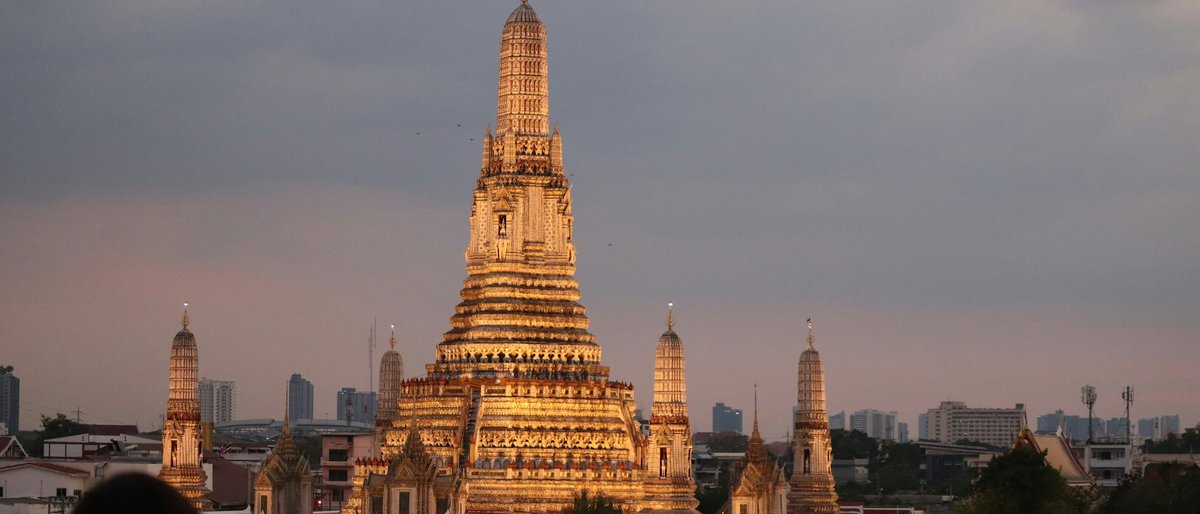
Walk south from the Grand Palace (ten minutes on shaded pavement) and you reach Wat Pho, home of the 46-metre reclining Buddha. The statue fills the entire viharn; your neck cranes to follow it from gilded toenails to serene face. The feet alone stand three metres tall, inlaid with 108 mother-of-pearl panels that feel cool to the eye against all that surrounding gold. Entry is 300 baht. Mind you, the pace here is different from the Grand Palace. The grounds are shadier, the crowds thin under old trees, and there is a massage school on-site where a one-hour traditional Thai massage runs about 480 baht. You will want it after two hours of walking on hot stone. From Wat Pho's river pier, the cross-river ferry costs 4 baht and takes three minutes to Wat Arun on the Thonburi side. The central prang rises 82 metres, covered in broken porcelain and coloured glass that catches light differently at every hour. Best photographed from the east bank at sunset, but climbing partway up the narrow staircase at midday gives you a river-bend panorama no rooftop bar matches. Entry is 100 baht.
Here is the sequence that works. Arrive at the Grand Palace when gates open at 8:30am. Spend 90 minutes. Walk to Wat Pho: another hour. Ferry to Wat Arun: 45 minutes is enough. You will be done by noon, which matters because Bangkok's afternoon heat is not something you push through. In April the air temperature sits around 36-37°C but the humidity pushes the heat index past 42°C. Your body does not recover from that with a few minutes of shade. After Wat Arun, take a Grab back to your hotel and stay horizontal until 4pm. Before you leave Rattanakosin, stop at one of the boat-noodle shops near Tha Maharaj pier: bowls run 40-60 baht, and the broth tastes like slow-cooked pork with star anise and cinnamon bark, dark and salty and restorative. The afternoon push is where first-time visitors make their worst mistake: they force themselves onward to Chatuchak or Khao San Road and spend the next two days recovering from heat exhaustion instead of seeing anything.
A few honest notes. Khao San Road is not a must-see. It is a fine place to drink a 100-baht Chang beer after dark, but during the day it is pad Thai carts, tattoo parlours, and hostel bars that could be anywhere in Southeast Asia. The floating markets (Damnoen Saduak, Amphawa) sit over an hour outside Bangkok by road, and the experience at the busiest ones now tilts toward tourist performance rather than actual trade. To be fair, Amphawa on a Friday evening still has some of its old character. But if you have three days, spend day two on the Thonburi canal network by longtail boat instead. The khlongs still smell of river water and frying garlic from the stilt houses lining the banks, and the boat driver will stop at a riverside temple where you might be the only visitor. That is closer to what the floating markets were thirty years ago than anything the coach tours reach today.
The top three
Grand Palace
218,000 square metres of gilded architecture, the official royal residence since 1782. The Emerald Buddha sits inside. Go at 8:30am; morning light turns the gold rooflines to copper, and you beat the tour buses by an hour.
Wat Pho
The 46-metre reclining Buddha fills the entire hall: feet alone are three metres tall with 108 mother-of-pearl panels. Ten minutes south of the Grand Palace, with an on-site massage school that is the best 480 baht you will spend all trip.
Wat Arun
An 82-metre porcelain-mosaic prang on the Thonburi bank, three minutes by 4-baht ferry from Wat Pho. Best photographed from across the river at sunset, but climbing partway up gives a river-bend view no rooftop bar can match.
Verified attractions
Sourced from Wikidata and OpenStreetMap: each entry links to its authoritative page.
-
Grand Palace
archaeological siteofficial residence of the King of Thailand since 1782
View on Wikidata -
Wat Phra Kaew
place of worshipRoyal temple complex in Bangkok, Thailand
View on Wikidata -
Wat Arun
place of worshipBuddhist temple in central Bangkok, Thailand
View on Wikidata -
Wat Pho
place of worshipBuddhist temple in central Bangkok, Thailand
View on Wikidata -
Wat Benchamabophit
place of worshipBuddhist temple in Bangkok, Thailand
View on Wikidata -
Bangkok National Museum
museummuseum in Bangkok, Thailand
View on Wikidata -
Khaosan Road
attractionroad in Bangkok, Thailand
View on Wikidata -
Lumphini Park
parkpublic park in Bangkok
View on Wikidata -
Chatuchak Weekend Market
attractionlargest market in Thailand
View on Wikidata -
Democracy Monument
monumentmonument in Bangkok, Thailand
View on Wikidata -
Rama VIII Bridge
bridgebridge in Thailand
View on Wikidata -
Erawan Shrine
place of worshipshrine Dedicated to Brahma in Bangkok
View on Wikidata -
Rama IX Bridge
bridgebridge in Bangkok, Thailand
View on Wikidata -
Dusit Palace
palaceThai royal residence compound
View on Wikidata -
Lumpinee Boxing Stadium
stadiumstadium in Bangkok, Thailand
View on Wikidata -
Sanam Luang
plazasquare in Bangkok, Thailand
View on Wikidata -
Wat Suthat
place of worshipBuddhist temple in Bangkok, Thailand
View on Wikidata -
Assumption Cathedral
churchprincipal Roman Catholic church of Thailand
View on Wikidata -
Bhumibol Bridge
bridgebridge
View on Wikidata -
Chitralada Royal Villa
palaceroyal residence in Bangkok, Thailand
View on Wikidata -
Victory Monument
monumentmonument in Bangkok, Thailand
View on Wikidata -
Wat Saket
place of worshipBuddhist temple in Bangkok, Thailand
View on Wikidata -
Krungthep Bridge
bridgebascule bridge in Bangkok, Thailand
View on Wikidata -
Suphachalasai Stadium
stadiumstadium in Bangkok
View on Wikidata -
Thunderdome Stadium
stadiumfootball stadium in Thailand
View on Wikidata -
Wat Bowonniwet Vihara
place of worshipBuddhist temple in Bangkok, Thailand
View on Wikidata -
Wat Paknam Phasi Charoen
place of worshipBuddhist temple in Bangkok, Thailand
View on Wikidata -
Bangkok Art and Culture Centre
museumart museum and cultural center in Bangkok
View on Wikidata -
Rajadamnern Stadium
stadiumSport arena
View on Wikidata -
Wat Intharawihan
place of worshipBuddhist temple in Bangkok, Thailand
View on Wikidata -
Wat Mahathat Yuwaratrangsarit
place of worshipBuddhist temple in Bangkok, Thailand
View on Wikidata -
Wat Yan Nawa
place of worshipBuddhist temple in Bangkok, Thailand
View on Wikidata -
Ananta Samakhom Throne Hall
attractionarchitectural structure in Bangkok, Thailand
View on Wikidata -
Chatuchak Park
parkpublic park just north of Chatuchak Weekend Market
View on Wikidata -
Kanchanaphisek Bridge
bridgeThai road bridge over the Chao Phraya
View on Wikidata -
Memorial Bridge
bridgebridge crossing Chao Phraya River, Thailand
View on Wikidata -
National Art Gallery
museumart gallery in Bangkok, Thailand
View on Wikidata -
Sao Chingcha
attractionlandmark in Phra Nakhon district, Bangkok, Thailand
View on Wikidata -
Sri Maha Mariamman Temple, Bangkok
place of worshipAmman Temple in Bangkok, Thailand
View on Wikidata -
Jim Thompson House
museummuseum in Bangkok
View on Wikidata
Last verified by automated review (v1.5.J.2) on . What is automated review?