Stay in Bangkok in February
78 hotels in the Trip.com pool for Bangkok, from US$8 a night.
Opens Trip.com on Fri 5 Feb to Sun 7 Feb 2027; change the dates there.
February in Bangkok sits at the comfortable tail end of the cool season, and it likely represents your last window of genuinely pleasant weather before March and April turn up the heat. Daytime temperatures hover around 32.6°C (91°F), which still feels warm by most standards, but nights drop to a relatively mild 23.7°C (75°F). Step outside in the early morning near Lumphini Park and you might notice the air carries a dry quality compared to the sticky monsoon months. A 5-kilometer walk through Rattanakosin feels comfortable rather than punishing.
This is still firmly peak tourist season, the November-to-February window that brings Bangkok's highest visitor numbers. The crowds that arrived for Christmas and New Year have thinned somewhat, but February brings its own draw. Chinese New Year celebrations take over Yaowarat Road in years when the lunar calendar places it in February, filling hotels across the old city and Chinatown districts for days. Expect rooftop bars along Silom to operate at capacity most evenings.
The main caveat is air quality, which tends to decline across much of Thailand between January and March. Agricultural burning pushes haze into Bangkok by the second half of February, though the city sees far less impact than Chiang Mai or Chiang Rai. If you have respiratory sensitivities, the Air4Thai app gives daily district-level readings. Mind you, this is still one of the 3 best months to visit.
Why visit in February
- Rainfall averages 54mm across about 7 days, one of Bangkok's driest months. A full day walking between temples in Rattanakosin or browsing Chatuchak typically stays dry from start to finish.
- Humidity hovers near 69%, the lowest Bangkok sees all year. Temple visits and market browsing feel noticeably less oppressive than during the May-through-October monsoon window.
- February's cultural calendar carries 2 major observances. Makha Bucha Day brings candlelit processions at temples across the city, and Chinese New Year turns Yaowarat into a multi-day street festival in years when the date lands in this month.
- Morning light along the Chao Phraya is ideal for photography. The dry season's clear skies produce sharp reflections off the riverside temple spires that overcast monsoon dawns wash out entirely.
Worth knowing
- Peak season pricing persists through February. The December-January holiday premium has passed, but hotel rates across the city remain well above their annual average.
- Major temple complexes are at their busiest through February. Midday arrivals at Wat Phra Kaew and the surrounding palace grounds mean exposed sun and slow-moving queues.
- On haze-heavy days, rooftop dining spots along the Chao Phraya lose their panoramic views. February's air quality is variable enough that sunset plans should stay flexible.
Best for
Think twice if
February is the last month of Bangkok's cool season, though 'cool' is relative. The dry heat feels noticeably more bearable than the wet months ahead. Mornings tend to be the most pleasant window for outdoor activity, with the heat building steadily after 11 a.m. Showers are infrequent and typically pass within 20-30 minutes. The real weather story this month is the occasional haze from regional burning rather than precipitation.
Seasonal caution
- February falls within Thailand's agricultural burning season, which runs from January through March. PM2.5 levels in Bangkok can exceed WHO recommended limits on peak days, particularly during the second half of the month. Visitors with respiratory conditions should carry prescribed medication and consider a KN95 mask for extended time outdoors.
Year-round climate
Averages from the last 5 years.
| Month | Avg high (°C) | Avg low (°C) | Rainfall (mm) |
|---|---|---|---|
| Jan | 32 | 22 | 12 |
| Feb | 33 | 24 | 54 |
| Mar | 34 | 26 | 59 |
| Apr | 34 | 27 | 88 |
| May | 33 | 26 | 199 |
| Jun | 33 | 26 | 163 |
| Jul | 31 | 26 | 255 |
| Aug | 32 | 25 | 222 |
| Sep | 31 | 25 | 339 |
| Oct | 31 | 24 | 233 |
| Nov | 31 | 24 | 108 |
| Dec | 32 | 23 | 14 |
Holidays and festivals in February
Public holidays
- Makha Bucha Day(วันมาฆบูชา)21 February 2027
Headline events
Chinese New Year on Yaowarat Road
Varies with the lunar calendar. Falls between late January and mid-February. In some years it lands entirely in January.
Bangkok's Chinatown, centered on Yaowarat Road, hosts one of Southeast Asia's largest Chinese New Year celebrations. Dragon and lion dance troupes wind through streets closed to traffic, fireworks burst over Odeon Circle, and food stalls stretch for blocks on either side. The air fills with the layered scent of incense, grilled pork, and mandarin oranges. Street-level festivities run for 2-3 nights.
Best things to do in February
Walk the Rattanakosin historic core
sightseeingThe old royal district holds the Grand Palace (built 1782), Wat Phra Kaew, Sanam Luang, and the Bangkok National Museum (est. 1874) within a 2-kilometer radius. The route is entirely on foot and takes 4-5 hours at a relaxed pace, crossing through the original street grid of the city.
February's dry heat and sub-33°C mornings make this the last comfortable month for a full-day walk before March's temperature climb.Booking tipThe Grand Palace opens at 8:30 a.m. Arriving at opening avoids both the heat and the tour-bus crowds that appear by 10.
Cycle through Bang Krachao
outdoorOften called Bangkok's green lung, this river-bend peninsula of gardens, elevated walkways, and small temples sits across the Chao Phraya from the central city. Rent a bicycle at the pier and spend 3-4 hours looping through the quiet paths, stopping at Sri Nakhon Khuean Khan Park at the center.
February evenings cool into the mid-20s °C, making the cycling loop far more pleasant than in the 35°C months ahead.Attend a Wien Thien candlelight procession for Makha Bucha Day
culturalOn the full moon of the third lunar month, Buddhist temples across Bangkok hold Wien Thien ceremonies where devotees walk three times around the main prayer hall carrying candles, incense, and lotus flowers. The atmosphere is quiet, warm, and scented with jasmine. Wat Benchamabophit (the Marble Temple) is one of the most attended.
Makha Bucha Day falls in February in most years, marking one of Buddhism's three most important holidays.Booking tipNo booking needed. Arrive by 7 p.m. for the main evening ceremony.
Chinese New Year food crawl on Yaowarat Road
foodDuring the Chinese New Year festival, Yaowarat Road closes to vehicles and becomes a kilometer-long stretch of food stalls, lion dance troupes, and firecracker smoke. The food alone is worth the visit. Fresh hoy tod (crispy mussel omelets), guay jab (rolled noodle soup), and roasted duck come from the Chinatown shophouses that have operated here for generations.
Chinese New Year celebrations on Yaowarat typically fall between late January and mid-February, depending on the lunar calendar.Booking tipTake the MRT to Wat Mangkon station. Taxis cannot reach Yaowarat during the festival road closures.
Sunrise at Wat Arun from the Thonburi side
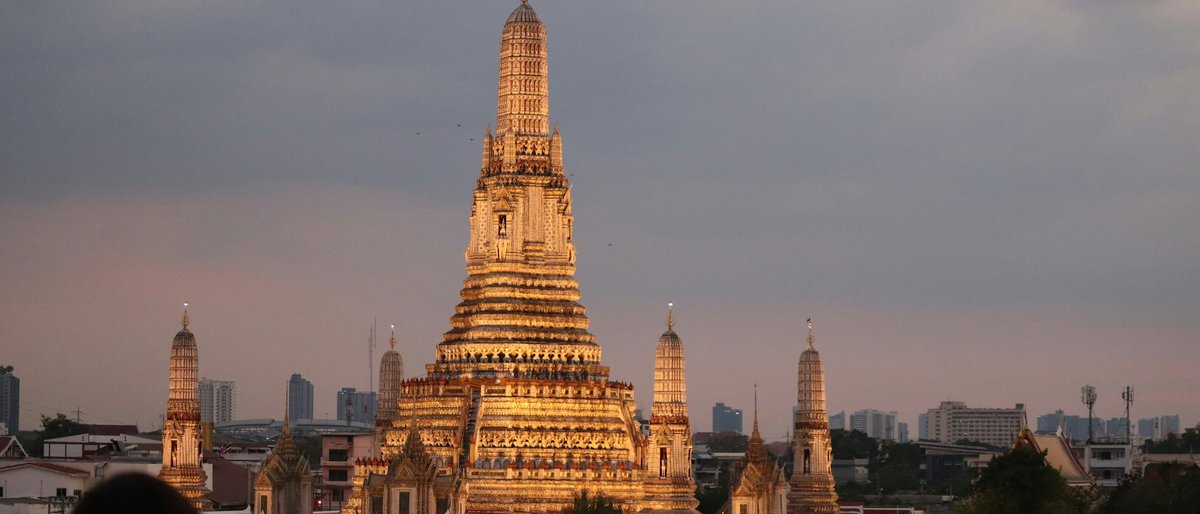
sightseeingCrossing to the Thonburi bank of the Chao Phraya early in the morning gives you the full facade of Wat Arun (founded 1656) lit by sunrise. The porcelain-encrusted prang catches the first light in a way that renders the temple almost orange against the pale sky. February mornings are clear more often than not.
Dry-season mornings produce the clear skies and low-angle light that make this view worth the early alarm. Monsoon months tend toward overcast dawns.Booking tipThe cross-river ferry from Tha Tien pier starts running early, typically around 6 a.m.
Evening tasting tour at Or Tor Kor Market
foodAdjacent to Chatuchak, Or Tor Kor is a clean, orderly market focused on premium Thai produce and prepared foods. February brings the convergence of several peak-season fruits. The market's air-conditioned section serves ready-to-eat dishes from southern, Isaan, and central Thai traditions side by side.
February is the overlap point for sweet tamarind, pomelo, and highland strawberry seasons. The strawberries in particular disappear by early March.Rooftop bar evening during the dry season
nightlifeBangkok's rooftop bar scene operates year-round, but the experience is weather-dependent. February's lower humidity and reduced chance of rain mean you can sit outside comfortably from sunset through late evening without worrying about a sudden downpour canceling the view. The Silom and Sathorn area has the highest concentration of elevated venues.
February combines low rain probability, moderate humidity, and cooler evenings. The monsoon months (June-October) see frequent cancellations from afternoon storms.Booking tipReserve 3-4 days ahead for Friday and Saturday evenings. Most venues enforce a smart-casual dress code.
What to eat in February
In season: fruit
Sweet Tamarind (Makham Wan)
Phetchabun province's famous sweet tamarind reaches Bangkok's markets in peak condition during January and February. The flesh is sticky, sweet, and faintly sour, with a date-like texture. Look for the plump, dark-shelled pods at Or Tor Kor Market or Pak Khlong Talat.
Thai Highland Strawberries
Grown at altitude on the Royal Project farms around Doi Ang Khang in Chiang Mai province, these small, fragrant berries flood Bangkok's fruit stands from December through February. They are sweeter and more aromatic than the imported alternatives, though smaller.
Pomelo (Som O)
Thailand's cool-season citrus peaks from November through February. Nakhon Pathom province produces the most prized varieties. The segments are sweet, firm, and less bitter than grapefruit, often eaten with a salt-sugar-chili dipping mixture.
On menus now
Jim Jum
An Isaan-style hotpot cooked in a small clay pot over charcoal. Pork, liver, glass noodles, and basil go into a simmering broth fragrant with lemongrass. February's cooler evenings make this sidewalk dish more appealing than during the hot season. The Ratchada and Ari neighborhoods have strong options.
Festival food
Khanom Pia and Nian Gao
During Chinese New Year weeks, Yaowarat's bakeries produce traditional pastries filled with mung bean, durian, or taro (Khanom Pia), alongside sticky rice cake (Nian Gao). Both are sold warm from glass-fronted display cabinets on the street, and the pastry fillings are seasonal productions that disappear after the holiday.
Regular events in February
Makha Bucha DayFree
One of Thailand's most important Buddhist holidays, commemorating a gathering of 1,250 disciples before the Buddha. Nationwide alcohol sales ban from midnight to midnight. Bars, clubs, and nightlife venues close entirely. Convenience stores stop selling beer. Wien Thien candlelight processions take place at temples in the evening.
Full moon of the third lunar month, usually mid- to late February. Occasionally falls in early March.Valentine's Day flower surge at Pak Khlong TalatFree
Thailand celebrates Valentine's Day with genuine enthusiasm. The Pak Khlong Talat flower market near Memorial Bridge swells to several times its normal size in the days leading up to February 14. Rose prices rise, but the spectacle of trucks unloading thousands of bouquets through the night is free and genuinely striking.
February 10-14Kite season begins at Sanam LuangFree
The dry, breezy conditions of February mark the start of Bangkok's traditional kite-flying season. The ceremonial field has been a center of this activity for decades, and you might see traditional chula (star-shaped) and pakpao (diamond) kites alongside modern designs. Vendors appear along the edges on weekends.
February through April, weekends especiallyBest places this February
Lumphini Park
parkBangkok's central green space is at its most comfortable in February. The morning crowd of joggers, tai chi practitioners, and monitor lizards basking near the lake peaks around 6:30 a.m. The grass stays green from residual monsoon moisture, and the shade of the rain trees makes midday bearable.
SilomYaowarat Road (Chinatown)
neighborhoodEven outside Chinese New Year, Yaowarat's evening street food scene is at its best during the dry season, when stalls spill further onto the sidewalks without fear of rain. The gold shops, herbal medicine stores, and after-dark food carts have operated here for over a century. The warm glow of gold-shop neon against the darkening sky is a February evening constant.
SamphanthawongTalat Noi
neighborhoodThe old Chinese-Portuguese neighborhood between Yaowarat and the river is best explored on foot in February's walkable temperatures. Narrow lanes wind past colonial shophouses with peeling paint, small shrines trailing joss-stick smoke, and street art on every other wall. The area still sounds residential. Laundry flaps overhead and motorbikes idle at corners.
SamphanthawongChatuchak Weekend Market
marketWith over 15,000 stalls across 27 acres, Chatuchak is an endurance event in the hot season. February's temperatures make it possible to browse for 3-4 hours without overheating. The outer sections, where the smell of fresh leather and coconut smoothies mixes with vendors calling out prices, are less crowded than the clothing aisles.
ChatuchakWat Benchamabophit (Marble Temple)
templeBuilt with Italian Carrara marble under King Chulalongkorn, this is one of Bangkok's most architecturally distinctive temples. During Makha Bucha Day, the Wien Thien procession here draws hundreds of devotees. Even on regular February evenings, the courtyard is quiet enough to sit and hear the monks' chanting carry across the stone.
DusitSanam Luang
public spaceThe ceremonial field facing the Grand Palace grounds serves as an evening gathering spot in the dry season. Locals bring mats and food, kite strings hum in the late-afternoon breeze, and vendors sell grilled corn and som tam on the perimeter. The view toward the illuminated temple spires at dusk is one of the most photographed angles in the city.
Rattanakosin
Your packing checklist
Tick items off as you pack. Your progress saves in this browser.
All packed — have a great trip.
Insider tips
If you are in Bangkok the night before Valentine's Day (February 14), set an alarm for 2 a.m. and walk to Pak Khlong Talat. The flower wholesalers unload trucks of roses and orchids under floodlights, and the 3 a.m. energy of the market feels nothing like its daytime self.
For Chinese New Year on Yaowarat, skip the main road and duck into Soi Charoen Krung 16. The smaller alleys host family-run shrines doing lion dance blessings, and the food stalls there are less picked-over than the main strip.
When the haze is bad, escape to the Bangkok Art and Culture Centre (BACC) near National Stadium BTS. Free admission, air-conditioned, and typically running 3-4 exhibitions. February tends to have fresh rotations since the Thai art calendar resets after the December-January holiday period.
The Chao Phraya express boat (orange flag line) costs a fraction of the tourist boats and covers the same route between Saphan Taksin BTS and the old city piers. The morning commuter rush from 7 to 8:30 a.m. is cramped, but the ride gives you the riverside view for the price of local transit.
Avoid these mistakes
- Scheduling a pub crawl that collides with Makha Bucha Day. The nationwide alcohol ban catches visitors by surprise every year, since the date moves with the lunar calendar. Check before you finalize evening plans.
- Planning outdoor sightseeing for the 11 a.m. to 3 p.m. window. Even in February, the midday sun at full intensity makes temple hopping uncomfortable. Experienced visitors follow the local pattern. Outdoors early morning and late afternoon, indoors during the middle of the day.
- Assuming dry season means zero rain and leaving the hotel without any protection. February does see occasional afternoon showers, and getting caught mid-temple-complex without cover turns a mild inconvenience into a soaking 30 minutes.
Practical tips for February
Book Rattanakosin and Riverside-area hotels at least 3 weeks ahead. February is peak season, and Chinese New Year tightens availability further in years when it falls this month. Carry a photocopy of your passport, as the Grand Palace security checks bags and occasionally requests ID. The BTS and MRT accept contactless Visa and Mastercard, which eliminates the need for single-journey tokens. Check the lunar calendar for Makha Bucha Day before finalizing evening plans, since the alcohol restrictions affect restaurants and hotel minibars alike. Currency exchange booths on Sukhumvit and Silom consistently offer rates within 0.5% of the interbank rate, making them better value than airport counters. At around 33 THB to the US dollar, Bangkok remains affordable even at peak-season pricing for most Western visitors. Temples generally open by 8:30 a.m. and close at 5 p.m., with last entry 30 minutes before closing.
FAQ
Is February a good time to visit Bangkok?
February is one of the strongest months to visit. The weather is warm and dry, tourist infrastructure operates at full capacity, and the cultural calendar is active. Trade-offs include high-season hotel rates and occasional haze from agricultural burning. For most visitors, it ranks among the top 3 months of the year.
What is the weather like in Bangkok in February?
Expect warm, dry days in the low 30s °C (around 90°F) with comfortable evenings in the mid-20s °C (mid-70s °F). Rain is infrequent and brief when it arrives. Humidity stays well below the levels you would experience during the May-October monsoon. It feels hot by European or North American standards but mild by Bangkok's own annual range, especially compared to the April peak.
Is Bangkok crowded in February?
Yes. February falls within peak tourist season, and major attractions see their highest footfall. That said, the post-holiday dip after Christmas and New Year means slightly less pressure than in December. Booking accommodation and popular restaurants ahead of time is advisable, particularly for Riverside and old-city properties.
What events happen in Bangkok in February?
The two major observances are Chinese New Year, celebrated intensely on Yaowarat Road when the lunar calendar places it in this month, and Makha Bucha Day, a Buddhist holiday with evening temple ceremonies and restrictions on alcohol sales. Valentine's Day also draws attention to the city's flower markets. Dates for both Chinese New Year and Makha Bucha shift annually, so check the calendar before booking.
Things to Do in Bangkok in February

Bangkok Private Highlights Tour with Local Guide
City tour: 8 hours.
via Viator Free cancellation
 Half-Day Floating Market and Railway Market Tour from Bangkok
Day trip: free cancellation.
via Viator Free cancellation
 Bangkok: Floating Market and Train Market Experience
Day trip: 8.5 hours, free cancellation.
via Viator Free cancellation
 Experience Real Bangkok by Bike
City tour: 3 hours, free cancellation.
via Viator Free cancellation
 Hidden Bangkok Longtail Boat Tour to Big Buddha&Canal Life 2hrs
Cruise: 2 hours, free cancellation.
via Viator Free cancellation
 UNESCO's Ayutthaya Historical Park: Full-Day Tour from Bangkok
Day trip: 11.5 hours, free cancellation.
via ViatorFind a flight to Bangkok
Live fares to Bangkok appear here once cookies are accepted.
Last verified by automated review (v1.7.2) on . What is automated review?