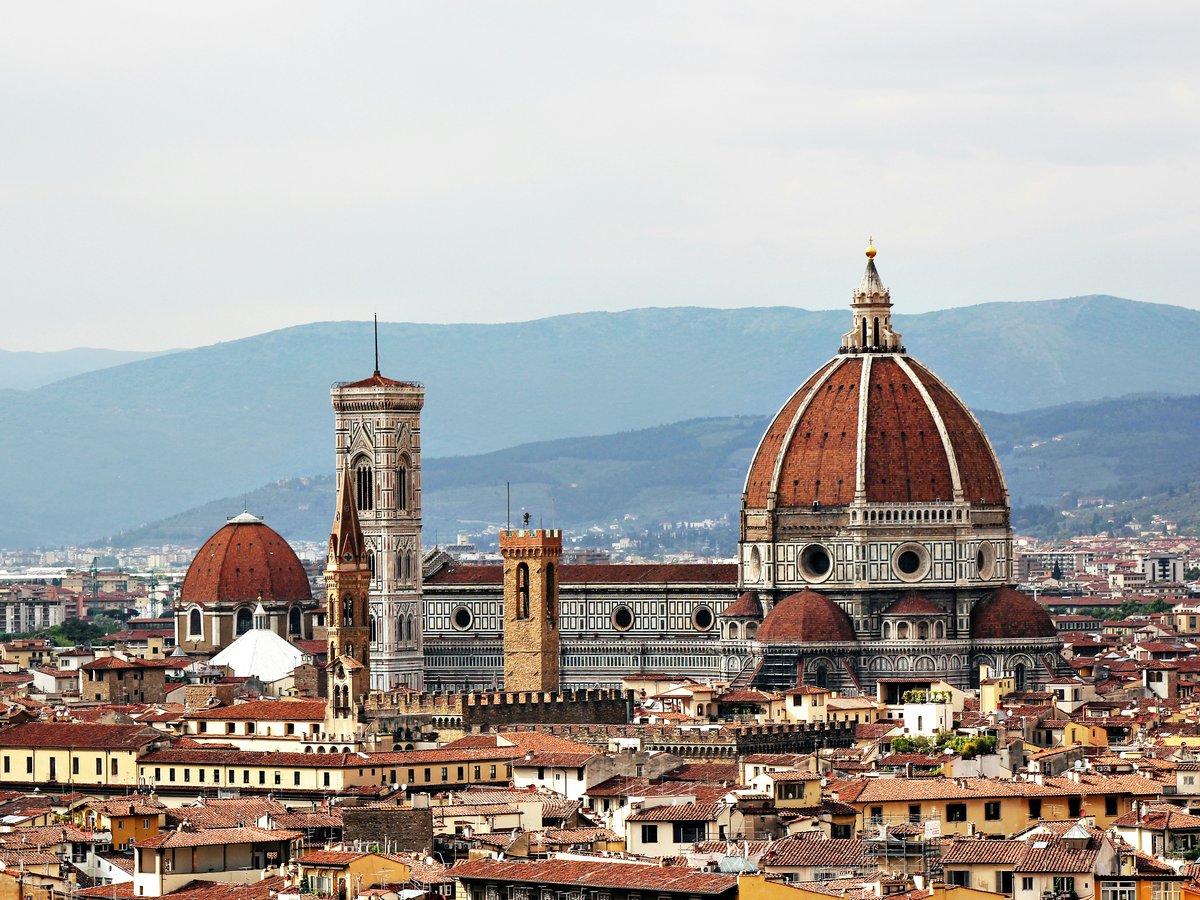
Compare every Italy city in March →
Stay in Florence in March
109 hotels in the Trip.com pool for Florence, from US$23 a night.
Opens Trip.com on Fri 5 Mar to Sun 7 Mar 2027; change the dates there.
March in Florence is a shoulder-season bet that usually pays off. Daytime highs reach about 15.8°C (60°F), mornings still drop to 5°C (41°F), and the city gets roughly 100mm of rain spread across 10 days. Some of those days feel like winter never left. Others, particularly after the 15th, carry a warmth that makes sidewalk espresso at a cafe in Santo Spirito feel like a reasonable idea by noon.
The real argument for March is access. The Uffizi, which pulls 3-hour queues in July, might take 20 minutes. Hotel rates across Oltrarno and Santa Croce sit 30-40% below their June peaks. The Galleria dell'Accademia, where Michelangelo's David stands in a room that fits maybe 200 people comfortably, feels like a museum rather than a crowd-control exercise. You'll share the Ponte Vecchio with Florentines on their lunch break, not tour groups 50-deep.
The trade-off is real, though. The Giardino di Boboli still looks more bare branch than green canopy until the final week. Evening temperatures drop quickly after sunset, and you'll want a warm layer for any walk along the Lungarno after 6pm. Almond trees start blooming along the Arno by mid-month, wisteria shows color on the old walls near San Niccolò by the 20th, and March 25 brings Capodanno Fiorentino, the city's own historical New Year. Florence counted its calendar from the Feast of the Annunciation for centuries. A small ceremony still takes place in Piazza della Santissima Annunziata. Most visitors never hear about it.
Why visit in March
- Museum access without summer crowds. The Uffizi and Accademia see a fraction of their July-August visitors, and timed entry slots are widely available even a few days out.
- Hotel rates run 30-40% below the June-September peak across neighborhoods like Oltrarno, Santa Croce, and San Lorenzo.
- Early spring light sits lower on the Arno than in summer, producing the warm, golden-hour conditions that photographers wait for, especially from Ponte Santa Trinita looking east toward Ponte Vecchio around 5pm.
- Seasonal Tuscan ingredients, particularly carciofi (artichokes) and agretti, start appearing on trattoria menus and at Mercato di Sant'Ambrogio.
- Walking temperatures are comfortable for long days on foot. At 15°C you can cover 15-20km without the heat exhaustion that stops people in July.
Worth knowing
- Rain is likely. With 100mm across 10 days, you'll probably lose at least 2-3 afternoons to showers, and outdoor plans need a backup.
- Morning cold catches people off guard. At 5°C (41°F), the walk from your hotel to a 9am museum opening feels more like November than spring.
- The Giardino di Boboli and Giardino delle Rose are still largely dormant until late in the month. If gardens are a priority, April or May deliver far more.
- Some restaurants in the centro storico operate on reduced winter hours until Easter, with fewer evening seatings and earlier closings.
Best for
Think twice if
March in Florence tends to be changeable. Cool mornings around 5°C (41°F) warm to 15.8°C (60°F) by early afternoon, though overcast days may hold closer to 12°C. Expect about 10 rainy days, usually in short bursts rather than all-day downpours. Humidity sits around 73%, which you'll feel mainly in the morning chill along the Arno. Clear afternoons can feel genuinely pleasant between 11am and 3pm, with real warmth in the sun. Evenings cool quickly after sunset, which falls around 6:15pm on March 1 and shifts past 7:30pm by the 31st after Italy switches to daylight saving time on the last Sunday of the month.
Year-round climate
Averages from the last 5 years.
| Month | Avg high (°C) | Avg low (°C) | Rainfall (mm) |
|---|---|---|---|
| Jan | 11 | 3 | 96 |
| Feb | 13 | 4 | 91 |
| Mar | 16 | 5 | 100 |
| Apr | 19 | 7 | 92 |
| May | 23 | 12 | 104 |
| Jun | 30 | 17 | 45 |
| Jul | 33 | 19 | 34 |
| Aug | 33 | 19 | 60 |
| Sep | 27 | 15 | 136 |
| Oct | 22 | 12 | 115 |
| Nov | 16 | 7 | 133 |
| Dec | 12 | 4 | 119 |
Holidays and festivals in March
Public holidays
- Easter Sunday(Pasqua)28 March 2027
- Easter Monday(Lunedì dell'Angelo)29 March 2027
Best things to do in March
Visit the Uffizi without the crowds
cultureThe Galleria degli Uffizi holds one of the world's deepest collections of Renaissance painting, from Botticelli's Primavera to Caravaggio's Medusa. In March, the rooms feel like an actual gallery rather than a transit corridor. You can stand in front of the Birth of Venus for 5 minutes without someone's selfie stick in your peripheral vision.
Visitor numbers in March run at roughly a third of July-August levels, and timed entry slots are available days out rather than weeks.Booking tipBook tickets on the official Uffizi website 3-4 days ahead. Tuesday and Wednesday mornings before 10am tend to be the quietest.
Climb Brunelleschi's Dome
sightseeingThe 463-step climb inside the Duomo's dome leads through the frescoed interior of Vasari's Last Judgment before emerging onto the outdoor terrace, 91 meters above Piazza del Duomo. The 360-degree view covers the Arno valley, Fiesole's hills to the north, and the Chianti ridgeline to the south.
At 15°C, the climb is physically comfortable. In July, the narrow staircase between the dome's inner and outer shells traps heat above 35°C and people routinely feel faint.Booking tipAdvance booking is required year-round. Slots open 30 days ahead. First slot of the day (8:15am) tends to have the shortest wait at the entrance.
Walk the Oltrarno artisan quarter
cultureThe streets south of the Arno between Ponte Vecchio and Piazza Santo Spirito hold dozens of small workshops. Bookbinders, leather workers, frame gilders, and mosaic restorers still operate in ground-floor botteghe. Via Maggio and Borgo San Frediano are the densest stretches.
Workshop doors are open more often in the mild March weather than in winter, and the artisans have time to talk. By May, tour groups fill the narrow streets and the mood shifts.Booking tipNo booking needed. Go on a weekday morning between 10am and 12:30pm, when most botteghe are open.
Sunset from Piazzale Michelangelo
sightseeingThe terrace above the Arno's south bank gives the classic postcard view of Florence. The Duomo, Palazzo Vecchio, and the Arno bridges line up below. In March, sunset falls between 6:15pm and 7:30pm depending on the week.
The low-angle March light hits the Duomo's marble facade at a steep slant that picks out the pink and green panels. Summer sunsets come from a higher angle and wash out the detail. March also means fewer people on the terrace.Booking tipArrive 30-40 minutes before sunset. The 13 bus from Stazione Santa Maria Novella drops you a 5-minute walk away, or walk up from San Niccolò in about 15 minutes.
Day trip to Chianti wine country
food and drinkThe vine-covered hills between Florence and Siena are about 45 minutes south by car or bus. March is pruning season, and the vineyards have a spare, sculptural look. Tasting rooms in towns like Greve in Chianti and Panzano are quiet, and pourers have time to walk you through a proper vertical.
Tasting rooms that require reservations in summer welcome walk-ins in March. The landscape may be less photogenic than June, but the experience is more personal and less production-line.Booking tipIf you don't have a car, SITA buses run from Florence to Greve in Chianti on weekdays. Weekend service is limited. A small-group wine tour avoids the transport headache.
Cooking class with spring ingredients
food and drinkFlorence has dozens of cooking schools, from market-to-table classes at Mercato Centrale to private kitchen sessions in Oltrarno apartments. March classes typically focus on the winter-to-spring transition. You might make ribollita alongside a spring artichoke dish in the same session.
Class sizes are smaller in March, often 4-6 people versus 12-15 in summer. Seasonal ingredients are at a turning point that makes the menu more interesting than a mid-summer class.Booking tipBook at least a week ahead. Weekend classes fill faster than weekdays.
Explore Palazzo Pitti and the Palatina Gallery
cultureThe Medici's main residence on the south bank of the Arno houses the Galleria Palatina, with Raphael's La Velata and Titian's La Bella hung salon-style on damask walls. The royal apartments on the floor above give a sense of the scale these families operated at. The building alone is worth the visit.
March visitor numbers are low enough that you can study the paintings rather than glimpse them over shoulders. The combined ticket with the Boboli Gardens makes sense even though the gardens are still waking up.Booking tipA combined Palazzo Pitti ticket covers the Palatina, Modern Art Gallery, Costume Gallery, and Boboli Gardens. Buy online to skip the ticket line.
Morning walk to San Miniato al Monte
sightseeingThe Romanesque basilica sits on the hill above Piazzale Michelangelo, surrounded by a monumental cemetery with views across the entire Arno valley. The marble facade dates to 1090, and the interior's geometric patterns in green and white marble are among the finest in Tuscany. The Benedictine monks sell honey, herbal tinctures, and liqueurs in a small shop by the entrance.
The walk up from San Niccolò through the old city gate is pleasant at March temperatures. In summer, the steep climb in 33°C heat discourages all but the determined. March mornings at the basilica are almost empty.Booking tipNo booking needed. The basilica opens at 9:30am. The monks' shop keeps irregular hours but is usually open by 10am.
What to eat in March
On menus now
Ribollita
The last good month for this bread-thickened Tuscan bean and kale soup. By April, kitchens start shifting to lighter fare. March ribollita at a trattoria in Oltrarno, served in a terracotta bowl with a generous pour of new-season olive oil, is the kind of meal that makes cold-weather Florence worth it.
In markets
Carciofi (artichokes)
Tuscan artichoke season peaks in March. Look for carciofi fritti (fried) or carciofi ripieni (stuffed) on trattoria menus across Santa Croce and Oltrarno. The Romanesco variety, with its purple-tipped leaves, appears at Mercato di Sant'Ambrogio.
Agretti (monk's beard)
This thin, grassy green has a fleeting season from mid-March through April. Restaurants in Santo Spirito serve it sauteed with garlic and lemon alongside grilled fish. It tastes faintly of the sea.
Pecorino fresco
Fresh spring-milk pecorino from sheep that have been grazing on new Tuscan grass starts appearing at cheese stalls in Mercato Centrale by mid-March. The flavor is milder and creamier than the aged versions.
Festival food
Frittelle di riso di San Giuseppe
Traditional Tuscan rice fritters made for the Festa di San Giuseppe on March 19. They are fried, dusted with powdered sugar, and scented with orange zest. Bakeries across San Lorenzo and the centro storico stock them for about two weeks around the date.
Schiacciata alla Fiorentina
A flat, orange-scented cake dusted with powdered sugar in the shape of the Florentine lily. Traditionally a Carnival sweet, it appears in bakeries (forni) from February into March. The texture sits somewhere between cake and focaccia.
Regular events in March
Capodanno FiorentinoFree
Florence's historical New Year, celebrated on March 25, the Feast of the Annunciation. The city used this date as the start of its calendar year for centuries. A civic ceremony takes place in Piazza della Santissima Annunziata, with a small procession in historical costume. It's a distinctly local event.
March 25Festa della DonnaFree
International Women's Day on March 8. Men give women sprigs of mimosa across Italy. Restaurants and bars in neighborhoods like Santo Spirito and Santa Croce run special menus and events. Some museums offer free entry for women on this day.
March 8Taste
An annual food and wine fair organized by Pitti Immagine, held at the Stazione Leopolda in the San Frediano area. It brings together Italian artisan food producers, winemakers, and chefs for tastings and workshops. Dates shift between late February and mid-March depending on the year.
Late February to mid-March (varies by year)Festa di San GiuseppeFree
The feast of St. Joseph on March 19, also Father's Day in Italy. Bakeries across Florence stock frittelle di riso (rice fritters) for the occasion. It's not a public holiday but the food tradition is strong.
March 19Best places this March
Mercato di Sant'Ambrogio
marketA covered daily market in the Santa Croce neighborhood that serves locals rather than tourists. The produce stalls carry early spring greens like agretti and artichokes in March. A small lunch counter inside serves tripe sandwiches and plates of pasta for under 10 euros. The atmosphere is working-class Florence, not curated.
Santa CrocePiazzale Michelangelo
viewpointThe panoramic terrace above San Niccolò with the full-skyline view of Florence. In March, the low sun creates dramatic light on the Duomo's marble. Fewer visitors than summer means you can find a spot on the wall to sit without competition. The walk up from Porta San Niccolò takes about 15 minutes and passes through olive groves.
San NiccolòGiardino delle Rose
parkA terraced rose garden on the hillside below Piazzale Michelangelo. The roses are not yet blooming in March, but the garden opens for the season and the bronze sculptures by Jean-Michel Folon are worth the visit. The views of Florence from the terraces rival the piazzale above, with fewer people. Free entry.
San NiccolòBasilica di San Miniato al Monte
churchA Romanesque church from 1018 perched above the Arno valley. The geometric marble facade catches morning light beautifully in March. Inside, the crypt and the Chapel of the Cardinal of Portugal are standouts. The Benedictine monks' shop sells products made on site.
San NiccolòPiazza Santo Spirito
piazzaThe main square of the Oltrarno neighborhood, anchored by Brunelleschi's Basilica di Santo Spirito. In March, the daily morning market sells produce, clothing, and household goods. The piazza's cafes and bars are where Florentines do their evening aperitivo, away from the tourist center across the river.
OltrarnoMercato Centrale (San Lorenzo)
marketThe 19th-century iron-and-glass market building in the San Lorenzo neighborhood. The ground floor sells meat, cheese, produce, and bread from local vendors. March brings early artichokes and fresh pecorino. The upper floor houses a food hall with prepared dishes, though it skews more tourist-oriented.
San LorenzoOfficina Profumo-Farmaceutica di Santa Maria Novella
historic siteA 13th-century pharmacy near the train station, still operating as a perfumery and herbalist. The frescoed rooms smell of rose water, iris root, and camphor. On a rainy March afternoon, this is one of the most atmospheric indoor experiences in Florence. The iris-based scents are particularly Florentine.
Santa Maria NovellaPalazzo Strozzi
museumA 15th-century Renaissance palace that now hosts major temporary art exhibitions. March typically falls within the run of one of their headline shows. The courtyard is free to enter, and the building itself is worth seeing for the rusticated stone facade. Check their exhibition schedule before visiting.
Centro Storico
Your packing checklist
Tick items off as you pack. Your progress saves in this browser.
All packed — have a great trip.
Insider tips
Mercato di Sant'Ambrogio in Santa Croce sells the same produce as Mercato Centrale at lower prices, with almost no tourist traffic. The porchetta sandwich at the lunch counter inside is one of the best cheap meals in the city.
The afternoon light on the Arno from Ponte Santa Trinita, looking east toward Ponte Vecchio, peaks around 4:30-5pm in March. Photographers line up on the bridge in summer, but in March you might have it to yourself.
Piazza Santo Spirito's aperitivo bars are where Florentines drink in the evening. Prices run 5-7 euros for a spritz with snacks. Across the river in the centro storico, the same drink costs 9-12 euros near Piazza della Signoria.
The Capodanno Fiorentino ceremony on March 25 in Piazza della Santissima Annunziata is a genuinely local event. If you happen to be in town, the small historical procession and the ceremony at the Basilica della Santissima Annunziata are worth 30 minutes. No crowds, no entry fee, no tourist infrastructure around it.
For a quiet morning away from museums, walk from Porta San Miniato up through the hillside to San Miniato al Monte before 10am. The city noise fades within 5 minutes of the gate, and the monks' honey from the basilica shop makes a good portable souvenir.
Avoid these mistakes
- Packing for spring weather and leaving the warm layers at home. At 5°C in the morning, the walk from your hotel to a 9am Uffizi slot feels like November. People in shorts and sandals on early March mornings in Florence are easy to spot, and easy to pity.
- Assuming March is quiet enough to skip advance tickets at the Uffizi and Accademia. Visitor numbers are lower than summer, but timed entry still sells out, especially for weekend morning slots. Showing up without a booking means either a long wait or missing the museum entirely.
- Planning a full day outdoors without a rain contingency. With 10 rainy days in March, the odds of a completely dry week are low. Have a museum, church, or covered market ready as a backup for every outdoor plan.
- Wearing smooth-soled leather shoes on Florence's stone streets. The pietra serena paving in the centro storico turns into a skating rink when wet. This is the number one preventable injury for tourists in the rainy months.
Practical tips for March
Book Uffizi and Accademia tickets online at least 3-4 days ahead, even in March, since timed entry slots still fill for weekend mornings. Several major museums have weekly closure days that shift seasonally, so check schedules before mapping your route. Most trattorias in the centro storico close between lunch and dinner, typically from 3pm to 7pm, and this catches visitors who try to eat at 4pm. Daylight saving time starts on the last Sunday of March, pushing sunset past 7:30pm and giving you a bonus hour of evening light for the final days of your trip. Dress in layers rather than one heavy coat. Mornings along the Arno run 5-8 degrees cooler than sunny piazzas by midday. If you are planning day trips to Siena or the Chianti towns, weekday bus schedules from the SITA terminal behind Santa Maria Novella station run more frequently than weekends.
FAQ
Is March a good time to visit Florence?
March is a solid shoulder-season choice. You get shorter museum queues at the Uffizi and Accademia, hotel rates 30-40% below summer, and walking temperatures around 15°C (60°F) that let you cover serious ground on foot. The trade-off is about 10 rainy days and mornings that still feel cold at 5°C (41°F). If your priority is art and food over gardens and outdoor dining, March delivers good value. It ranks around 6th out of 12 months overall, behind May, September, October, April, and June, but well ahead of the hot, packed summer months.
What is the weather like in Florence in March?
Expect highs around 15.8°C (60°F) and lows near 5°C (41°F). March averages 100mm of rainfall across about 10 days, with humidity around 73%. The rain typically comes in short bursts rather than all-day events. The first half of the month tends to feel more like late winter, while the second half starts to hint at spring, particularly on sunny afternoons. Bring layers and a rain jacket.
Is Florence crowded in March?
No. March is low season by Florence standards. The summer crush, which peaks from June through September, has not started. You will still encounter visitors at the Uffizi and around the Duomo, but the density is a fraction of July. Weekend foot traffic picks up somewhat, and spring break weeks (which vary by country) can bring short spikes, but overall March offers a much calmer experience. Restaurants that need reservations in summer are typically walk-in in March.
Do I need to book museum tickets in advance for March?
Yes, for the Uffizi and Galleria dell'Accademia. Even in low season, timed entry slots for weekend mornings sell out. Booking 3-5 days ahead online is usually sufficient. Palazzo Pitti and the Bargello rarely require advance booking in March. For the Duomo dome climb, advance reservation is mandatory year-round and slots open 30 days ahead.
What should I eat in Florence in March?
March is the transition from winter to spring cooking in Tuscany. Ribollita, the bread-thickened bean and kale soup, is still on most menus and at its best in the last cool weeks. Artichokes (carciofi) appear in late February and peak through March, served fried, stuffed, or braised. Agretti, a grassy spring green, has a brief season starting mid-March. Around March 19 (Festa di San Giuseppe), bakeries sell frittelle di riso, fried rice fritters dusted with powdered sugar. Fresh spring-milk pecorino starts showing up at cheese stalls in Mercato Centrale and Mercato di Sant'Ambrogio by mid-month.
Things to Do in Florence in March
 Free cancellation
 Tuscany Day Trip from Florence: Siena, San Gimignano, Pisa and Lunch at a Winery
Day trip: 12 hours, free cancellation.
via Viator Free cancellation
 Pasta Cooking Class with Unlimited Wine in Florence
Cooking class: 2.5 hours, free cancellation.
via Viator Free cancellation
 Cinque Terre Day Trip with Optional Hiking or Pisa from Florence
Outdoor experience: 13 hours, free cancellation.
via Viator Free cancellation
 Small-Group Wine Tasting Experience in the Tuscan Countryside
Cooking class: 4.8 hours, free cancellation.
via Viator Free cancellation
 Florence Pizza or Pasta Class with Gelato & Wine at a Tuscan Farm
Cooking class: 5 hours, free cancellation.
via Viator Free cancellation
 Pisa, Siena, San Gimignano with Lunch & Wine Tasting at a Winery
Day trip: 12 hours, free cancellation.
via ViatorFind a flight to Florence
Live fares to Florence appear here once cookies are accepted.
Last verified by automated review (v1.7.2) on . What is automated review?