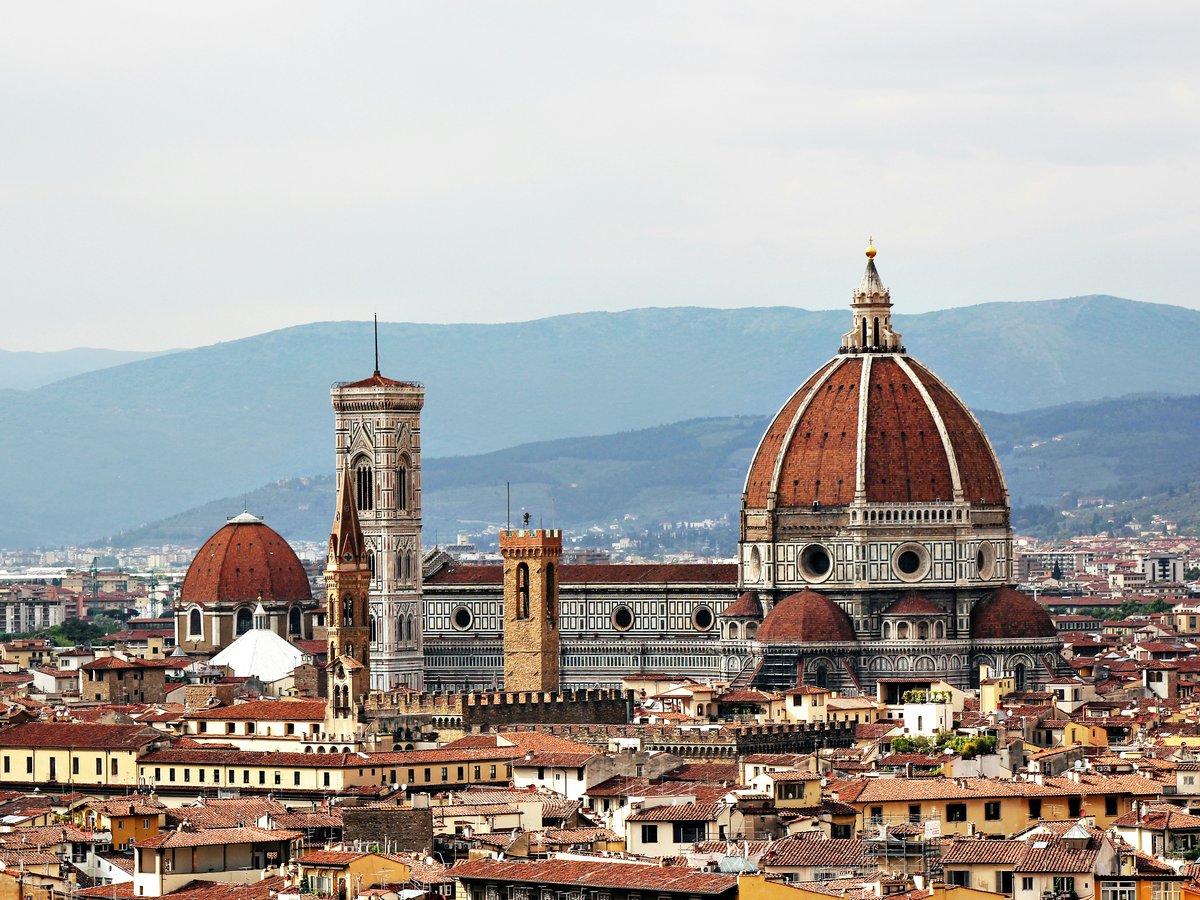
What's the must-see thing in Florence?
Climb Brunelleschi's dome at Florence Cathedral, and book it before anything else in the city. Entry runs on timed slots that tend to sell out days ahead, so you cannot improvise this one. Once you have your slot, build the Uffizi Gallery and the Bargello National Museum around it. The cathedral floor below is free and needs no ticket.
The dome of Florence Cathedral, not the Uffizi. The Uffizi is the correct second answer, but great paintings can be seen in Paris or Madrid, and nowhere else lets you walk inside the double shell of a brick dome that Filippo Brunelleschi raised without wooden centering. The climb is 463 steps. There is no lift, the stairwell stone stays cold to the touch even in July, and the passages narrow to shoulder width near the top. Partway up you step onto a gallery an arm's length from Giorgio Vasari's Last Judgment fresco, close enough to see the brush marks on the devils. Then the lantern, the wind, and the terracotta roofs of Florence running out to the Fiesole hills. Skip it if you are claustrophobic or have bad knees. Giotto's bell tower next door has 414 steps, wider landings, and the better photograph, since the dome is in it.
The dome is sold only through the Brunelleschi Pass, currently about €30, which at the 13 October 2026 rate of 0.8938 euros to the dollar is roughly $34. You pick the dome slot when you buy the Brunelleschi Pass, and it likely cannot be changed afterwards. The pass stays valid for three days and also covers the bell tower, the Florence Baptistery and the Opera del Duomo Museum, so spread those out. Don't book the climb for your arrival day, because jet lag and a spiral staircase make a poor pair, and the first slot on day two, at around 8.15am, tends to be the quietest. The queue on Piazza del Duomo for the free cathedral floor can run 45 minutes, for an interior that is plainer than the green and white marble outside suggests. Shoulders and knees must be covered at the cathedral door.
The Uffizi Gallery comes second, and what it needs from you is a plan, not stamina. Tickets currently run around €25 in high season, the gallery is closed on Mondays, and booking a timed entry slot could save you an hour on the pavement under the Vasari loggia. Head straight to the second floor for the Botticelli rooms, where Birth of Venus and Primavera hang a few steps apart, then find Leonardo's Annunciation. Ninety minutes is enough for a first visit. By 11am the Botticelli rooms sound like a station concourse, with guides murmuring into headsets in six languages, so book the opening slot or one after 4pm. If Viator shows the morning sold out, check GetYourGuide before giving up: the two resellers often hold separate allocations.
Third is the Bargello National Museum on Via del Proconsolo, and this is where we part with most lists. The Galleria dell'Accademia has Michelangelo's David, 5.17 metres of marble, and it is worth seeing if you can get a slot. That said, the Accademia is one statue and a long queue on Via Ricasoli. The Bargello holds Donatello's bronze David, early Michelangelo and a stone courtyard that was once the city's jail yard, for around €10 and often with no line at all. It tends to close in the early afternoon on many days, so go in the morning. A full-size copy of Michelangelo's David stands free outside Palazzo Vecchio on Piazza della Signoria. Tuesday 13 October was clear and 18.7°C at 7pm, and on an evening like that the square is the place to eat a schiacciata from All'Antico Vinaio on Via dei Neri, warm and salty with olive oil, while the campanile bells carry over the rooftops. Ponte Vecchio is a five-minute walk west from there.
The top three
Brunelleschi's Dome, Florence Cathedral
The one top sight in Florence that punishes a lack of planning. You climb between the two brick shells, pass Vasari's fresco at arm's length and come out above the whole Arno valley. Entry by timed slot, so this booking sets the shape of your trip.
Uffizi Gallery
Botticelli and Leonardo in one corridor of the Medici's old offices beside the Arno. Second because it rewards a short, targeted visit to one floor and turns into a slog if you try to see every room. Go at opening or late afternoon.
Bargello National Museum
Florence's sculpture collection in a former jail on Via del Proconsolo, with Donatello's David and a fraction of the Accademia's crowd. The trade-off is that you see Michelangelo's David as the outdoor copy on Piazza della Signoria.
Reservations required for at least one of these.
Verified attractions
Sourced from Wikidata and OpenStreetMap: each entry links to its authoritative page.
-
Uffizi Gallery
museumpalace and art museum in Florence, Italy
View on Wikidata -
Florence Cathedral
museum13th-century cathedral in Florence, Italy
View on Wikidata -
Palazzo Pitti
museumRenaissance palace and museum in Florence, Italy
View on Wikidata -
Ponte Vecchio
attractionbridge in Florence, Italy
View on Wikidata -
Palazzo Vecchio
museumpalace in Florence, Italy
View on Wikidata -
Basilica of Santa Croce
museumFranciscan church in Florence, Italy
View on Wikidata -
Stadio Artemio Franchi
stadiumfootball stadium in Florence, Italy
View on Wikidata -
Bargello National Museum
museumart museum in Florence, Italy
View on Wikidata -
Florence Baptistery
churchbaptistery in Florence, Italy
View on Wikidata -
Basilica of Santa Maria Novella
museumchurch in Florence, Italy
View on Wikidata -
Basilica of San Lorenzo
museumchurch in Florence, Italy
View on Wikidata -
piazza della Signoria
plazasquare in Florence, Italy
View on Wikidata -
Boboli Gardens
museumpark in Florence, Italy
View on Wikidata -
Palazzo Strozzi
palacepalace in Florence
View on Wikidata -
Galleria dell'Accademia
museumart museum in Florence, Italy
View on Wikidata -
Palazzo Medici Riccardi
museumpalace and museum in Florence, Italy
View on Wikidata -
Orsanmichele
churchchurch and municipal building in Florence, Italy
View on Wikidata -
San Miniato al Monte
churchbasilica in Florence, Italy
View on Wikidata -
Vasari Corridor
museumelevated enclosed passageway in Florence, Italy
View on Wikidata -
Giotto's Campanile
towerbell tower by Giotto
View on Wikidata -
Pazzi Chapel
churchchapel at Santa Croce, Florence
View on Wikidata -
Stadio Carlo Castellani
stadiumMulti-purpose stadium in Empoli, Italy
View on Wikidata -
Palazzo Rucellai
palacepalazzo
View on Wikidata -
Santa Maria del Carmine
churchchurch in Florence, Italy
View on Wikidata -
Santissima Annunziata
churchRoman Catholic minor basilica in Florence, Italy
View on Wikidata -
Brancacci Chapel
museumchapel in the Church of Santa Maria del Carmine in Florence, Italy
View on Wikidata -
National Archaeological Museum
museumarchaeological museum of Florence, Italy
View on Wikidata -
Basilica of the Holy Trinity
churchchurch in Florence, Italy
View on Wikidata -
Medici Chapels
museumstructures at the Basilica of San Lorenzo, Florence, Italy
View on Wikidata -
Museo dell'Opera del Duomo
museumart museum in Florence, Italy
View on Wikidata -
Casa Buonarroti
museummuseum in Italy
View on Wikidata -
Museo Galileo
museumItalian museum for the history of science
View on Wikidata -
Villa Castello
historic houseMedici Villa in the hills near Florence, Tuscany
View on Wikidata -
Ognissanti Church
museumchurch in Florence
View on Wikidata -
piazzale Michelangelo
plazasquare in Florence, Italy
View on Wikidata -
Prato Cathedral
churchcathedral in Prato, Italy
View on Wikidata -
Tomb of Antipope John XXIII
monumenttomb monument of Baldassare Cossa created by Donatello and Michelozzo in the Baptistery, Florence, Italy
View on Wikidata -
Villa Medici at Careggi
museumbuilding in Careggi, Italy
View on Wikidata -
Fountain of Neptune
monumentfountain in Florence
View on Wikidata -
Great Synagogue of Florence
place of worshipsynagogue
View on Wikidata
Last verified by automated review (v1.7.2) on . What is automated review?