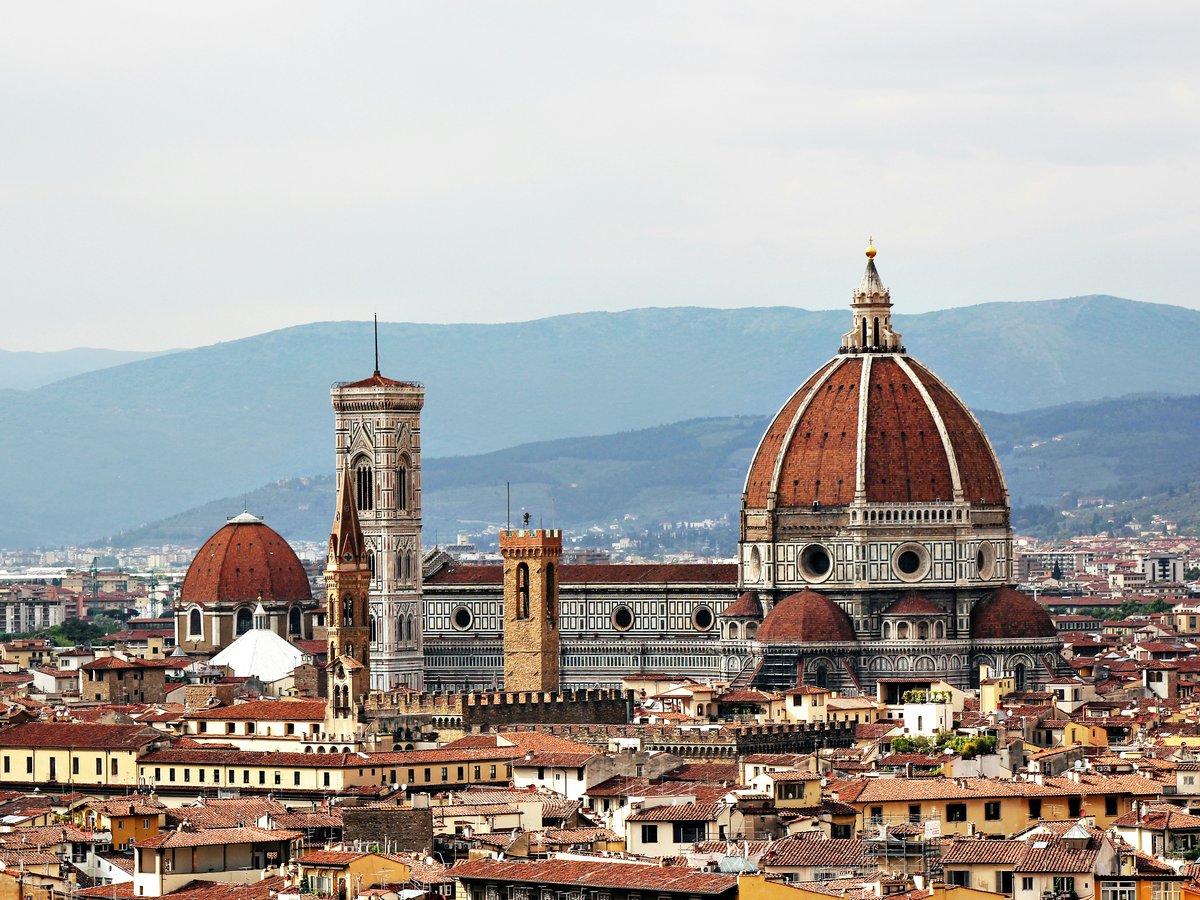
What should I pack for Florence?
Covered shoulders and knees for Florence's churches, broken-in walking shoes for its pietra serena cobblestones, and a Type C or L plug adapter for Italy's 230V outlets. Summer visitors need sun protection for 33-38°C days with little shade in Piazza della Signoria. Skip packing umbrellas and toiletries. Buy them at any farmacia for less.
Shop the packing list (16 items)Florence's major churches enforce a strict dress code. The Duomo (Cathedral of Santa Maria del Fiore, founded 1296), the Basilica of Santa Croce (1294), and Santa Maria Novella (1278) all turn away visitors with bare shoulders or shorts above the knee. Guards at the Duomo entrance check before you enter. Pack a lightweight scarf or shawl that fits in a day bag. Women and men both get refused. The paper disposable covers sold by street vendors near Piazza del Duomo cost 5 EUR and feel like wearing a trash bag in 35°C heat. One long cotton skirt or a pair of linen pants solves the problem for a full trip. To be fair, some smaller churches in Oltrarno are more relaxed, but the 4 major basilicas are not.
The single most important item in your suitcase is footwear. Florence's centro storico is paved almost entirely in pietra serena sandstone, and the irregular flagstones are slippery when wet and uneven when dry. The walk from the Ponte Vecchio (1335) up to Piazzale Michelangelo is a 2.5 km climb with steep stone steps. Fashion sneakers with flat soles won't cut it. Bring shoes with real tread and ankle support that you've already broken in. Blisters on day 1 will follow you through every room of the Uffizi (founded 1560), where you'll likely spend 3-4 hours on marble floors. Sandals are fine for a dinner in San Frediano, but they're a liability on the steps of Fiesole's Roman amphitheatre.
Florence sits in a river valley, and the Arno traps heat in summer and cold damp air in winter. Right now in late June, temperatures are reaching 34-35°C with humidity around 35%, which feels dry compared to Southeast Asian cities but the direct sun on stone streets radiates heat back at you from below. Pack moisture-wicking shirts, a hat with a brim, and SPF 50 sunscreen. From November through February, expect 3-10°C mornings with a penetrating chill. The fog off the Arno at dawn near the Ponte alle Grazie has a cold wetness that cuts through thin jackets. Winter visitors need a proper wool layer and a water-resistant shell. Spring and autumn, roughly March through May and September through October, might bring afternoon rain 30-40% of days. A packable rain jacket weighs less than an umbrella and keeps your hands free for the steep climb up to San Miniato al Monte.
Italy runs on 230V with Type C and Type L outlets. If you're coming from North America, you need a plug adapter. Leave 110V appliances at home unless they have a dual-voltage switch (check the label, most phone chargers already handle 100-240V). Bring a portable battery pack. Google Maps navigation through the narrow streets of Santa Croce and Oltrarno drains a phone by mid-afternoon, and there are few public charging spots. Skip packing large bottles of sunscreen, shampoo, or insect repellent. Florence has a farmacia every 3-4 blocks, and Italian pharmacy brands like Bionike SPF 50 run about 12 EUR for 200ml. Mosquito coils and plug-in repellent from a Conad or Esselunga supermarket cost 4-6 EUR. Umbrellas at any tabaccaio are 8-10 EUR when you need one. The Officina Profumo-Farmaceutica di Santa Maria Novella on Via della Scala has been selling toiletries since 1612, if you want the upscale version.
Essentials
- Lightweight scarf or shawl for church dress codes (the Duomo, Santa Croce, and Santa Maria Novella all enforce covered shoulders) Shop
- Knee-covering pants or skirt in linen or cotton (required at all 4 major basilicas, and the 5 EUR vendor covers feel awful in summer heat) Shop
- Broken-in walking shoes with real tread for pietra serena cobblestones and the 2.5 km climb to Piazzale Michelangelo Shop
- Type C or Type L plug adapter for Italy's 230V outlets (North American 110V hair tools won't work even with an adapter) Shop
- Portable battery pack (Google Maps navigation through Santa Croce and Oltrarno drains a phone by mid-afternoon) Shop
- 3-4 moisture-wicking shirts (cotton gets heavy fast at 34°C on stone streets that radiate heat from below) Shop
- Packable rain jacket (weighs less than an umbrella and keeps hands free on steep stone stairways) Shop
- Reusable water bottle (Florence has free public drinking fountains, the nasoni, throughout the centro storico) Shop
- SPF 50 sunscreen for summer visits, or plan to buy Bionike at a local farmacia for about 12 EUR Shop
- Hat with a brim for June through September (little shade in Piazza della Signoria or the Boboli Gardens) Shop
Seasonal extras
- Summer (June-September): UV-blocking sunglasses for the glare off white stone piazzas Shop
- Summer: linen shorts for non-church hours around San Frediano and Santo Spirito Shop
- Winter (November-February): wool mid-layer for 3-10°C mornings and Arno valley fog Shop
- Winter: water-resistant shell jacket for rain that settles into the river valley Shop
- Winter: warm scarf and gloves for December-January evenings (5°C or below after dark) Shop
- Spring and Autumn (March-May, September-October): light cardigan for 12-16°C evening temperatures along the Lungarno Shop
Buy on arrival
- Sunscreen at any farmacia (Bionike SPF 50, about 12 EUR for 200ml, less than US drugstore prices)
- Umbrellas at any tabaccaio (8-10 EUR, sold everywhere when rain starts)
- Mosquito plug-in repellent at Conad or Esselunga supermarket (4-6 EUR, works better than US brands for Italian mosquitoes)
- Italian pharmacy toiletries (better formulations than most US equivalents at similar or lower prices, the one exception being deodorant)
- Leather belt or wallet at San Lorenzo Market (negotiate from 50% of asking price, quality varies wildly between stalls)
Last verified by automated review (v1.7.2) on . What is automated review?