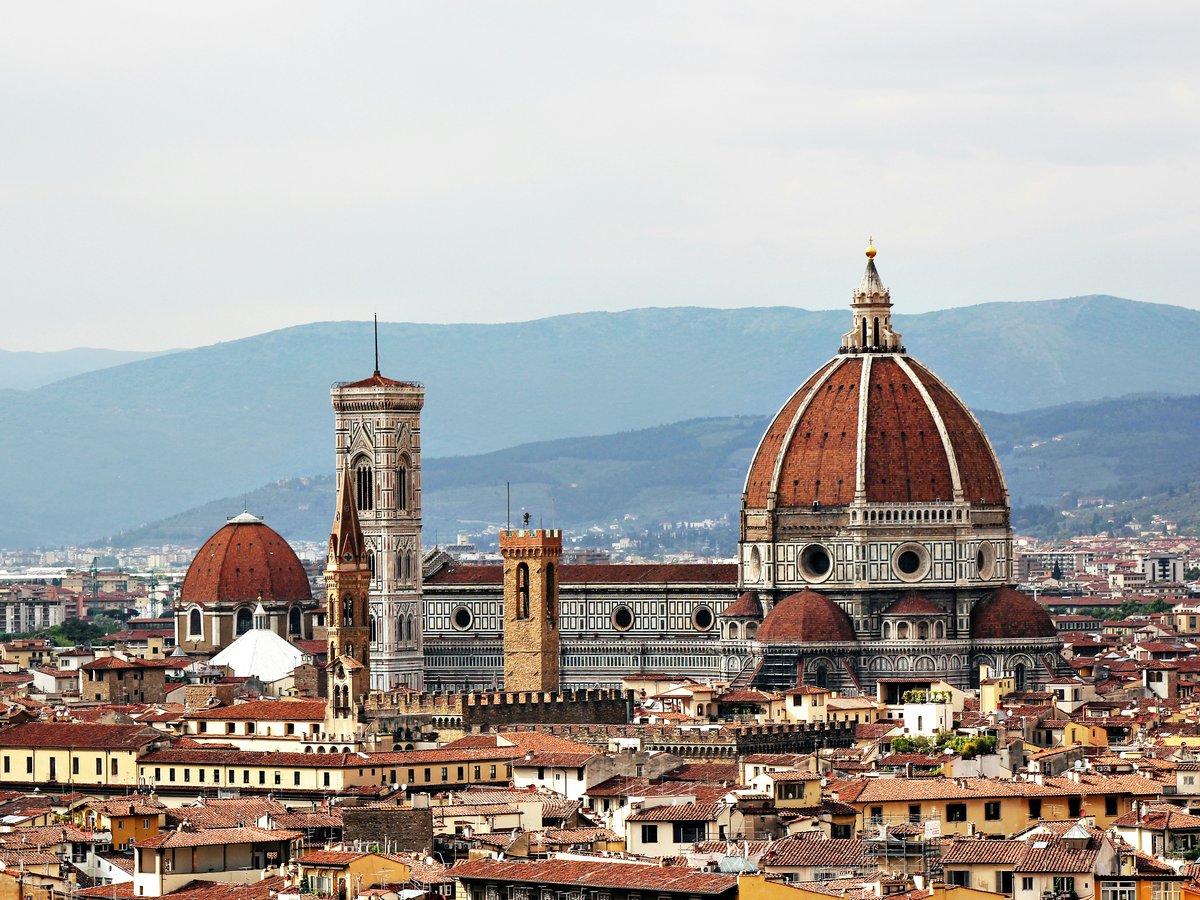
Florence built half its identity outdoors and on church walls. The Arno cuts through a city where 15th-century frescoes sit in churches that still don't charge, where a hillside rose garden opens every morning at 9, and where an open-air sculpture gallery on Piazza della Signoria has operated for over 500 years without a ticket booth. The concentration of free art per square kilometre here likely exceeds anywhere else in Europe. You might spend 4 full days walking neighborhoods like the Oltrarno and San Niccolò, visiting cenacoli and free churches, climbing to viewpoints, and browsing morning markets without once reaching for your wallet. That said, the big-ticket museums (Uffizi, Accademia, Palazzo Pitti) do cost between 16 and 25 euros on normal days. But the Italian state still runs its Domenica al Museo programme, opening those collections free on the first Sunday of each month. Mind you, that means queues from 7am. The rest of the month, Florence still delivers more free cultural content than most cities offer behind a paywall.
Free attractions
-
Cattedrale di Santa Maria del Fiore
The Duomo itself. Entry to the cathedral nave is free, every day. Brunelleschi's dome, the Campanile, and Battistero di San Giovanni require a combined ticket (currently around 30 euros), but the interior of the cathedral, with its 3,600-square-metre Vasari and Zuccari fresco ceiling, costs nothing. The cool marble interior drops the temperature noticeably on summer afternoons. You'll find the 44-metre-high nave surprisingly quiet if you arrive before 9:30am.
Centro Storicochurch -
Loggia dei Lanzi
An open-air sculpture gallery on Piazza della Signoria, accessible 24 hours, no barrier, no ticket. Giambologna's Rape of the Sabine Women (1583) and Cellini's bronze Perseus (1554) stand under the three wide arches. The stone bench along the back wall tends to fill with locals reading newspapers by mid-morning. The scale of these pieces hits differently at night when the floodlights catch the marble grain.
Centro Storicooutdoor sculpture -
Basilica di San Miniato al Monte
A Romanesque church from 1018, still free to enter, perched 100 metres above the Arno on the south hillside. The geometrical green-and-white marble facade looks almost impossibly crisp for its age. Inside, the raised presbytery, the 13th-century mosaic of Christ in the apse, and the Cappella del Crocifisso by Michelozzo are all visible without charge. The Benedictine monks still chant Vespers here at 17:30 in winter and 18:00 in summer. Worth noting, the graveyard behind the church holds Carlo Collodi's tomb.
San Niccolòchurch and viewpoint -
Piazzale Michelangelo
The terrace sits about 85 metres above the Arno, reached by a 20-minute uphill walk from Ponte alle Grazie or via the stone steps from San Niccolò gate. The panoramic view sweeps from Fiesole's hillside across the Duomo, Palazzo Vecchio's tower, and the Ponte Vecchio. No ticket, no hours, open around the clock. The bronze David replica in the centre was placed here in 1873. Sunset pulls crowds from roughly 19:00 in summer, but the dawn light on the terracotta rooftops, when perhaps 3 other people are there, tends to be the better experience.
San Niccolòviewpoint -
Cenacolo di Sant'Apollonia
Andrea del Castagno painted his Last Supper here around 1447. The single-room museum on Via XXVII Aprile holds one of Florence's earliest monumental cenacoli. Free entry, currently open Tuesday through Saturday, 8:15 to 13:50. The fresco fills the entire end wall of what was the refectory of the Benedictine convent. The violent energy in Castagno's Judas figure, isolated on the near side of the table, still startles.
San Marcofree museum -
Cenacolo di Ognissanti
Domenico Ghirlandaio's 1480 Last Supper, free to visit in the refectory of the Chiesa di Ognissanti on Borgo Ognissanti. The soft light through the single window on the left wall is the same angle Ghirlandaio painted into the fresco itself. Open Monday and Saturday mornings, roughly 9:00 to 12:00. The detail on the tablecloth, the cherries, the individually rendered glass carafes, rewards close attention.
Santa Maria Novellafree museum -
Chiesa di Orsanmichele
A former grain market converted to a church in the 14th century. The exterior niches hold bronze and marble saints by Donatello, Ghiberti, and Verrocchio (several are now copies, with originals in the upstairs museum that opens free on select days). The interior houses Orcagna's enormous Gothic tabernacle (1359), gilded and inlaid, which alone would anchor a paid museum anywhere else. Free entry daily from 10:00 to 17:00.
Centro Storicochurch and sculpture -
Giardino delle Rose
A terraced rose garden below Piazzale Michelangelo, open daily from 9:00, free year-round. The 1,000-odd rose varieties peak in May and June. Twelve bronze sculptures by Jean-Michel Folon were installed permanently in 2011, scattered among the bushes and gravel paths. The lower terrace has a direct sightline to the Duomo across the river. In early morning the scent of old-garden roses mixes with damp stone from the retaining walls.
San Niccolòpark -
Parco delle Cascine
Florence's largest public park, 3.3 kilometres long, running west along the Arno's north bank from Ponte alla Vittoria. Originally a Medici dairy farm (cascina means farmstead). The Tuesday morning market fills the eastern end. Runners, cyclists, and the rowing club populate it daily. The amphitheatre sometimes hosts free summer concerts. The old Pavoniere pool building marks roughly the halfway point.
Cascinepark -
Giardino dell'Iris
A specialist iris garden on the slope below Piazzale Michelangelo, open free during bloom season, typically late April through late May. Florence's symbol is the iris (the giglio on the city crest is a stylised iris, not a lily). Around 1,500 varieties grow here. The garden runs an annual international competition for new cultivars. Opens 10:00 to 12:30 and 15:00 to 19:00 during season.
San Niccolòpark -
Galleria degli Uffizi (first Sunday)
The state collection opens free on the first Sunday of each month under the Domenica al Museo national programme. The Uffizi holds Botticelli's Birth of Venus (1485), Caravaggio's Medusa, and rooms of Raphael, Titian, and Leonardo. Queues on free Sundays can reach 2 to 3 hours. Arriving by 7:45am, before the 8:15 opening, cuts that significantly. This policy has been in place since 2014 but could change with ministerial decisions, so confirm before travelling.
Centro Storicofree-on-first-sunday museum -
Galleria dell'Accademia (first Sunday)
Also free on the first Sunday of the month. Michelangelo's David (1504), at 5.17 metres tall, dominates the tribune hall. The unfinished Prisoners series lines the approach corridor. The same early-arrival strategy applies. The museum is on Via Ricasoli, a 7-minute walk north of the Duomo.
San Marcofree-on-first-sunday museum
Free activities
-
Oltrarno artisan workshop walk
Via Maggio, Via Santo Spirito, Borgo San Frediano, and Sdrucciolo de' Pitti still hold working botteghe. Bookbinders, gilders, marble-paper makers, and furniture restorers leave their doors open. The smell of hide glue and linseed oil drifts into the street. Most are happy to let you watch for a few minutes, particularly before 11:00 when tourist density is still low. The Oltrarno Artigiano map (free at the Santo Spirito pharmacy) marks about 40 workshops.
Oltrarnowalking route -
Ponte Vecchio and Lungarno walk
The 1345 bridge costs nothing to cross. The goldsmith shops in their cantilevered wooden boxes overhang the Arno on both sides. Walking the full Lungarno from Ponte San Niccolò west to Ponte alla Vittoria covers about 4.5 kilometres along the river. The stone parapets stay warm into the evening from absorbed sun. The stretch between Ponte Santa Trinita and Ponte alla Carraia, on the south bank, tends to be quieter and gives better views north to the historic centre.
Centro Storico / Oltrarnowalking route -
Mercato di Sant'Ambrogio
A covered food market on Piazza Ghiberti, open Monday through Saturday from roughly 7:00 to 14:00. Less touristic than Mercato Centrale. Vendors sell seasonal produce, lampredotto from the stalls outside, and stacked rounds of pecorino. The surrounding streets (Via dei Macci, Borgo la Croce) fill with locals doing morning shopping. Browsing is free. The atmosphere peaks between 9:00 and 11:00 when the fish counter is still active and the produce stalls are fully stocked.
Sant'Ambrogiomarket -
San Niccolò quarter street art and towers
Via di San Niccolò runs east from Ponte alle Grazie under the medieval gate (Porta San Niccolò, which opens for free tower climbs on summer evenings). The narrow street has accumulated street art, ceramic workshops, and a cluster of wine bars that spill chairs onto the pavement by 18:00. The tower climb, when open June through September, gives a 360-degree view from 35 metres up with no ticket required.
San Niccolòwalking route and viewpoint -
Piazza Santo Spirito morning life
The Augustinian basilica fronts a daily neighbourhood piazza that hosts a small organic market on the second Sunday of each month and a flea market on the third Sunday. The rest of the time, the fountain, the bench-lined perimeter, and the facade of Brunelleschi's last church (1444) are the draw. Morning espresso crowds gather at Caffè Ricchi on the east side. The piazza surface is unpaved gravel that crunches underfoot.
Oltrarnopiazza and market -
Fiesole hillside walk via Via Vecchia Fiesolana
A free uphill route from San Domenico to Fiesole, about 2.5 kilometres, following the old road lined with Renaissance villas behind high stone walls. The final stretch opens to views over the entire Florence basin. The bus (number 7 from Piazza San Marco, currently 1.70 euros) gets you back down, or you walk the return in about 35 minutes. At the top, the main piazza in Fiesole has a free panoramic terrace.
Fiesolewalking route
Free events
-
Domenica al Museo
First Sunday of each monthItaly's national free-museum Sunday. All state museums in Florence (Uffizi, Accademia, Palazzo Pitti, Giardino di Boboli, Museo del Bargello, Cappelle Medicee, and others) open without charge on the first Sunday of each month. The programme has run since July 2014 under a ministerial decree. Queues form early, particularly at Uffizi and Accademia. Smaller state venues like the Cenacolo di Andrea del Sarto and Museo di San Marco are equally free but draw far shorter lines.
All Italian state museums in Florence -
Festa di San Giovanni
24 June annuallyFlorence's patron saint celebration on 24 June. The evening fireworks over the Arno, launched from Piazzale Michelangelo, are free to watch from any bridge or riverbank. The Calcio Storico final (a brutal historical football match in Piazza Santa Croce) takes place around this date. The match itself requires a ticket, but the medieval procession in Renaissance costume through the centre beforehand is free to watch along the route.
Arno riverbanks and city centre -
Scoppio del Carro
Easter SundayOn Easter Sunday, a gilded 17th-century cart is wheeled to Piazza del Duomo and exploded with fireworks at approximately 11:00. A mechanical dove on a wire travels from the high altar inside the cathedral to the cart outside, igniting it. The spectacle is free and draws thousands to the piazza. Arrive by 9:30 to secure a sightline. The tradition dates to 1622 in its current form.
Piazza del Duomo -
Estate Fiorentina
June through September (selected evenings)The city's summer cultural festival runs roughly June through September, with a programme of free outdoor concerts, film screenings, and theatre in parks and piazzas. Venues shift year to year but have included the Anfiteatro delle Cascine, the Limonaia di Villa Strozzi, and various Oltrarno courtyards. The full programme appears on the Comune di Firenze website each May.
Various parks and piazzas -
Notte Bianca
Late April or early May (one night annually)An annual late-April or early-May event when shops, museums, and bars stay open past midnight. Several smaller city museums waive entry fees for the evening. Street performers and musicians fill Via de' Calzaiuoli and Piazza della Repubblica. The event typically runs from 19:00 to 2:00. The date varies annually.
City centre -
Free summer concerts at Manifattura Tabacchi
Friday and Saturday evenings, June through SeptemberThe converted tobacco factory complex in the Cascine area has been hosting free weekend concerts and DJ sets on its courtyard terrace since 2019. Events run Friday and Saturday evenings through summer. The industrial brick architecture and open-air setting attract a younger local crowd. Check their programme directly as schedules shift monthly.
Manifattura Tabacchi, Via delle Cascine 35
What used to be free but now requires a ticket
The Battistero di San Giovanni (Baptistery) was free to enter until 2019 and is now part of the combined Duomo ticket at around 30 euros. Giardino di Boboli has charged entry for years (currently 10 euros, or free on first Sunday). The Museo dell'Opera del Duomo, which holds Ghiberti's original Gates of Paradise panels, has never been free on regular days. Palazzo Vecchio's tower and museum charge 12.50 euros (the courtyard with Verrocchio's putto fountain remains free to enter during opening hours). Santa Croce's basilica charges 8 euros. These are worth knowing so you can plan first-Sunday visits around the ones that matter most to you.
The cenacoli circuit. Florence's overlooked free museums
Florence has at least 6 Last Supper frescoes in former convent refectories, and most are free. Beyond Sant'Apollonia and Ognissanti, the Cenacolo del Fuligno on Via Faenza holds a Perugino fresco (free, open Thursday to Monday mornings). The Cenacolo di San Salvi, east of the centre on Via San Salvi 16, shows Andrea del Sarto's 1527 Last Supper. It is free and open daily except Monday. The fresco survived the 1530 siege of Florence because imperial soldiers reportedly refused to destroy it. Each cenacolo takes about 15 to 20 minutes. You could visit 4 in a single morning by starting at Sant'Apollonia at 8:15, walking south to Fuligno, then looping back via Ognissanti before bussing east to San Salvi.
Free viewpoint timing guide
Piazzale Michelangelo faces west-northwest, so sunrise lights the city from behind you and sunset fires the facade of the Duomo gold and orange. The best dawn light hits between 6:00 and 7:00 in summer. San Miniato al Monte, 50 metres higher, adds the Forte Belvedere and the Boboli treeline to the panorama. Fiesole's piazza faces south over the entire basin and catches afternoon light cleanly. The Torre di San Niccolò (free summer climb, June to September, evening hours only from 17:00 to 20:00) offers the tightest urban view. Each viewpoint rewards at a different hour.
Drinking water and rest stops that cost nothing
Florence has public drinking fountains (fontanelle) throughout the centre. The restored nasone-style fountain on Via dei Calzaiuoli near Orsanmichele runs cold and clean. The larger fountain in the Parco delle Cascine near the amphitheatre fills bottles quickly. Piazza Santo Spirito's fountain runs year-round. The steps of San Lorenzo church and the low wall along the Arno between Ponte Vecchio and Ponte Santa Trinita serve as de facto rest benches. Public restrooms are scarce and usually cost 1 euro. The restrooms inside the train station (Santa Maria Novella) cost 1.50 euros. The bookshop Feltrinelli RED on Piazza della Repubblica has free-to-use restrooms on the upper floor if you walk in confidently.
FAQ
Are the Uffizi and Accademia ever free to visit?
Both open free on the first Sunday of each month under Italy's Domenica al Museo programme, which has run since 2014. Queues are significantly longer on these days. The Uffizi can reach 2 to 3 hour waits by 9:00. Arriving before 8:00 helps. EU citizens aged 18 to 25 pay a reduced 2-euro fee on regular days, and under-18s from any country enter free any day with ID.
Is it free to enter Florence's Duomo cathedral?
Entering the cathedral nave of Santa Maria del Fiore is free, daily. No ticket or reservation needed. The Brunelleschi dome climb, Giotto's Campanile, the Baptistery, the crypt, and the Museo dell'Opera del Duomo all require a combined ticket currently priced around 30 euros. The queue for the free cathedral entry is separate from the dome queue and moves quickly, typically under 15 minutes before 10:00.
Which day of the week has the most free options?
The first Sunday of the month opens all state museums free (Uffizi, Accademia, Bargello, Palazzo Pitti, Boboli, Cappelle Medicee, and smaller sites). On a normal week, Tuesday through Saturday gives the widest access because the free cenacoli and Orsanmichele are open. Mondays close most museums including some free ones (San Salvi). The Tuesday market at Cascine adds a free browsing option to the morning.
Can I see Michelangelo's David without paying?
The original David is inside the Galleria dell'Accademia, which costs 16 euros on normal days. You can see it free on the first Sunday of the month. A full-size bronze copy stands permanently at Piazzale Michelangelo, and a marble copy has stood in David's original position on Piazza della Signoria since 1910. Both copies are free and outdoors, viewable at any hour.
Is Florence safe to walk around at night?
The historic centre stays active until midnight or later most nights, particularly around Piazza Santo Spirito, Via de' Benci, and Santa Croce. The walk up to Piazzale Michelangelo is lit and popular on summer evenings. Parco delle Cascine is less frequented after dark and locals tend to avoid its western end at night. Standard city-awareness applies. The Oltrarno back streets (Santo Spirito, San Frediano) feel safe and lively into the late evening.
How much can I realistically do in Florence on zero budget for 3 days?
Comfortably fill 3 days. Day 1 could cover the Duomo interior, Loggia dei Lanzi, Orsanmichele, and the Ponte Vecchio-to-Piazzale Michelangelo walk via Giardino delle Rose. Day 2 might take the cenacoli circuit (Sant'Apollonia, Fuligno, Ognissanti, San Salvi), plus the Oltrarno artisan streets. Day 3 could head to Fiesole in the morning and Parco delle Cascine in the afternoon, or time your visit so day 3 falls on a first Sunday for the state museums. You'll walk roughly 12 to 18 kilometres per day on this kind of itinerary.
Last verified by automated review (v1.7.2) on . What is automated review?