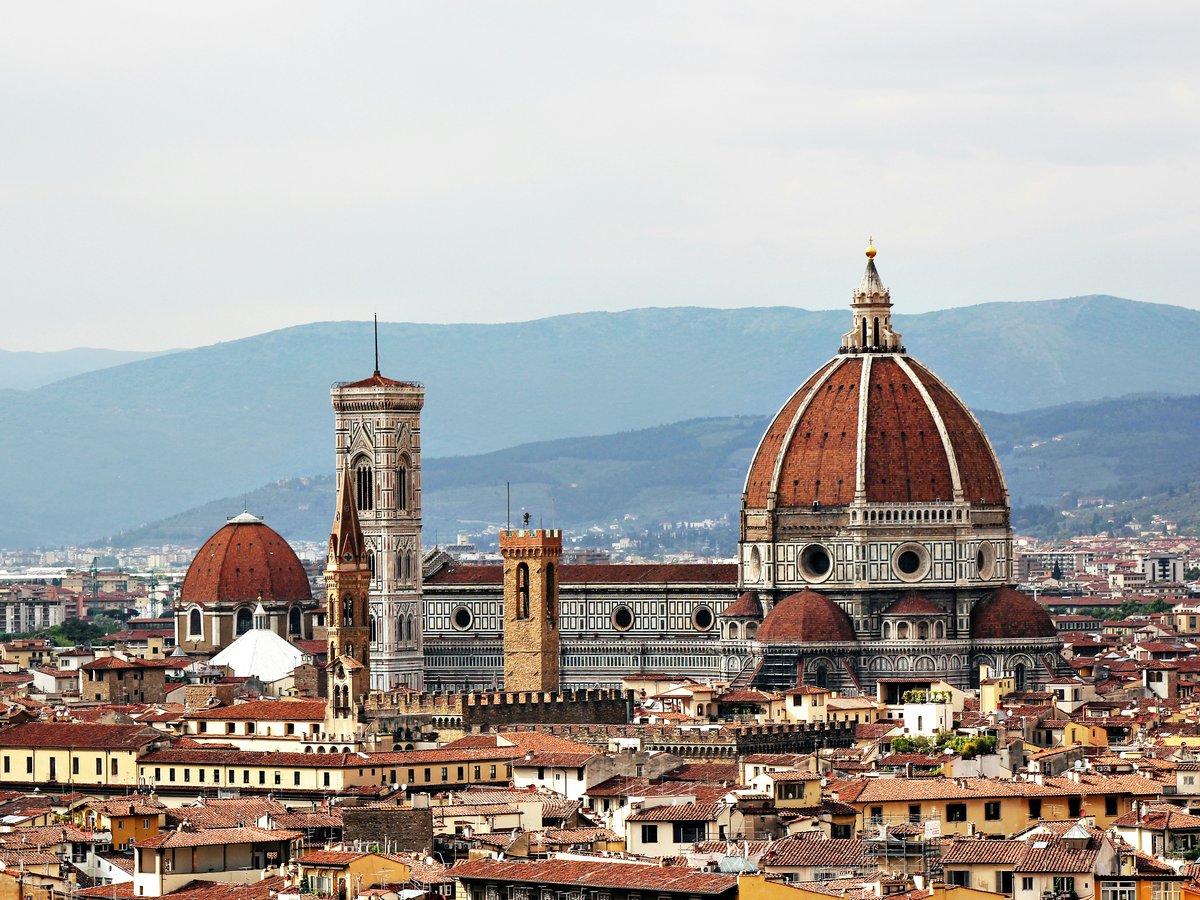
Florence is a compact city, smaller than most visitors expect. The historic center spans roughly 3 kilometers east to west and maybe 2 north to south, split by the Arno River into two distinct halves. North of the river holds the Duomo, the train station, and most of the Renaissance heavyweights. South of the river, the Oltrarno, feels like a different town entirely, quieter and more residential, with workshop smells drifting out of open doorways. The neighborhoods bleed into each other without hard borders, so you'll walk from one to the next in 10 or 15 minutes without realizing you've crossed over. That said, each carries a noticeably different pace. The centro storico around Piazza della Signoria tends to run loud and tourist-dense from about 9am to midnight. Move 4 or 5 blocks in any direction and the ratio shifts. Florence rewards that short walk more than almost any city in Italy.
Neighborhoods
-
Duomo and Centro Storico
This is the dense medieval core, where every second building seems to date from the 1300s or 1400s. The streets are narrow, paved in pietra serena flagstone, and the sound of rolling suitcases on cobblestones is constant between March and October. Leather goods shops and gelaterias crowd the ground floors. The scale of the Duomo still catches you off guard when you turn a corner onto Piazza del Duomo, even after your fifth visit. The air smells like espresso and warm stone in the morning, shifting to pizza and diesel by midday.
- Best for
- First-time visitors who want to walk to every major sight, couples who don't mind trading quiet for convenience
- Key streets
- Via dei Calzaiuoli connects Piazza del Duomo to Piazza della Signoria in about 400 meters, and it is the city's main pedestrian artery. Via Roma runs from the Duomo northwest toward Santa Maria Novella. Piazza della Repubblica sits midway, a 19th-century square with the old carousel and the Giubbe Rosse literary cafe. Via del Corso heads east and gets quieter quickly.
-
Santa Croce
East of the centro storico, Santa Croce opens up around its wide piazza, which still hosts the annual Calcio Storico matches every June. The neighborhood has a grittier feel than the Duomo area. More locals, more students from the Universita degli Studi di Firenze, more bars that stay open past 1am. The buildings are tall, the alleys shadowy even at noon, and you'll hear Italian spoken more than English once you pass Piazza dei Ciompi. The leather school inside the Basilica di Santa Croce, Scuola del Cuoio, is the real deal, not the tourist-trap shops on the bridges.
- Best for
- Younger travelers and nightlife seekers, anyone who wants a residential feel within a 10-minute walk of the Uffizi
- Key streets
- Borgo dei Greci leads from Piazza della Signoria directly into the neighborhood. Via de' Benci is the aperitivo strip, lined with bars like Diorama and the old-school Enoteca Fuori Porta near the city gate at Porta San Miniato. Piazza dei Ciompi hosts a daily flea market. Via Pietrapiana runs east past local trattorias where a primo and secondo might run 12 to 18 euros.
-
San Lorenzo and San Marco
North of the Duomo, San Lorenzo is dominated by the Mercato Centrale and the open-air leather stalls that surround it. The neighborhood feels commercial and slightly chaotic. Hawkers line Via dell'Ariento and the surrounding blocks. But the indoor Mercato Centrale, especially the upstairs food hall that opened in 2014, is worth the crowd. San Marco, a few blocks further north, shifts to a quieter university quarter. The cloister of San Marco, with its Fra Angelico frescoes in every cell, still draws fewer visitors than the Uffizi despite being one of the most moving spaces in the city.
- Best for
- Budget travelers near Santa Maria Novella station, food lovers, anyone who likes market energy and doesn't need nightlife
- Key streets
- Via dell'Ariento runs alongside the leather market. Via Cavour heads north from the Medici-Riccardi Palace to Piazza San Marco. Via XXVII Aprile connects San Lorenzo to the quieter residential blocks north of the university. Piazza San Lorenzo itself has the unfinished facade of the basilica, rough brick where marble was never laid despite 500 years of discussion.
-
Oltrarno
Cross the Ponte Vecchio or Ponte Santa Trinita and the city exhales. The Oltrarno is the south bank, historically the artisan quarter, and it still feels that way. You'll hear hammering from frame-makers on Via Maggio, smell wood shavings from restoration workshops on Borgo San Frediano. The ochre and terracotta facades are the same age as those across the river but less polished, more cracked plaster and hanging laundry. Piazza Santo Spirito is the neighborhood's living room, lined with small restaurants and one of Florence's few remaining neighborhood churches that doesn't charge admission.
- Best for
- Repeat visitors to Florence, artists and designers, couples looking for atmosphere over sightseeing efficiency, anyone wanting to eat well without tourist markups
- Key streets
- Via Maggio is the antiques corridor, full of gilded mirrors and 17th-century furniture in shopfronts. Borgo San Frediano runs west toward the Porta San Frediano gate and gets more local with every block. Via di Santo Spirito connects to Piazza del Carmine, where the Brancacci Chapel holds Masaccio's frescoes from the 1420s. Piazza Santo Spirito has a small morning market most weekdays.
-
San Frediano
The western end of the Oltrarno, past Piazza del Carmine, San Frediano has become Florence's most interesting food and drink neighborhood over the past decade or so. It still feels rough around the edges compared to the polished centro. The buildings are lower, the streets wider, and you'll see more scooters than tour groups. The Porta San Frediano, a 14th-century gate still standing at the end of Borgo San Frediano, marks where the medieval city ended. Past it, the neighborhood blends into regular Florentine residential life, with small alimentari shops and laundromats.
- Best for
- Food-focused travelers, people who want to stay in a neighborhood that still functions as a neighborhood, those comfortable being a 20-minute walk from the Duomo
- Key streets
- Borgo San Frediano is the main spine. Via del Leone and Via della Chiesa run parallel and hold most of the newer wine bars and restaurants. Piazza Tasso, further west, is a genuine neighborhood piazza where kids play football in the evenings. The stretch between Piazza del Carmine and Porta San Frediano has the highest density of good restaurants in Florence per block.
-
Santa Maria Novella
The area immediately around the train station, Firenze Santa Maria Novella, gets dismissed as a transit zone, but it has more to offer than most visitors realize. The basilica of Santa Maria Novella has a marble facade by Alberti from 1470 that still looks like a geometry lesson. West of Via dei Fossi, the streets quiet down rapidly. The Officina Profumo on Via della Scala is in this neighborhood, not in the Duomo area as most maps imply. Hotels cluster here because of station proximity, which keeps prices about 15 to 25 percent lower than equivalent rooms in the centro storico.
- Best for
- Travelers arriving by train who want to drop bags and start walking, budget-conscious visitors, anyone who values a direct rail connection for day trips to Siena or Lucca
- Key streets
- Via dei Fossi is an underrated antiques and design street, quieter than Via Maggio across the river. Piazza Santa Maria Novella fronts the basilica and has recently been repaved, making it one of the more pleasant open spaces in the center. Via della Scala heads northwest toward the old city walls. Via de' Tornabuoni, technically bordering this neighborhood to the east, is the luxury shopping street with Ferragamo, Gucci, and Pucci all within 200 meters of each other.
-
Piazzale Michelangelo and San Niccolo
San Niccolo sits at the foot of the hill below Piazzale Michelangelo, tucked between the old city walls and the Arno's south bank. It is one of the smallest and quietest neighborhoods in central Florence. The climb up to Piazzale Michelangelo takes about 15 minutes on foot from Via di San Niccolo, following a stairway shaded by cypress trees. The smell of pine resin and warm stone hangs in the air on summer evenings. From the top, you get the full panorama of the city, the Duomo, the Palazzo Vecchio tower, the Arno, and the hills of Fiesole to the north. The neighborhood below is residential and calm after dark.
- Best for
- Travelers who want quiet evenings, runners and walkers, photographers, anyone who finds the centro storico too dense
- Key streets
- Via di San Niccolo is the main street, with a handful of restaurants and wine bars. Via di Belvedere climbs toward Forte di Belvedere, a Medici fortress from 1590 that hosts occasional art exhibitions. Porta San Niccolo, the tallest surviving medieval gate in Florence at about 35 meters, anchors the eastern end. Via San Miniato leads up to the Basilica di San Miniato al Monte, an 11th-century Romanesque church that holds vespers with Gregorian chanting daily at 5:30pm.
FAQ
Which Florence neighborhood is best for a first visit?
The Duomo and Centro Storico area puts you within 10 minutes of the Uffizi, the Accademia, and the Ponte Vecchio. You'll pay more for accommodation, with doubles averaging 150 to 250 euros per night for a mid-range hotel, and the streets stay loud until midnight in summer. But the trade-off is that you can walk to every major sight without relying on buses. If the noise is a concern, look for rooms on upper floors facing internal courtyards. Hotels on Via dei Calzaiuoli and Piazza della Repubblica tend to be loudest.
Is the Oltrarno safe to stay in at night?
The Oltrarno is generally safe, and it tends to be quieter than the north bank after 11pm. Piazza Santo Spirito can get rowdy on weekend nights in summer, with groups drinking on the church steps until 1 or 2am. San Frediano and San Niccolo are calmer. The usual city rules apply. Keep your phone secure, watch for scooters on narrow sidewalks, and stick to lit streets. Violent crime against tourists is rare in Florence overall, with the main risk being pickpocketing on crowded buses, particularly the C1 and C2 lines.
How walkable is Florence between neighborhoods?
Florence is one of the most walkable cities in Europe. The historic center is largely car-free or restricted-traffic (ZTL zone), so you are mostly contending with pedestrians, bikes, and the occasional delivery van. Walking from Santa Maria Novella station to Piazzale Michelangelo takes about 35 to 40 minutes at a normal pace. Ponte Vecchio to Santa Croce is about 12 minutes. The ATAF bus system covers wider distances, with a single ticket at 1.50 euros valid for 90 minutes, but most visitors inside the center never need it.
Where should I stay in Florence for the best food?
San Frediano and the western Oltrarno currently have the highest concentration of quality restaurants at reasonable prices. A full dinner with wine at most of these places runs 25 to 40 euros per person. The centro storico has excellent restaurants too, but they are harder to find between the tourist traps, and prices tend to run 30 to 50 percent higher for comparable quality. Worth noting, some of the best quick lunches in the city are still at the Mercato Centrale ground floor in San Lorenzo, where a lampredotto sandwich costs under 5 euros.
What is the best neighborhood for a quiet stay in Florence?
San Niccolo, below Piazzale Michelangelo, is the quietest central neighborhood. It has maybe 6 or 7 restaurants and bars on its main street, no clubs, and very few tour groups. The trade-off is a 20-minute walk to the Duomo and limited late-night dining. The eastern end of the Oltrarno around Via dei Bardi is similarly calm. If you want quiet but still close to restaurants, the residential blocks north of Piazza Santo Spirito on Via del Campuccio and Via Santa Monica offer a good middle ground.
Last verified by automated review (v1.7.2) on . What is automated review?