Compare every Italy city in April →
Stay in Florence in April
109 hotels in the Trip.com pool for Florence, from US$23 a night.
Opens Trip.com on Fri 2 Apr to Sun 4 Apr 2027; change the dates there.
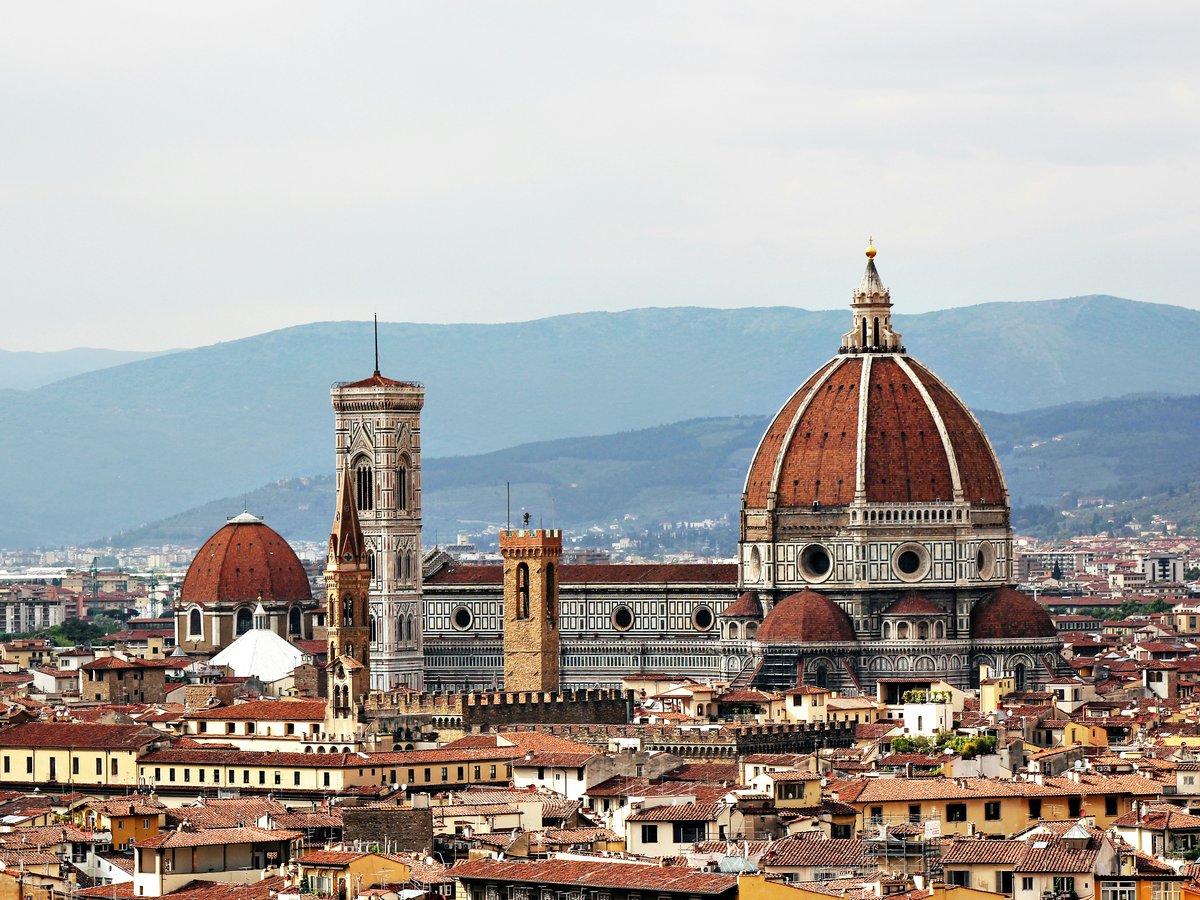
April in Florence is the month the city shakes off winter. Daytime temperatures reach about 18.6°C (65°F), the wisteria at Giardino Bardini starts to bloom in thick purple curtains, and the Arno catches that particular late-afternoon gold that has kept painters coming back for 600 years. The single most important thing to know is that when Easter falls in April, Florence stages the Scoppio del Carro, a ceremony with roots stretching back over 900 years to the First Crusade. It draws tens of thousands to Piazza del Duomo before noon. That one event can reshape your entire trip, for better or worse, depending on whether you planned for it.
The weather is genuinely pleasant but unpredictable. You might get 3 straight days of warm sun in the low 20s, then a grey stretch with steady rain that drops temperatures back to 10°C (50°F). Mornings tend to be cool, around 7°C (45°F), and you'll want a layer if you're walking across Ponte Vecchio before 9am. Rainfall sits at about 92mm across 11 rainy days, which is roughly what March delivers. Not a washout, but you'll see rain.
Crowds are building but haven't peaked. The summer crush that packs the Uffizi corridor wall-to-wall from June through August hasn't arrived, but April is no secret either. Easter week brings a noticeable spike, and the second half of the month trends busier than the first. Hotel rates reflect this. You're paying more than winter, less than June. It's shoulder season tipping toward high, and you can feel it in the queue times at the Accademia.
Why visit in April
- Wisteria and iris blooms across the city, with Giardino Bardini's famous purple canopy typically peaking in mid-to-late April and drawing photographers from across Europe.
- Temperatures between 7°C and 19°C (45-65°F) make full-day walking comfortable. You can cover 15-20km on foot through the centro storico without the heat exhaustion that July and August bring.
- The Uffizi, Accademia, and Palazzo Pitti still have manageable queues compared to the 2-3 hour waits common in July. Timed-entry tickets are available within a few days rather than weeks ahead.
- Scoppio del Carro on Easter Sunday is one of Florence's most theatrical public spectacles. Free, outdoors, and unlike anything else in Italy.
- Outdoor dining season opens up across Oltrarno and Santo Spirito without the sticky 33°C heat that makes summer terraces uncomfortable after noon.
Worth knowing
- Rain is real. 92mm across 11 days means you'll likely lose 2-3 afternoons to grey skies and steady drizzle, which can disrupt plans at Piazzale Michelangelo or the Boboli Gardens.
- Easter week (and the days around April 25, Liberation Day) can spike hotel prices well above normal April rates, especially in Santa Croce and the blocks around the Duomo.
- Morning temperatures around 7°C (45°F) catch visitors off guard. If you packed only for spring, that first walk across Ponte Santa Trinita at 8am will feel cold.
- Some smaller restaurants and artisan workshops in Oltrarno close for up to a week around Pasquetta (Easter Monday), and again around April 25.
Best for
Think twice if
April in Florence feels like proper spring, but with a catch. Afternoons can be warm and golden, reaching 18.6°C (65°F), while mornings hover near 7.3°C (45°F) with a damp chill rising off the Arno. You'll notice the temperature swing if you're out early to see the Duomo without crowds and then sitting on a terrace in Santo Spirito by 2pm. Humidity sits around 72%, which isn't oppressive but gives rainy days a persistent dampness that seeps into lighter jackets. Those 92mm of rain spread across about 11 days, so most rainy spells are a few hours rather than full-day downpours. That said, you'll get the occasional day where it rains from morning to evening, and the cobblestones in San Lorenzo get slippery.
Year-round climate
Averages from the last 5 years.
| Month | Avg high (°C) | Avg low (°C) | Rainfall (mm) |
|---|---|---|---|
| Jan | 11 | 3 | 96 |
| Feb | 13 | 4 | 91 |
| Mar | 16 | 5 | 100 |
| Apr | 19 | 7 | 92 |
| May | 23 | 12 | 104 |
| Jun | 30 | 17 | 45 |
| Jul | 33 | 19 | 34 |
| Aug | 33 | 19 | 60 |
| Sep | 27 | 15 | 136 |
| Oct | 22 | 12 | 115 |
| Nov | 16 | 7 | 133 |
| Dec | 12 | 4 | 119 |
Holidays and festivals in April
Public holidays
- Liberation Day(Festa della Liberazione)25 April 2027
Headline events
Scoppio del Carro (Explosion of the Cart)
Easter Sunday (date varies, falls in April most years)
A ceremony whose origins trace to Pazzino de' Pazzi bringing sacred flint stones back from the First Crusade in 1101. On Easter Sunday morning in Piazza del Duomo, a decorated oxcart loaded with fireworks is pulled by white oxen from Porta al Prato to the cathedral. During the Easter Mass, the Archbishop lights a dove-shaped rocket (the Colombina) that races along a wire from the altar to ignite the cart. The explosion lasts about 20 minutes. Locals believe a successful explosion means a good harvest. Tens of thousands pack the piazza, and the crack of fireworks echoes off the Baptistery walls. The smell of gunpowder lingers in the streets for hours afterward.
Best things to do in April
Walk the Giardino Bardini wisteria tunnel
natureThe wisteria pergola at Giardino Bardini, perched on the hillside above Costa San Giorgio, blooms in cascading purple and white clusters during April. The garden is significantly less crowded than the neighboring Boboli, and the terrace at the top gives you a clear view of the Duomo, Palazzo Vecchio, and the hills beyond. The scent of the flowers is thick enough to catch from 10 meters away.
The wisteria bloom window typically runs from mid-April to early May, lasting about 2-3 weeks before the petals drop.Booking tipBuy the combined Bardini-Boboli ticket to save a second queue. Morning visits before 10am have the lightest crowds.
Visit the Uffizi Gallery with spring light
cultureThe Uffizi's east-facing rooms along the Arno get direct morning sunlight in April, and the Botticelli rooms (10-14) are warm with natural light by 9am. April queues run 30-45 minutes without a reservation, compared to 2-3 hours in July. Botticelli's Primavera, painted around 1480, feels particularly fitting when you've spent the morning watching Florence's own spring bloom.
Queue times drop to a fraction of summer's peak, and the natural light in the galleries is at its best angle before the sun climbs too high.Booking tipBook timed-entry tickets 3-5 days ahead on the official Uffizi site. Tuesday and Wednesday mornings tend to be quietest.
Eat your way through Mercato di Sant'Ambrogio
foodFlorence's less-touristed covered market in the Santa Croce neighborhood is where local cooks shop for spring produce. The vendors are chattier here than at Mercato Centrale, and you'll find tables of fresh fava beans, artichokes, agretti, and bundles of wild asparagus from the Casentino hills. The cooked-food stalls at the back serve tripe sandwiches and plates of ribollita.
April is peak spring produce season in Tuscany, and Sant'Ambrogio's vendors carry varieties that the more tourist-oriented Mercato Centrale sometimes skips.Booking tipGo before 11am on weekdays. Saturday mornings are lively but packed by 10am.
Climb to San Miniato al Monte at sunset
cultureThe Romanesque basilica of San Miniato al Monte, built starting in 1013, sits above Piazzale Michelangelo on the south bank of the Arno. The April sunset hits the white and green marble facade around 7:30pm, and the view north over the city catches the Duomo, the Bargello tower, and the Fiesole hills behind. The Gregorian chant vespers service, held daily at 5:30pm by the Olivetan monks, is open to visitors.
April's clear evenings and sunset around 7:45pm give you soft golden light without the haze that builds in summer months.Booking tipNo booking needed. Walk up from Porta San Niccolò through the old city gate for the most scenic approach.
Day trip to the Chianti hills
excursionThe drive from Florence south through Greve in Chianti (about 40 minutes on the SR222) takes you past vineyards that are bright green with new growth in April. Wineries like Castello di Verrazzano and Vignamaggio are open for tastings, and the hilltop villages of Panzano and Radda have spring markets on weekends. The countryside is carpeted with wild poppies and broom flowers by late April.
Vine growth is visible but harvest is months away, so winery staff have more time for visitors. The wildflower bloom along the SR222 peaks in the second half of April.Booking tipWinery tastings require a reservation at least 2-3 days ahead. Weekdays are significantly quieter than weekends.
Explore the Oltrarno artisan workshops
cultureThe streets between Piazza Santo Spirito and Porta San Frediano hold Florence's densest concentration of traditional craftspeople. Leather workers, gilders, bookbinders, and mosaic artisans still operate out of ground-floor botteghe that open directly onto the street. In April, most workshops keep their doors open to the warm air, and you can watch restorers working on gilt frames or marbled paper being laid out to dry.
The mild weather means workshop doors stay open for airflow, giving you a view into the craft process that's hidden behind closed doors in winter and blocked by tour groups in summer.Booking tipNo booking needed for most workshops. Stefano Bemer's leather workshop on Via di San Niccolò offers scheduled visits.
What to eat in April
On menus now
Fave e Pecorino
Fresh raw fava beans eaten with slices of young Pecorino Toscano. April is peak fava season in Tuscany, and the beans are tender enough to eat straight from the pod. You'll find this combination at wine bars across Santo Spirito and at Mercato di Sant'Ambrogio, sometimes with a drizzle of local olive oil. The texture is grassy and slightly bitter against the salty, crumbly cheese.
Schiacciata alla Fiorentina
This soft, vanilla-scented sponge cake dusted with powdered sugar in the shape of a Florentine lily appears in bakeries across the centro storico during the spring months. It tends to be lighter and flatter than most Italian cakes, with a faint citrus note from orange zest. Pasticceria Nencioni on Via Pietrapiana has been making it since the 1950s.
What to drink
Vigna Vecchia rosé wines
April is when Tuscan producers start releasing their new-vintage rosatos, and wine bars in San Frediano and Santa Croce rotate them onto their lists. Wines from the Chianti Classico zone and the hills around Carmignano are popular choices, often poured by the glass alongside those fava beans and pecorino boards.
In markets
Carciofi (Tuscan artichokes)
The morellino and violetto varieties hit the markets in April. Florentine trattorias serve them deep-fried whole (carciofo fritto), braised with garlic and nepitella mint, or sliced raw into salads. The Mercato Centrale typically has 3-4 vendors selling them by the kilo, and the earthy, slightly nutty flavor of the spring harvest tends to be more delicate than what you'll find later in May.
Regular events in April
Festa della Liberazione (Liberation Day)Free
April 25 is a national holiday commemorating Italy's liberation from Nazi occupation in 1945. Florence marks the day with ceremonies at Piazza della Signoria and wreath-layings at partisan memorials. Most museums remain open, but many shops and smaller businesses close for the day.
April 25Maggio Musicale Fiorentino (preview concerts)
Italy's oldest music festival, founded in 1933, officially opens in late April or early May at the Teatro del Maggio Musicale on Piazza Vittorio Gui. Preview concerts and rehearsals sometimes begin in the last week of April, and the programme typically includes opera, symphonic works, and ballet through June.
Late April (festival officially runs May-June)Mostra dell'Artigianato (Craft Fair)
The Fortezza da Basso hosts this annual exhibition of Italian artisanship, running for about 8-10 days in late April. Ceramicists, textile makers, jewelers, and furniture makers from across Tuscany and beyond set up stalls inside the Renaissance-era fortress. The fair has been running since 1931.
Late April (dates vary)Best places this April
Giardino Bardini
gardenA terraced Renaissance garden on the Oltrarno hillside with the city's most photographed wisteria pergola. The garden covers about 4 hectares and includes a baroque staircase, an English-style woodland section, and a belvedere with panoramic views of the Duomo. The wisteria bloom typically peaks in mid-to-late April.
OltrarnoMercato Centrale
marketFlorence's two-story iron-and-glass market hall, built in 1874 by Giuseppe Mengoni (who also designed Milan's Galleria). The ground floor sells fresh produce, meat, cheese, and bread from Tuscan suppliers. The upper floor is a food hall with prepared dishes. April's spring produce fills the ground-floor stalls with artichokes, fava beans, and fresh ricotta.
San LorenzoBasilica di San Miniato al Monte
religious siteOne of the finest Romanesque churches in Tuscany, with a green-and-white marble facade visible from across the city. Construction began in 1013 over the site of a 4th-century shrine. The interior's 13th-century mosaic in the apse and the Chapel of the Cardinal of Portugal (1473) are worth the uphill walk. Olivetan monks still chant vespers here daily.
OltrarnoPiazza Santo Spirito
squareThe Oltrarno's main square, anchored by Brunelleschi's Basilica di Santo Spirito (completed 1481). The daily morning market sells produce and household goods, and the square's restaurants fill their outdoor tables as soon as April's warmer afternoons arrive. The area around the piazza is the heart of Florence's artisan workshop neighborhood.
OltrarnoPalazzo Pitti and Boboli Gardens
museumThe Medici's former palace houses 5 separate museums, including the Palatine Gallery with works by Raphael, Titian, and Caravaggio. The Boboli Gardens behind the palace cover 4.5 hectares of formal Italian garden, with the April rose bloom beginning in the upper terraces. The Kaffeehaus terrace gives views east over the Arno valley.
OltrarnoPonte Vecchio
landmarkFlorence's oldest bridge, rebuilt in its current form in 1345 after a flood destroyed the previous structure. The goldsmiths' and jewelers' shops lining both sides have been here since the Medici era (butchers were banned in 1593). April mornings before 8am, when the shops are shuttered and the light comes in low over the water, are the quietest time to cross.
Centro StoricoPiazzale Michelangelo
viewpointThe panoramic terrace on the south bank, designed by Giuseppe Poggi in 1869 during Florence's brief stint as Italy's capital. The bronze replica of Michelangelo's David stands at the center. April sunsets from here, around 7:30-7:45pm, catch the Duomo and Palazzo Vecchio in warm light with the Fiesole hills behind.
Oltrarno
Your packing checklist
Tick items off as you pack. Your progress saves in this browser.
All packed — have a great trip.
Insider tips
The Uffizi's lesser-known Contini Bonacossi collection, accessible through a separate entrance on Via Lambertesca, has works by Goya and Velázquez and is routinely empty even in April when the main galleries fill up.
Giardino dell'Iris, a small garden below Piazzale Michelangelo dedicated to iris cultivation, opens only from late April to mid-May during bloom season. Florence's symbol is the iris (the fleur-de-lis on the city crest), and this garden grows over 1,500 varieties. Free entry.
The Farmacia di Santa Maria Novella, operating since 1221, is both a functioning pharmacy and an informal museum. The frescoed chapel room sells herbal remedies and perfumes made from recipes that go back centuries. The scent of potpourri and rose water hits you from the doorway.
If you're visiting Piazzale Michelangelo at sunset and want to avoid the crowd, walk 5 minutes further up to San Miniato al Monte. The view is almost identical, the atmosphere is quieter, and you might catch the monks singing vespers.
Trattoria Mario near San Lorenzo has been serving fixed-menu Florentine lunches since 1953. It opens at noon, seats are shared communal-style, and the ribollita typically sells out within the first hour. No reservations accepted.
Avoid these mistakes
- Packing only for warm spring weather. April mornings at 7°C (45°F) feel genuinely cold, and visitors in shorts and sandals at 8am near the Arno are visibly uncomfortable. Bring layers.
- Skipping the Oltrarno entirely. Most first-time visitors spend all their time north of the Arno between the Duomo and Santa Croce, and miss the artisan workshops, Santo Spirito's piazza, and the Bardini wisteria that make April in Florence distinctive.
- Not booking timed-entry museum tickets. The Uffizi and Accademia still require advance booking in April. Walk-up queues run 30-60 minutes, and on Easter week they can double. The official museum websites sell timed slots.
- Underestimating the Liberation Day closures on April 25. Small shops, family-run trattorias, and some artisan botteghe close for the full day. Larger museums generally stay open, but if your itinerary depends on a specific small business, check ahead.
- Driving into the centro storico. Florence's ZTL (restricted traffic zone) covers most of the historic center, and the cameras are active. The fines arrive by post months later. Park outside the ZTL at Stazione Firenze SMN's underground garage or at Parcheggio Beccaria near Santa Croce.
Practical tips for April
April in Florence calls for flexibility. Build at least one backup indoor plan per day, since roughly 1 in 3 days will see rain. Carry a light rain jacket rather than an umbrella, as the narrow streets in San Lorenzo and Santa Croce make umbrellas awkward. Museums like the Bargello and Palazzo Davanzati are less crowded alternatives to the Uffizi on rainy days and rarely need advance booking. If Easter falls during your visit, book restaurants for Easter Sunday lunch at least a week ahead, as many Florentines eat out that day and popular spots in Oltrarno fill up. The ATAF bus network covers the city well, but Florence's centro storico is compact enough that you'll walk most places within 20 minutes. The T1 tram line connects Stazione SMN to the Scandicci suburbs but doesn't reach the major tourist sites. For day trips, the regional train from Santa Maria Novella station reaches Siena in 90 minutes, Lucca in 80, and Pisa Centrale in under an hour.
FAQ
Is April a good time to visit Florence?
April is one of the best months for Florence. Temperatures are comfortable for walking at 7-19°C (45-65°F), the spring blooms at Giardino Bardini and Boboli Gardens are at their peak, and museum queues are a fraction of what you'll face in July or August. The main tradeoffs are unpredictable rain (roughly 11 days see some) and higher accommodation costs than winter. If your dates align with Easter, you'll get the Scoppio del Carro spectacle but also bigger crowds and steeper rates.
How rainy is Florence in April?
Florence averages about 92mm of rain across 11 days in April. Most of that falls in short spells of a few hours rather than all-day downpours, though you will occasionally get a full grey day. The rain tends to come in clusters of 2-3 wet days followed by clear stretches. A packable waterproof jacket is more practical than an umbrella in the narrow centro storico streets.
What should I wear in Florence in April?
Dress in removable layers. Mornings start around 7°C (45°F) and afternoons can reach 18-20°C, so a fleece or light sweater plus a t-shirt underneath works well. Bring a waterproof shell for the frequent rain, and closed-toe shoes with grip for wet cobblestones. Churches like the Duomo and Santa Croce require covered shoulders and knees, so carry a light scarf or cardigan.
Is Florence crowded in April?
Moderately. April sits in the shoulder-to-high season transition, noticeably busier than January through March but well below the July-August peak. Easter week is the busiest stretch, with queues at the Uffizi and Accademia growing to 45-60 minutes even with timed tickets. The second half of April trends busier than the first. Visiting major museums on weekday mornings and exploring the Oltrarno side of the river helps you sidestep the densest crowds.
What food is in season in Florence in April?
April is prime time for fresh fava beans, eaten raw with young Pecorino Toscano at wine bars across the city. Tuscan artichokes (morellino and violetto varieties) appear at Mercato Centrale and Sant'Ambrogio, served fried whole, braised, or sliced raw. Wild asparagus from the Casentino hills shows up at better trattorias, and the first Tuscan rosé wines of the new vintage start appearing on wine bar lists in San Frediano and Santa Croce.
Things to Do in Florence in April
 Free cancellation
 Tuscany Day Trip from Florence: Siena, San Gimignano, Pisa and Lunch at a Winery
Day trip: 12 hours, free cancellation.
via Viator Free cancellation
 Pasta Cooking Class with Unlimited Wine in Florence
Cooking class: 2.5 hours, free cancellation.
via Viator Free cancellation
 Cinque Terre Day Trip with Optional Hiking or Pisa from Florence
Outdoor experience: 13 hours, free cancellation.
via Viator Free cancellation
 Small-Group Wine Tasting Experience in the Tuscan Countryside
Cooking class: 4.8 hours, free cancellation.
via Viator Free cancellation
 Florence Pizza or Pasta Class with Gelato & Wine at a Tuscan Farm
Cooking class: 5 hours, free cancellation.
via Viator Free cancellation
 Pisa, Siena, San Gimignano with Lunch & Wine Tasting at a Winery
Day trip: 12 hours, free cancellation.
via ViatorFind a flight to Florence
Live fares to Florence appear here once cookies are accepted.
Last verified by automated review (v1.7.2) on . What is automated review?