Compare every Italy city in January →
Stay in Florence in January
109 hotels in the Trip.com pool for Florence, from US$23 a night.
Opens Trip.com on Fri 1 Jan to Sun 3 Jan 2027; change the dates there.
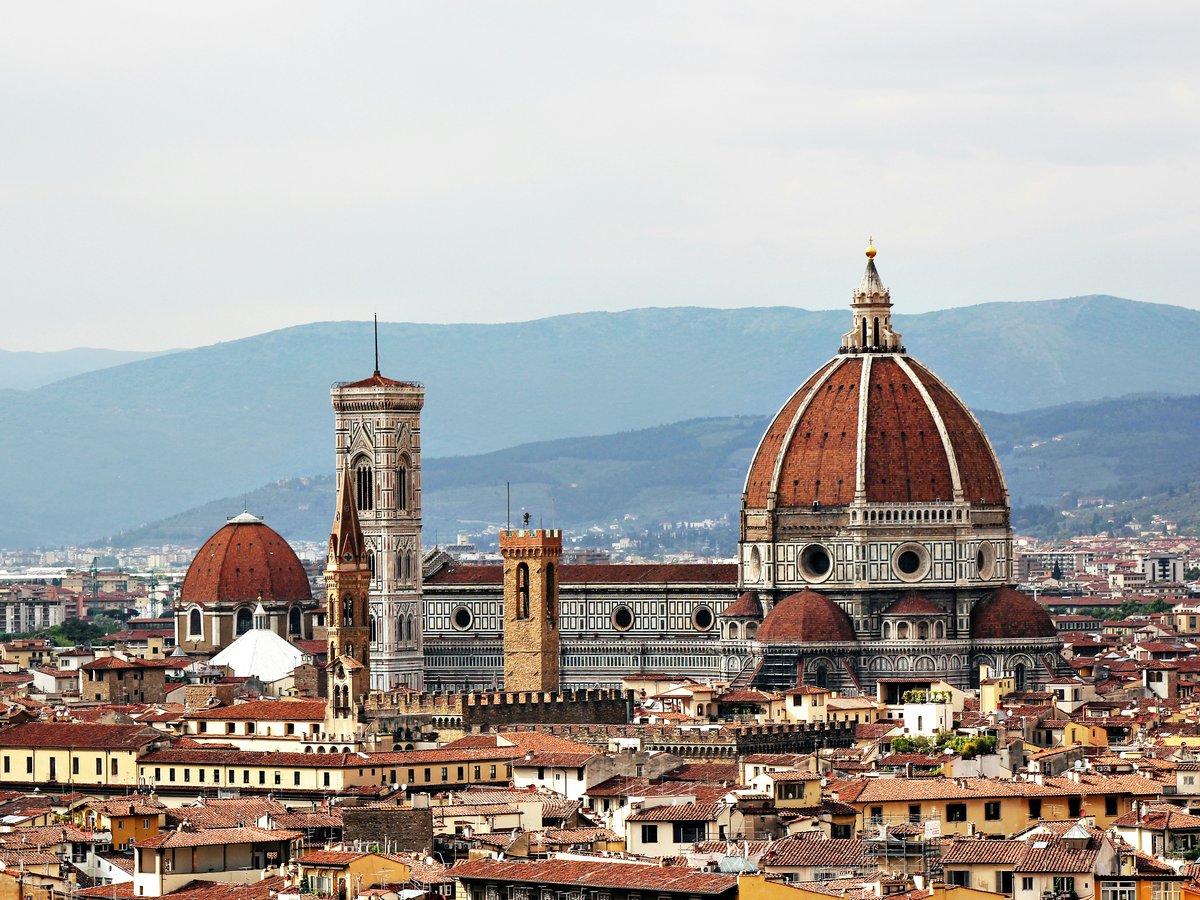
Florence in January is cold, gray, and genuinely quiet. Daytime temperatures hover around 10.9°C (52°F), dropping to 3°C (37°F) after dark, and the Arno valley traps enough moisture to make those numbers feel sharper than they look on paper. The sun sets before 5 PM. Piazza della Signoria, which in June holds shoulder-to-shoulder crowds, empties out by late afternoon. If you're coming for warm-weather strolling and terrace dining along the Lungarno, this is not your month.
That said, January might be the single best time to see Florence's art. The Uffizi on a Tuesday morning in mid-January can feel like a private viewing. You'll stand alone in front of Botticelli's Primavera. The Accademia's Michelangelo hall, which requires 90-minute waits in high season, typically has walk-in availability all month. Hotel rates across Santa Croce and San Lorenzo drop 40-50% from their May peaks. The saldi invernali, Italy's regulated winter sales, start in the first week of January with discounts of 30-50% on Via de' Tornabuoni and through the Oltrarno boutiques.
The trade-off is real, though. Rain falls on roughly 11 days of the month, totaling about 96mm. Florence is an indoor city in January. The trattorias serve ribollita and peposo, the churches smell of old stone and candle wax, and the city's extraordinary density of world-class art fills every gray hour. If you come prepared for damp cold and short days, you'll find a version of Florence that peak-season visitors never see.
Why visit in January
- Minimal crowds at the Uffizi, Accademia, and Palazzo Pitti. Weekday mornings in January often mean near-empty galleries, letting you linger with the art instead of being herded through.
- Hotel rates drop 40-50% below May-June peaks. Central neighborhoods like Santa Croce and San Lorenzo have wide availability, and you can often book well-reviewed doubles at deep low-season rates without advance planning.
- Saldi invernali (winter sales) run all month, with 30-50% discounts at shops along Via de' Tornabuoni, Borgo San Jacopo, and through the leather workshops in San Lorenzo.
- Peak season for Tuscan winter cooking. Ribollita, peposo, and castagnaccio appear on nearly every trattoria menu, and the Mercato Centrale's ground-floor stalls sell cavolo nero and fresh porcini at their seasonal best.
- Pitti Uomo fills Florence's streets with international fashion during the second week of January. Even if you're not attending the trade show at Fortezza da Basso, the street-style scene outside the venue is a spectacle worth seeing.
Worth knowing
- Short daylight hours. Sunrise is around 7:40 AM and sunset by 4:50 PM, giving you roughly 9 hours of usable light. Outdoor sightseeing requires tight scheduling.
- Damp cold that penetrates layers. Florence's 81% average humidity in January makes 3°C mornings feel well below freezing, especially on the exposed bridges and along the river.
- Rain on about 11 days of the month (96mm total). Storms tend to pass in a few hours rather than lasting all day, but you'll want a backup indoor plan every afternoon.
- Some smaller restaurants and family-run trattorias close for 1-2 weeks in early January after the holiday period. The Oltrarno and San Frediano neighborhoods are particularly affected.
Best for
Think twice if
January is Florence's coldest month. Mornings typically start around 3°C (37°F) with occasional frost on parked cars in neighborhoods like Campo di Marte. Afternoons reach about 10.9°C (52°F) on clear days, though overcast skies keep it cooler. Fog settles in the Arno valley on still mornings, sometimes not burning off until 10 AM. Rain tends to come in bursts rather than all-day drizzle, with 96mm spread across about 11 days. The air holds an 81% average humidity that makes the cold feel more penetrating than the thermometer suggests. You might get 1-2 genuinely sunny days per week where the light turns the ochre and terracotta facades golden. Worth noting that snow in Florence is rare, maybe once every 3-4 years, but when it does happen the city comes to a standstill since it has almost no clearing infrastructure.
Seasonal caution
- Overnight temperatures can dip below 0°C (32°F) during cold snaps, particularly in the second and third weeks of January. Frost forms on bridges and cobblestones, making walking surfaces slippery. The damp cold at 81% humidity feels considerably colder than the same temperature in a dry climate.
- Fog in the Arno valley occasionally reduces visibility to under 200m during early mornings. This can affect driving on the A1 autostrada between Florence and Bologna and delays buses to hilltop towns.
Year-round climate
Averages from the last 5 years.
| Month | Avg high (°C) | Avg low (°C) | Rainfall (mm) |
|---|---|---|---|
| Jan | 11 | 3 | 96 |
| Feb | 13 | 4 | 91 |
| Mar | 16 | 5 | 100 |
| Apr | 19 | 7 | 92 |
| May | 23 | 12 | 104 |
| Jun | 30 | 17 | 45 |
| Jul | 33 | 19 | 34 |
| Aug | 33 | 19 | 60 |
| Sep | 27 | 15 | 136 |
| Oct | 22 | 12 | 115 |
| Nov | 16 | 7 | 133 |
| Dec | 12 | 4 | 119 |
Holidays and festivals in January
Public holidays
- New Year's Day(Capodanno)1 January 2027
- Epiphany(Epifania)6 January 2027
Headline events
Pitti Uomo
Second week of January (usually Tuesday through Friday)
The world's largest menswear trade fair takes over Fortezza da Basso for 4 days each January, drawing roughly 30,000 buyers, designers, and fashion journalists from over 100 countries. The show itself requires trade credentials, but the real spectacle is outside the gates. Street-style photographers line the entrance, and Florence's bars, restaurants, and hotels fill with an international fashion crowd. The Oltrarno neighborhood hosts satellite events and pop-up showrooms in converted palazzi. Even if fashion isn't your thing, the energy is infectious and the people-watching along Via della Vigna Nuova is remarkable.
Best things to do in January
Unhurried mornings at the Uffizi Gallery
cultureJanuary strips away the crowds that define the Uffizi experience from April through October. You can spend 15 minutes with Caravaggio's Medusa without someone's selfie stick in your peripheral vision. The Botticelli rooms, which typically require shuffling through in a human chain, allow you to stand back and take in the scale of the Birth of Venus from across the room.
Peak-season wait times of 90-plus minutes drop to near-zero on January weekdays, and the galleries feel contemplative rather than frenetic.Booking tipTuesday and Wednesday mornings tend to be quietest. The museum is closed on Mondays.
Browsing the saldi invernali on Via de' Tornabuoni
shoppingItaly's government-regulated winter sales begin in the first week of January and run through early March. Florence's luxury shopping street, Via de' Tornabuoni, hosts Gucci's flagship (the brand was founded here in 1921), Ferragamo, and Emilio Pucci, all participating. The Oltrarno side has smaller leather goods workshops that also mark down inventory.
The saldi are legally restricted to this period. Discounts of 30-50% on Italian-made leather, cashmere, and designer goods are standard.Exploring the Palazzo Pitti museums
cultureThe Pitti Palace holds 4 separate museums, and in January you can realistically visit 2-3 in a single day without exhaustion. The Palatine Gallery's Raphael collection (11 paintings, the largest concentration outside the Vatican) deserves at least 2 hours. The Boboli Gardens behind the palace are stark in January, but the bare geometries of the Italian formal garden are arguably more visible without summer foliage.
Low visitor numbers mean you can move through the Palatine Gallery's enfilade of rooms at your own pace, something physically impossible in July.Day trip to Siena
day_tripSiena in January is profoundly quiet. The Piazza del Campo, which holds 40,000 during the Palio in July, might have 50 people on a Tuesday afternoon. The Duomo's marble floor panels, which are covered with protective boards during high season, are sometimes partially uncovered in winter for restoration work. The Pinacoteca Nazionale holds Duccio and Simone Martini paintings in near-solitude.
Siena's tourism drops even more sharply than Florence's in January, and the 75-minute bus ride from SITA's Florence terminal runs year-round.Wandering the Oltrarno artisan workshops
cultureThe neighborhood south of the Ponte Vecchio still has working botteghe (workshops) where craftspeople restore antique frames, bind books by hand, and carve marble. January's slower pace means artisans are more likely to chat. Via Maggio, Borgo San Frediano, and the streets around Piazza Santo Spirito are the core of this district.
Without summer crowds, the narrow Oltrarno streets feel intimate rather than congested, and workshop doors tend to stay open longer.Attending a concert at the Teatro della Pergola
entertainmentFlorence's historic theater, built in 1656, runs a full winter program of opera, chamber music, and drama through January. The 1,000-seat horseshoe auditorium has 4 tiers of boxes with red velvet and gilt stucco. It's one of Italy's oldest active theaters and the acoustics in the smaller Saloncino space are especially good for string quartets.
The winter concert season is in full swing, with performances most evenings. January tends to have strong programming as it falls outside the holiday lull.Morning espresso rituals at historic cafes
food_drinkCaffè Gilli on Piazza della Repubblica has been serving espresso since 1733. Rivoire on Piazza della Signoria is known for its thick hot chocolate, and the marble-topped bar at Procacci on Via de' Tornabuoni still serves truffle panini. In January, these places have available seating at the bar and tables by the window. The smell of roasted coffee and warm pastry cuts through the cold morning air.
Peak-season queues vanish, and the experience of sitting in a 290-year-old cafe watching fog lift off the piazza is distinctly a winter pleasure.What to eat in January
On menus now
Ribollita
This thick bread-and-vegetable soup hits its stride in January, when cavolo nero (Tuscan black kale) is at peak sweetness after the first frosts. Every trattoria in the Oltrarno seems to have its own version, some thicker and almost stew-like, others more brothy. The bread soaks up the stock overnight, which is where the name (meaning "reboiled") comes from.
Peposo
A slow-cooked beef stew drenched in black pepper and Chianti, originally made by the tileworkers who built Brunelleschi's dome. They'd leave it in the kilns overnight. January's cold makes it especially welcome, and you'll find it on menus across San Frediano and Santo Spirito.
Castagnaccio
A flat, dense chestnut-flour cake studded with rosemary, pine nuts, and raisins. It's an acquired taste, not sweet in the conventional sense, more earthy and nutty. January is the tail end of chestnut season, so the flour is still fresh. Bakeries around Sant'Ambrogio market tend to carry it.
Schiacciata alla Fiorentina
This orange-scented sponge cake traditionally appears in bakeries from late January through Carnival in February. It's dusted with powdered sugar, sometimes with the Florentine lily stenciled on top. The texture sits somewhere between cake and focaccia.
In markets
Cavolo Nero
Tuscan black kale reaches peak flavor after December and January frosts, which break down the cell walls and concentrate the sugars. You'll see enormous bunches at the Mercato Centrale and Sant'Ambrogio. It appears in ribollita, on crostini with garlic, and sautéed as a contorno.
Regular events in January
Epiphany and La Befana celebrationsFree
January 6th marks the Festa della Befana, when a figure dressed as an old woman on a broomstick delivers sweets to children. In Florence, the Cavalcata dei Magi (Procession of the Magi) processes from Palazzo Pitti across the Ponte Vecchio to the Duomo, with participants in Renaissance costume. The procession has run since the 15th century.
January 6Mercato delle Pulci (Flea Market) in Piazza dei CiompiFree
This daily antique and flea market in the Santa Croce neighborhood operates year-round, but January's thinned-out vendor competition means more room to browse old prints, vintage ceramics, and mid-century Italian furniture. The last Sunday of each month brings an expanded version with additional dealers.
Daily, with expanded market last Sunday of the monthFirenze Winter Park
An ice skating rink and small winter village typically set up near Piazza della Libertà or the Parterre area, running from mid-December into late January. It's more of a local family outing than a tourist draw, but on a cold evening the glow and the sound of skates on ice adds a nice atmosphere.
Through late JanuaryBest places this January
Uffizi Gallery
museumHome to Botticelli's Birth of Venus and Primavera, Caravaggio's Medusa, and Titian's Venus of Urbino. January weekday mornings can feel almost private. The 2nd-floor cafe terrace, while cold, offers a direct view of the Palazzo Vecchio tower.
Centro StoricoBasilica di San Miniato al Monte
churchThis 11th-century Romanesque church sits above Piazzale Michelangelo. The geometric marble facade gleams even under January's gray sky, and the crypt holds 13th-century frescoes. Gregorian chant vespers still happen daily at 5:30 PM. The steep walk up takes about 20 minutes from the river.
OltrarnoMercato Centrale
marketThe ground floor of this 19th-century iron-and-glass market hall is the place to see (and smell) January produce. Stalls piled with cavolo nero, winter squash, blood oranges, and fresh porcini. The upper floor has a food hall with sit-down counters, but the ground-floor stalls are where Florentines shop.
San LorenzoPalazzo Vecchio
museumFlorence's 13th-century town hall still functions as the city government seat. The Salone dei Cinquecento on the main floor has massive battle frescoes by Vasari. January means you can linger in the smaller studiolo of Francesco I, a tiny jewel-box room that gets overwhelmed by 3 visitors in summer.
Centro StoricoMuseo di San Marco
museumA former Dominican convent where Fra Angelico painted an Annunciation fresco in each monk's cell during the 1430s and 1440s. The experience of walking from cell to cell, each holding a quiet, luminous fresco, is meditative at any time of year, but January's emptiness makes it feel genuinely monastic.
San MarcoOfficina Profumo-Farmaceutica di Santa Maria Novella
shoppingThis pharmacy has operated since 1612, and the vaulted frescoed rooms sell soaps, perfumes, and herbal remedies still made from Dominican-era recipes. The smell of iris root, rose water, and old wood is overwhelming in the best way. January means no line at the door.
Santa Maria NovellaPonte Vecchio
landmarkThe medieval bridge lined with goldsmiths' shops is less photogenic in January's flat light than in golden-hour summer, but it's one of the few times you can walk across it without being swept along in a crowd. The view upstream toward the Ponte Santa Trinita with morning fog on the water is worth an early walk.
Centro StoricoBiblioteca Medicea Laurenziana
museumMichelangelo designed this library's vestibule staircase in the 1520s for the Medici family. The reading room displays illuminated manuscripts and Renaissance texts. It's rarely crowded even in peak season, and in January you might be the only visitor, which suits the hushed atmosphere.
San Lorenzo
Your packing checklist
Tick items off as you pack. Your progress saves in this browser.
All packed — have a great trip.
Insider tips
The Firenze Card (72-hour museum pass) might seem less necessary in January since queues are short, but it still saves meaningful money if you plan to visit 4 or more museums. It also lets you skip the ticket line entirely at the Uffizi and Accademia, which still exists even in low season.
The SITA bus station behind Santa Maria Novella runs comfortable coaches to Siena (75 minutes), San Gimignano (75 minutes with a change in Poggibonsi), and Arezzo. January schedules are reduced but still regular, and you'll often have a double seat to yourself.
Trattoria Mario near the Mercato Centrale has been serving lunch since 1953. It only does lunch (no reservations, shared tables), and in January the usual hour-long wait drops to maybe 15 minutes. They close at 3:30 PM sharp.
Church visits are free in Florence, and January is when you can appreciate them. Santa Croce holds Giotto frescoes and the tombs of Michelangelo, Galileo, and Machiavelli. Santo Spirito has a Brunelleschi interior that rivals the Duomo in spatial drama, but without any of the crowds.
If Pitti Uomo is happening during your visit, the neighborhood around Fortezza da Basso and Via della Spada fills with unofficial events, trunk shows, and after-parties that are open to the public. Bar Basso near Piazza della Libertà is the unofficial fashion-week gathering point.
Avoid these mistakes
- Underestimating the cold because 10°C sounds mild. Florence's Arno valley humidity at 81% makes single-digit mornings feel brutal. Visitors from dry climates are often caught off-guard.
- Planning exclusively outdoor itineraries. January daylight runs 7:40 AM to 4:50 PM, and at least 3-4 of those days will have rain. Build museum and indoor time into every day, not as backup plans.
- Booking a Val d'Orcia or Chianti countryside day trip without checking seasonal closures. Many agriturismos, wine estates, and hilltop restaurants close from November through February or March. The rolling green hills of calendar photos are brown and bare in January.
- Assuming all trattorias reopen immediately after New Year's. Many family-run places in the Oltrarno and San Frediano take 1-2 additional weeks off in early January. Check before walking across the city for a specific restaurant.
- Skipping the Pitti Palace because you've already done the Uffizi. The Palatine Gallery's Raphael and Caravaggio holdings are a distinct collection, not a branch of the Uffizi, and the Pitti's ornate room decor (frescoed ceilings, gilded frames) creates a completely different viewing experience.
Practical tips for January
January in Florence runs on winter hours. Most museums open at 8:15 or 8:30 AM and close by 5 PM, with last entry 30-45 minutes before closing. The Duomo complex keeps slightly shorter winter hours for the Cupola climb (closed on Sundays for worship). Restaurants typically serve lunch from 12:30 to 2:30 PM and dinner from 7:30 PM. Many trattorias don't take reservations in January since walk-in tables are widely available, though checking Google Maps for seasonal closures saves wasted trips. ATAF bus tickets can be bought at tabacchi shops throughout the city, and the C1, C2, and C3 electric minibus lines are useful for crossing the centro storico when rain makes walking unpleasant. The Florence Santa Maria Novella train station connects to Pisa (1 hour), Bologna (35 minutes by Frecciarossa), and Rome (90 minutes by high-speed rail) for day trips if the weather turns truly dismal.
FAQ
Is January too cold to enjoy Florence?
It's cold, but Florence is fundamentally an indoor city. The Uffizi, Palazzo Pitti, the Bargello, dozens of churches, the Mercato Centrale, and the cafe culture all function perfectly in winter. Daytime highs around 10.9°C are manageable with proper layers. The dampness is the real challenge, not the temperature itself.
Are museums and attractions open in January?
Nearly all major museums operate on winter schedules. The Uffizi, Accademia, Palazzo Pitti, and Bargello are open (closed Mondays for some). The Duomo Cupola climb runs on shorter hours. Some smaller private museums may have reduced days. The main benefit is that you rarely need advance tickets since walk-in availability is common.
What is Pitti Uomo and will it affect my trip?
Pitti Uomo is a 4-day menswear trade fair held at Fortezza da Basso, typically during the second week of January. It draws roughly 30,000 attendees. If your hotel is near the Fortezza or Santa Maria Novella station, expect higher rates that week. The upside is a lively atmosphere with pop-up events, and the street-style scene is entertaining even if fashion isn't your thing.
Can I do day trips from Florence in January?
Train-connected cities work well. Siena (75 minutes by bus), Lucca (80 minutes by train), and Pisa (1 hour by train) are all open and very quiet in January. Rural Tuscany is trickier. Many agriturismos and wine estates in Chianti and Val d'Orcia close for winter, and the landscape is brown rather than the green of spring postcards. Check specific properties before planning.
Do I need to book restaurants in advance in January?
Generally not. January is deep low season, and most trattorias have walk-in availability even at prime dinner hours. The exceptions are the handful of Michelin-starred restaurants and any popular spot during Pitti Uomo week. A few family-run places close for 1-2 weeks in early January after the holidays, so check ahead for specific restaurants.
Things to Do in Florence in January
 Free cancellation
 Tuscany Day Trip from Florence: Siena, San Gimignano, Pisa and Lunch at a Winery
Day trip: 12 hours, free cancellation.
via Viator Free cancellation
 Pasta Cooking Class with Unlimited Wine in Florence
Cooking class: 2.5 hours, free cancellation.
via Viator Free cancellation
 Cinque Terre Day Trip with Optional Hiking or Pisa from Florence
Outdoor experience: 13 hours, free cancellation.
via Viator Free cancellation
 Small-Group Wine Tasting Experience in the Tuscan Countryside
Cooking class: 4.8 hours, free cancellation.
via Viator Free cancellation
 Florence Pizza or Pasta Class with Gelato & Wine at a Tuscan Farm
Cooking class: 5 hours, free cancellation.
via Viator Free cancellation
 Pisa, Siena, San Gimignano with Lunch & Wine Tasting at a Winery
Day trip: 12 hours, free cancellation.
via ViatorFind a flight to Florence
Live fares to Florence appear here once cookies are accepted.
Last verified by automated review (v1.7.2) on . What is automated review?