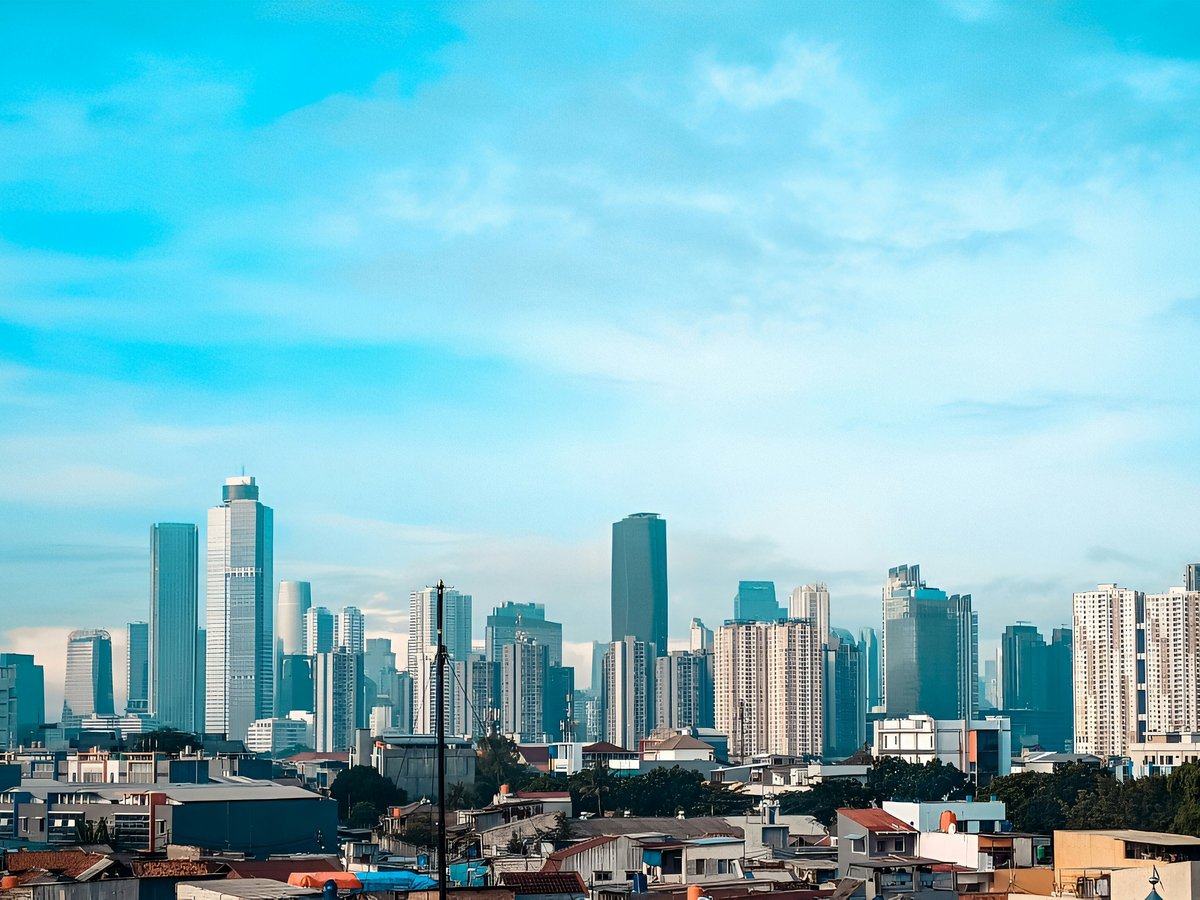
Stay in Jakarta in June
125 hotels in the Trip.com pool for Jakarta, from US$12 a night.
Opens Trip.com on Fri 4 Jun to Sun 6 Jun 2027; change the dates there.
June in Jakarta announces itself the moment you step outside Soekarno-Hatta's air-conditioned terminals. The humidity wraps around you like a warm, damp cloth, and within minutes the air carries the smoky sweetness of satay vendors firing up charcoal grills along the city's food streets. Daytime temperatures sit in the low 30s Celsius (upper 80s Fahrenheit), but the moisture makes every degree feel heavier. Afternoon showers still arrive on most days. They hit with a sudden wall of warm rain that drums on the corrugated roofs of roadside warungs, soaks everything for 30 to 60 minutes, and then vanishes as steam rises off the pavement. This is not Jakarta at its driest or most photogenic. It is the city at the start of its festival season, between the monsoon deluge and the cooler months of July and August.
What gives June its personality is a convergence of two events. Pekan Raya Jakarta, the city's annual fair at JIExpo Kemayoran, opens around the same week as HUT DKI Jakarta on June 22, the anniversary of the city's founding. The fair has run since 1968 and draws millions over several weeks. Walk through the food halls at 9 PM on any night and the air is thick with charcoal smoke, the sizzle of kerak telor cooking over clay stoves, and tinny amplified music from competing stages. The anniversary triggers Betawi cultural performances across the city, with ondel-ondel giant puppet parades moving through Kemayoran and Senen, traditional lenong theater in Kota Tua, and street-food vendors filling side streets from Condet to Central Jakarta. For a few days, Jakarta's indigenous Betawi culture moves to the foreground. The city's rapid modernization tends to push these traditions to the margins, so the anniversary is one of the few occasions when traditional dance, music, and theater fill public spaces.
If your schedule is flexible, July and August offer drier conditions and slightly cooler nights. But June's combination of lower hotel rates along the Thamrin-Sudirman corridor, thinner international tourist crowds, and the anniversary festivities makes it a practical shoulder-season choice. The Transjakarta BRT covers the main tourist axis from Blok M to Kota for a flat Rp 3,500 fare, and the MRT connects Lebak Bulus to Bundaran HI in under 30 minutes. You will need patience with the humidity and a waterproof bag for your electronics, but you will not be fighting for space at Monas or waiting in long queues at Museum Fatahillah.
Why visit in June
- Rainfall drops to roughly half of what January delivers, so outdoor walks through Menteng's tree-lined avenues, Kota Tua's canal bridges, and Kebayoran Baru's market lanes are feasible on most mornings
- Pekan Raya Jakarta opens during the month at JIExpo, bringing one of Southeast Asia's longest-running city fairs with food, live music, and trade exhibitions
- Hotel occupancy sits below the July-August dry-season peak, and international tourist density is lower than in the two months that follow
- The HUT DKI Jakarta anniversary triggers Betawi cultural festivals with ondel-ondel parades, lenong theater, and traditional street food in neighborhoods from Senen to Condet
Worth knowing
- Humidity remains high enough that even moderate temperatures feel significantly hotter, and the air rarely provides relief after dark
- Afternoon downpours still fall on most days, and the heavier ones temporarily flood low-lying roads in areas like Kampung Melayu and parts of Central Jakarta near the Ciliwung River
- Jakarta's traffic, already among the worst in Southeast Asia, intensifies during the fair period as visitors from across Greater Jakarta converge on Kemayoran and clog Jalan Benyamin Sueb
Best for
Think twice if
June sits in the early stretch of Jakarta's dry season, though 'dry' is relative when you are 6 degrees south of the equator. Rain falls on roughly 23 days, totaling about 166mm (6.5 inches), mostly as concentrated afternoon downpours rather than all-day drizzle. Mornings tend to start clear and warm, with clouds building by midday. By early afternoon, a heavy shower often rolls through, sometimes with thunder that rattles the glass in office towers along Sudirman. You hear it before you see it. The wind shifts, hawkers on Jalan Sabang cover their grills with plastic tarps, and then the rain arrives, hard and warm. It drums on tin roofs and turns gutters into small rivers. The whole cycle takes 30 to 60 minutes before the sun reappears and steam rises off the asphalt. Humidity holds at around 83%, and the overnight low of 23.5°C (74°F) offers little relief. The air stays sticky through the night. The average high of 31.4°C (89°F) sounds manageable on paper, but the moisture pushes the felt temperature closer to 38°C (100°F) during peak afternoon hours. A clear June morning in Merdeka Square feels pleasant, with bird calls from the banyan trees and joggers circling the perimeter path. By noon, the combination of heat and saturated air becomes oppressive for anyone not acclimatized to the tropics.
Seasonal caution
- Heat index frequently exceeds 38°C (100°F) when afternoon humidity combines with the day's peak temperatures. Heat exhaustion is a real risk for visitors unacclimatized to tropical conditions, particularly during midday walks through open areas like Merdeka Square or the Ancol waterfront
- Flash flooding can occur in low-lying parts of Jakarta during heavier downpours. Areas along the Ciliwung River, including parts of Kampung Melayu and Manggarai, are most susceptible and can see knee-deep water within an hour of sustained heavy rain
Year-round climate
Averages from the last 5 years.
| Month | Avg high (°C) | Avg low (°C) | Rainfall (mm) |
|---|---|---|---|
| Jan | 30 | 24 | 331 |
| Feb | 30 | 24 | 292 |
| Mar | 31 | 24 | 279 |
| Apr | 32 | 24 | 205 |
| May | 32 | 24 | 190 |
| Jun | 31 | 24 | 166 |
| Jul | 32 | 23 | 102 |
| Aug | 33 | 23 | 99 |
| Sep | 33 | 24 | 133 |
| Oct | 33 | 24 | 177 |
| Nov | 32 | 24 | 246 |
| Dec | 31 | 24 | 269 |
Holidays and festivals in June
Public holidays
- Pancasila Day(Hari Lahir Pancasila)1 June 2027
Best things to do in June
Explore Pekan Raya Jakarta at JIExpo
festivalThe annual Jakarta Fair fills the JIExpo Kemayoran complex with hundreds of food vendors, live music stages, consumer goods exhibitions, and carnival rides. The food section alone can take a full evening to cover. Walk past rows of kerak telor stalls where charcoal smoke drifts thick enough to taste, then follow the scent of grilled seafood toward the outdoor stages. Expect dense crowds after 7 PM on weekends, with the noise level of a stadium and the heat of hundreds of grills. The Transjakarta BRT has stops near JIExpo, and reaching the venue by bus avoids the traffic gridlock that clogs Jalan Benyamin Sueb on fair nights.
The fair opens in late June and runs for several weeks. It is Jakarta's single largest annual event and defines the social calendar for the month.Booking tipGo on a weeknight between Tuesday and Thursday to avoid the worst crowds. Arrive by 5 PM to explore the exhibition halls before the evening food rush.
Walk Kota Tua's colonial-era streets
cultureThe old Batavia district holds the Jakarta History Museum (Museum Fatahillah), the Wayang Museum, and the Fine Arts and Ceramics Museum, all within walking distance of Fatahillah Square. Entry to each museum is typically around Rp 5,000. The cobblestones underfoot and weathered Dutch warehouse facades feel like a different city from the glass towers along Jalan Sudirman, 5 km to the south. Cafe Batavia, facing the square, occupies a restored 19th-century building and serves coffee upstairs with a view over the cobblestones and street musicians below.
June's drier weather makes the outdoor walks between museums more comfortable than in the January-March wet season, when the square sometimes floods.Booking tipVisit on a weekday morning for the quietest experience. The museums close by 3 PM.
Watch ondel-ondel parades during HUT DKI Jakarta
cultureThe Betawi giant puppets, some standing over 2.5 meters tall, parade through streets in several neighborhoods during the anniversary celebrations. A performer dances inside each bamboo-and-rattan frame while musicians play tanjidor brass-band music alongside. The sound is a bright, chaotic mix of trumpets and drums that carries several blocks. The puppet faces are painted in bold reds and golds, and the fabric skirts swirl as the dancers spin. Parades move through parts of Kemayoran, Senen, and neighborhoods in East Jakarta.
The city's founding anniversary is the primary occasion for these parades. They are rare outside this period.Booking tipCheck the Jakarta Tourism Board announcements in the week before June 22 for confirmed parade routes and neighborhood schedules.
Morning visit to Ragunan Zoo
natureRagunan Zoo in South Jakarta, founded in 1864, covers 140 hectares and holds Komodo dragons, Sumatran orangutans, and white rhinoceroses among its collection. Entry is typically around Rp 4,000 for adults. The grounds include dense tropical canopy that drops the temperature a few degrees below the surrounding streets. Arrive early when the orangutans are active and feeding, and the morning light filters through the overhead leaves. The Schmutzer Primate Centre inside the zoo grounds houses gibbons and gorillas in open-air enclosures.
June's reduced rainfall keeps the paths drier and less muddy than in the wet season, making the full circuit more feasible on foot.Booking tipWeekday mornings are nearly empty compared to the weekend crowds. Arrive before the 8 AM opening for the shortest gate queue.
Day trip to Kepulauan Seribu (Thousand Islands)
natureThe island chain lies 1 to 3 hours by speedboat from Muara Angke harbor in North Jakarta. Pulau Tidung and Pulau Pramuka are among the more accessible options, with coral reefs shallow enough for snorkeling from the beach. The water tends toward warm and calm, with visibility that improves as the dry season settles in. Speedboats from Muara Angke start running around 7 AM, and the morning crossing is typically smoother than afternoon returns when the sea can pick up.
Seas are calmer in June than during the December-February monsoon. Crossings that get cancelled in the wet season run more reliably.Booking tipBook speedboat tickets 3-5 days ahead for weekend departures from Muara Angke. Friday afternoon boats fill early.
Sunset from the Monas observation deck
sightseeingThe National Monument, completed in 1975, rises 132 meters above Merdeka Square. The observation deck near the top offers a 360-degree view across the city's sprawl, from the red roofs of Menteng to the Java Sea in the north. On clear June evenings, you can watch the call-to-prayer lights flicker on across Jakarta's mosques as the sun drops, while the sound of the adhan from Istiqlal Mosque carries across the square below.
June evenings are more likely to be clear than in the wet-season months. The observation deck is also less crowded than during the July-August peak.Booking tipArrive by 3 PM on weekdays to catch the sunset without the worst queues. Weekend elevator waits run 60-90 minutes.
Night food crawl through Glodok
foodJakarta's Chinatown district comes alive after dark with dumpling stalls, noodle shops, and bakeries that have operated for decades. Petak Sembilan, the narrow lane through the heart of Glodok, smells of roasted duck, char siu, and sweet soy sauce after sundown. Stall-front tables spill onto the pavement, the clatter of woks competes with motorbike horns, and vendors call out their offerings in Indonesian and Hokkien. Some of the noodle stalls along this stretch have been run by the same families for three or more generations.
June's drier evenings mean fewer rain-related closures of open-air stalls along Petak Sembilan. The post-sunset temperatures, still in the upper 20s Celsius, are more comfortable for walking than during the wet-season months.Booking tipGo after 7 PM when most stalls are fully set up. No reservations needed.
What to eat in June
In season: fruit
Duku
This small, translucent-fleshed fruit ships to Jakarta from Palembang in South Sumatra and appears in local markets for roughly 6-8 weeks starting around mid-year. The flesh tastes sweet with an occasional tart seed. Worth trying if you spot it at Pasar Santa or any traditional market, since the window is narrow and supply fluctuates week to week.
On menus now
Soto Betawi
Jakarta's signature beef and coconut-milk soup, enriched with cow's milk for a distinctive richness. Jakartans eat it year-round, but during the anniversary period vendors set up pop-up stalls in Senen and Kemayoran with home-style versions that use fattier cuts and richer coconut milk than the typical warung preparation.
Street food peaks
Kerak telor
This Betawi egg-and-sticky-rice snack is cooked by tilting a hot pan over charcoal, letting the heat crisp the bottom into a crackling coconut crust while the egg sets on top. It appears everywhere during the Jakarta anniversary and Pekan Raya Jakarta. Vendors set up their portable clay stoves along Jalan Senen Raya and throughout the JIExpo food halls, and the char-smoky scent becomes one of the defining smells of June in the city.
What to drink
Bir pletok
A non-alcoholic Betawi drink made from ginger, lemongrass, sappanwood, and pandan. It turns a deep red and tastes warm and peppery despite often being served cold. The anniversary celebrations bring it out of the few Betawi restaurants that normally carry it and into street stalls across the Kota Tua area and Condet in East Jakarta.
Es cendol
Shaved ice with pandan-flavored rice jelly, coconut milk, and palm sugar. The palm sugar gives it a caramel-like sweetness that cuts through the pandan's grassy flavor. In June's heat, vendors sell it from carts along Jalan Fatmawati and other main streets in South Jakarta, and the cool coconut milk is genuinely restorative after a humid afternoon.
Regular events in June
HUT DKI Jakarta (Jakarta Anniversary)Free
The city's founding anniversary brings Betawi cultural performances, ondel-ondel parades through Kemayoran and Senen, street food pop-ups, and community events to neighborhoods across Jakarta. The celebrations typically span a week, with the main ceremony at City Hall on Jalan Medan Merdeka Selatan.
June 22 (celebrations span roughly a week)Pekan Raya Jakarta (Jakarta Fair)
Indonesia's largest consumer fair occupies the JIExpo Kemayoran complex with hundreds of food stalls, product exhibitions, live entertainment, and amusement rides. It draws millions of visitors over its multi-week run. The food halls alone contain several hundred vendors, and the charcoal smoke and noise carry well beyond the fairgrounds.
Opens mid-to-late June, runs through mid-JulyHari Lahir Pancasila (Pancasila Day)Free
A national public holiday on June 1 commemorating the state ideology. Government offices, banks, and some businesses close, but tourist attractions at Monas, Kota Tua, and Ragunan generally stay open. Flag ceremonies take place at government buildings across the city.
June 1Best places this June
Kota Tua (Old Town Jakarta)
historic districtThe former Batavia district centered on Fatahillah Square. June's reduced rainfall makes the open-air square and surrounding canal walks more comfortable than in the wet season. On weekend mornings, street musicians set up near the cafe tables on the square's edges, and the colonial-era building facades catch warm light before 10 AM. Cafe Batavia, facing the square, occupies a restored 19th-century building with a second-floor balcony that overlooks the cobblestones below.
Kota TuaTaman Mini Indonesia Indah
cultural parkA 150-hectare cultural park in East Jakarta, opened in 1975, with pavilions representing each of Indonesia's provinces. The outdoor layout means dry weather matters. June's conditions let you cover the grounds on foot without the muddy detours the wet season forces. The Javanese and Balinese pavilions have the most detailed interior collections. The textile and craft displays inside the regional pavilions offer some of the best introductions to Indonesian diversity outside of a multi-island trip.
CipayungNational Museum of Indonesia (Museum Nasional)
museumFounded in 1778, it is the oldest museum in Southeast Asia and holds one of the region's largest collections of archaeological and ethnographic artifacts. The air-conditioned interior makes it a practical midday escape from June's humidity. The Hindu-Buddhist stone sculpture collection on the ground floor includes 8th-century Javanese pieces originally from the Borobudur and Prambanan temple complexes. The textile gallery on the upper floor displays batik from dozens of Indonesian regions.
GambirAncol Dreamland (Taman Impian Jaya Ancol)
recreation areaJakarta's waterfront recreation complex on the north coast includes beaches, an art market, and ocean-facing boardwalks. June evenings bring sea breezes off the Java Sea that provide genuine relief from the inland humidity. The Pasar Seni art market section has open-air craft stalls, and the salt-air smell of the coast mixes with paint and sawdust from the woodworking vendors.
AncolMenteng
neighborhood walkSouth of Merdeka Square, Menteng's broad tree-lined avenues and colonial-era houses give it a quieter character than most of Jakarta. The mature canopy cover drops temperatures a few degrees at street level. Taman Suropati, a small park at the neighborhood's center, fills with buskers and local artists on weekend mornings. Jalan Cikini Raya runs along its eastern edge with independent cafes, the TIM (Taman Ismail Marzuki) arts center, and several galleries.
MentengPasar Santa
marketA former traditional market in Kebayoran Baru that has partially converted into a creative food-and-vintage-goods space. The upper floor hosts small vendors selling vinyl records from Indonesian and Western labels, handmade leather goods, and single-origin coffee from roasters who source their beans from Sumatra and Flores. The building is entirely indoor, making it rain-proof for June's afternoon downpours.
Kebayoran Baru
Your packing checklist
Tick items off as you pack. Your progress saves in this browser.
All packed — have a great trip.
Insider tips
The Transjakarta BRT system is the most reliable way to bypass Jakarta's traffic in June. Corridor 1 runs from Blok M to Kota, passing Sarinah, Monas, and the Glodok area. The flat Rp 3,500 fare cards are sold at every station and work across both the BRT and MRT networks.
For the Jakarta Fair, enter through JIExpo Gate 1 rather than the main entrance on Jalan Benyamin Sueb. Main-gate queues can run 30-45 minutes on weekend evenings, while Gate 1 is typically half that wait.
Menteng's side streets, particularly Jalan Cikini Raya between the TIM (Taman Ismail Marzuki) arts center and Cikini Station, have some of Jakarta's best independent coffee shops. The roasters tend to source single-origin beans from Sumatra and Flores, and the spaces are quieter and less formulaic than the branded chains inside the Sudirman corridor malls.
If you want to see ondel-ondel during the anniversary week but prefer smaller crowds, skip the main parade routes and head to the neighborhood celebrations in Condet (East Jakarta), where the Betawi community is most concentrated and the atmosphere feels more personal.
Jalan Sabang (also called Jalan KH Agus Salim) is Jakarta's most concentrated food street and lies within walking distance of Monas. After 6 PM, the sidewalk stalls open with sate ayam, nasi goreng, martabak, and fresh juices. The crowd is mostly local office workers and university students.
Jalan Surabaya in Menteng hosts a long strip of antique and vintage shops selling wayang puppets, Dutch colonial-era ceramics, and old batik. Prices are negotiable and tend to run lower on weekday mornings when foot traffic is light.
Avoid these mistakes
- Booking outdoor sightseeing at Monas, Kota Tua, or Ragunan Zoo between 12 PM and 3 PM. The felt temperature in June often exceeds 38°C (100°F) during those hours. Move open-air activities to before 9 AM or after 4 PM, and use the midday stretch for air-conditioned spaces like Museum Nasional in Gambir or the National Gallery of Indonesia on Jalan Medan Merdeka Timur.
- Going to the Jakarta Fair on a Saturday evening without a plan for the crowd density. Weekend evenings at JIExpo mean shoulder-to-shoulder foot traffic that makes moving between food stalls a slow, sweaty exercise. Weeknight visits between Tuesday and Thursday offer the same stalls and stages with enough breathing room to sit down and eat.
- Relying on Gojek or Grab between 5 PM and 8 PM for cross-city trips. A 5 km ride from Thamrin to Kemang by car can take 45-60 minutes during the evening rush. The MRT from Bundaran HI to Blok M takes 12 minutes for the same distance, and the Transjakarta busway has dedicated lanes that bypass most of the gridlock.
Practical tips for June
The Transjakarta BRT and MRT run slightly reduced schedules on Pancasila Day (June 1), so check departure times if you plan to travel that morning. Many government offices and banks close for the holiday, but tourist attractions typically stay open. If your visit overlaps with the anniversary week around June 22, book accommodation at least 2 weeks ahead, as domestic visitors fill mid-range hotels near JIExpo Kemayoran and along the Thamrin corridor. Jakarta's solo-traveler safety sits at 5.2/10 (see the TTDI Solo-Safety Index). Use registered ride-hailing apps like Gojek or Grab rather than unofficial taxis, particularly after dark in the Kota Tua district. Dress modestly when visiting Istiqlal Mosque, Southeast Asia's largest, located adjacent to Merdeka Square. Lightweight long trousers and covered shoulders are required inside. Mind you, most upscale restaurants in Kemang and SCBD enforce a closed-toe-shoe policy, so pack one pair if you plan to eat beyond the street-food circuit.
FAQ
Is June a good time to visit Jakarta?
June sits in the transition from wet to dry season, with roughly half the rainfall of January but more than July or August. The Jakarta Fair and the city's founding anniversary on June 22 give the month a cultural dimension that the drier months lack. Hotel rates along the Thamrin corridor and in Kemang tend to run 15-25% below the July-August peak, and international tourist density stays noticeably lower. If you want the driest conditions, come in August. If you want lower costs, thinner crowds, and Betawi street festivals while still being able to eat outdoors on Jalan Sabang most evenings, June delivers that combination.
What is the weather like in Jakarta in June?
Warm, humid, and punctuated by afternoon rain. Daytime temperatures hold in the low 30s Celsius (high 80s Fahrenheit) and nights stay around 23-24°C (74-75°F). The humidity, typically around 83%, is the defining factor. Step out of any air-conditioned mall on Jalan Sudirman and the air hits you like a warm, damp cloth. Most rain arrives as short, intense afternoon showers that clear within an hour, often preceded by a sudden darkening of the sky around 2 PM. Mornings tend to start clear, so a 7 AM walk through Menteng or around Taman Suropati park is one of the more comfortable outdoor windows in the day.
Is Jakarta crowded in June?
International tourist numbers in June sit below the July-August dry-season peak. The Jakarta Fair draws large domestic crowds, particularly on weekend evenings when JIExpo Kemayoran can feel shoulder-to-shoulder after 7 PM. Areas around Kemayoran and Pademangan get congested during the fair weeks. That said, South Jakarta neighborhoods like Kemang and Cipete remain quieter, and weekday mornings at Kota Tua or Museum Nasional feel almost relaxed. The rest of the city operates at its normal, dense baseline. Mind you, Jakarta's normal is still louder and more packed than most Southeast Asian capitals.
Is Jakarta family-friendly in June?
Jakarta scores 5.8/10 for family friendliness (see the TTDI Family-Friendliness Index). Ragunan Zoo in South Jakarta has a dedicated children's section and a primate exhibit that keeps younger visitors engaged for a full morning. Taman Mini Indonesia Indah in East Jakarta is designed for family visits with interactive provincial pavilions spread across 150 hectares. The Jakarta Fair also has rides and carnival games aimed at children. That said, the heat and humidity can be taxing for kids under 5, and Jakarta's sidewalks are uneven in many areas, making strollers difficult to manage outside of malls like Grand Indonesia or Pacific Place. KidZania at Pacific Place offers an air-conditioned alternative when the afternoon heat peaks.
Do I need a visa to visit Jakarta?
Indonesia offers visa-on-arrival to nationals of many countries, valid for 30 days and extendable once. Some nationalities qualify for visa-free entry for shorter stays. Check the latest requirements with the Indonesian embassy in your home country before booking, as policies change periodically. The visa-on-arrival counter at Soekarno-Hatta International Airport Terminal 3 typically processes arrivals in 15-30 minutes, though the queue can stretch longer on flights arriving between 10 PM and midnight when multiple international services overlap.
Things to Do in Jakarta in June
 Free cancellation
 Active Volcano, Rice Field, Hot Spring, Fruit market, Tea Plantation with Lunch
Day trip: free cancellation.
via Viator Free cancellation
 Private Car Charter in Bali with an English-speaking Driver
Day trip: free cancellation.
via Viator Free cancellation
 Private Full-Day Guided Tour: Explore Jakarta’s Top Highlights
Day trip: free cancellation.
via Viator Free cancellation
 Bali Jungle Swing Experience Full Activity
Outdoor experience: free cancellation.
via Viator Free cancellation
 Jakarta Half-Day Sightseeing Tour To Modern City and Old Town
Day trip: free cancellation.
via Viator Free cancellation
 Jakarta Bogor Botanical Garden, Waterfall and Rice terrace, Lunch
Outdoor experience: free cancellation.
via ViatorLast verified by automated review (v1.7.2) on . What is automated review?