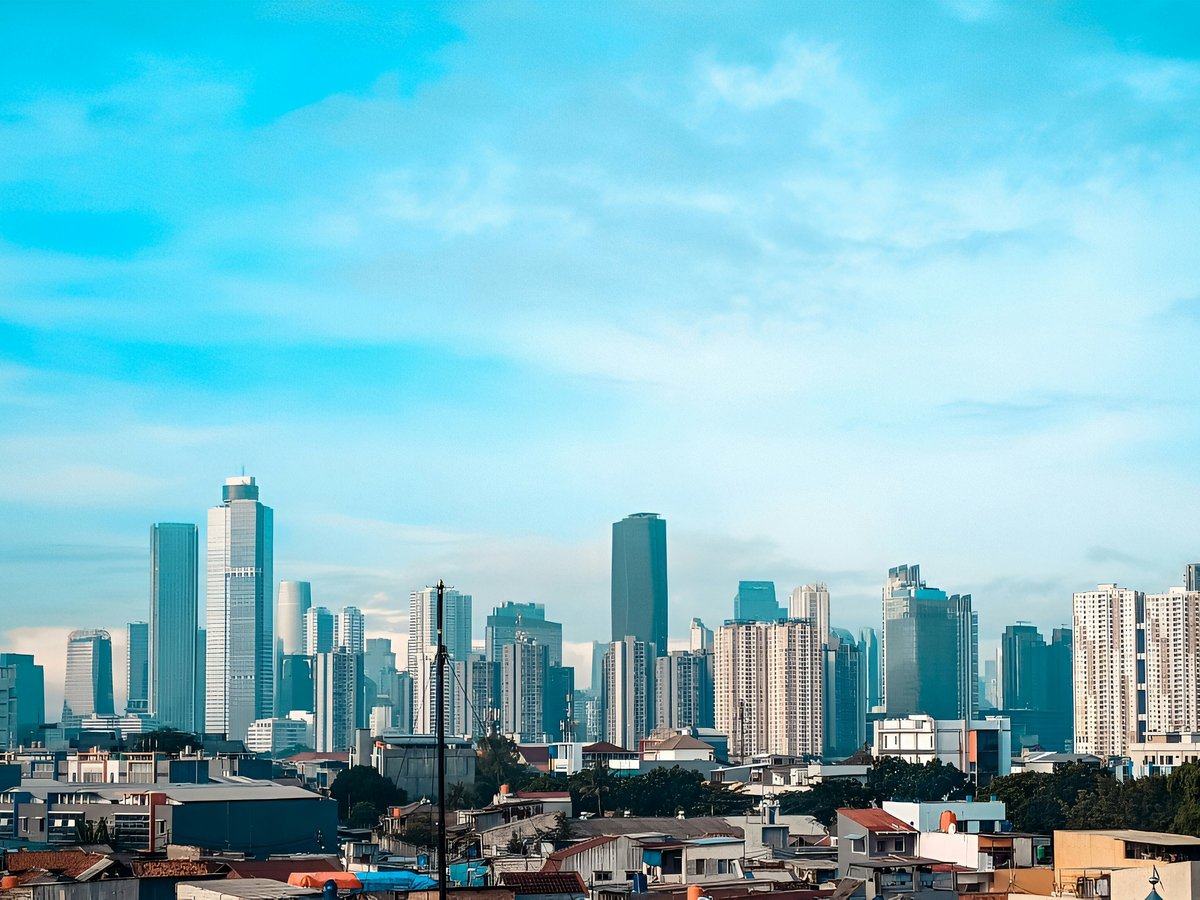
Jakarta spreads across a low-lying alluvial plain where the Ciliwung River empties into the Java Sea. The city sits mostly below 10 meters elevation, and at midday the air currently reads 33.7°C with humidity at 45%, though it feels closer to 38.3°C. With over 10 million residents in the city proper, Jakarta might seem like unlikely territory for outdoor recreation. The dry season from May through October opens a real window for hiking, cycling, and island trips. The wet months from November to April bring 200 to 300 mm of rain per month, turning unpaved trails into thick red-brown mud that clings to everything below the knee.
Jakarta's coastal position on the north edge of Java works in your favor, though. Kepulauan Seribu, the Thousand Islands, begins about 45 km north of Muara Angke port. The volcanic highlands near Bogor and Puncak rise roughly 60 km south, where peaks climb above 2,900 meters and the air drops to 18 to 22°C. Within the city, Merdeka Square anchors the center with enough open green space to draw joggers before dawn. Several newer urban parks have expanded the walkable landscape over the past decade. Jakarta's equatorial latitude, about 6 degrees south, sets the daily pattern. Start before 7 AM, when the temperature still sits near 26°C and the streets carry the warm oil-and-spice scent of tempeh frying at the morning warungs. Seek shade or water by noon.
Outdoor activities
-
Car-Free Day cycling on Jalan Sudirman and Jalan MH Thamrin
Every Sunday morning from 6 AM to roughly 11 AM, Jakarta closes a stretch of about 6 km along Jalan Sudirman and Jalan MH Thamrin to motor traffic. The road fills with cyclists, joggers, and walkers. You can rent a bicycle from vendors lining the route for around 30,000 to 50,000 IDR per hour. The flat terrain and wide lanes make it genuinely enjoyable, and you'll pass the Bundaran HI roundabout and the Welcome Monument along the way. Mind you, it gets packed by 8 AM, so arrive early if you want room to ride without weaving through pedestrian clusters.
- Difficulty
- Easy
- Duration
- 1 to 3 hours
- Best season
- Year-round, but the dry months from May to October are more comfortable
-
Trail running near Sentul, Bogor Regency
The hills around Sentul, about an hour's drive south on the Jagorawi toll road, have some of the closest unpaved running terrain to the city. Local trail-running clubs organize weekend group runs through plantation roads and forest paths near Babakan Madang. Elevation gain is modest, maybe 200 to 400 meters over a 10 km loop, but the red-laterite surface gets slippery after rain. You might hear Javan gibbons calling in the canopy on quieter mornings in the Babakan Madang stretches. The air at Sentul's 400 to 700 meter elevation feels noticeably cooler than the low-lying city center.
- Difficulty
- Moderate
- Duration
- 2 to 4 hours including travel
- Best season
- June through September for drier trail surfaces
-
Bird watching at Muara Angke Wildlife Reserve
Muara Angke Wildlife Reserve sits on Jakarta's northwest coast, a roughly 25-hectare remnant of mangrove forest surrounded by fishponds and urban development. The reserve is reportedly home to around 90 recorded bird species, including resident kingfishers and seasonal migratory waders from as far as Siberia. The boardwalk paths are flat and short, maybe 2 km total, but the birding can be productive in early morning. Bring binoculars and mosquito repellent. The salt-and-fish smell from the neighboring fish market is constant background atmosphere.
- Difficulty
- Easy
- Duration
- 2 to 3 hours
- Best season
- October through March for migratory species
-
Running the Gelora Bung Karno Sports Complex
The grounds around Gelora Bung Karno Stadium, which opened in 1962 for the Asian Games, form one of Jakarta's most popular running circuits. The outer perimeter loop covers roughly 3.5 km on paved paths, shaded in parts by mature rain trees. Regulars arrive between 5:30 and 6:30 AM before the heat builds. The complex also has a public swimming pool for around 35,000 IDR. Weekend mornings tend to fill with family groups by 8 AM. Weekday runners before 6 AM often have the circuit nearly to themselves.
- Difficulty
- Easy
- Duration
- 1 to 2 hours
- Best season
- Year-round, early morning
-
Walking Kota Tua, Jakarta's Old Town
The Kota Tua district in West Jakarta sits on the site of old Batavia, the Dutch colonial capital that stood here from 1619 to 1949. A walking circuit of about 3 km connects the Jakarta History Museum on Fatahillah Square, the old Dutch buildings along Kali Besar, and the Sunda Kelapa harbor where traditional pinisi schooners still dock. The harbor smells of tar and dried fish. Fatahillah Square is lined with colonial-era buildings that predate Indonesian independence. Start before 9 AM to beat the midday heat and the weekend crowds that pack the square by noon.
- Difficulty
- Easy
- Duration
- 2 to 3 hours
- Best season
- May through October for dry, less humid conditions
Day hikes
-
Gunung Pancar forest walk and hot springs
Gunung Pancar sits about 70 km south of Jakarta in Bogor Regency. The walk through the Pinus merkusii plantation follows a wide dirt path that gains roughly 100 to 200 meters of elevation over 3 to 4 km. It is more of a nature walk than a proper hike, but the forest is quiet on weekday mornings and the hot sulfur springs at the end make the trip worthwhile. You'll catch the sulfur smell about 500 meters before the pools. Entry to the forest area costs around 20,000 IDR. Drive time from central Jakarta is 1.5 to 2 hours via the Jagorawi toll road.
- Difficulty
- Easy
- Duration
- Half day including 1.5 to 2 hours of driving each way
- Best season
- May through October for dry trails, though the pine canopy provides shade year-round
-
Kawah Ratu crater hike on Gunung Salak
Kawah Ratu is a volcanic crater on the northern slope of Gunung Salak, accessed from the Taman Nasional Gunung Halimun Salak boundary near Bogor. The trail from the entry post to the crater rim covers about 6 km one way, mostly through dense tropical forest with steep sections over exposed roots. The path can be muddy even during the dry months. You'll feel the temperature drop as you climb above 1,500 meters. The crater itself vents sulfurous steam from several fumaroles, and the ground near the rim feels warm underfoot. Hire a local guide, because trail markings tend to be inconsistent.
- Difficulty
- Moderate to strenuous
- Duration
- Full day, 5 to 7 hours on trail plus roughly 2 hours driving each way
- Best season
- June through September for the driest conditions
-
Gunung Gede summit via Cibodas Botanical Garden
Gunung Gede rises to 2,958 meters in the Gunung Gede Pangrango National Park, about 100 km southeast of Jakarta. The trail from the Cibodas entrance passes through the botanical garden, then montane forest, and eventually sub-alpine meadow. The Suryakencana meadow at around 2,750 meters is a field of Javanese edelweiss that catches most hikers off guard. Total ascent from the trailhead is roughly 1,700 meters of elevation gain over about 10 km. Registration at the park office is required, and a daily quota limits hiker numbers. Most sunrise-summit hikers start the trail between 2 and 3 AM.
- Difficulty
- Strenuous
- Duration
- Full day, 8 to 12 hours on trail, or overnight with camping
- Best season
- June through September; the park sometimes closes trails during peak wet season
-
Curug Cilember waterfall walk near Puncak
Curug Cilember is a series of 7 waterfalls connected by a forest trail in the Puncak highlands, about 80 km south of Jakarta. The walk to the first 3 falls follows a maintained path that most fitness levels can handle without trouble. The trail to the upper falls gets steeper and less maintained. The forest sits at a notably cooler 22 to 25°C compared to the city, and the sound of running water is constant along the route. Butterflies cluster thickly in the clearings near the lower falls during the morning. Entry is around 25,000 IDR.
- Difficulty
- Easy for the lower falls, moderate for the full 7-waterfall circuit
- Duration
- 3 to 4 hours for all 7 waterfalls
- Best season
- Dry season from May through October for better footing, though the falls flow more after rain
Water activities
-
Snorkeling at Kepulauan Seribu (Thousand Islands)
The Thousand Islands chain stretches north into the Java Sea, with the marine national park zone around Pulau Harapan and Pulau Kelapa offering the best coral. Visibility ranges from 5 to 15 meters depending on season and recent weather. On good days you'll see clownfish, parrotfish, and occasional sea turtles on the outer reefs. Speed boats leave from the North Jakarta harbors, with the closer islands about 1.5 hours out and the outer park islands taking 3 hours or more. Round-trip boat tickets to the mid-range islands typically cost 300,000 to 500,000 IDR.
- Difficulty
- Easy to moderate depending on currents
- Duration
- Full day or overnight
- Best season
- April through October for calmer seas and better visibility
-
Mangrove kayaking at the Angke Kapuk coast
The mangrove forest along Jakarta's northwest coast near Pantai Indah Kapuk still supports a narrow band of protected habitat. A few local operators run kayak tours through the tidal channels, typically lasting 1.5 to 2 hours. The water is brackish and not clear, but the mangrove roots are dense with mudskippers and fiddler crabs. Birders might spot Javan pond herons and collared kingfishers in the branches overhead. Tours generally cost 150,000 to 250,000 IDR per person with equipment included. Go during higher tide for easier passage through the shallower channels.
- Difficulty
- Easy
- Duration
- 1.5 to 2 hours on the water
- Best season
- May through September for drier, less humid conditions
-
Swimming and cycling at Pulau Tidung
Pulau Tidung is a pair of connected islands in the Thousand Islands group, reachable in about 1.5 hours by speedboat from the mainland or roughly 3 hours by slow ferry. The main island has a resident community of a few thousand people, and the smaller island connects via a long pedestrian bridge that doubles as a popular jumping point for swimmers. The water around the bridge is shallow and relatively calm, suited to less confident swimmers. Bicycle rental on the island runs about 50,000 IDR per day, and the flat terrain lets you loop it in under an hour. Homestays cost around 200,000 to 400,000 IDR per night.
- Difficulty
- Easy
- Duration
- Overnight recommended, day trip possible
- Best season
- April through October for calm seas
-
Ancol Dreamland waterfront and boardwalk
Taman Impian Jaya Ancol, Jakarta's waterfront recreation complex in North Jakarta, stretches along several kilometers of the Jakarta Bay shoreline. The beach water is not recommended for swimming due to pollution, but the complex includes the Atlantis Water Adventure pool for proper swimming and a marina from which fishing charters and island boats depart. Jet ski rental runs around 500,000 IDR per 15 minutes in the marina area. The Ancol boardwalk is a flat, paved walk of about 3 km along the seawall. The late-afternoon sea breeze off Jakarta Bay makes it one of the few waterfront spots where the heat lets up. Entry to the Ancol complex costs around 25,000 IDR.
- Difficulty
- Easy
- Duration
- Half day
- Best season
- Year-round for the complex, April through October for boat trips from the marina
Parks & gardens
-
Merdeka Square
This 75-hectare public square at the center of Jakarta is dominated by the National Monument, completed in 1975, which rises 132 meters above the flat cityscape. The park grounds around the monument include walking paths, a fountain plaza, and open grass areas where families spread out on weekend mornings. The deer park in the northwest corner holds a small group of Javan deer behind low fencing. The square gets hot by mid-morning, so plan your visit before 8 AM if you want to walk the full perimeter, roughly 4.5 km.
Highlights: National Monument observation deck at 115 meters, Javan deer park, independence-era reliefs in the base museum
-
Ragunan Zoo and Botanical Garden
Ragunan has been operating since 1864, making it one of the oldest zoos in Southeast Asia. The grounds span roughly 140 hectares in South Jakarta's Pasar Minggu district, and the mature tree canopy provides genuine shade on hot days. The collection includes Komodo dragons, Sumatran tigers, orangutans, and a good range of native bird species. Beyond the enclosures, a section of secondary forest has walking trails where monitor lizards and long-tailed macaques move freely through the undergrowth. Entry costs under 50,000 IDR for foreign visitors.
Highlights: Schmutzer Primate Centre with orangutans and gorillas, Komodo dragon enclosure, shaded forest walking trails
-
Taman Mini Indonesia Indah
Taman Mini also opened in 1975, conceived as a cultural theme park showcasing Indonesia's provincial traditions across roughly 150 hectares. The grounds include 34 provincial pavilions, a large artificial lake shaped like the Indonesian archipelago, and several smaller museums. You can rent a bicycle to cover the grounds at a comfortable pace, and the mix of trees and open space makes it a reasonable half-day outdoor excursion in the east of the city. The cable car crossing the lake gives an aerial perspective of the layout below.
Highlights: Bicycle rental circuit through the grounds, cable car over the archipelago-shaped lake, 34 provincial pavilion gardens
-
Taman Suropati
FreeThis small circular park in the Menteng district sits at the intersection of three colonial-era avenues. The park covers maybe half a hectare, so you can walk through it in 10 minutes. But the ASEAN sculpture garden is worth a stop, with pieces contributed by member nations. In the evenings, amateur musicians sometimes set up on the benches and the sound drifts through the surrounding trees. The Menteng streets nearby are lined with colonial bungalows and old rain trees, making the broader neighborhood a fine area for a late-afternoon walk when the temperature eases below 30°C.
Highlights: ASEAN sculpture garden, evening street musicians, colonial-era Menteng neighborhood architecture
-
Tebet Eco Park
FreeTebet Eco Park opened in 2022 after the Jakarta city government converted a stretch of disused land along the Ciliwung River in South Jakarta. The park spans roughly 7 hectares and includes a boardwalk over a rehabilitated wetland section, a children's play area, and outdoor fitness stations. It tends to get very crowded on weekends, so weekday mornings offer a quieter experience. The landscaping uses native plants, and the wetland section attracts a few egret species that perch in the low trees along the water's edge.
Highlights: Ciliwung River boardwalk, wetland bird habitat, outdoor fitness stations
Practical tips
- Sun protection and hydration
- Jakarta's UV index regularly exceeds 10 between 10 AM and 2 PM. Apply SPF 50 sunscreen before heading out and reapply every 2 hours. Carry at least 2 liters of water for any outdoor activity lasting more than an hour. Rehydration salts, sold as oralit at any Indomaret or Alfamart for under 5,000 IDR per sachet, are worth carrying for longer hikes. Heatstroke risk is real in this climate. If you feel dizzy or stop sweating, get into shade immediately.
- Footwear and clothing
- For city parks and the Sunday cycling circuit, any comfortable athletic shoe works. For the highland hikes around Bogor and Puncak, bring proper trail shoes with good grip. Trails on Gunung Salak and Gunung Gede stay muddy even during drier months, and exposed roots make ankle support helpful. Lightweight, moisture-wicking fabric is essential. Cotton stays damp and heavy in Jakarta's humidity. Pack a light rain shell even in the dry season, since afternoon showers can still form above 1,000 meters.
- Getting to trailheads
- Most highland hiking areas south of the city require private transport or a hired car. Grab and Gojek ride-hailing apps operate throughout Jakarta and into Bogor Regency. A Grab car to Gunung Pancar from central Jakarta costs roughly 200,000 to 350,000 IDR one way, depending on traffic. For the Thousand Islands, boats depart from the harbor areas in North Jakarta. Book speedboat tickets a day in advance for weekend trips, as seats fill early. For more detail on city transit options, see https://en.wikivoyage.org/wiki/Jakarta#Get_around.
- Money and supplies
- 1 USD currently converts to about 17,727 IDR. Most trailhead entry fees, boat tickets, and gear rentals are cash-only. ATMs are easy to find in Jakarta proper but scarce near rural trailheads and nonexistent on the smaller islands. Withdraw enough cash before leaving the city. Minimarkets like Indomaret and Alfamart are everywhere in Jakarta and Bogor and carry sunscreen, insect repellent, and bottled water. For more on currency exchange and other logistics, see https://en.wikivoyage.org/wiki/Jakarta#Cope.
- Trail conditions and hazards
- Highland trails south of Jakarta sit on volcanic soil that turns extremely slippery when wet. Trekking poles help on the steeper sections. Leeches are common on forest trails during the wet season from November through March. Tuck pants into socks and check your skin regularly. Trail signage varies widely. The main routes on Gunung Gede are reasonably well marked, but secondary trails often lack markers entirely. Download offline maps or carry a GPS device.
- Safety
- Jakarta scores 5.2 out of 10 for solo-traveler safety (see the TTDI Solo-Safety Index). For outdoor activities specifically, the main risks are heat-related illness, slippery trails, and occasional petty theft at popular trailheads. Do not leave valuables visible in parked cars. On the islands, currents near channel openings can be stronger than they look. Let someone know your plans if heading into the highlands alone. Emergency services are reachable at 112, though response times outside Jakarta city limits can be slow. For a fuller safety overview, see https://en.wikivoyage.org/wiki/Jakarta#Stay_safe.
FAQ
What is the best time of year for outdoor activities around Jakarta?
The dry season from May through October offers the widest range of options. Highland trails are drier and more stable, seas around the Thousand Islands are calmer with better underwater visibility, and the city itself carries lower humidity than during the wet months. November through April brings heavy rain that can close some highland trails and delay island ferry services. That said, early mornings year-round tend to be workable for city parks and the running circuit at the GBK complex.
How do I get from central Jakarta to the Thousand Islands?
Speed boats and slow ferries depart from Muara Angke harbor in North Jakarta and from the marina inside the Ancol complex. The closer islands like Pulau Untung Jawa take about 30 to 45 minutes by speed boat. Popular mid-range destinations like Pulau Tidung and Pulau Pari are 1.5 to 2 hours by speed boat and roughly double that by slow ferry. Weekend boats fill up quickly, so booking through a local tour operator a day ahead is worth the small markup.
Do I need a guide for the volcano hikes south of Jakarta?
For Gunung Gede, the national park requires registration and limits daily hiker numbers. The main Cibodas trail is reasonably marked, but a local guide is still advisable for first-timers, especially for pre-dawn summit starts. For Kawah Ratu on Gunung Salak, a guide is more strongly recommended because markings can be sparse. Guides are typically available at the park offices for roughly 300,000 to 500,000 IDR per day. For easier walks like Gunung Pancar or the Curug Cilember waterfalls, a guide is not necessary.
Is the water safe to swim in at Jakarta's city beaches?
The Jakarta Bay shoreline at Ancol is not recommended for swimming due to pollution from the city's rivers and drainage. For open-water swimming, head to the Thousand Islands, where water quality improves significantly with distance from the mainland. The outer islands around the marine national park zone have the clearest conditions. For pool swimming in the city, the Ancol complex has Atlantis Water Adventure, and the sports complex near the National Monument area has a more affordable lap pool option.
What gear should I pack for a day hike from Jakarta?
Bring 2 to 3 liters of water per person, trail shoes with traction, a light rain shell, SPF 50 sunscreen, insect repellent, and a basic first aid kit. For highland hikes above 1,500 meters, add a fleece or long-sleeve layer because temperatures can run 10 to 15°C cooler than the city floor. Cash is essential since most trailheads have no card payment. Pack your trash out. Trail bins are rare and often overflowing on popular routes.
Can I cycle outside of the Sunday Car-Free Day in Jakarta?
You can, though Jakarta's weekday traffic makes road cycling on the main arteries risky. Dedicated bike lanes have expanded in some areas, particularly along parts of Jalan Sudirman, but they are not continuous and often blocked by parked vehicles or motorcycles. The GBK complex grounds are a safer option for cycling on non-Sunday mornings. For longer weekend rides, some cycling clubs use quieter routes through industrial zones in Cakung and Marunda before the commercial traffic picks up after 7 AM.
Outdoor experiences in Jakarta
 Free cancellation
 Bali Jungle Swing Experience Full Activity
Outdoor experience: free cancellation.
via Viator Free cancellation
 Jakarta Bogor Botanical Garden, Waterfall and Rice terrace, Lunch
Outdoor experience: free cancellation.
via Viator Free cancellation
 Ubud Private Tours with Jungle Swing Experience - all inclusive
Outdoor experience: free cancellation.
via Viator Free cancellation
 Jakarta: Hidden Waterfall Rainforest Trek & Botanical Garden Tour
Outdoor experience: free cancellation.
via ViatorLast verified by automated review (v1.7.2) on . What is automated review?