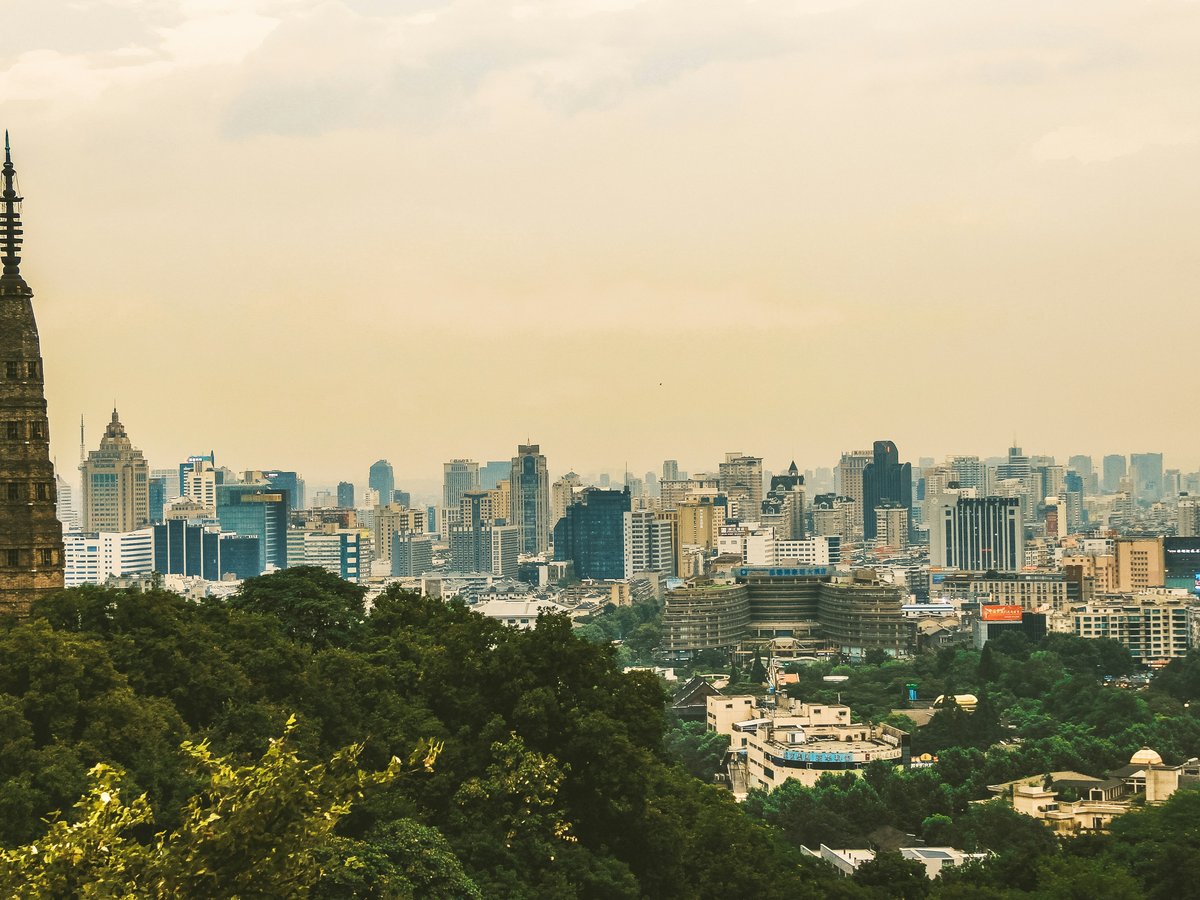
Stay in Nanjing in September
86 hotels in the Trip.com pool for Nanjing, from US$5 a night.
Opens Trip.com on Fri 3 Sep to Sun 5 Sep 2027; change the dates there.
September in Nanjing is the city's long exhale after two months of furnace-grade heat. Nanjing earned its place on China's historical 'Four Furnaces' list, and while July and August regularly push past 33°C (91°F), September pulls back to an average high of 28.7°C (84°F) with lows near 21.8°C (71°F). Humidity hovers at 79%, and you can expect roughly 10 rainy days through the month. Most of that rain falls as quick afternoon bursts that clear in 30-60 minutes rather than daylong downpours.
The cultural calendar picks up as the heat loosens its grip. In years when the Mid-Autumn Festival falls in late September, mooncake vendors fill the alleyways around Fuzimiao, and lantern displays stretch along the Qinhuai River. Whether or not the festival lands this month, late September brings the osmanthus bloom across the slopes of Zijin Shan. The flowers measure barely 5mm across and are easy to miss visually. The scent carries for blocks. A sweet, almost apricot-like fragrance settles over the Gulou and Xuanwu districts on still evenings, and it is the single most distinctive sensory marker of Nanjing's transition from summer to autumn.
September is not the peak month for visiting Nanjing. October and November bring drier air, sharper light, and the golden ginkgo avenues that draw photographers from across China. September is the transition, about 4°C cooler than July on average but still warmer and wetter than the months that follow. If you can tolerate a few sticky afternoons and keep a rain jacket in your daypack, you'll find Nanjing coming back to life with noticeably fewer tourists at the Presidential Palace and along the ancient city wall.
Why visit in September
- Summer heat has broken noticeably from July and August, with highs about 4°C lower than peak summer and evenings cool enough for comfortable outdoor dining along the Qinhuai River.
- Osmanthus trees bloom across Zijin Shan, Qingliang Park, and the Linggu Temple grounds from mid-September onward, producing one of the most distinctive seasonal scents in eastern China.
- Crowds thin considerably after the school summer holiday ends in late August, with shorter queues at the Sun Yat-sen Mausoleum and Ming Xiaoling compared to July.
- Shoulder-season accommodation rates sit well below the October Golden Week spike, offering the same hotels at notably lower prices than you'd pay 2 weeks later.
- Hairy crab season begins in late September at restaurants across Xinjiekou and the Confucius Temple area, with the earliest female crabs from nearby Gaochun before the October rush.
Worth knowing
- Humidity averages near 80% and the first half of September can still produce uncomfortably muggy days that feel closer to August than autumn, particularly in low-lying areas around Xuanwu Lake.
- Rainfall reaches 145mm across about 10 days, making it unreliable for travelers on tight schedules who need guaranteed clear skies for outdoor sightseeing.
- Late September sees early Golden Week price creep as hotels and rail tickets toward October 1 begin to rise, especially during the final 5-7 days of the month.
- Typhoon remnants occasionally push inland from the Jiangsu and Zhejiang coast, bringing 2-3 days of continuous heavy rain that can disrupt travel plans with limited advance warning.
Best for
Think twice if
The month opens warm and damp, still carrying summer's tail through its first 10 days. Early September can deliver the occasional 32°C (90°F) afternoon, while the final week's evenings might drop below 20°C (68°F). Rain tends to come in sharp afternoon showers that clear quickly, though typhoon remnants can bring prolonged wet spells once or twice per season. Morning fog sometimes settles over Xuanwu Lake before burning off by 10 AM. The overall trajectory is one of gradual improvement, with each passing week less oppressive than the last. By month's end, evening walks through the Gulou university district feel genuinely crisp.
Seasonal caution
- Typhoon remnants can reach Nanjing from the Zhejiang and Fujian coast between mid-September and early October, bringing sustained rainfall of 50-100mm over 2-3 days and disrupting high-speed rail schedules. Monitor the China Meteorological Administration forecasts if traveling during the second half of the month.
- Heat spikes in early September occasionally push daytime temperatures above 35°C (95°F) for 1-2 day stretches, carrying over from August's furnace pattern. These are uncommon but worth checking for if you plan outdoor hikes on Zijin Shan during the first week.
Year-round climate
Averages from the last 5 years.
| Month | Avg high (°C) | Avg low (°C) | Rainfall (mm) |
|---|---|---|---|
| Jan | 9 | 0 | 41 |
| Feb | 10 | 2 | 53 |
| Mar | 17 | 7 | 91 |
| Apr | 23 | 13 | 79 |
| May | 26 | 17 | 115 |
| Jun | 30 | 22 | 184 |
| Jul | 33 | 26 | 255 |
| Aug | 33 | 26 | 123 |
| Sep | 29 | 22 | 145 |
| Oct | 23 | 15 | 74 |
| Nov | 17 | 9 | 33 |
| Dec | 10 | 1 | 17 |
Holidays and festivals in September
Public holidays
- Mid-Autumn Festival(中秋节)15 September 2027
Headline events
Mid-Autumn Festival (中秋节)
Late September or early October (15th of the 8th lunar month, date shifts yearly)
China's second-most-important traditional holiday after Lunar New Year. Families gather to eat mooncakes, light lanterns, and admire the full moon. In Nanjing, Fuzimiao and the Qinhuai River corridor host large-scale lantern displays that draw tens of thousands of visitors over the 3-day public holiday. The festival date follows the lunar calendar and falls in late September in some years, early October in others.
Best things to do in September
Walk the osmanthus trails at Linggu Temple (灵谷寺)
natureThe forested paths around Linggu Temple on the eastern slope of Zijin Shan are lined with over 2,000 osmanthus trees. The blooming period typically spans from mid-September through early October, and the concentration of trees creates an almost overwhelming fragrance along the 3km walking loop. Morning visits before 9 AM offer the strongest scent and the fewest other visitors.
Osmanthus bloom peaks in mid-to-late September, and Linggu Temple holds the densest grove in the city.Booking tipNo booking needed. Accessible by metro Line 2 to Xiamafang station, then a short walk or shuttle bus through the Zhongshan Scenic Zone.
Climb Sun Yat-sen Mausoleum (中山陵) at dawn
sightseeingThe 392 stone steps leading to the mausoleum are a Nanjing landmark, but July and August heat makes a midday attempt miserable. September mornings in the low 20s°C turn the ascent into a genuinely pleasant experience. The view from the top stretches across the Zijin Shan canopy with early-autumn haze softening the cityscape below.
September is the first month since May where morning temperatures make the 392-step climb comfortable rather than grueling.Booking tipFree entry but reservation required through the Zhongshan Scenic Area WeChat mini-program. Weekend slots fill 2-3 days ahead.
Evening boat ride on the Qinhuai River (秦淮河)
cultureThe stretch of the Qinhuai River between Fuzimiao and Zhonghua Gate is lit with lanterns after dark, and traditional wooden boats hold 6-8 passengers for a 50-minute loop. September evenings are the first since spring where sitting on an open boat for nearly an hour feels comfortable rather than sweltering.
Evening temperatures drop enough to make the open-air boat ride pleasant. If Mid-Autumn falls in September, the lantern displays along the river intensify considerably.Booking tipBuy tickets at the Fuzimiao dock. Weekday evenings have shorter queues. Saturday waits can reach 45 minutes.
Explore the Sacred Way (神道) at Ming Xiaoling
historyThe 600m stone path lined with carved animals and officials leading to the Hongwu Emperor's mausoleum is one of the most atmospheric walks in eastern China. September's softer light and the beginning of canopy thinning give the stone figures a different quality than summer's dense green shade. Late afternoon around 4-5 PM produces the longest shadows along the path.
Summer tour groups have thinned after August, and the lower sun angle creates dramatic shadows along the Sacred Way that overhead summer light cannot produce.Booking tipPart of the Ming Xiaoling scenic area. Visit on a weekday to have stretches of the path nearly to yourself.
Mooncake tasting through Laomenxi (老门西)
foodThe narrow lanes of Laomenxi, one of the few surviving old residential neighborhoods in Nanjing, are home to several small bakeries producing handmade mooncakes in the weeks before Mid-Autumn. The savory duck-egg-yolk versions differ noticeably between shops. The neighborhood retains whitewashed walls and grey-tiled roofs, the kind of streetscape that most of Nanjing demolished decades ago.
Mooncake production peaks in September ahead of the Mid-Autumn Festival. Several Laomenxi bakeries only produce mooncakes during this 3-4 week window.Booking tipNo booking needed. Walkable from Zhonghua Gate metro station on Line 1. Go mornings when bakeries are pulling fresh batches from the ovens.
Rainy-day deep dive at Nanjing Museum (南京博物院)
cultureNanjing Museum, founded in 1950, holds over 400,000 artifacts across 6 exhibition halls spanning Chinese history from the Paleolithic to the Republic era. The Digital Hall and the reconstructed Republic-era street are standout sections. Lower tourist numbers mean you can spend time with individual exhibits rather than being swept along by group tours.
The 10 rainy days in September make indoor alternatives valuable. Post-summer-holiday crowd levels give the museum a quieter atmosphere than it has from June through August.Booking tipFree entry with advance reservation through the museum's WeChat account. Reserve at least 1 day ahead. Closed Mondays.
Sunset walk around Xuanwu Lake (玄武湖)
natureThe 10km loop around Xuanwu Lake passes through 5 connected islands and offers views of the Nanjing city wall, Zijin Shan, and the Gulou skyline. Late-season lotus blooms persist in the shallows through early September before fading, and the lake surface catches the lower autumn sun at angles that midsummer cannot match.
September evening temperatures make the full 10km lakeside loop feasible without the heat-exhaustion risk that July and August carry.Booking tipFree entry. The park stays open until 10 PM in September. Xuanwu Gate, near Xuanwumen metro on Line 1, is the most convenient entry.
Visit the Memorial Hall of the Victims in Nanjing Massacre
historyThe memorial, founded in 1985, is one of the most powerful museum experiences in China. The architecture moves visitors through progressively more confronting spaces and demands at least 2-3 hours for a meaningful visit. September's lower visitor numbers allow for the kind of quiet, reflective pace the memorial deserves.
Visitor numbers drop between the summer holiday peak and the October 1 national holiday, creating the contemplative atmosphere that this memorial requires.Booking tipFree. Reserve via the official WeChat account. Closed Mondays. Audio guides in multiple languages available at the entrance.
What to eat in September
In season: fruit
Pomelo (柚子)
September is peak pomelo season across the Yangtze River Delta. The thick-skinned citrus appears at every fruit stand in Nanjing, with the best specimens arriving from Fujian and Guangdong provinces. Locals favor the honey-pomelo variety with pink, slightly bitter flesh.
On menus now
Guihua Ya (桂花鸭, Osmanthus-Brined Duck)
Nanjing's signature salted duck takes on a seasonal twist in late September when fresh osmanthus flowers are folded into the brine. The result carries a faintly floral, almost honeyed note under the clean salt that local duck shops have refined since the Ming dynasty. Look for it at traditional vendors along Hunan Road and in the Fuzimiao lanes.
Hairy Crab (大闸蟹)
The season opens in late September with the first female crabs carrying rich, golden roe from Gaochun's Gucheng Lake, about 90 minutes south of central Nanjing. Early-season crabs tend to be smaller than October's peak harvest, but the roe density is prized by locals. Restaurants across Xinjiekou run dedicated crab set menus from late September onward.
Street food peaks
Osmanthus Cake (桂花糕)
A soft, steamed rice-flour cake studded with fresh osmanthus petals and a light sugar glaze. Traditional versions from shops near the Confucius Temple use petals harvested that same week. Available only during the 3-4 week blooming window, so the supply is genuinely limited.
What to drink
Osmanthus Jiuniang (桂花酒酿)
Fermented glutinous rice infused with fresh osmanthus blossoms, served warm or cold as a sweet, lightly alcoholic drink. Street vendors near the Confucius Temple and in the Gulou university district start selling it once the osmanthus blooms in the second half of the month. The warm version pairs well with the cooling evenings.
Festival food
Mooncakes (月饼)
Fresh-baked mooncakes appear at every bakery and street stall in September, peaking around the Mid-Autumn Festival. Nanjing-style versions lean savory, with duck-egg yolk and lotus-seed paste the most common local filling. Handmade versions from small bakeries in Laomenxi are worth seeking out over mass-produced alternatives.
Regular events in September
Teachers' Day (教师节)Free
A national observance on September 10 that sees students and alumni delivering gifts and flowers to teachers across Nanjing. Not a public holiday, but restaurants near the Gulou university district and Nanjing University's Xianlin campus often run special offers for educators. Small ceremonies sometimes take place at the Confucius Temple given its association with scholarship.
September 10Confucius Commemoration Ceremony (祭孔大典) at FuzimiaoFree
An annual ceremony marking the traditional birthday of Confucius, held at the Confucius Temple complex in the Fuzimiao district. The event includes classical music, ritual offerings, and costumed performances based on historical ceremony records. Nanjing's Fuzimiao is one of the largest Confucius temple complexes in China, and the ceremony draws scholars, students, and cultural tourists.
September 28Osmanthus Viewing Season (桂花观赏季)Free
A recognized seasonal period when parks and scenic zones across Nanjing celebrate the osmanthus bloom with extended hours and guided walks. Qingliang Park and the Linggu Temple area within the Zhongshan Scenic Zone serve as the primary viewing locations. Local media and park information boards track the bloom's progression each year, reporting peak dates as they develop.
Mid-September through early October, weather dependentBest places this September
Linggu Temple and Linggu Pagoda (灵谷寺)
temple, parkThe temple grounds hold the densest concentration of osmanthus trees on Zijin Shan. In late September the scent is strongest in the early morning. The 9-story Linggu Pagoda offers panoramic views over the eastern slope, and the Beamless Hall (无梁殿), a Ming-dynasty brick structure built without a single wooden beam, merits a stop regardless of the season.
Zijin Shan / Zhongshan Scenic ZoneQingliang Park (清凉公园)
parkA quieter alternative to the Zijin Shan osmanthus spots. Qingliang Park sits in a residential area west of the university district, and its smaller scale means the osmanthus fragrance concentrates in tighter spaces. The park draws mostly neighborhood residents rather than tour groups. Qingliang Temple within the park dates to the Southern Tang dynasty in the 10th century.
GulouFuzimiao and the Qinhuai River corridor (夫子庙, 秦淮河)
historic district, marketThe pedestrianized streets around the Confucius Temple fill with mooncake vendors and lantern sellers in September. The atmosphere shifts from commercial summer-tourist mode into something more locally festive when the Mid-Autumn Festival approaches. Evening walks along the canal between Fuzimiao and Zhonghua Gate are best between 7 and 9 PM.
Fuzimiao / QinhuaiPresidential Palace of Nanjing (总统府)
museum, historic siteThe former seat of government for the Republic of China occupies a sprawling complex that takes 2-3 hours to explore properly. The western garden section is particularly pleasant in September when the manicured grounds begin to show early autumn color changes. September's reduced visitor numbers allow for better photographs of the main ceremonial hall.
XinjiekouNanjing City Wall at Zhonghua Gate (中华门)
historic site, walkThe largest surviving city gate complex in China holds a labyrinth of tunnels, ramps, and guard chambers. September's cooling evenings make the walk along the top of the wall toward Jiming Temple a far more enjoyable route than in summer. The wall section here is wide enough for comfortable walking, with views over both Laomenxi's old rooftops and the modern skyline beyond.
Laomenxi / Zhonghua GateNanjing Botanical Garden, Memorial Sun Yat-Sen (中山植物园)
garden, natureSituated on the south slope of Zijin Shan, the botanical garden's 186 hectares include a dedicated osmanthus collection that blooms in late September. The garden draws fewer visitors than the main scenic spots nearby and offers a quieter, research-oriented experience. The tropical greenhouse provides a useful rainy-day alternative.
Zijin Shan1912 Bar District (南京1912街区)
nightlife, diningA block of restored Republic-era buildings near the Presidential Palace that houses bars, restaurants, and late-night cafes. September's cooler evenings make outdoor terrace seating viable again after months of being too hot. The district draws a younger crowd from nearby universities as the new academic semester begins in early September.
Xinjiekou
Your packing checklist
Tick items off as you pack. Your progress saves in this browser.
All packed — have a great trip.
Insider tips
The osmanthus bloom timing shifts by 1-2 weeks each year depending on summer heat patterns. Nanjing residents track the 'first bloom report' (初花期) on local WeChat channels and Weibo. Check these before planning a trip specifically around osmanthus, as a late bloom can push peak fragrance into early October.
If the Mid-Autumn Festival falls in September, book your train out of Nanjing at least 2 weeks before the holiday. Nanjing sits on the Shanghai-Beijing high-speed corridor, and the 3-day weekend causes near-total sellouts in both directions. The same applies to Golden Week tickets shortly after.
The Nanjing Metro's WeChat mini-program handles ticket purchasing without a local transit card. Line 2 reaches the Zhongshan Scenic Zone via Xiamafang station, and Line 1 connects Xinjiekou to Xuanwu Lake and Zhonghua Gate. Avoid Line 1 between 8-9 AM and 5:30-7 PM when university commuters pack the carriages.
For hairy crab in late September, locals head to restaurants on Shiziqiao Food Street (狮子桥美食街) near Hunan Road rather than the tourist-oriented spots in Fuzimiao. The Confucius Temple area restaurants charge more for comparable quality because of the location premium.
September's cooler evenings draw locals to the Ming City Wall's northern segment near Yuejiang Tower (阅江楼) for sunset. The walk along this stretch offers Yangtze River views that most visitors miss because guidebooks focus on the better-known Zhonghua Gate section to the south.
Avoid these mistakes
- Scheduling a full day of outdoor sightseeing on Zijin Shan during the first week of September without checking the 3-day forecast. Early September can still produce 33-35°C afternoons that carry over from August. If the forecast shows a heat spike, swap your mountain day for an indoor museum visit and hike later in the week.
- Arriving in the final weekend of September without advance hotel and train bookings. Late September overlaps with the pre-Golden Week travel surge, and Nanjing, sitting between Shanghai and Beijing on China's busiest rail corridor, sees trains and mid-range hotels fill 7-10 days before October 1.
- Planning a tight 3-day itinerary with no buffer for rain. With roughly 10 rainy days in September, there is a meaningful chance of losing a full outdoor day to a typhoon remnant or extended storm. Build at least one flexible indoor day (Nanjing Museum, Presidential Palace, Memorial Hall) into any September schedule.
- Booking a hotel near Fuzimiao for the Mid-Autumn Festival weekend without realizing the lantern displays and holiday crowds keep the district noisy and congested past midnight. If you want the festival atmosphere but need sleep, stay in the Gulou or Xinjiekou districts and metro over for the evening.
Practical tips for September
September sits in the gap between summer and Golden Week, making it logistically smooth if you plan around two pressure points. Book accommodation for late September (after the 25th) well ahead, as domestic travelers start locking in Nanjing hotels for the October 1-7 national holiday. Major museums and scenic zones now require advance reservations through WeChat mini-programs. The Presidential Palace, Sun Yat-sen Mausoleum, and Nanjing Museum all cap daily visitor numbers. Weekday slots remain available on 1-2 days' notice through most of September, but weekend mausoleum reservations should be made 3-4 days ahead. Nanjing family friendliness rates 6.5 out of 10 (see the TTDI Family-Friendliness Index), and the metro system makes it manageable for families with children, though stroller access at historic sites with extensive stairs requires planning. The digital-nomad suitability score of 3.5 out of 10 (sourced from TTDI's editorial rubric) reflects limited coworking infrastructure and internet restrictions that require VPN preparation before arrival. Most restaurants and shops operate on mobile payment through WeChat Pay or Alipay. Carry some cash for smaller vendors in Laomenxi and traditional market streets, but expect to use your phone for the large majority of transactions.
FAQ
Is September a good time to visit Nanjing?
September is a solid shoulder-season choice, ranking roughly 5th among the 12 months. The oppressive summer heat has eased, crowds have thinned from the school-holiday peak, and hotel pricing remains moderate before Golden Week. The main drawbacks are lingering humidity and enough rainy days to disrupt a rigid schedule. October and November are better for clear skies and fall foliage, but September offers a reasonable trade-off between comfort, cost, and crowd levels.
What is the weather like in Nanjing in September?
Warm and humid, with gradual improvement as the month progresses. The first week can still feel like an extension of summer, while late September evenings turn noticeably cooler. Rain comes mostly as brief afternoon showers, though typhoon remnants from the coast can occasionally bring 2-3 consecutive wet days. Pack breathable layers and a compact rain jacket, and check forecasts before committing to full-day outdoor plans.
Is Nanjing crowded in September?
September falls in a medium-crowd window. Chinese schools resume in late August, so the summer tourist surge has ended, and the October 1 Golden Week holiday has not yet started. Major sites like Sun Yat-sen Mausoleum and the Presidential Palace are noticeably less packed than in July or August. The exception is the final few days of the month, when early Golden Week travelers begin arriving. If Mid-Autumn falls in September, expect a 3-day spike in domestic visitors around the holiday.
What seasonal food should I try in Nanjing in September?
Two specialties define September in Nanjing. First, osmanthus-flavored dishes appear once the trees bloom in mid-to-late September. The brined duck, steamed cakes, and fermented rice drink jiuniang all incorporate fresh blossoms. Second, late September marks the start of hairy crab season, with the earliest female crabs arriving from Gaochun's Gucheng Lake south of the city. If the Mid-Autumn Festival lands in September, seek out handmade mooncakes from small bakeries in Laomenxi rather than the mass-produced versions.
Do I need to speak Mandarin to visit Nanjing?
Mandarin helps considerably. Nanjing has far less English infrastructure than Shanghai or Beijing. Metro stations have bilingual signage, and major museums offer English audio guides, but restaurants, shops, and taxi drivers operate almost entirely in Mandarin. A translation app on your phone is essential for menus and signs. Learning basic phrases for ordering food and asking directions will noticeably improve day-to-day interactions.
Last verified by automated review (v1.7.2) on . What is automated review?