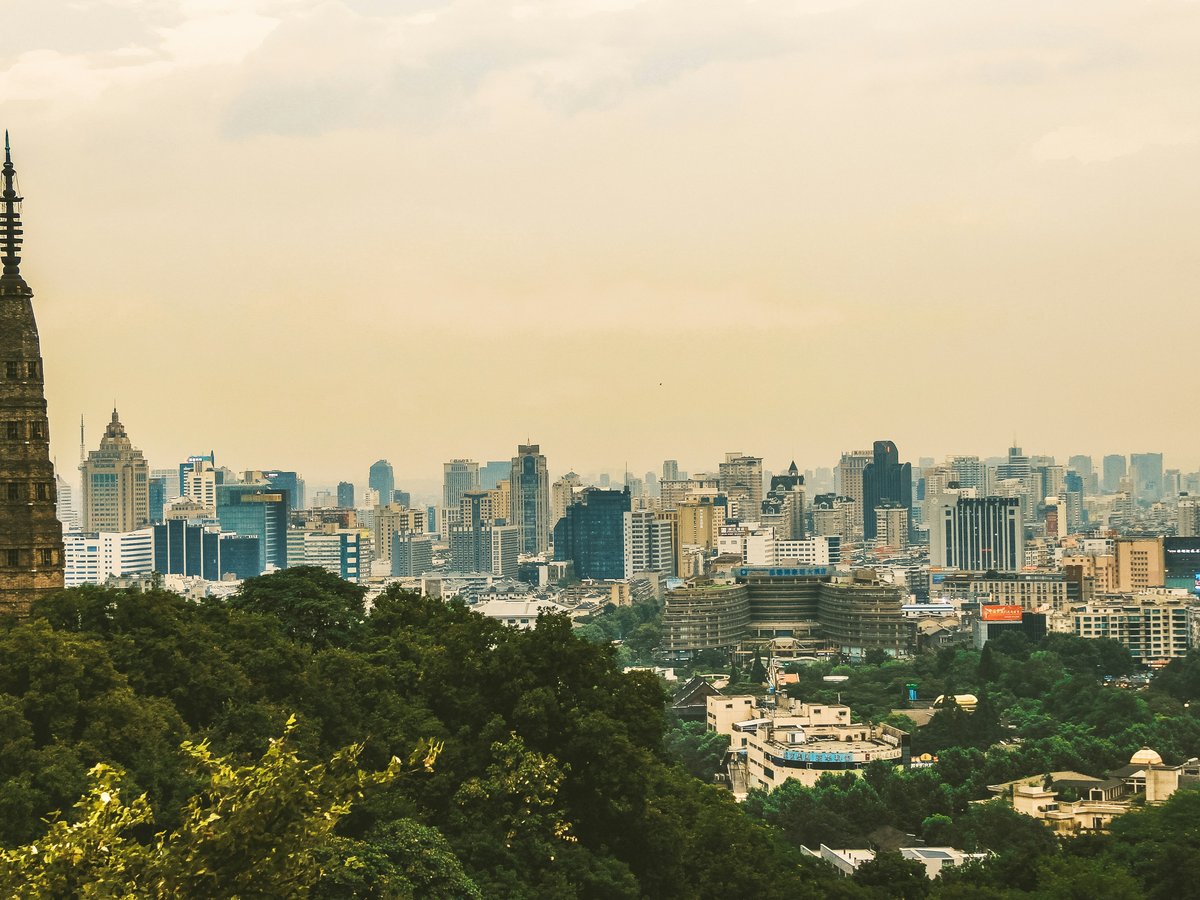
Stay in Nanjing in November
86 hotels in the Trip.com pool for Nanjing, from US$5 a night.
Opens Trip.com on Fri 6 Nov to Sun 8 Nov 2026; change the dates there.
November is Nanjing's sweet spot. Daytime highs average around 17.4°C (63°F); lows sit near 8.7°C (48°F). The month collects roughly 33mm of rain across about 5 rainy days: July brings around 255mm, so November feels almost arid by comparison. The air over Xuanwu Lake is clearer than in summer, the sky a pale autumn blue. The plane trees along Zhongshan Road turn copper and gold, their dry leaves scuffing underfoot.
The month's signature draw is Qixia Mountain's Red Maple Festival, which runs from mid-October into December. Qixia Temple is one of China's four great Buddhist temples, founded in 489 CE, and it sits at the base of slopes covered with tens of thousands of maples. Color peaks in early-to-mid November, when the canopy goes deep crimson in the low afternoon light. Day-trippers from Shanghai, Hefei, and Hangzhou know the timing well, so Saturdays at Qixia get crowded. On a Tuesday morning you can still hear the temple bells from the valley floor.
Inside the city, the ginkgos follow nearly the same schedule. Stone Elephant Road at Ming Xiaoling, the approach road to Linggu Temple, and Beijing East Road near Jiming Temple all go butter-yellow in the first half of the month. The plane-tree ring around Meiling Palace (the 'necklace' visible from above) hits full gold in late November.
The honest trade-off is the chill. Nanjing sits south of China's Qinling-Huai River heating line, so most homes and older hotels have no radiators. By late November, mornings can dip toward 5°C (41°F), and budget guesthouses fill with the thin whine of portable space heaters. A down jacket and a thermal layer solve most of it. In exchange you get post-Golden Week pricing, 33mm of rain for the whole month, and autumn color that rivals anything in the Yangtze Delta.
Why visit in November
- One of the driest months on Nanjing's calendar: about 33mm of rain over roughly 5 days. Full days of walking between Purple Mountain sites and the Xuanwu Lake shore are easy to plan.
- Peak autumn foliage across the city. Red maples at Qixia Mountain peak in early-to-mid November; the ginkgos on Stone Elephant Road, the Linggu Temple approach, and Beijing East Road turn gold in the same window.
- Hotels and attractions are noticeably quieter than during the October 1 to 7 Golden Week rush; weekday rooms are often bookable 2 to 3 days out.
- Highs around 17°C (63°F) suit walking-heavy itineraries, well clear of July's 32°C humidity and January's near-freezing mornings.
Worth knowing
- By the final week of November, lows can fall toward 5°C (41°F), and unheated lobbies and restaurants can feel colder than a sunny afternoon outside.
- Daylight shortens fast. Sunset arrives around 5:05 PM by November 30, which cuts afternoon time at open-air sites like Ming Xiaoling and the Sacred Way.
- Qixia Mountain draws large weekend crowds from across Jiangsu and Anhui provinces, which can make the paths around Qixia Temple feel more like a queue than a hike.
Best for
Think twice if
November in Nanjing runs crisp and dry. Afternoon highs average about 17.4°C (63°F) and overnight lows about 8.7°C (48°F), so a comfortable 2 PM walk around Xuanwu Lake can turn into a cold 7 PM stroll along the Qinhuai River. Rainfall averages roughly 33mm across about 5 rainy days, usually brief overcast spells rather than long downpours. Humidity sits around 72%, a relief after the sticky summer months. Late November begins the turn toward winter, and cold fronts from the north can knock temperatures well below average for 2 to 3 days at a stretch.
Seasonal caution
- Siberian cold fronts can push overnight lows below 0°C (32°F) in late November, though it happens rarely. Pack a genuinely warm outer layer in case one rolls through during your visit.
- Air quality drops when temperature inversions trap emissions over the Yangtze River plain. PM2.5 readings can exceed 150 on heavy haze days, making long outdoor exposure inadvisable for anyone with respiratory conditions. Check the local AQI forecast before committing to a full day on Purple Mountain.
Year-round climate
Averages from the last 5 years.
| Month | Avg high (°C) | Avg low (°C) | Rainfall (mm) |
|---|---|---|---|
| Jan | 9 | 0 | 41 |
| Feb | 10 | 2 | 53 |
| Mar | 17 | 7 | 91 |
| Apr | 23 | 13 | 79 |
| May | 26 | 17 | 115 |
| Jun | 30 | 22 | 184 |
| Jul | 33 | 26 | 255 |
| Aug | 33 | 26 | 123 |
| Sep | 29 | 22 | 145 |
| Oct | 23 | 15 | 74 |
| Nov | 17 | 9 | 33 |
| Dec | 10 | 1 | 17 |
Headline events
Qixia Mountain Red Maple Festival (栖霞山红枫节)
Mid-October through early December, with color peaking in early-to-mid November.
Tens of thousands of maple trees across Qixia Mountain turn crimson through November, drawing visitors from across eastern China. The festival runs photography competitions, guided hikes through the maple trails, and cultural performances at Qixia Temple. It is the defining autumn event in Nanjing and the most celebrated foliage spectacle in the lower Yangtze region.
Best things to do in November
Hike Qixia Mountain for the Red Maple Festival
natureFollow the main trail from the south gate past Qixia Temple up to the ridgeline viewpoints, where the hillside glows red below you. The full loop takes about 3 hours at a comfortable pace. The temple itself, originally built in 489 CE during the Southern Qi dynasty, is worth a stop for its Thousand Buddha Cliff carvings.
Maple color peaks in early-to-mid November, with the best saturation before the leaves begin to brown in the last week of the month.Booking tipBuy tickets online the day before for weekend visits. The venue occasionally caps daily entries during peak weekends.
Walk the Sacred Way and Stone Elephant Road at Ming Xiaoling Mausoleum
historyStone Elephant Road (石象路), the first stretch of the Sacred Way leading to the Hongwu Emperor's tomb, is lined with ginkgo trees. The path runs past paired stone lions, camels, elephants and mythical beasts carved in the late 14th century, then bends past civil and military officials. Early light filters through the canopy and throws long shadows across the figures.
The ginkgos on Stone Elephant Road usually turn fully gold in the first half of November. Yellow leaves against grey Ming-dynasty stonework make one of Nanjing's most photographed autumn scenes.Booking tipArrive before 9 AM to photograph the Sacred Way without crowds. The mausoleum complex opens at 6:30 AM.
See the Meiling Palace 'necklace' and the Linggu Temple ginkgos
natureMeiling Palace (美龄宫), completed in 1934 for Soong Mei-ling, sits inside a ring of plane trees that turns gold in autumn and looks like a pendant necklace from above. A short ride east, the road into the Linggu Temple scenic area passes ginkgo stands on the way to the Ming-era Beamless Hall and the 1930s Linggu Pagoda.
The Linggu ginkgos tend to peak in early-to-mid November. The Meiling plane-tree ring usually reaches full gold later, around the last week of November.Booking tipMeiling Palace requires a separate ticket. Scenic-area shuttle buses link Ming Xiaoling, Sun Yat-sen Mausoleum and Linggu Temple.
Explore the Presidential Palace grounds and Nanjing 1912 district
historyThe former seat of the Republic of China government occupies a large compound of Qing and Republican-era architecture, formal gardens, and exhibition halls tracing Nanjing's role as national capital. Next door, Nanjing 1912 is a dining and nightlife strip in restored Republican-era buildings.
At 17°C, you can spend 3 to 4 hours covering the full compound without the 32°C July heat that wears most visitors out by noon.Cycle or walk the Xuanwu Lake perimeter
outdoorThe 10km lakefront path circles Xuanwu Lake with views of Purple Mountain (Zijin Shan) reflected in the water. Five connected islands hold gardens, a small zoo, and teahouses. The autumn colors along the eastern and northern shores peak in November.
Clear autumn skies produce the sharpest reflections of Purple Mountain in the lake, and 17°C afternoons make a full lap comfortable without summer humidity.Booking tipBike rentals are available near the Xuanwu Gate entrance. Weekday mornings are quietest.
Visit the Memorial Hall of the Victims in Nanjing Massacre
historyThis memorial, founded in 1985, documents the events of December 1937 through artifacts, survivor testimonies, and archaeological remains. The architecture is austere and affecting. Plan at least 2 hours; the experience doesn't compress well.
As the December 13 national memorial day approaches, the hall mounts additional temporary exhibitions in the weeks before the commemoration. Late November visits carry a particular weight.Booking tipFree entry, but tickets must be reserved online. The memorial closes on Mondays.
Stroll Laomendong and the Qinhuai River evening waterfront
cultureLaomendong is a restored Ming and Qing-era neighborhood south of the Confucius Temple area, with narrow stone lanes, artisan workshops, and street food stalls. After dark, the Qinhuai River glows with traditional lantern boats and illuminated historic buildings along both banks.
Evenings around 10°C make the lantern glow feel intimate rather than stifling. Summer humidity and mosquitoes are gone, and the crowds are a fraction of Golden Week levels.Booking tipRiver cruise boats run until about 9:30 PM. No reservation needed on weeknight evenings.
Photograph the ginkgo corridor on Beijing East Road (北京东路)
natureBeijing East Road in the Xuanwu district, running past Jiming Temple, is one of Nanjing's best-known ginkgo avenues. In November the trees shed golden leaves across the sidewalks and the canopy filters afternoon light into amber. The stretch runs about 2km; peak color usually holds for 2 to 3 weeks.
Ginkgo peak color in Nanjing typically falls between early and mid-November, when fallen leaves carpet the pavement in gold.What to eat in November
On menus now
Hairy crab (大闸蟹)
October and November are peak months for freshwater hairy crab. Gaochun District, Nanjing's own crab-producing area, harvests from Gucheng Lake; the more famous Yangcheng Lake supply comes from neighboring Suzhou. Female crabs, prized for their rich orange roe, are at their best in November. Locals eat them steamed with a ginger-vinegar dipping sauce, the sweet meat pulling cleanly from the shell.
Nanjing salted duck (盐水鸭)
Autumn-cured salted duck (sometimes called guihua ya (osmanthus duck) for the season in which it is brined) is the best of the year. The meat is tender, mildly salty, and served cold in thin slices. Look for it at established shops in the Fuzimiao area.
Street food peaks
Duck blood and vermicelli soup (鸭血粉丝汤)
Silky glass noodles in rich duck broth with cubes of set duck blood, tofu puffs, and duck gizzard. This is Nanjing's signature street meal, and it hits differently on a 6°C November morning. The hot broth and peppery finish cut through the chill. Stalls in Laomendong serve it from early morning.
Roasted sweet potatoes (烤红薯)
Street vendors fire up their barrel ovens once the weather cools, and by November the smell of charring sweet potato skin drifts through neighborhoods across the city. The flesh turns caramel-soft and steaming. Sold by weight from portable drum ovens that appear on sidewalks from Gulou to Xinjiekou.
What to drink
Chrysanthemum tea (菊花茶)
November chrysanthemum harvests from nearby Chuzhou and the Huangshan region in Anhui supply fresh flowers for tea. The pale yellow brew is mildly sweet, slightly cooling, and a staple in Nanjing teahouses during autumn.
Regular events in November
Nanjing Marathon (南京马拉松)
Full marathon, half marathon, and 10km race through central Nanjing, routing along Xuanwu Lake, under sections of the Ming city wall, and through the Xinjiekou commercial district. Around 30,000 runners enter and major roads close for the morning.
Mid-to-late November; exact dates vary by year.Singles' Day (双十一)Free
China's largest online shopping event falls on November 11. The action is mostly digital, but Xinjiekou malls and Deji Plaza run parallel promotions with extended hours and pop-up events. Foot traffic in the commercial districts picks up noticeably in the days around 11/11.
November 11, with promotions starting in late October.Xuanwu Lake Chrysanthemum Exhibition (玄武湖菊花展)Free
An annual outdoor display of thousands of chrysanthemum varieties in themed installations across Xuanwu Lake's islands and shores. The tradition goes back decades and draws local families and photographers on weekends.
Late October through late NovemberBest places this November
Qixia Mountain (栖霞山)
natureThe trails behind the mountain are quieter and pass older maples with denser canopy than the main tourist path. Most domestic tour groups enter from the south gate and turn left, so bearing right after Qixia Temple puts you clear of the worst crowds.
QixiaMing Xiaoling Sacred Way (明孝陵神道)
historyBeyond the ginkgo-lined Stone Elephant Road, the mausoleum complex contains the Ming dynasty's founding imperial tomb: massive walls enclosing an unexcavated underground palace. The full grounds take over an hour to walk and connect to the broader Zhongshan scenic area.
Zhongshan scenic areaMeiling Palace (美龄宫)
historyA 1934 villa with a green-glazed tile roof, built for Soong Mei-ling on a hill inside the Zhongshan scenic area. The plane trees lining the ring road turn gold in late November and form the 'necklace' pattern that appears in every Nanjing autumn photograph.
Zhongshan scenic areaLinggu Temple scenic area (灵谷寺)
historyThe approach road is lined with ginkgos that usually peak in early-to-mid November. Inside, the Beamless Hall (无梁殿): a brick structure from 1381 raised without a single wooden beam: stands alongside the nine-story Linggu Pagoda from the early 1930s.
Zhongshan scenic areaXuanwu Lake Park (玄武湖公园)
parkFree entry. The park sits beside Nanjing railway station, bordered by long sections of the Ming city wall that frame the autumn lake views. The eastern shore has the cleanest sightline to Purple Mountain.
XuanwuQingliang Park (清凉山公园)
parkA quieter alternative to the famous foliage spots. Qingliang Mountain has dense ginkgo groves and a small hilltop temple. Local calligraphers and chess players gather here, and the autumn canopy keeps the place feeling secluded: though Xinjiekou is only a few metro stops away.
GulouNanjing Museum (南京博物院)
museumFounded in 1933 as the National Central Museum, Nanjing Museum is one of China's leading national museums. Its Republic of China hall traces Nanjing's modern political history with original documents and photographs. A strong indoor option on one of November's 5 or so rainy days or on a heavy haze day.
Zhongshan scenic areaLaomendong and Zhonghua Gate (老门东 / 中华门)
neighborhoodNext to Zhonghua Gate, one of the best-preserved sections of Nanjing's 35km Ming city wall. Climbing the gate gives a view across Laomendong's restored rooftops framed by autumn foliage. The narrow lanes are comfortable to browse in the dry November air.
QinhuaiYihe Road Republican-era district (颐和路民国建筑群)
neighborhoodA quiet residential area in Gulou lined with 1920s–1940s mansions built for foreign diplomats and Nationalist officials. The old plane trees along Yihe Road turn amber in November, and the European-influenced architecture sets the neighborhood apart from the rest of the city. Far fewer tourists than the major sites.
Gulou
Your packing checklist
Tick items off as you pack. Your progress saves in this browser.
All packed — have a great trip.
Insider tips
The back trails at Qixia Mountain have fewer crowds and older maples than the main path most tour groups follow. After entering at the south gate, bear right past Qixia Temple rather than following the crowd left.
For hairy crab, locals head to restaurants in Gaochun District, about 90 minutes south of central Nanjing, rather than tourist-area spots near Fuzimiao. If that trip is too far, neighborhood wet markets in Gulou or Xuanwu sell live crabs at local rates.
Yihe Road's Republican-era mansions photograph best on overcast November days, when flat light brings out the texture of the 1930s stucco and the plane trees offer a muted amber backdrop. Bright sun produces harsh contrast.
Time the ginkgo and plane-tree streets in sequence. Stone Elephant Road, Linggu Temple, and Beijing East Road typically peak in the first half of November, while the Meiling Palace plane-tree ring tends to peak in the last week.
The Nanjing Metro accepts Alipay and WeChat Pay at all stations. Visitors without Chinese payment apps can buy a Nanjing Transportation Card at any metro customer service window. The card works on city buses as well.
Avoid these mistakes
- Visiting Qixia Mountain on a Saturday or Sunday without arriving before 8 AM. Weekend crowds at the south gate can mean 30-minute waits for entry by mid-morning during peak maple season. Weekday visits avoid this almost entirely.
- Underestimating how cold indoor spaces feel. Visitors accustomed to central heating are caught off guard when hotel lobbies and restaurant dining rooms sit well below 18°C. The weather is not extreme, but the persistent indoor chill wears on you without warm layers.
- Scheduling outdoor photography at Purple Mountain for midday. The autumn light is flat and harsh between 11 AM and 2 PM. Golden hour in November starts around 4 PM, and sunset comes by about 5:05 PM at month's end. Shoots before 9 AM produce the best results.
Practical tips for November
Book Qixia Mountain tickets online at least a day ahead for weekend visits during peak maple season; daily entry caps do apply. The Nanjing Metro runs 6 AM to 11 PM and covers all major tourist areas: Line 2 reaches the Purple Mountain scenic zone via Xiamafang station, and Line 3 stops at Fuzimiao for the Confucius Temple district. Most museums close on Mondays, Nanjing Museum and the Memorial Hall included. November is shoulder season for hotels: same-day weekday bookings go through without trouble, though properties near Qixia fill on weekends. International visitors need a VPN for Google Maps, WhatsApp, and Instagram. Download offline maps and a translation app before you land.
FAQ
Is November a good time to visit Nanjing?
November ranks as one of the strongest months to visit, second only to October. Highs average 17.4°C (63°F), rain totals roughly 33mm over about 5 days, and Qixia Mountain's maples peak in early-to-mid November. Crowds thin noticeably after the October 1 to 7 Golden Week. The main downsides are late-month lows near 5°C (41°F) and the near-total absence of indoor heating in many buildings.
What is the weather like in Nanjing in November?
Expect mild, mostly dry days. Average highs run to 17.4°C (63°F), lows to 8.7°C (48°F), with humidity near 72%. Rainfall averages about 33mm across roughly 5 days, typically short overcast spells rather than sustained rain. Late November cold fronts can push lows toward 0 to 5°C for 2 to 3 days. Pack layers and a warm jacket for early mornings and evenings.
Is Nanjing crowded in November?
Crowd levels are moderate overall: the October 1 to 7 Golden Week rush is over and winter travel hasn't started. The exception is Qixia Mountain on weekends during the Red Maple Festival, when day-trippers from Jiangsu and Anhui fill the trails. Visit Qixia on a weekday if you can. The Presidential Palace and Sun Yat-sen Mausoleum are uncrowded on most November weekdays.
When is the best week to visit Nanjing in November for autumn foliage?
The first two weeks of November are the prime window. Qixia Mountain's maples typically peak between early and mid-November, though timing can shift by a week depending on when cold fronts arrive. The ginkgos on Stone Elephant Road, the Linggu Temple approach, and Beijing East Road follow a similar schedule. The Meiling Palace plane-tree ring runs later, usually turning fully gold in the last week of November.
Where are the best ginkgo and plane-tree streets in Nanjing?
Start with Stone Elephant Road (石象路) at Ming Xiaoling, where ginkgos line the stone animal statues. Then take the road into the Linggu Temple scenic area and the 2km ginkgo stretch of Beijing East Road near Jiming Temple. For plane trees, walk Zhongshan Road, Yihe Road in Gulou, and the ring road around Meiling Palace in the Zhongshan scenic area.
Last verified by automated review (v1.7.2) on . What is automated review?