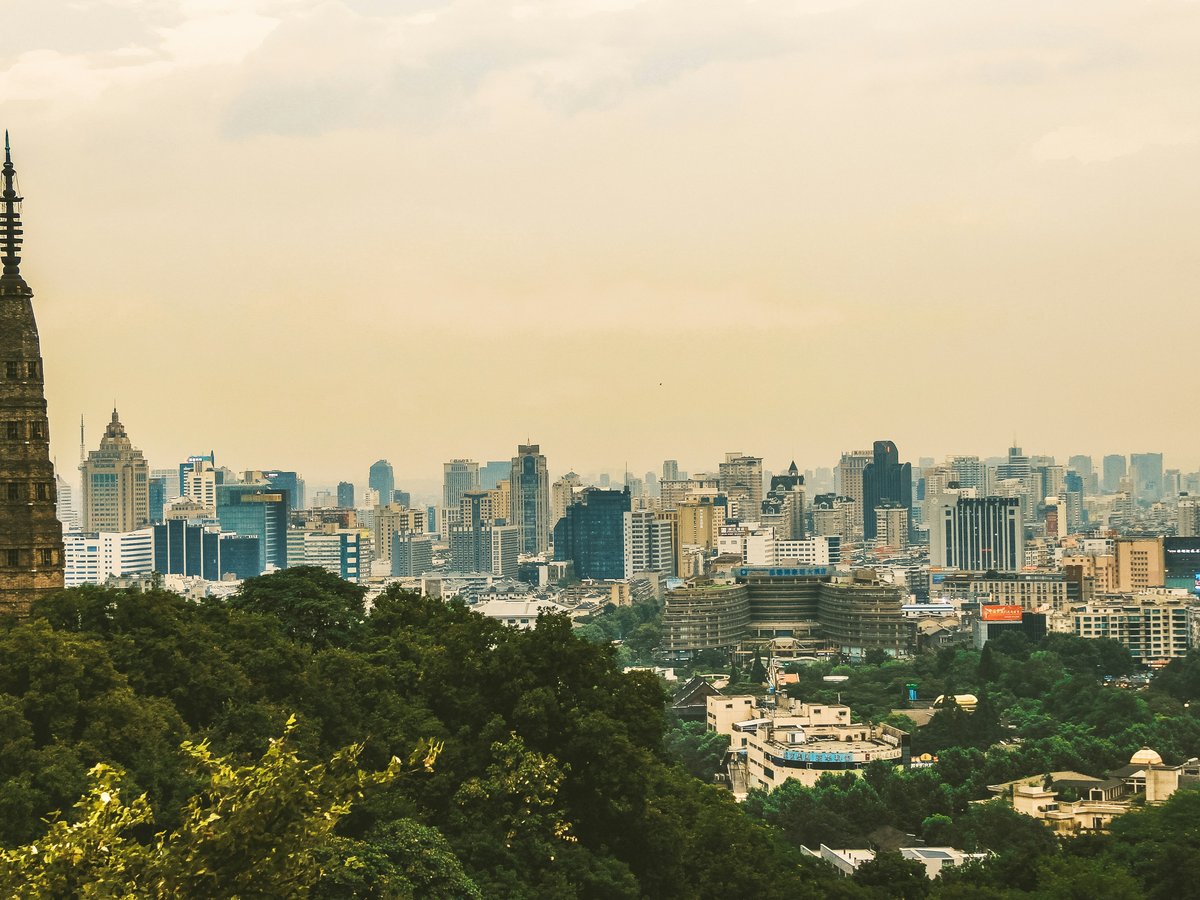
Nanjing sits where the Yangtze River bends south through Jiangsu Province, roughly 300 kilometers from Shanghai by high-speed rail. The city grew around Zijin Shan (Purple Mountain), a forested ridge that reaches nearly 450 meters on the eastern edge of the old walled center. That proximity to real elevation is unusual for a Yangtze Delta city of 9 million people. The Ming-era fortification wall still traces a 35-kilometer circuit through the urban core, with restored sections that double as elevated walking paths above the plane-tree-lined avenues. Xuanwu Lake fills a broad basin against the wall's northern arc, with about 4 square kilometers of open water inside the city. Summers in Nanjing are punishing. The city earned its old label as one of China's 'Three Furnaces,' with July temperatures regularly topping 37°C and humidity thick enough that the air sits heavy on your skin. Spring from March through May and autumn from late September into November are the real outdoor windows. Late September currently brings temperatures around 22°C with light drizzle and 95% humidity. October tends to dry out, with temperatures settling between 15°C and 25°C across the month.
Outdoor activities
-
Walking the Ming City Wall
Several restored sections of Nanjing's Ming-dynasty wall are open to walkers, with the stretch from Zhonghua Gate (Zhonghuamen) north to Jiefang Gate being the most popular at about 5 kilometers. The wall sits 12 to 15 meters above street level, so you walk with plane-tree canopies at eye level and city rooftops spread below. Stone paving is uneven in spots near the less-restored sections around Shence Gate. Zhonghuamen, the largest surviving gate complex, has three interior courtyards that could hold over 3,000 soldiers. Entry runs about 30 to 50 yuan per section depending on the access point. Walk in the early morning before the stone surface absorbs the sun and radiates heat back at you.
- Difficulty
- Easy
- Duration
- 2-4 hours for the main sections
- Best season
- March through May, October through November
-
Cycling Nanjing's Greenway Network
The Binjiang greenway follows the Yangtze through the Hexi New Town district for roughly 10 kilometers on a dedicated lane separated from car traffic. The river side of the path looks out over cargo-barge traffic and the far bank's industrial silhouette. A separate loop circles Xuanwu Lake on about 10 kilometers of flat, shared path alongside joggers and morning tai chi groups. Meituan Bike and Hello Bike docks sit at metro exits across the city, typically 1.5 yuan per 30 minutes. Bring a phone with WeChat or Alipay loaded, since the bike-share apps require one of those payment methods to unlock.
- Difficulty
- Easy to Moderate
- Duration
- 2-3 hours
- Best season
- March through May, September through November
-
Trail Running on Purple Mountain
The Zhongshan Scenic Area covers the lower and middle slopes of Zijin Shan with kilometers of paved roads and packed-earth paths through dense camphor and oak forest. A popular southern loop starts near the Xiamafang parking area and rolls through forest past the outer walls of Ming Xiaoling, the Mausoleum of the Hongwu Emperor. The canopy keeps the air noticeably cooler than the city floor, and the ground smells of damp leaf litter after rain. Expect rolling terrain with some steep pitches on unpaved connectors between the main tourist roads. Mornings before 8:00 are quietest. After that, the paved sections near the main monuments fill with tour groups and portable speakers.
- Difficulty
- Moderate
- Duration
- 1-2 hours depending on route
- Best season
- March through May, October through November
-
Dawn Exercise at Xuanwu Lake Park
By 6:00 on any morning, the causeways and paths around Xuanwu Lake fill with locals doing tai chi, ballroom dancing, and group calisthenics. The southern causeway from Xuanwu Gate metro station is the busiest, with clusters of retirees running through sword forms under the willows. Some swimmers enter the lake from the rocky shore near Liang Zhou island during summer months, though the water quality varies and there are no lifeguards. The park is free to enter and stays open from roughly 5:00 to 23:00. You might hear erhu players near the bridge, and you will likely see calligraphy brushed onto the pavement with water before the sun dries it.
- Difficulty
- Easy
- Duration
- 1-2 hours
- Best season
- April through October
Day hikes
-
Zijin Shan (Purple Mountain) Summit
The main summit of Purple Mountain sits at roughly 449 meters, about 400 meters above the lake level at the base. Most hikers start from the south entrance near Sun Yat-sen Mausoleum and follow stone-stepped paths northeast through mixed forest toward the ridgeline. The route to the top takes about 90 minutes at a steady pace. Stone steps and packed earth make up most of the trail surface, though sections near the summit get slippery after the frequent autumn rains. October mornings tend to offer the clearest views north toward the Yangtze and south over the old walled city. The Purple Mountain Observatory, established in 1934, sits on a neighboring ridge at 267 meters and makes a worthwhile detour on the descent.
- Difficulty
- Moderate
- Duration
- 3-4 hours round trip
- Best season
- October through November
-
Qixia Mountain (Qixia Shan)
About 22 kilometers northeast of the city center, Qixia Shan is famous for its autumn maple foliage, which typically peaks in mid-to-late November. The main trail climbs from Qixia Temple at the base to the summit at about 286 meters. The Thousand Buddha Cliff, carved into the rock face near the temple, dates to the Southern Qi and Liang dynasty periods in the 5th and 6th centuries. Mind you, the mountain's east face holds denser forest and fewer tourists, but the trails there are less maintained and less clearly signed. Reach it via Metro Line 2 toward Xianlin and then a bus or taxi for the remaining distance.
- Difficulty
- Easy to Moderate
- Duration
- 3-4 hours including transit
- Best season
- Mid-November for maple color, spring for fewer crowds
-
Niushou Mountain (Bull Head Mountain)
About 15 kilometers south of the city center in Jiangning District, Niushou Shan rises to roughly 243 meters across two peaks that, from a distance, resemble the horns of an ox. The main trail follows a paved path through bamboo groves and secondary forest to the ridgeline between the peaks. The Buddhist cultural park at the base, anchored by the Usnisa Palace, draws pilgrims and architecture tourists, but the hiking route loops through the quieter eastern slopes away from the developed areas. The bamboo sections are cool even in early summer, with light filtering green through the canopy above. Reach it by taxi in about 40 minutes from Xinjiekou or by metro toward the southern suburbs with a connecting ride.
- Difficulty
- Moderate
- Duration
- 3-5 hours including transit
- Best season
- April through May, October through November
-
Mufu Mountain (Curtain Mountain)
On Nanjing's northern edge, Mufu Shan sits directly above the Yangtze with a cliff face that resembles a hanging curtain of rock. The highest point reaches only about 200 meters, making this the shortest major hike near the city. From the top, you look down at the river and the traffic moving through the Yangtze shipping channel. The Yanziji scenic area on the western slope has stone paths and several pavilions from the Republican era. That said, the views alone make it worthwhile on a clear day. The mountain is about 30 minutes by taxi from the city center.
- Difficulty
- Easy
- Duration
- 2-3 hours round trip
- Best season
- Year-round, best visibility October through December
Water activities
-
Boating on Xuanwu Lake
Pedal boats, rowing boats, and electric boats are available for rent from several docks around the lake, with the main rental pier near the south gate by Xuanwu Gate metro. Pedal boats typically cost about 40 yuan per hour for a 4-person vessel. The lake is shallow, averaging about 1 meter in depth, so capsizing is more embarrassing than dangerous. Paddle between the islands and under the bridges connecting them. Evening sessions are popular in summer when the city wall lights up along the southern shore.
- Difficulty
- Easy
- Duration
- 1-2 hours
- Best season
- April through October
-
Qinhuai River Evening Boat Tour
The stretch of the Qinhuai River near the Confucius Temple area has been running lantern-lit boat tours for decades. Covered wooden boats carry about 20 passengers on a roughly 50-minute loop past illuminated traditional facades and restaurants overhanging the water. Tours depart from the dock near the Fuzimiao scenic area entrance and cost around 80 to 100 yuan per person. The experience is touristy. Worth noting, though, that the red lantern reflections rippling across the dark water create a scene you will not find elsewhere in eastern China.
- Difficulty
- Easy
- Duration
- 50 minutes to 1 hour
- Best season
- Year-round, most atmospheric in autumn and winter evenings
-
Yangtze River Ferry Crossing
Several ferry routes still cross the Yangtze between Nanjing's south bank and Pukou on the north side. The Zhongshan Wharf crossing takes about 20 minutes and costs around 2 yuan with a transit card. The deck gives you a cargo ship's-eye view of the river, which runs over a kilometer wide at this point. You pass close to the Nanjing Yangtze River Bridge, a double-deck road-and-rail structure completed in 1968 that was a major source of national pride. It is not a leisure cruise, but the short crossing on open water beats any river viewpoint on land.
- Difficulty
- Easy
- Duration
- 20-30 minutes one way
- Best season
- Year-round
-
Tangshan Hot Springs
About 30 kilometers east of the city center, the Tangshan area has natural thermal springs that have been used since the Southern Dynasty period in the 5th and 6th centuries. Multiple resort-style facilities offer outdoor soaking pools at temperatures typically between 30°C and 45°C. The water is sulfurous, and you will smell it before you see the pools. Entry to the main public springs runs about 120 to 200 yuan, with higher-end resorts charging more. The springs feel best in cooler months when the contrast between the cold air and warm water is sharpest. Reach Tangshan by bus or taxi in about 45 minutes from the city center.
- Difficulty
- Easy
- Duration
- Half day
- Best season
- November through March
Parks & gardens
-
Xuanwu Lake Park
FreeThe largest urban park in Nanjing occupies a basin north of the Ming wall, with five islands connected by causeways and arched bridges. Cherry and plum trees line the southern shores, putting on a dense pink display from late February into March. The Ying Zhou (Cherry Island) area tends to be the most photographed during blossom season. Lotus beds cover large sections of the eastern water in summer. The smell carries surprisingly far in July's humidity. It is an easy walk from Xuanwu Gate station on Metro Line 1.
Highlights: Cherry and plum blossoms in late February through March, summer lotus beds, free entry year-round
-
Nanjing Botanical Garden, Memorial Sun Yat-Sen
This botanical garden sits on the southern slope of Purple Mountain and covers roughly 186 hectares across its northern and southern sections. Over 3,000 plant species grow here, with the rose garden and tropical greenhouse drawing the most visitors. Paths wind uphill through metasequoia groves that turn bronze in late November. The garden feels removed from the city even though the Xiamafang metro area is a 10-minute walk downhill. Crowds peak during the May Day holiday week in early May.
Highlights: Metasequoia groves in autumn color, rose garden, tropical greenhouse, hillside forest paths
-
Qingliang Park
FreeThis hillside park in Nanjing's western Gulou district sits on a ridge topping out around 60 meters, with views over old residential neighborhoods toward the Yangtze. The park grew up around the historic Qingliang Temple, a Buddhist site since at least the Southern Dynasty period. Old camphor trees shade the stone paths, and in summer the elevation and tree cover keep it several degrees cooler than the streets below. Locals come here to play Chinese chess and practice ground calligraphy. It tends to be less crowded than the big lakeside parks.
Highlights: Qingliang Temple grounds, hillside views toward the Yangtze, shaded paths cooler in summer
-
Mochou Lake Park
This park takes its name from the folk legend of a woman called Mochou, meaning 'no sorrow' in Chinese. It wraps around a lake of about 0.3 square kilometers in the Jianye district. Classical covered walkways and rockeries ring the water in a formal Chinese garden layout. The Shenqi Pavilion sits at a high point overlooking the lake and is the park's most photographed structure. Visit on a weekday morning and it is quiet enough to hear carp breaking the surface. Entry runs about 35 yuan.
Highlights: Formal Chinese garden architecture, Shenqi Pavilion, covered walkways, rockeries
-
Bailuzhou Park
FreeThis narrow island park sits in the Qinhuai River in the southern part of the old city, not far from the Fuzimiao commercial district. It stretches about 1 kilometer along the river with stone-paved paths under ginkgo trees that turn vivid yellow in mid-November. The park is less manicured than Nanjing's major gardens, which gives it a relaxed neighborhood feel. Elderly residents bring caged songbirds in the morning, and the sound carries across the water.
Highlights: Ginkgo tree canopy in autumn, Qinhuai River views, morning songbird culture
Practical tips
- Summer Heat and Hydration
- The summer furnace reputation is earned. Between June and August, plan strenuous outdoor activities for before 8:00 or after 17:00. Carry at least 2 liters of water on any hike longer than 2 hours. Convenience stores (Family Mart, Lawson) near most trailheads sell bottled water for about 2 yuan per 500ml. Do not drink unboiled tap water.
- Sun Protection
- UV levels run high from May through September, especially on the exposed city wall sections and open lake causeways. A wide-brim hat and SPF 50 sunscreen are essential. Local pharmacies stock Korean and Japanese sunscreen brands for 40 to 80 yuan. Lightweight UV-blocking arm sleeves, widely used by Chinese hikers, can be found at Decathlon stores in the Xinjiekou and Hexi areas for about 30 yuan.
- Trail Conditions and Footwear
- Most trails on Purple Mountain and Qixia Shan are stone-stepped or packed earth, manageable in sturdy walking shoes or light trail runners. Dedicated hiking boots are not necessary for any hike described here, but avoid smooth-soled shoes on wet stone steps. The shaded sections of the Zijin Shan trails can stay slick for a full day after rain. Carry trekking poles if you have knee trouble on descents.
- Getting to Trailheads
- Nanjing's metro system reaches most central outdoor areas directly. Xuanwu Lake and the Ming City Wall are on metro lines. Purple Mountain's south entrance is a 15-minute walk from Xiamafang station on Metro Line 2. For more distant destinations like Niushou Shan or Tangshan, use Didi (China's ride-hailing app) or negotiate with a taxi. Expect about 60 to 100 yuan each way for trips to the southern or eastern hills.
- Currency and Costs
- The exchange rate currently sits at about 6.71 CNY to 1 USD. Most outdoor costs are modest, with park entry fees ranging from free to about 70 yuan for major scenic zones. Cash is rarely needed since WeChat Pay and Alipay handle nearly everything, but foreign visitors may need to link an international card through the apps' recently added international-visitor features. Some smaller vendors at trail rest stops still accept only cash.
- Solo Safety Outdoors
- Nanjing scores 6.8/10 for solo-traveler safety (see the TTDI Solo-Safety Index). Trails are generally well-trafficked during daylight, especially on Purple Mountain and around the lake parks. Solo hikers should stay on marked paths and avoid the remote eastern slopes of Qixia Shan or Niushou Shan late in the day. Cell reception on China Mobile and China Unicom networks is reliable on all trails described here.
FAQ
What is the best time of year for outdoor activities in Nanjing?
October and November tend to have the best combination of dry weather and comfortable temperatures for hiking and cycling. Spring is the runner-up season. The summer months are genuinely risky for extended outdoor exertion due to heat and humidity. Winter stays dry and cold enough for empty trails if you dress for lows near freezing. For autumn maple color specifically, aim for mid-to-late November at Qixia Shan.
Are hiking trails around Nanjing well-marked?
The main tourist routes on Purple Mountain and Qixia Shan have stone steps, handrails, and directional signage in Chinese and sometimes English. Secondary forest paths on Purple Mountain's north slopes and the eastern side of Niushou Shan are less developed, with fewer signs and occasionally unclear forks. Download an offline map on Gaode Maps (Amap) or Baidu Maps before heading out. Google Maps does not work reliably in China without a VPN.
Can I rent bikes in Nanjing without a Chinese phone number?
Meituan Bike and Hello Bike both now support international payment methods through their apps, though setup can be finicky with non-Chinese cards. Some visitors find it easier to register using a local SIM card purchased at Lukou Airport on arrival. Sporting goods stores in the major shopping districts sell budget bikes starting around 800 yuan if you want your own for a longer stay.
Do any of these hikes require permits or advance booking?
None of the hikes described here require a permit. Most scenic areas sell entrance tickets on-site and through the Meituan or Ctrip apps, often at a small discount if booked the day before. During national holidays, particularly May Day and National Day in early October, some parks limit daily visitor numbers and may sell out online by mid-morning.
Is it safe to swim in Xuanwu Lake or the Yangtze River?
Some locals swim in Xuanwu Lake during summer mornings, but there are no lifeguards and water quality varies seasonally. The Yangtze River is dangerous for recreational swimming due to strong currents, heavy barge traffic, and unpredictable undertows. Stick to the lake if you want open water, and swim near other swimmers rather than in isolated sections. Indoor pools at hotels and fitness centers throughout the Gulou and Xinjiekou districts are the safest option.
Last verified by automated review (v1.7.2) on . What is automated review?