Best Time to Visit Varanasi, by Season
Varanasi's average daily high stays at or above 32°C for seven months of the year and drops below 22°C in January. That leaves a narrow comfort window around October, November, and February. Here is the month-by-month case for each season, grounded in five-year daily weather observations, with the single best arrival month named for every type of traveler.
Published
1 October and November Own a 10-Degree Comfort Window No Other Month in Varanasi Touches
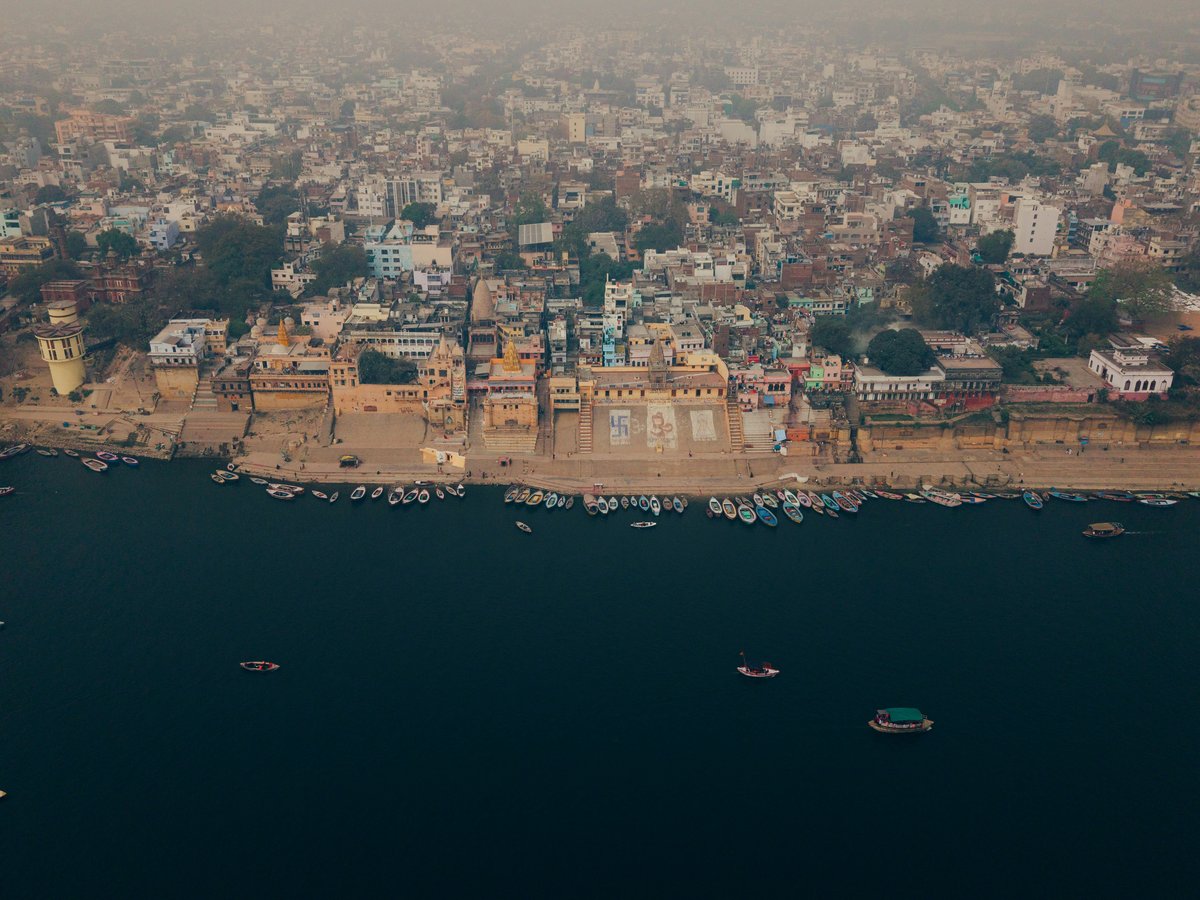
The smoke from evening aartis at Dashashwamedh Ghat hangs low and still in November. It settles into fabric and hair because the air has cooled to 27.8°C and there is no breeze to lift it. That stillness is the whole point. Varanasi has exactly two months where the weather cooperates fully, and November is the better one.
November's average high of 27.8°C and average low of 16.3°C land in a narrow band where you can walk the ghats from dawn to dusk without overheating or shivering. October runs warmer at 30.8°C for its average high and 22.3°C at night. Comfortable evenings, but midday can still feel heavy along the stone steps that radiate stored heat. The difference between October's 30.8°C and November's 27.8°C might read as 3 degrees on a chart. On the ghats, it feels like a different season.
For context, September still carries monsoon residue with an average high of 32.0°C and a low of 25.8°C. Nights in September rarely drop below 25°C, so your guesthouse room never fully cools. December, on the other side, drops to an average high of 23.4°C and an average low of 12.0°C. That sounds mild until you account for the fog that blankets the Ganga from early morning until about 10 AM and hides the far bank entirely.
November avoids both problems. The monsoon is 6 weeks behind, the river has receded to expose the lower ghats, and the air is dry enough that early-morning boat rides feel crisp rather than damp. October is the runner-up, better for travelers who can handle warmth but want to skip the December-January tourist density that builds around Christmas and New Year. If you can choose one month for Varanasi, November is it. October's 30.8°C average high runs 3 degrees warmer but sits comfortably below the 32°C threshold where walking the ghats becomes work.
If you can choose one month for Varanasi, November is it.
2 December and January Drop Below 12°C at Dawn. Expect Dense Fog on the Ganga Until Mid-Morning.
Before dawn in January, the Ganga disappears. Not metaphorically. The fog at Assi Ghat is dense enough that the far bank is invisible and boats appear as dark shapes drifting through white. The famous sunrise view from every Varanasi photograph does not materialize until roughly 10 AM. January is Varanasi's coldest month, with an average high of 21.2°C and an average low of 10.1°C. December is marginally warmer at 23.4°C for its high and 12.0°C at night, but the fog runs about the same.
The cold catches visitors who picture India as uniformly tropical. January's 10.1°C pre-dawn low means you need a proper jacket for the morning boat ride, not a light scarf. Most budget guesthouses along the ghats have no heating, and the stone floors hold the chill. The gap between January's 10.1°C low and November's 16.3°C low is over 6 degrees, enough to be the difference between sleeping comfortably and waking up stiff under a thin blanket.
That said, December and January are peak tourist months for good reason. The daytime highs of 23.4°C in December and 21.2°C in January make midday walking genuinely pleasant. Varanasi's old city lanes, narrow enough that two rickshaws cannot pass, trap heat brutally in summer. In January those same lanes stay cool and walkable all afternoon. The trade-off is real. You get the year's best walking weather, paired with the worst visibility at dawn and dusk, precisely when the Ganga is most photogenic.
December is the better pick if you care about warmth. Its 23.4°C high gives you 2.2 extra degrees over January's 21.2°C, and the fog tends to be thinner before the deep cold of January settles in. January works better for budget travelers, because guesthouse rates tend to drop after the New Year rush. February, at an average high of 26.6°C and a low of 13.4°C, sits almost perfectly between winter's chill and the coming spring heat.
January's 10.1°C pre-dawn low means you need a proper jacket for the morning boat ride, not a light scarf.
3 February Averages 26.6°C and Clear Skies. It Is the Best-Kept Secret Month in Varanasi.
Morning light on the Ganga in February has a clarity that no other month matches. The fog of January has lifted, the dust of pre-summer has not arrived, and the river sits near its annual low point. Stone steps at Manikarnika Ghat that spend most of the year underwater stand exposed and dry. February's average high of 26.6°C and average low of 13.4°C create what might be the most photographable conditions Varanasi offers all year.
The numbers tell the story directly. January closes at an average high of 21.2°C. February jumps to 26.6°C, a 5.4-degree rise that changes the character of the day. January mornings require layers and patience while the fog clears. February mornings are cool at 13.4°C but visibly clear, and by 10 AM you are in shirtsleeves. March, at an average high of 33.0°C, is already uncomfortable. February is the gap between those two worlds.
The 6.4-degree leap from February's 26.6°C to March's 33.0°C is the steepest month-over-month jump in Varanasi's entire annual cycle. February ends in one climate and March begins in another. Travelers who book late February into early March, thinking it is all one season, often land in two different cities weather-wise. The safe play is to arrive in the first half of February, when nights still dip to 13.4°C and afternoons rarely push past the 26.6°C average.
February's downside is wind. Dry northwesterly gusts pick up sand from the exposed riverbed and carry it into the lanes around Vishwanath Temple. The air tends to feel grittier than November. For travelers with respiratory sensitivities, November's 27.8°C and cleaner post-monsoon air is the better choice. For photographers chasing clear sightlines across the Ganga, February's low-angle winter light wins every time. Mind you, February is short. The window is 28 days, and the second half already starts to preview March's 33.0°C average.
The 6.4-degree leap from February's 26.6°C to March's 33.0°C is the steepest month-over-month jump in Varanasi's entire annual cycle.
4 March Starts at 33°C and Does Not Look Back. This Is the Month That Tricks Visitors.
The stone steps at Tulsi Ghat by mid-March feel warm underfoot at 9 AM and punishing by noon. March is the month international visitors most often mistime, because a late-February booking that bleeds into the first week of March crosses a hard climate boundary. February's average high is 26.6°C. March's is 33.0°C. That 6.4-degree gap lands within the first 10 days of the month.
March's average low of 18.7°C still sounds moderate, and the mornings carry a trace of February's cooler air. But by noon the 33.0°C average high makes the narrow lanes of the old city feel airless. The Ganga has receded to its seasonal low, and the exposed mud flats on the eastern bank bake and crack. The overnight lows tell the same story. February's 13.4°C low becomes March's 18.7°C, a 5.3-degree jump that strips the nights of their refreshing edge.
April is worse. Its average high of 38.9°C comes with a warning label nobody misreads. March sneaks up on you. A traveler arriving March 1 might still catch conditions closer to February's 26.6°C. A traveler arriving March 20 is functionally in April territory. The city looks different at 33°C. Stray dogs retreat to shade by 10 AM. The chai stalls along Meer Ghat run at half the foot traffic of November.
If your schedule forces a March visit, target the first 10 days. By mid-month, the 33.0°C average likely understates the afternoon peak. March's average low of 18.7°C is still 5.1 degrees cooler than April's 23.8°C, so the nights offer a measure of relief that the following 3 months will take away entirely.
A traveler arriving March 1 might catch February's 26.6°C. A traveler arriving March 20 is functionally in April.
5 April Through June Averages 38.6°C. For 90 Days, Varanasi Belongs to Residents.
The air above Harishchandra Ghat in May shimmers visibly by 8 AM. It rises off the stone in waves you can watch bend the skyline across the Ganga. Metal railings along the ghats become too hot to grip by 10 AM. April through June is a 90-day block where the daily high never drops below 38.2°C, and the overnight lows climb steadily from April's 23.8°C to June's 28.4°C. This is not a tourist season by any measure.
April opens the furnace at an average high of 38.9°C and an average low of 23.8°C. It is the hottest month by daytime peak, though May at 38.6°C and 26.6°C and June at 38.2°C and 28.4°C are functionally identical for discomfort. The variance in highs across all three months is 0.7 degrees. The meaningful deterioration happens overnight. April's 23.8°C low still allows a fan-cooled room to reach sleeping temperature. June's 28.4°C does not. The stone buildings and ghats store daytime heat and release it through the night, so a June evening in the old city without air conditioning is an endurance event.
The tourist economy along Dashashwamedh Ghat slows almost to a halt in this quarter. Hotels and guesthouses that charge peak rates in November drop their prices. That said, no price reduction compensates for the physical reality of walking Varanasi's lanes at 38.9°C. The lanes are narrow, shaded by buildings that radiate heat from both sides, and the stillness of the pre-monsoon air means there is no breeze to carry it away.
If forced to choose within this quarter, April is the least oppressive. Its 23.8°C overnight low runs 4.6 degrees cooler than June's 28.4°C, and the pre-monsoon humidity has not yet arrived. The honest recommendation is to avoid all three months. October's 30.8°C average high is 8.1 degrees cooler than April's 38.9°C peak.
6 July Drops to 33.8°C When the Monsoon Arrives. The Humidity Makes It Feel Worse.
The first heavy monsoon downpour in Varanasi sounds like handfuls of gravel hitting the corrugated rooftops above the lanes of Bengali Tola. July's average high falls to 33.8°C from June's 38.2°C, a 4.4-degree drop that reads as relief on paper. It is not relief. July's average low of 27.1°C means the air stays warm and now carries monsoon humidity that makes 33.8°C feel heavier than June's dry 38.2°C.
August settles slightly lower at an average high of 32.1°C and 26.1°C at night. September holds nearly steady at 32.0°C and 25.8°C. The three monsoon months form a tight 1.8-degree band on their highs, from September's 32.0°C to July's 33.8°C. The visual landscape transforms entirely. The Ganga rises and turns brown, swallowing the lower steps at Assi Ghat and Dashashwamedh Ghat. Boats that sat on mud in February now float meters above the same spot.
To be fair, the monsoon has a specific appeal. The old city empties of tour groups. Guesthouse rates drop to their lowest of the year. The rain greens the far bank of the Ganga into a vivid strip that photographs well against dark monsoon skies. August's 32.1°C average high and 26.1°C overnight low make it marginally more tolerable than July, and the heaviest downpours tend to concentrate in July rather than spreading evenly across all three months.
September at 32.0°C and 25.8°C marks the transition. The rains thin out, and the river begins its slow retreat. September is the monsoon month most worth considering, because it offers rain-washed atmosphere with drier stretches between showers and a direct exit ramp into October's 30.8°C and 22.3°C comfort zone. July and August are for residents. September's 25.8°C overnight low is already 1.3 degrees cooler than July's 27.1°C.
7 The Verdict. November for Everyone, February for Photographers, October if You Want the Ghats Quiet.
Assi Ghat, 6 PM, November. The temperature has settled toward 16.3°C and the light over the Ganga is amber and completely clear. There are no bad evenings in November. That is why it wins.
November's average high of 27.8°C and average low of 16.3°C make it the default recommendation for any traveler without a specific scheduling constraint. The range is comfortable from sunrise to midnight. The monsoon ended 6 weeks prior. Fog is absent. November is the month Varanasi functions at its best. October at 30.8°C and 22.3°C is the closest runner-up. Slightly warmer, still fully comfortable, and it tends to draw fewer visitors than November. If November is sold out or too expensive, October is the move.
February's 26.6°C high and 13.4°C low serve a different traveler. The air is the clearest of the entire year. The river sits near its annual low, exposing the full vertical span of the ghat steps. Morning light lands at a low winter angle that makes the sandstone glow along Dashashwamedh Ghat. The trade-off is a grittier, dustier atmosphere compared to November's post-monsoon clarity, and a window that lasts exactly 28 days before March's 33.0°C arrives. February is for photographers and anyone who values light over comfort margins.
January at 21.2°C and 10.1°C is for budget travelers willing to tolerate cold mornings and fog in exchange for lower guesthouse rates and thinner crowds. The afternoon high of 21.2°C is fine for walking. Plan your ghat visits for 11 AM onward, after the fog lifts from the Ganga.
September at 32.0°C and 25.8°C is the wildcard, the monsoon month for travelers who want atmosphere over comfort and empty ghats over clear skies. Avoid April through June entirely. That 90-day block holds daily highs from 38.2°C to 38.9°C, with overnight lows that never cool below 23.8°C. October's 30.8°C average high sits 8.1 degrees below April's 38.9°C peak.
Avoid April through June entirely. That 90-day block holds daily highs from 38.2°C to 38.9°C.
Last verified by automated review (v1.7.2_onboard-varanasi-flagship-2026-08-20) on . What is automated review?