Santorini With Kids: What Works
Santorini scores 5.8 out of 10 for families. The caldera views from Oia are real, the stroller access is not. The itinerary that survives small children avoids the famous sunset, leans on the east coast, and treats one Bronze Age ruin as the best family attraction on the island.
Published
1 A 5.8 Out of 10 Is Honest: Santorini Was Not Built for Strollers
The cobblestones in Fira catch a stroller wheel before you've gone 50 metres from the bus stop. Not the caldera view. Not the white walls curving toward Oia on the northern rim. It is the uneven volcanic stone under your feet, tilted and cracked, announcing what the next four days will feel like.
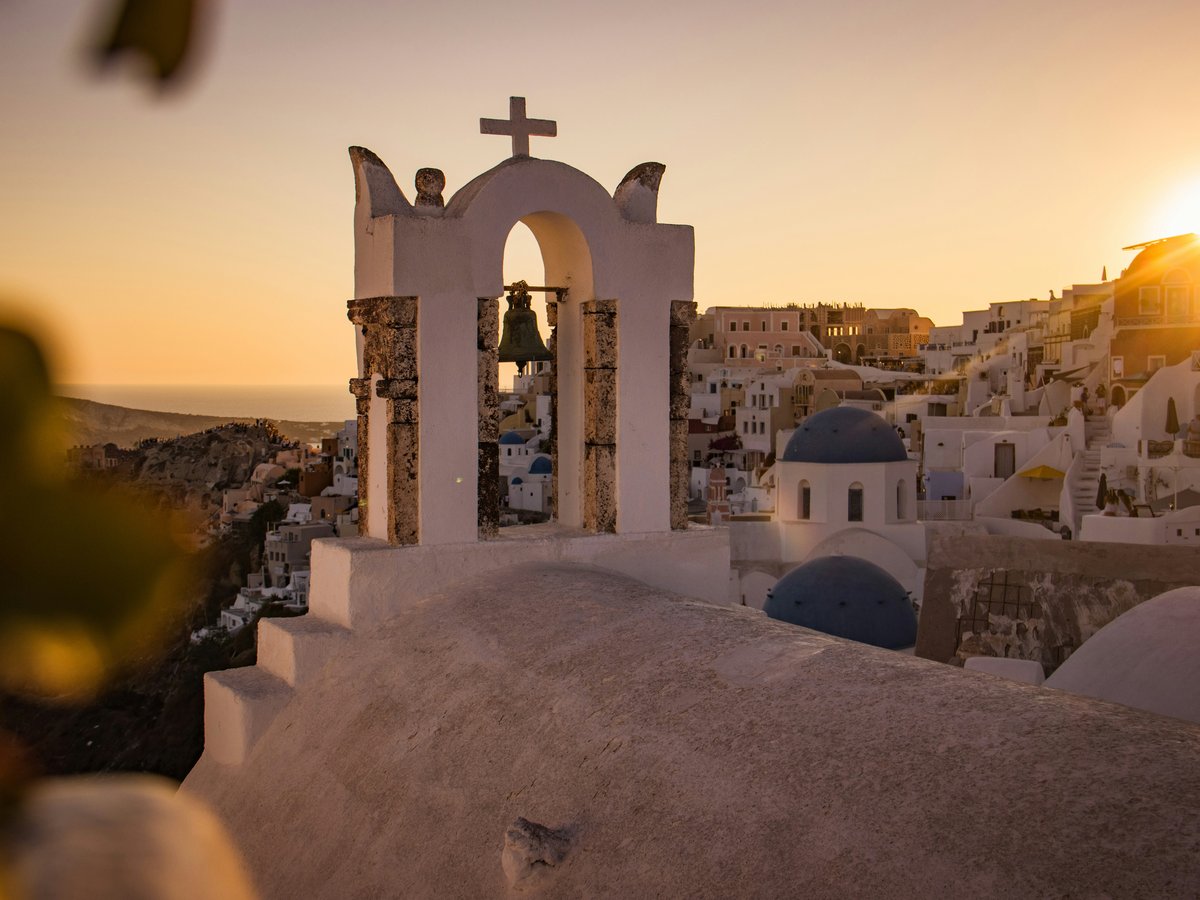
Santorini scores 5.8 out of 10 for family friendliness, and the number tells the truth. The caldera-rim towns of Oia, Fira, Imerovigli, and Firostefani were built vertically on cliff faces by people who never imagined a pushchair. Steps replace sidewalks in every village above the waterline. The drop from a restaurant terrace in Fira to the Aegean below can be 200 metres, with nothing between a curious toddler and the edge but a low stone wall.
Santorini is not hostile to families. It is indifferent to them in the caldera villages, and surprisingly good to them on the east coast. Kamari and Perissa, the two main beaches on Santorini's sheltered side, have shallow entries that stay wadeable for 15 or 20 metres, organized sunbed rows, and tavernas close enough that a parent can eat grilled octopus while a child digs in the black volcanic sand. Akrotiri's archaeological site, 12 kilometres south of Fira, has a shaded walkway system that holds a toddler's attention for 45 minutes. Fira's cable car covers the 200-metre cliff in 6 minutes, saving the 588 steps of the old donkey path.
The 5.8 reflects a split island. You can have strong family days on Santorini if you choose Kamari over Red Beach, Akrotiri over the Oia sunset, and mornings over afternoons. Oia at golden hour is on one side of that score. Akrotiri at 9 AM, Kamari by noon, and the cable car back to the hotel by 1 PM are on the other.
The 5.8 reflects a split island.
2 Oia's Sunset Crowd Is a Meltdown Trap for Anyone Under Six
You hear Oia's sunset crowd before you see the caldera. The Byzantine Castle ruins sit on Oia's northern tip, and by 7 PM in July, somewhere between 1,500 and 3,000 people pack into the surrounding viewing area. The space comfortably holds maybe 400. Selfie sticks swing at toddler-head height. Bodies press shoulder to shoulder near the Oia castle with no barriers, no seating, no shade.
For a four-year-old who skipped a nap, the Oia sunset ritual is a crisis. You will stand for 45 minutes to an hour before the sun touches the Aegean. A child who needs water or a toilet in Oia's sunset crowd has nowhere to go. The exit from the castle area is back through the same mass of bodies.
Mind you, Oia itself is lovely before the golden-hour crush. The marble-paved lanes near the Naval Maritime Museum are quiet before 11 AM. Atlantis Books, a cave bookshop on Oia's main street, can hold an older child's attention for 20 or 30 minutes. But the sunset ritual is Santorini's single biggest family trap, and every guidebook recommends it without caveat.
The fix is 8 kilometres south. Watch the sunset from Imerovigli instead, about 2 kilometres north of Fira on the caldera rim. Skaros Rock, the fortified headland at Imerovigli, offers an elevated western view with a fraction of the crowd. You might share Skaros Rock with 30 or 40 people on a July evening instead of the 2,000 at Oia's castle. There is space to sit on the ground in Imerovigli. A toddler can fidget without blocking anyone on that open terrain.
Fira's caldera-side bars near the cable car station also face west with less pressure than Oia and put a taverna dinner 5 minutes from your sunset seat.
The sunset ritual is Santorini's single biggest family trap.
3 Akrotiri's Bronze Age Ruins Win the Day Without a Tantrum
You smell dry volcanic earth first, warmed under a bioclimatic canopy that covers the entire Akrotiri excavation. The site sits on Santorini's southern tip, about 12 kilometres from Fira, and what you walk into is a 3,600-year-old Minoan city frozen mid-collapse by the eruption of roughly 1600 BC.
Akrotiri is the under-rated family winner on Santorini, and the reason is structural. The site reopened in 2012 after a closure following a roof collapse in 2005. The new tensile fabric canopy shades the full dig at Akrotiri. On a 34°C August afternoon, the temperature inside drops by several degrees. Elevated metal walkways loop above the excavated streets, which means a toddler in a carrier gets a bird's-eye view of two-storey Minoan buildings, ceramic storage jars still in position, and drainage channels that predate Rome by a millennium.
Children respond to Akrotiri because the ruins have human scale. These are rooms with doorways in a house from 1600 BC. You can see where a Bronze Age staircase rose and point at window frames older than classical Athens. The walkway circuit at Akrotiri takes 45 minutes to an hour at a family pace, which fits a preschooler's attention span.
The runner-up family attraction is the Museum of Prehistoric Thera in Fira, where many of Akrotiri's frescoes and artifacts live. The museum holds the Saffron Gatherers and the Boxing Children frescoes, both excavated at Akrotiri in the 1960s and 1970s. If your children are under three and the ruins feel abstract, the Museum of Prehistoric Thera's painted figures offer something vivid at eye level, with a circuit of about 30 minutes.
Worth noting, the famous frescoes from travel posters, the Spring Fresco and the Fisherman, are in the National Archaeological Museum in Athens, not on Santorini. Arrive at Akrotiri by 9 AM when the site opens and you might share the walkways with 20 other visitors. By noon, tour buses from the Athinios cruise port line the car park.
Children respond to Akrotiri because the ruins have human scale.
4 Kamari Beach Beats Red Beach for Families, and It Is Not Close
The black sand at Kamari holds heat like cast iron by 1 PM in July. You feel it through your sandals before the first wave reaches your toes. Bring water shoes for any child under 10, and Kamari becomes the most practical beach day on Santorini.
Kamari Beach sits on the island's southeast coast, sheltered by the headland of Mesa Vouno. The beach runs about 1.5 kilometres, lined with sunbed operators, waterfront tavernas, and the Kamari Open Air Cinema, which screens films from June through September. The water entry at Kamari is gradual. The Aegean stays shallow for the first 15 or 20 metres, and the organized section means lifeguard coverage in the summer months. A family can set up sunbeds at Kamari by 10 AM, eat lunch at a beachfront taverna without leaving the sand, and stay until the heat breaks around 5 PM.
Red Beach, near Akrotiri on Santorini's southern tip, looks extraordinary in photographs. The cliff face is rust-red volcanic rock, the water is teal, and the whole scene suggests a film set. But the access path to Red Beach crosses an unstable cliff section where rockfalls have injured visitors. Parts of the Red Beach trail have been officially closed at various points in recent years. With a three-year-old on your shoulders, Red Beach is a liability, not a destination. Visit by boat from Akrotiri's small port if you must see Red Beach, but do not walk the cliff path with children.
Perissa Beach, on the opposite side of Mesa Vouno from Kamari, is the runner-up for families. Perissa tends to be slightly less crowded than Kamari, with the same black volcanic sand and a taverna strip that feels more local in character. If your accommodation is near Fira or Oia, Kamari is the closer drive. If you are staying near Akrotiri or Megalochori, Perissa saves 10 minutes of driving.
5 The Fira-to-Oia Trail Is 10 Kilometres of No Shade and No Guardrails
The wind hits the back of your neck on the caldera rim above Fira by 10 AM, and then the sun arrives. There is no cover on the exposed trail between the villages. The Fira-to-Oia hiking trail runs roughly 10 kilometres along the cliff edge, passing through Firostefani and Imerovigli before dropping into Oia from the south. Most walkers take 3 to 5 hours.
Travel blogs list the Fira-to-Oia trail as essential Santorini. For two adults, it likely is. For a family with anyone under eight, the trail is a hard pass. The path is uneven volcanic rock for most of its 10-kilometre length. Sections between Imerovigli and Oia have sheer drops to the caldera with no railing. Shade appears only in the villages, at Firostefani around kilometre 1.5 and at Imerovigli around kilometre 3, leaving exposed stretches of 30 to 45 minutes between cover.
A child in a carrier adds 10 to 15 kilograms to a parent on terrain that demands careful foot placement. Water sources along the Fira-to-Oia trail are limited to village mini-markets in Firostefani and Imerovigli. The trail has no emergency vehicle access for most of its middle section between Imerovigli and Oia.
The family-friendly version is the Fira-to-Firostefani segment only, about 1.5 kilometres on a relatively paved caldera-rim path. You pass the Three Bells of Fira church and reach Firostefani's cafes in 20 to 25 minutes. The caldera view from Firostefani is the same panorama you would see 8 kilometres later at Oia's end. You get it in a morning stroll rather than a full-day march.
If your children are 10 and up with some hiking experience, the full Fira-to-Oia trail in October or November is reasonable. Summer heat above 33°C on the exposed ridge makes the full route unworkable for most families between June and September.
6 Perissa's Taverna Row Is Where Family Dinners Work
The smell of charcoal-grilled lamb drifts off Perissa's waterfront before you see the tavernas. The strip runs about 800 metres along the black sand of Perissa Beach, and by 7 PM in summer, most of the dozen tavernas have set tables close enough to the Aegean that a child can run to the sand and back between courses.
This matters on Santorini more than it sounds. Fira's caldera-side restaurants sit on terraces 200 metres above the water. Dinner in Fira with toddlers is a stress test. The terraces are narrow, the drops below are real, and the prices in Fira's caldera restaurants run 2 to 3 times higher than the beach villages for comparable seafood. You spend the meal watching hands rather than tasting the grilled bream.
Kamari's beachfront tavernas are the runner-up for family dinners. The setting on Kamari Beach mirrors Perissa's layout, the food quality is comparable, and the choice between them often comes down to which side of Mesa Vouno your hotel sits on. Kamari's strip draws more visitors, which keeps the taverna competition honest. Perissa has slightly more breathing room on a busy August night.
For one splurge sunset dinner, consider Imerovigli over Oia. Imerovigli's caldera restaurants offer the western view without the Oia crowd, and the walk from restaurant to hotel in Imerovigli is 5 minutes rather than a 30-minute shuffle through Oia's packed lanes.
To be fair, Santorini's taverna culture island-wide is tolerant of children in ways many European resort destinations are not. Greek families dine late, children included. A child making noise at 9 PM in Perissa raises no eyebrows at any of the dozen waterfront spots along the 800-metre strip.
7 The Itinerary Shape That Survives Small Children: Mornings Out, Afternoons Off
The light at 8 AM on Santorini has a warmth you will not find elsewhere in the Cyclades in summer. Something about the caldera's curvature and the white walls of Fira at that hour produces a glow that has not yet turned punishing. The streets of Fira are empty enough before 9 AM that a stroller can pass.
Families who make Santorini work share one pattern. Out by 8:30 or 9 AM. One activity before noon. Back at the hotel by 1 PM. Do not resurface until 5 or 6 PM. The midday hours in July and August routinely reach 33 to 35°C with limited shade anywhere on Santorini. The afternoon heat breaks a family's day, and often the trip.
A three-day family itinerary that works on Santorini. Day 1, Akrotiri archaeological site at 9 AM for 45 minutes to an hour on the walkways, then south to Perissa or Kamari Beach for the rest of the morning. Day 2, Museum of Prehistoric Thera in Fira for 30 minutes, then the Fira-to-Firostefani caldera walk, 20 minutes each way, with coffee at a Firostefani cafe. Day 3, boat trip to the volcanic island of Nea Kameni from Fira's old port, typically 3 to 5 hours round trip including a stop at the hot springs near Palea Kameni.
Notice what is absent from those 3 days. No Oia sunset. No Red Beach scramble. No Fira-to-Oia hike. A 5.8 out of 10 family-friendliness score means Santorini gives you about 3 strong family days before you start repeating yourself or reaching into the hazard zone. That is enough for most families, who rarely spend more than 4 or 5 nights on the island.
The accommodation choice matters on Santorini. A hotel with a pool in Kamari or Perissa costs less than a caldera-view suite in Oia or Fira, and beach access from the east-coast villages means the morning-to-beach-to-nap rhythm does not require a car. In Oia, you need transport for every activity outside the village itself.
Last verified by automated review (v1.7.2_onboard-santorini-flagship-2026-09-15) on . What is automated review?