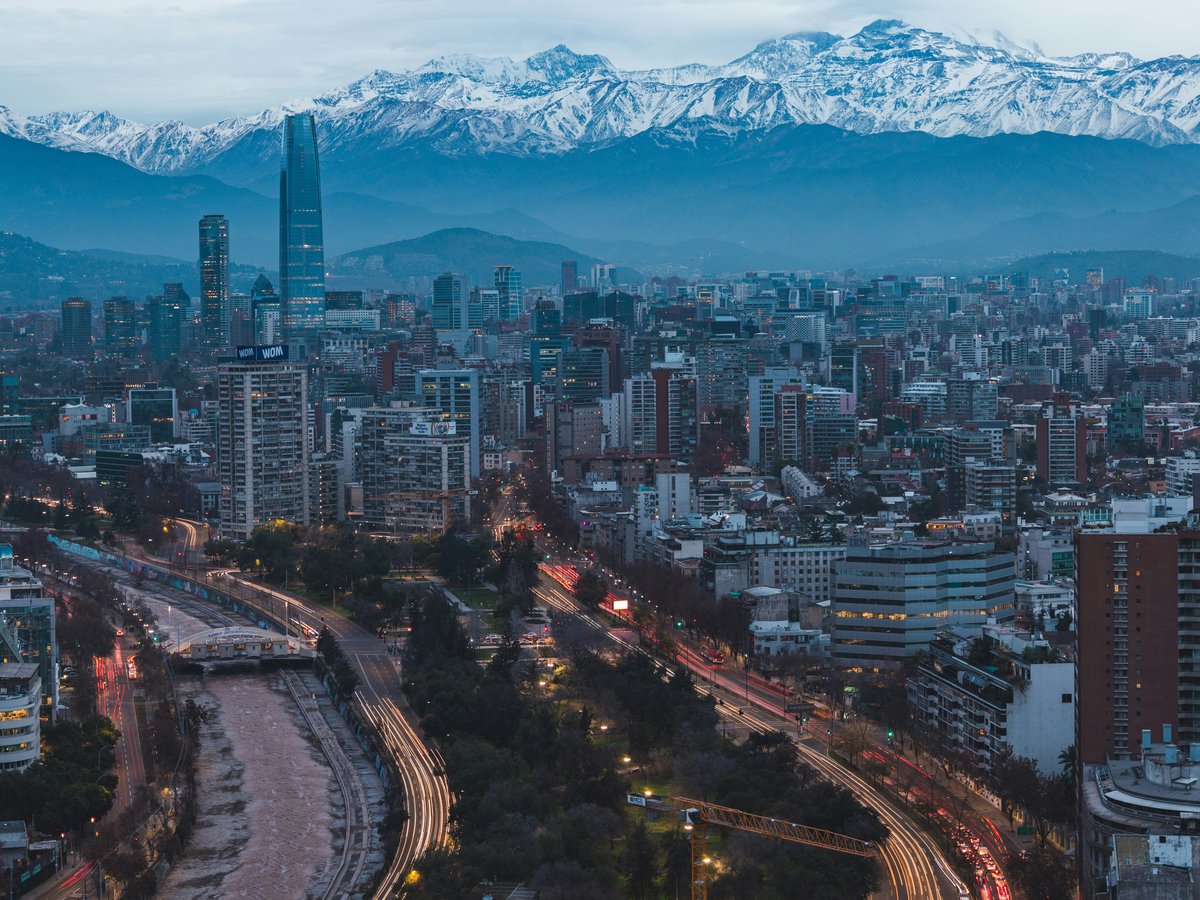
Santiago sits in a bowl between the Andes to the east and the Coastal Range to the west, with the Mapocho River running east-west through the northern third of the city. Neighborhoods fan out from the colonial core around Plaza de Armas. Wealthier districts climb eastward toward the mountains, while working-class comunas spread south and west toward the Central Valley. Metro Line 1 runs the main axis beneath Avenida Libertador Bernardo O'Higgins (locals call it the Alameda) and continues east under Avenida Providencia, connecting the historic center to the modern business corridor in about 30 minutes. The system currently has 7 lines and around 140 stations, which makes cross-city trips straightforward by South American standards. In late August, Santiago mornings hover around 7°C with 95% humidity, and the valley tends to trap smog on still days between the two ranges. The city scores 5.8 out of 10 for solo-traveler safety (see the TTDI Solo-Safety Index), so standard urban awareness applies, particularly around Centro after dark and on packed Metro cars at rush hour.
Neighborhoods
-
Centro (Santiago Centro)
The oldest part of the city, built on the 1541 colonial grid Pedro de Valdivia laid out around Plaza de Armas. Stone-and-stucco buildings from the 1800s sit next to 1960s concrete towers, and the sidewalks along Paseo Ahumada and Paseo Huérfanos stay packed with vendors, office workers, and evangelical preachers from about 8 AM until nightfall. Corner stalls fry sopaipillas in big vats of oil, 3 for 500 CLP, and the smell carries for blocks. The Santiago Metropolitan Cathedral, completed in 1800, anchors the north side of the plaza. Two blocks south on Calle Bandera, the Chilean Museum of Pre-Columbian Art has occupied a colonial-era customs house since 1981, holding one of the strongest textile collections in the Americas.
- Best for
- History-focused travelers and budget visitors who want walkable access to museums, churches, and Metro hubs without paying Providencia prices
- Key streets
- Plaza de Armas for orientation, Paseo Ahumada and Paseo Huérfanos for pedestrian shopping, Calle Bandera for museums, and the Alameda (Av. Libertador Bernardo O'Higgins) as the southern boundary
-
Lastarria (Barrio Lastarria)
A compact rectangle of maybe 8 blocks wedged between Santa Lucía Hill and the Alameda, south of the Mapocho. The streets are narrow, lined with early-1900s townhouses converted into wine bars, independent bookshops, and small galleries. It feels quiet compared to Centro, though weekend afternoons bring a craft market to Calle José Victorino Lastarria that makes the sidewalks tight. The Chilean National Museum of Fine Arts, operating since 1880, sits at the neighborhood's northern edge inside the Palacio de Bellas Artes. Its glass-domed main hall catches long afternoon light. The Santiago Museum of Contemporary Art, open since 1947, shares the same building on the opposite wing.
- Best for
- Couples, art-focused solo travelers, and anyone who wants to walk to 3 major museums and eat well within a 4-block radius
- Key streets
- Calle José Victorino Lastarria for restaurants and bookshops, Calle Merced running parallel with quieter cafes, and the paths up Santa Lucía Hill for views of downtown and the Andes on clear mornings
-
Bellavista
Bellavista sits on the north bank of the Mapocho, split between a flat commercial strip along Calle Pío Nono and a steeper residential section that climbs toward Cerro San Cristóbal. The Pío Nono stretch is Santiago's noisiest corridor after midnight on Fridays, with bars and restaurants stacked shoulder to shoulder and groups of university students spilling into the road. Higher up toward the cerro, the streets narrow and the noise drops to birdsong and barking dogs. Pablo Neruda's house, La Chascona, sits on Calle Fernando Márquez de la Plata halfway up the hill. The neighborhood has the highest concentration of lapis lazuli shops in Chile, a legacy of the country's near-monopoly on the stone. The LGBTQ+ scene here is the most visible in Santiago, which scores 7.5 out of 10 for LGBTQ+ friendliness (sourced from TTDI's editorial rubric).
- Best for
- Nightlife seekers, younger travelers on a mid-range budget, and anyone who wants bars, restaurants, and the San Cristóbal funicular within walking distance
- Key streets
- Calle Pío Nono for bars and late-night food, Calle Constitución for slightly calmer restaurants, Calle Dardignac for newer cocktail spots, and Avenida Bellavista for the Patio Bellavista complex
-
Providencia
A long, tree-lined residential district running east from the Mapocho along Avenida Providencia and Avenida Nueva Providencia. The buildings are mostly 1970s to 1990s mid-rises, 8 to 12 floors, with ground-floor shops and cafes underneath. The pace feels suburban compared to Centro, though the Manuel Montt and Pedro de Valdivia Metro stations anchor busy commercial clusters at every 3rd or 4th block. Sidewalks are wide enough to walk two abreast without dodging traffic, and mornings here are more birdsong than car horns. Parque Balmaceda and Parque de las Esculturas follow the riverbank at the district's northern edge. The city's family-friendliness score of 7.2 out of 10 (see the TTDI Family-Friendliness Index) shows most clearly in neighborhoods like this one, with stroller-friendly paths and reliable pharmacies on every other corner.
- Best for
- First-time visitors wanting a calm, well-connected base with good restaurants, and families needing safe sidewalks, parks, and supermarkets within walking distance
- Key streets
- Avenida Providencia from Metro Los Leones to Pedro de Valdivia for shops and dining, Avenida Suecia for a cluster of after-work bars, and Calle Bucarest for quieter cafes south of the main avenue
-
Las Condes
Santiago's business district, anchored by the glass towers along Avenida Apoquindo between Metro El Golf and Metro Tobalaba. This is where multinational offices, high-end hotels, and Costanera Center (the tallest building in South America at 300 meters, with a viewing deck on the 62nd floor) dominate the skyline. The streets are wide, clean, and feel corporate Monday through Friday. Residential blocks between the avenues are quiet and guarded. The whole area looks more like a North American suburb than a South American capital. Prices for food, lodging, and everything else run 30 to 50 percent higher here than in Centro or Bellavista.
- Best for
- Business travelers, visitors who prefer international hotel chains, and anyone who values English-speaking services and modern shopping over neighborhood texture
- Key streets
- Avenida Apoquindo from Tobalaba to El Bosque for corporate towers and restaurants, Avenida Isidora Goyenechea (nicknamed Sanhattan by locals) for high-end dining and cocktail bars, and Calle El Bosque Norte for the densest restaurant cluster
-
Barrio Italia
A residential grid between Avenida Italia and Avenida Irarrázaval in the comuna of Ñuñoa. The houses are low, mostly 1920s to 1940s construction with thick adobe walls, tiled floors, and small front gardens. Over the past decade, these homes have been steadily converting into antique shops, design studios, small-batch coffee roasters, and restaurants that open only for lunch. You'll hear dogs barking and cumbia drifting from kitchen radios between the storefronts. The neighborhood draws a weekend crowd from Providencia and Las Condes, less so foreign visitors. Worth noting, Santiago scores 6.2 out of 10 for digital-nomad suitability (sourced from TTDI's editorial rubric), and Barrio Italia's cafes with strong wifi and 2,500 CLP flat whites are where many remote workers end up.
- Best for
- Design-minded travelers, vintage hunters, and digital nomads who want to eat and browse without a tourist crowd
- Key streets
- Avenida Italia between Diagonal Oriente and Avenida Irarrázaval for the densest cluster of shops, Calle Caupolicán for newer restaurants, and Calle Condell one block east for quieter cafes
-
Barrio Yungay
West of Centro, Barrio Yungay is one of Santiago's oldest residential districts, declared a national heritage zone in 2009. The streets are wide and the buildings are low, 2 to 3 stories, with ornate 19th-century facades that haven't been renovated the way Lastarria's have. The plaster is often cracking, the ironwork oxidized. It smells like damp stone and fresh bread from the corner panaderías. The Museum of Memory and Human Rights, which opened in 2010 to document the Pinochet dictatorship, sits at the neighborhood's western edge near Metro Quinta Normal. Parque Quinta Normal, a 36-hectare green space next door, holds the Chilean National Museum of Natural History, which has operated continuously since 1830.
- Best for
- Travelers interested in Chilean political history, 19th-century architecture, and a neighborhood that hasn't been polished for tourism. To be fair, it requires a bit more street awareness than Providencia or Lastarria
- Key streets
- Calle Compañía and Calle Huérfanos heading west from Centro, Plaza Yungay as the neighborhood's anchor square, Calle Libertad for old houses and small galleries, and Avenida Matucana for the museum corridor near Quinta Normal
-
Ñuñoa
A broad residential comuna southeast of Providencia, centered on Plaza Ñuñoa, a tree-lined square surrounded by restaurants, a couple of old single-screen cinemas, and neighborhood bars. The housing stock is mostly 1950s to 1970s houses and low apartment buildings with front gardens gone slightly wild. The Julio Martínez Prádanos National Stadium, built in 1938, sits in Ñuñoa's northern section and still hosts concerts and national team matches on weekends. The neighborhood moves at a distinctly local pace, with families at corner bakeries and old men reading El Mercurio on park benches. Accommodation here costs roughly 40 percent less than comparable options in Providencia, 2 Metro stops west.
- Best for
- Longer-stay visitors who want a residential base with Metro access on Lines 3 and 6, local restaurants, and lower accommodation costs than the tourist-facing barrios
- Key streets
- Plaza Ñuñoa and the surrounding blocks for restaurants and weekend markets, Avenida Irarrázaval as the commercial spine running east-west, and Calle Jorge Washington for a quieter residential stretch with old gardens
-
Vitacura
The wealthiest comuna in Santiago, running along the Mapocho's north bank east of Bellavista. The streets are wide and lined with mature trees. Houses sit behind high walls, and the commercial stretches along Avenida Vitacura and Avenida Nueva Costanera feel closer to Miami than to the rest of Santiago. Contemporary art galleries, including Galería Patricia Ready and Galería Isabel Aninat, cluster along Nueva Costanera. Bicentenario Park, a 30-hectare strip along the river, has jogging paths and flamingos in its artificial lagoons. Restaurant prices here are the highest in the city, with a dinner for two reaching 50,000 to 80,000 CLP before wine.
- Best for
- Art collectors, luxury-oriented travelers, and visitors with a car or ride-hailing budget, since Metro coverage is limited to the southern edge of the comuna
- Key streets
- Avenida Nueva Costanera for galleries and high-end restaurants, Avenida Vitacura between Tabancura and Américo Vespucio for design shops and boutiques, and Avenida Bicentenario for river-path jogging and views toward the Andes
FAQ
Which Santiago neighborhood is best for a first-time visitor?
Providencia tends to be the safest bet for first-timers. It sits on Metro Line 1 between Centro and Las Condes, so you can reach the historic core or the modern east side in 10 to 15 minutes. Hotels and Airbnbs around the Manuel Montt or Pedro de Valdivia stations put you within walking distance of parks, reliable restaurants, and pharmacies. The sidewalks are well-lit and the neighborhood stays active until about 11 PM without getting rowdy. Lastarria works well too if you prefer a smaller, more walkable radius near museums and cafes, though accommodation options there are fewer and tend to cost 20 to 30 percent more than comparable rooms in Providencia.
Is it safe to stay in Santiago Centro?
Centro is fine during the day, particularly along the main pedestrian corridors and around Plaza de Armas. After about 9 PM, the streets empty quickly and the blocks south of the Alameda can feel isolated. Phone snatching and bag slashing on crowded sidewalks are the primary concerns. If you book in Centro, choose somewhere on the north side near Mercado Central or along Calle Bandera, where foot traffic lasts longer into the evening. The Metro closes around 11 PM on weeknights and 11:30 PM on weekends, so plan your return from other neighborhoods accordingly.
How easy is it to get between neighborhoods in Santiago?
The Metro handles most cross-city trips well. Line 1 connects Centro, Providencia, and Las Condes along the main east-west axis, and newer lines serve Ñuñoa and southern comunas. A single ride costs 800 CLP during peak hours. Buses (the RED system, formerly Transantiago) cover areas the Metro misses, including parts of Barrio Italia and Vitacura. A bip! card, available at any Metro station for 1,550 CLP, works on both. Taxis and ride-hailing apps fill the remaining gaps, with a typical 15-minute ride costing 3,000 to 5,000 CLP.
Where should I stay in Santiago for nightlife?
Bellavista is the obvious answer, and it's not wrong. The Pío Nono strip and surrounding streets have the highest bar density in the city. That said, the scene there skews young and loud, and some Pío Nono spots are tourist-oriented with marked-up drink prices. For a more curated night, look at the Constitución and Dardignac blocks east of Pío Nono. You could also stay in Lastarria and walk across the Mapocho via Puente Pío Nono, which takes about 10 minutes on foot and drops you into the middle of the action.
What is the best neighborhood in Santiago for families with children?
Providencia and Las Condes are the most practical bases. Providencia has Parque Balmaceda and Parque de las Esculturas along the river, both with open lawns and playground areas. Las Condes has Parque Araucano near the Costanera Center, with dedicated play structures and weekend puppet shows. Both neighborhoods offer wide sidewalks, well-stocked pharmacies, and supermarkets (Jumbo, Líder) within walking distance. Accommodation with kitchen facilities is more common in these two comunas, which matters when traveling with smaller children.
When is the best time of year to visit Santiago?
October through December (Chilean spring) tends to bring clear skies, daytime temperatures between 18°C and 28°C, and the Andes still capped with snow, which makes for the best mountain views from the city. March and April (early autumn) are similarly pleasant and slightly cheaper for accommodation. January and February run warmest, often above 32°C, and many santiaguinos leave for the coast, which empties some neighborhoods and shutters smaller restaurants. Late August, when the city is still in winter mode with cold, damp mornings, is functional but gray over the Mapocho basin.
Last verified by automated review (v1.7.2) on . What is automated review?