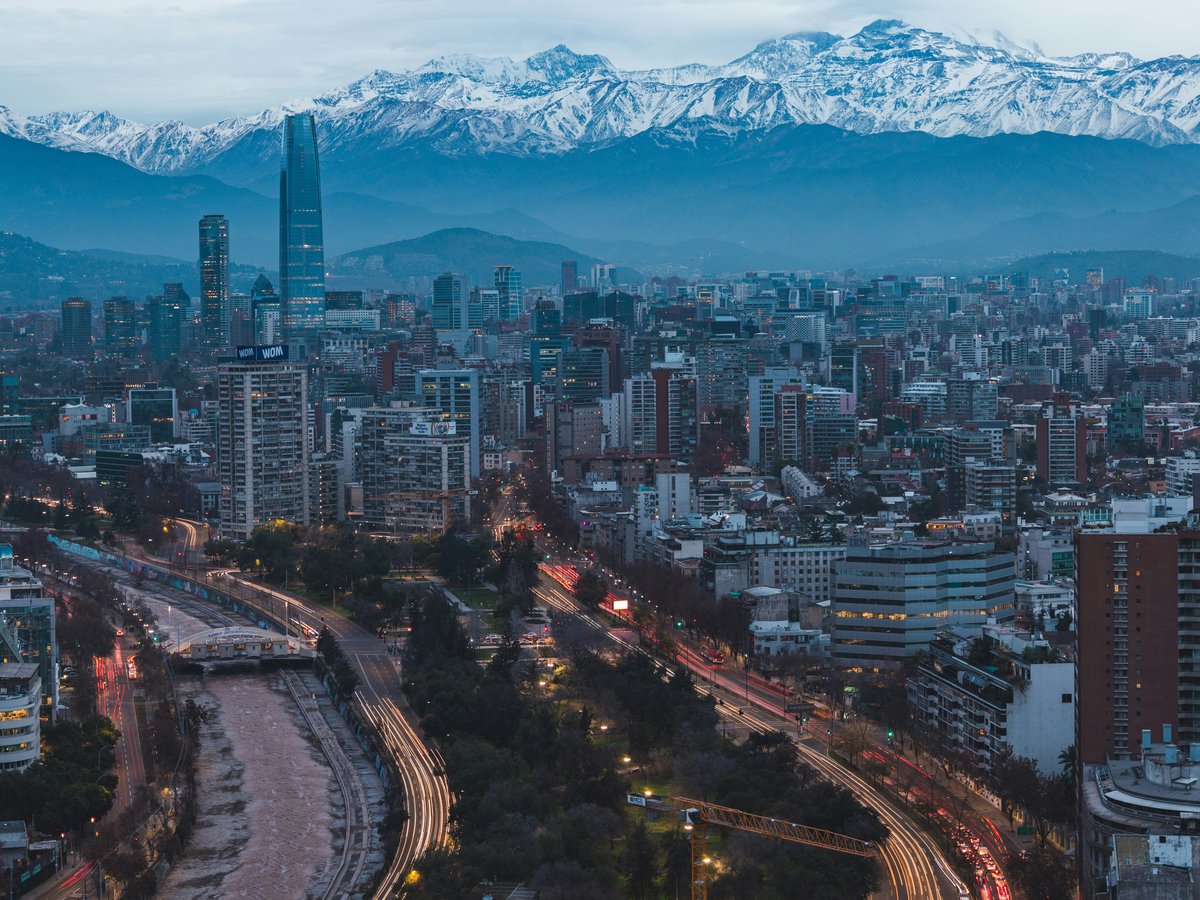
Santiago sits between the Andes and the Chilean Coastal Range in a wide valley that catches winter fog and summer heat in equal measure. Over nearly two centuries the city has assembled one of South America's most generous collections of free public institutions. Four national-caliber museums charge nothing year-round. The centro histórico runs from Plaza de Armas south to the Alameda, compact enough to cover on foot in a morning. Two hills, Cerro Santa Lucía and Cerro San Cristóbal, give you Andean panoramas for nothing more than a steep walk. La Vega Central and Mercado Central welcome browsers with no expectation of purchase, and the smell of fresh congrio and reineta at the fish stalls tends to stay with you longer than most ticketed experiences would. In late August, mornings currently hover around 7°C with heavy humidity, so bring a warm layer. By midday the sun usually warms the stone plazas, and on clear days the Andes fill the eastern skyline from almost every elevated corner of the city.
Free attractions
-
Museo Nacional de Bellas Artes
Chile's national fine-arts museum was established in 1880 and moved into the Palacio de Bellas Artes when the building opened for the country's 1910 centennial celebrations. Permanent galleries cover Chilean and Latin American painting from the colonial era through the 20th century, with rotating shows on the upper floors. Admission has been free for the museum's entire history. The main hall sits under a soaring Art Nouveau glass dome that fills the space with diffused natural light, and portrait painters sometimes set up easels on weekday mornings.
Lastarriamuseum -
Museo de la Memoria y los Derechos Humanos
This museum opened in 2010 to document Chile's military dictatorship from 1973 to 1990. The São Paulo firm Estudio América designed the copper-clad building, which appears to float above a shallow reflecting pool. Exhibits move through photographs, declassified documents, and recorded testimony from survivors and their families. The audio recordings can be difficult to sit through. Free admission every day, and the permanent collection tends to require 2 to 3 hours. The ground-floor temporary hall rotates shows on human rights themes from across Latin America.
Quinta Normalmuseum -
Museo Nacional de Historia Natural
South America's oldest natural history museum was founded in 1830 by the French naturalist Claudio Gay. The building itself dates to 1875 and sits inside the Quinta Normal park grounds. Upper-floor galleries cover Chilean ecosystems from the Atacama Desert to Patagonia, with taxidermy specimens and geological samples arranged by region. The heavy wooden floors creak underfoot on the second level. Free every day, and school groups tend to concentrate in the paleontology wing, so start there early if you prefer quiet.
Quinta Normalmuseum -
Museo de Arte Contemporáneo
MAC has operated since 1947 and currently occupies two buildings. The Parque Forestal wing shares the Palacio de Bellas Artes with the national fine-arts collection. The second location sits inside Quinta Normal, in a smaller pavilion that tends to host more experimental installations and video art. Both venues are always free. Worth noting that the two buildings stand about a 20-minute walk apart, so plan accordingly if you want to see both in one outing.
Santiago Centromuseum -
Cerro Santa Lucía
This terraced hill rises from central Santiago a few blocks south of Plaza de Armas. Colonial-era fortifications at the base give way to stone staircases, fountains, and lookout terraces as you climb. Pedro de Valdivia founded Santiago at this hill's base in 1541, and the current park layout dates to an 1872 renovation led by the city's intendente Benjamín Vicuña Mackenna. Summit views extend to the Andes on clear mornings, though winter smog can limit visibility to a few kilometers. Free to enter at any hour.
Santiago Centroviewpoint -
Catedral Metropolitana de Santiago
The present structure on Plaza de Armas was completed in 1800, though earlier churches stood on the same site from the 1560s. The neoclassical facade faces the square, and the interior holds ornate wooden altarpieces and a pipe organ from the mid-19th century. It remains an active place of worship, so you might walk into a Mass in progress. The wooden pews and stone floors keep the interior cool even when summer temperatures reach the high 20s outside. No admission fee.
Santiago Centrolandmark -
Parque Metropolitano de Santiago
Santiago's largest green space covers roughly 722 hectares across Cerro San Cristóbal and the adjoining ridgeline. You can walk or jog the trail network from the Bellavista entrance to the Virgen de la Inmaculada Concepción statue at the 880-meter summit. The funicular and teleférico charge fares, but the trails themselves cost nothing. The Jardín Botánico Mapulemu, partway up the hill, maintains a native-plant collection and rarely draws crowds. On clear mornings the summit views reach the snow-covered peaks of the main Andean cordillera.
Providenciapark -
Parque Forestal
This long, narrow park follows the south bank of the Río Mapocho from the Mercado Central area east toward Barrio Bellavista. Old European-style plane trees line the paths, and on weekends local artists set up easels along the central walkway. The walk from one end to the other covers about 1.5 kilometers, and the tree canopy provides shade even in midsummer. On winter mornings the fog hangs low between the branches and the park feels almost deserted before 09:00.
Santiago Centropark -
Quinta Normal
This 36-hectare park in western Santiago Centro contains the national natural-history museum, MAC's second location, and the Museo de la Educación Gabriela Mistral. On weekends, families spread picnic blankets near the lagoon, and you'll see rowboats circling slowly in the still water. The grounds date to 1842, when the Chilean government established them as an agricultural research station. The tall palms near the northern entrance are likely among the oldest planted trees in central Santiago.
Quinta Normalpark -
Museo Chileno de Arte Precolombino
This museum opened in 1981 to house one of Latin America's strongest collections of pre-Columbian artifacts, from Mapuche silverwork to Inca textiles and Moche ceramics. Regular admission is paid, but the first Sunday of every month is free. The building, a former Real Aduana (Royal Customs House) from 1807, sits on Calle Bandera near Plaza de Armas. If you time your visit for that first Sunday, arrive before 11:00 to avoid the longest queues. The textile galleries on the second floor are worth the patience.
Santiago Centromuseum
Free activities
-
Walking Barrio Lastarria
Barrio Lastarria sits between Cerro Santa Lucía and Parque Forestal, centered on Calle José Victorino Lastarria. Narrow streets fill with bookshops, independent cafes, and small galleries. On weekends a book market and crafts fair lines the pedestrian strip near Plaza Mulato Gil de Castro. The architecture is mostly early-20th-century townhouses converted to commercial use. You'll catch the smell of fresh coffee from at least three roasters within a two-block radius.
Lastarriawalk -
Browsing La Vega Central
Santiago's largest fresh-produce market sprawls across several blocks north of the Río Mapocho in the Recoleta district. Vendors sell fruit, vegetables, seafood, dried legumes, and spices from stalls that open before dawn and wind down around 17:00. The market has operated on roughly the same site since 1895. Small food counters around the perimeter serve plates for under 3,000 CLP, though browsing costs nothing. You'll hear the vendors before you see them, and the smell of cilantro and fresh fish carries across the main hall.
Recoletamarket -
Street art walk in Barrio Bellavista
Bellavista, on the north bank of the Río Mapocho below Cerro San Cristóbal, has Santiago's densest concentration of street murals. Calle Constitución and Calle Dardignac display large-scale works by Chilean and international artists, with walls rotating every year or two. La Chascona, Pablo Neruda's former home on Calle Fernando Márquez de la Plata, sits in the same neighborhood, though that one charges admission. The murals run for several blocks and you'll want at least an hour to photograph them properly.
Bellavistawalk -
Browsing Mercado Central
The iron-framed Mercado Central opened in 1872 near the south bank of the Río Mapocho. The central hall sells fresh fish and shellfish, and the surrounding stalls carry dried goods, olives, and nuts. Restaurant touts will try to seat you, but there is no obligation to eat. To be fair, the seafood restaurants in the outer ring tend to offer better prices than the ones clustered directly under the dome. The building's ornate iron roof structure was fabricated in England and shipped to Chile in pieces.
Santiago Centromarket -
Walking Barrio Yungay
West of the Alameda, Barrio Yungay still feels like a residential Santiago from decades past. Streets around Plaza Yungay display crumbling neoclassical facades alongside newer murals. The neighborhood was declared a Zona Típica (historic conservation zone) in 2009. Saturday mornings bring a small flea market to the plaza. The Peluquería Francesa, a converted 19th-century barbershop on Calle Compañía de Jesús, now operates as a cultural venue with occasional free exhibitions and live music on weekend evenings.
Yungaywalk -
Walking the Alameda and Palacio de La Moneda
Avenida Libertador General Bernardo O'Higgins, universally called the Alameda, runs east-west through central Santiago for roughly 7 kilometers. The stretch between Universidad de Chile and Los Héroes metro stations passes several landmarks visible from the sidewalk. The Palacio de La Moneda, Chile's presidential palace, sits one block south at Plaza de la Constitución. Its exterior courtyards are open to pedestrians, and the subterranean Centro Cultural Palacio de La Moneda often hosts free exhibitions alongside ticketed ones. The Alameda's plane trees provide welcome shade in summer, and the Metro runs directly beneath for the return trip.
Santiago Centrowalk
Free events
-
Día del Patrimonio Cultural
Last weekend of May (typically the last Sunday)Chile's national heritage day opens hundreds of buildings that are normally closed to the public. Government offices, private mansions, military installations, and cultural institutions participate across Santiago. The interior of the Palacio de La Moneda typically opens for guided walks, and the Palacio Cousiño in Barrio Brasil is another popular stop. The event has been held annually since 1999.
Citywide -
Free programming at Centro Cultural Gabriela Mistral (GAM)
Year-round, with most free events on weekendsGAM, on the Alameda near the Lastarria neighborhood, is Santiago's largest performing-arts complex. The building replaced the Diego Portales conference center, which the military government used as its headquarters after the 1973 coup. GAM's outdoor plazas and several indoor exhibition halls are always open at no charge. The monthly calendar typically includes free concerts, film screenings, and dance performances. The central plaza's concrete steps fill with university students sharing lunch on weekday afternoons.
Avenida Libertador Bernardo O'Higgins 227 -
Fiestas Patrias
September 18-19 (often extended through the nearest weekend)Chile's independence celebrations run from September 18 to at least September 19 each year, with most workers getting an extended holiday. Temporary fondas (festival pavilions with food, drink, and live cueca music) spring up in parks across the city, and the largest installations tend to concentrate in Parque O'Higgins. You'll smell grilled anticuchos and sopaipillas from blocks away. Mind you, the chicha and terremoto cocktails cost money, but the celebrations themselves are free to attend.
Parque O'Higgins and citywide fondas -
Santiago a Mil
January (typically runs 2 to 3 weeks)This international performing-arts festival has run every January since 1994, and its outdoor program includes free theatre, circus, and dance in public plazas and parks. Past editions have staged performances at Plaza de la Ciudadanía, Parque Forestal, and the GAM esplanade. Ticketed indoor shows run in parallel, but the outdoor program is reliably free. Summer evening crowds on the Forestal paths can reach several thousand for headline acts.
Multiple public venues across Santiago
Getting around Santiago on a budget
Santiago's Metro covers most of the tourist-relevant areas, and a single ride costs well under 1,000 CLP at even the busiest peak rate. At the current exchange rate of roughly 913 CLP per dollar, that works out to about 1 USD per trip. You'll need a Bip! card to ride the Metro or the micros (city buses), and cards are sold at any station. That said, most of the free attractions in central Santiago sit within a 4-kilometer radius of Plaza de Armas, and walking between them rarely takes more than 30 minutes. The neighborhoods of Lastarria, Bellavista, Barrio Yungay, and Quinta Normal are all reachable on foot from the centro. If you do take a taxi or ride-hailing app, a cross-town trip from the centro to Providencia or Barrio Italia might run 3,000 to 5,000 CLP. For detailed neighborhood-by-neighborhood transit advice, the Wikivoyage Santiago guide (https://en.wikivoyage.org/wiki/Santiago#Get_around) is a useful starting point.
When free activities work best in Santiago
Santiago's Mediterranean climate means dry summers from December through February, with highs near 30°C and clear skies, and cool damp winters from June through August with highs closer to 14°C. Outdoor free activities tend to work best from October to April, when rain is unlikely and daylight stretches past 20:00. The museums are year-round options and see their lightest crowds between May and August. September brings the national independence celebrations, and late May has its own draw with the heritage-day building openings, so both shoulder seasons carry reasons to visit. If you arrive in winter, mornings can feel raw, but afternoon sunshine usually breaks through by early afternoon. Santiago seldom drops below freezing, so free walking routes stay practical even in the coldest weeks.
Sources and further reading
This guide draws on the following references for current transit, attraction, and safety details. Wikivoyage's Santiago overview (https://en.wikivoyage.org/wiki/Santiago) covers general orientation. The attractions section (https://en.wikivoyage.org/wiki/Santiago#See) lists museums and landmarks with hours and practical notes. The safety section (https://en.wikivoyage.org/wiki/Santiago#Stay_safe) offers neighborhood-level guidance. The practical-information section (https://en.wikivoyage.org/wiki/Santiago#Cope) covers money, tipping, and language basics. Museum founding dates are cross-referenced with Wikidata entries for each institution.
FAQ
Is Santiago safe for solo travelers exploring free attractions?
Santiago scores 5.8/10 for solo-traveler safety (see the TTDI Solo-Safety Index). The central tourist areas around Lastarria, Providencia, and Las Condes tend to feel secure during daylight. Petty theft and phone snatching are the primary concerns, especially on crowded Metro carriages and at busy markets. After dark, the well-lit commercial streets in Providencia and Bellavista are reasonable for walking, though quieter blocks near Cerro Santa Lucía empty out after 22:00 and feel less comfortable. For neighborhood-specific notes, the Wikivoyage safety section (https://en.wikivoyage.org/wiki/Santiago#Stay_safe) has useful detail.
Are Santiago's free museums and parks suitable for families with children?
Santiago rates 7.2/10 for family friendliness (see the TTDI Family-Friendliness Index). The Museo Nacional de Historia Natural tends to be the biggest hit with young children, thanks to its fossil displays and habitat dioramas. Parque Metropolitano has playgrounds along the lower trails that are free to use, even though the zoo near the Bellavista entrance charges separately. Quinta Normal's wide lawns and lagoon give kids space to run. Most Santiago museums are relaxed about strollers and noise from small children.
What is the best time of year for free outdoor activities in Santiago?
October through April offers the driest weather and longest daylight for outdoor activities. September is festive due to the independence celebrations, and late May has its own draw with the heritage-day building openings. Winter visits are cooler and occasionally wet, but the museums remain open year-round and visitor queues are noticeably shorter. Santiago seldom freezes, so free walking routes stay practical even in July and August.
Is Santiago welcoming for LGBTQ+ travelers?
Santiago scores 7.5/10 for LGBTQ+ friendliness (sourced from TTDI's editorial rubric). Chile legalized same-sex marriage in March 2022, and the Barrio Bellavista and Lastarria neighborhoods have visible LGBTQ+ scenes with bars, cafes, and community events. The annual Marcha del Orgullo (Pride March) typically takes place in June along the Alameda and draws large crowds. Same-sex couples in the central neighborhoods are unlikely to encounter problems, though attitudes may vary in more suburban areas.
Can I get by in Santiago without speaking Spanish?
English is not widely spoken outside upscale restaurants, international hotels, and tourist-oriented areas in Providencia and Las Condes. Museum signage at the major institutions often includes English translations, but market vendors at La Vega and Mercado Central rarely speak it. A basic Spanish vocabulary of 50 to 100 words covers most daily interactions. Smartphone translation apps with camera features work well on menus and signs. Metro station staff and Carabineros (police) sometimes speak limited English, but it is better not to count on it.
Is Santiago a good base for digital nomads on a budget?
Santiago rates 6.2/10 for digital-nomad suitability (sourced from TTDI's editorial rubric). Free Wi-Fi is available at most cafes in Lastarria, Providencia, and Ñuñoa, and the Biblioteca Nacional on the Alameda offers free internet access along with quiet reading rooms. The GAM building also provides open seating areas with reliable connectivity. Co-working day passes typically run 8,000 to 15,000 CLP (roughly 9 to 16 USD). The main limitation is that Santiago lacks the deep digital-nomad infrastructure you would find in cities like Medellín or Lisbon.
Last verified by automated review (v1.7.2) on . What is automated review?