What's the must-see thing in Lisbon?
Jerónimos Monastery in Belém, not the castle. São Jorge has the views everyone photographs, but Jerónimos is where Lisbon's identity as a maritime power becomes physical: 500-year-old limestone columns carved to look like ropes, coral, and sea creatures, all paid for with spice-trade wealth. Go at 10am Tuesday through Saturday. Tickets €10.
Every guide defaults to Castelo de São Jorge. The panoramic view IS good: Alfama's terracotta rooftops tumbling toward the Tagus, the bridge cables catching late afternoon light. But the castle walls are a 1940s reconstruction. You're paying €15 to stand on modern concrete dressed in old stone. Jerónimos Monastery in Belém is the opposite: original Manueline limestone from 1502, untouched because the 1755 earthquake that flattened downtown Lisbon spared this stretch of riverbank. Walk through the south portal and the temperature drops five degrees. The cloister smells like cool mineral dust. Every column is carved differently (rope knots, coral branches, pepper vines, armillary spheres) and the detail rewards slow looking. This is what a country builds when it controls the sea route to India and hasn't yet figured out that the money won't last. Tickets are €10, or free the first Sunday of each month. Go Tuesday through Saturday around 10am; the tour buses from cruise ships start arriving by 11:30.
Belém is a 20-minute tram ride west of Praça do Comércio on the 15E, or a quick Uber for about €8. Build a half-day around the monastery. Torre de Belém is a five-minute walk along the waterfront: worth seeing from outside, though the interior is a narrow spiral staircase with not much at the top. The stop you shouldn't skip after Jerónimos is Pastéis de Belém on Rua de Belém, the bakery that has made custard tarts since 1837. The queue looks long but moves fast. Order at the counter, not from a waiter: you'll wait half as long. The tarts arrive warm, the pastry shattering into buttery flakes, the custard still trembling. Dust them with cinnamon at the table. They cost about €1.40 each. Mind you, every café in Lisbon sells pastéis de nata, but the ones here have a slightly charred top and a crispier shell that the imitators don't quite match.
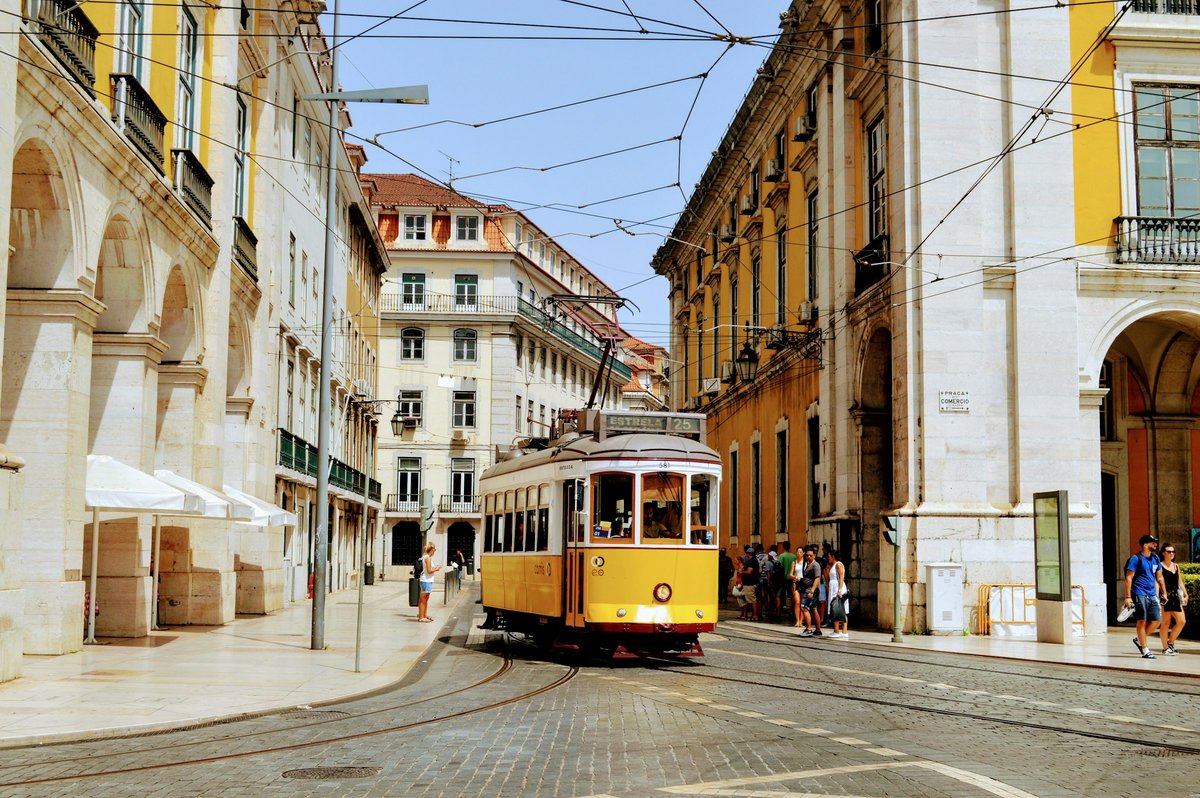
Praça do Comércio is where Lisbon meets the water. The yellow-walled ministries frame three sides of the square; the fourth opens directly onto the Tagus through a triumphal arch. Before the 1755 earthquake this was the royal palace grounds: the disaster levelled everything and the Marquis of Pombal rebuilt the entire Baixa district on a rational grid, which is why downtown Lisbon feels oddly orderly compared to the tangled hills around it. The square works best at golden hour, when the light off the river turns the arcades amber and the marble steps at the waterline fill with people sharing bottles of Sagres. It's free, always open, and serves as a natural starting point for walking north through Rua Augusta into Rossio. That said, the restaurants under the arcades are overpriced and mediocre: eat literally one block inland on Rua dos Fanqueiros instead.
The Calouste Gulbenkian Museum is the one most first-timers skip, and that's exactly why it works so well. While crowds pack the Belém monuments, you'll find yourself nearly alone in front of a Rembrandt portrait or a case of René Lalique dragonfly brooches with enamel wings so thin they look wet. Gulbenkian was an Armenian oil magnate who spent sixty years assembling one of every beautiful thing: Egyptian scarabs, Chinese porcelain, Impressionist canvases, Ottoman textiles. The building sits in its own garden park near the São Sebastião metro stop, well north of the tourist circuit. Spend two hours inside, then sit in the garden where the peacocks wander between the sculptures. Tickets are €10; free on Sundays after 2pm. If you only have one full day in Lisbon, do Belém in the morning and Gulbenkian in the afternoon. The monastery gives you the history. The museum gives you the art. The city fills in the rest while you walk between them.
The top three
Jerónimos Monastery
The one building in Lisbon no other city can replicate. Manueline carvings funded by Vasco da Gama's spice-route profits: rope-knot columns, coral motifs, armillary spheres in limestone. UNESCO listed, €10, and the cloister alone is worth the trip to Belém.
Praça do Comércio
Lisbon's front door to the Tagus river. The 18th-century reconstruction after the 1755 earthquake made this Europe's largest waterfront square. Free, always open, and the marble steps at the water's edge are where locals sit at sunset.
Calouste Gulbenkian Museum
Europe's most underrated collection in a purpose-built modernist pavilion. Rembrandts, Lalique jewelry, Islamic ceramics, Egyptian antiquities: one collector's obsession displayed across 6,000 pieces. €10, almost never crowded. Worth the metro ride to São Sebastião.
Reservations required for at least one of these.
Verified attractions
Sourced from Wikidata and OpenStreetMap: each entry links to its authoritative page.
-
Belém Tower
towerfortified tower located in the civil parish of Santa Maria de Belém in the municipality of Lisbon, Portugal
View on Wikidata -
Estádio da Luz
stadiumFootball stadium owned by S.L. Benfica and located in Lisbon, Portugal
View on Wikidata -
Estádio José Alvalade
stadiumfootball stadium in Lisbon, Portugal
View on Wikidata -
Pena Palace
palacepalace in Sintra, Portugal
View on Wikidata -
Lisbon Cathedral
churchRoman Catholic Cathedral located in Lisbon, Portugal
View on Wikidata -
Padrão dos Descobrimentos
monumentmemorial in Lisbon, Portugal
View on Wikidata -
Praça do Comércio
plazasquare in Lisbon, Portugal
View on Wikidata -
Castle of Saint George
castleMoorish castle in Lisbon, Portugal
View on Wikidata -
Estádio Nacional
stadiumfootball stadium
View on Wikidata -
Calouste Gulbenkian Museum
museumart museum in Lisbon, Portugal
View on Wikidata -
National Museum of Ancient Art
museummuseum in Lisboa, Portugal
View on Wikidata -
Palace of Queluz
palaceformer royal palace and current national palace at Queluz, Sintra, Portugal
View on Wikidata -
Sintra National Palace
palacebuilding in Sintra, Lisbon District, Portugal
View on Wikidata -
Church of Santa Engrácia
churchchurch in Lisbon
View on Wikidata -
Belém Palace
palacebuilding in Santa Maria de Belém, Lisbon District, Portugal and official residence of the President of the Portuguese Republic
View on Wikidata -
Vasco da Gama Tower
towerbuilding in Lisbon, Lisbon District, Portugal
View on Wikidata -
Castle of the Moors
castlecultural heritage monument in Sintra, Portugal
View on Wikidata -
Quinta da Regaleira
museumculture heritage estate near Sintra, Portugal
View on Wikidata -
Águas Livres Aqueduct
monumenthistoric aqueduct in Lisbon, Portugal
View on Wikidata -
Palace of Ajuda
palacebuilding in Lisbon, Lisbon District, Portugal
View on Wikidata -
Teatro Nacional de São Carlos
theateropera house in Lisbon, Portugal
View on Wikidata -
Carmo Convent
archaeological siteformer monastery of the Carmelite Order in Lisbon
View on Wikidata -
Estrela Basilica
churchchurch building in Lisbon, Lisbon District, Portugal
View on Wikidata -
Rossio railway station
monumentrailway station in Portugal
View on Wikidata -
Rossio Square
plazasquare in Lisbon, Portugal
View on Wikidata -
Rua Augusta Arch
monumenttriumphal arch
View on Wikidata -
Sanctuary of Christ the King
monumentmonument and Catholic shrine dedicated to the Sacred Heart of Jesus situated in Almada, Portugal
View on Wikidata -
Igreja de São Roque
churchchurch in Lisbon
View on Wikidata -
Lisbon Oceanarium
parkoceanarium in Lisbon, Portugal
View on Wikidata -
National Archaeology Museum
museumbuilding in Lisbon, Lisbon District, Portugal
View on Wikidata -
Ribeira Palace
palacebuilding in Lisbon, Lisbon District, Portugal
View on Wikidata -
Edward VII Park
parkpark in Lisbon, Portugal
View on Wikidata -
Estádio do Restelo
stadiumfootball stadium in Lisbon, Portugal (European Union)
View on Wikidata -
National Azulejo Museum
museummuseum in Lisbon
View on Wikidata -
Navy Museum
museummuseum in Portugal
View on Wikidata -
Praça da Figueira
plazasquare in Lisbon
View on Wikidata -
Restauradores Square
plazasquare in Lisbon, Portugal
View on Wikidata -
Electricity Museum
museummuseum in Lisbon
View on Wikidata -
Marquess of Pombal Square
plazasquare in Lisbon, Portugal
View on Wikidata -
Monsanto Forest Park
attractionprotected forest in Lisbon, Portugal
View on Wikidata
Last verified by automated review (v1.5.J.2) on . What is automated review?