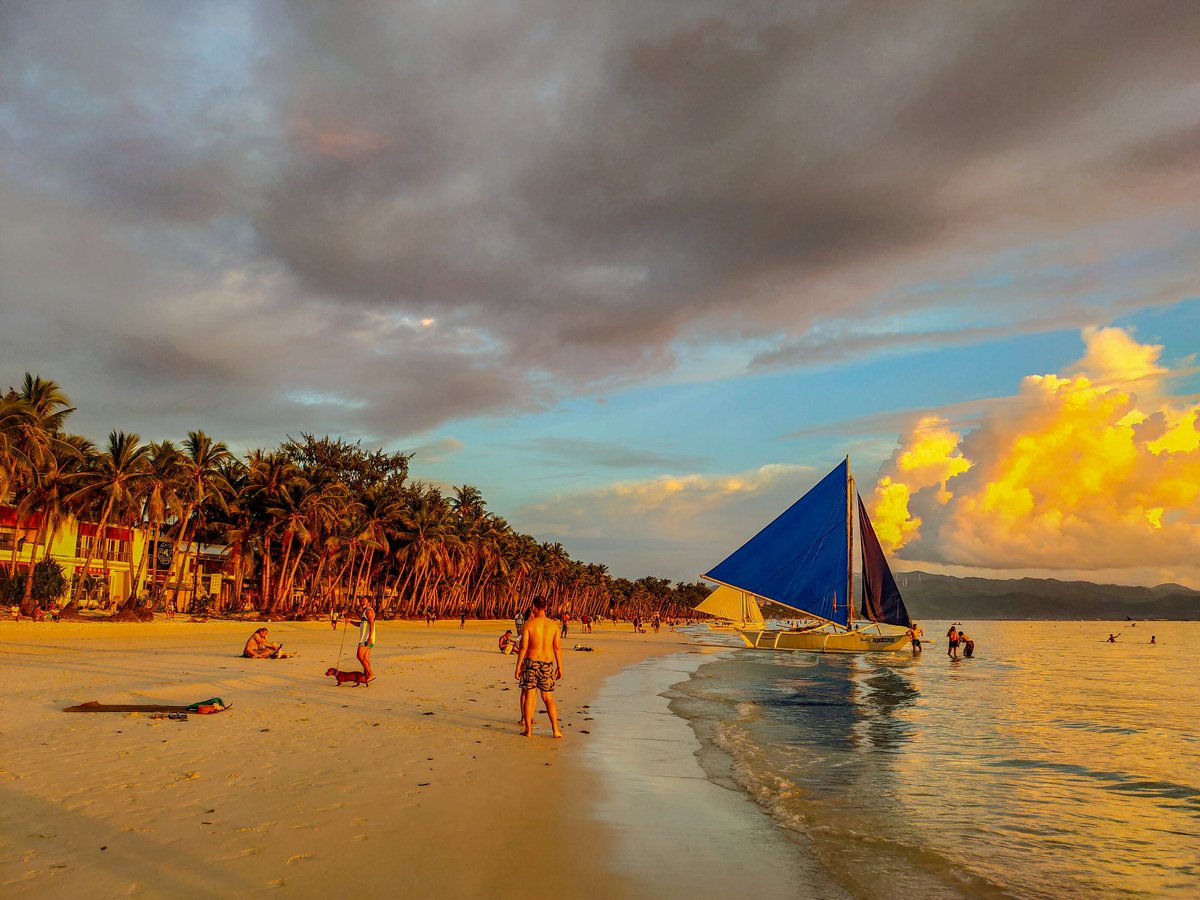
Boracay occupies about 10 square kilometers of coral platform in the Sibuyan Sea, off the northwest tip of Panay island in Aklan province. The island tapers to roughly 1 kilometer at its narrowest point near Balabag, which gives it a distinct hourglass profile you can trace from higher ground. White Beach runs about 4 kilometers along the west coast, with calm turquoise shallows during the amihan (northeast monsoon) months from November through May. The opposite shore catches steady trade winds from the same system, turning its stretch of coarse, tan sand into one of Southeast Asia's busiest kiteboarding zones. Beyond the beaches, freshwater wetlands spread through the interior near Manoc-Manoc, and reef systems ring most of the coastline. The terrain stays mostly flat, though Mount Luho marks the island's high point near the northeast coast. At about 7 kilometers end to end, you can shift between mangrove boardwalks, reef flats, and low forest within a single morning. Mid-September conditions currently read 25.3°C at 97% humidity under overcast skies, typical of the habagat (southwest monsoon) period from June through October.
Outdoor activities
-
Cliff Diving at Ariel's Point
The boat from Boracay to the Buruanga coast of Panay takes about 30 minutes and drops you at a limestone cliff complex with platforms at roughly 3, 5, 8, and 15 meters. Most operators run full-day packages that include the boat transfer, lunch, and drinks for around 2,500 to 3,500 PHP. The lower platforms suit first-timers. Anything above 8 meters gets genuinely committed. Staff position themselves in the water as spotters, and the depth below the cliffs allows safe entry. To be fair, the party atmosphere might not be for everyone, but the limestone coastline and the deep water below it are hard to argue with.
- Difficulty
- Moderate to advanced (depends on platform height)
- Duration
- Full day (about 6-8 hours including boat transfer)
- Best season
- November through May (operators sometimes cancel during habagat swells)
-
Parasailing Over the West Coast
Tandem and solo flights launch from the shallows between Station 1 and Station 2, with rides lasting 10 to 15 minutes at about 150 meters altitude. Operators typically charge 2,000 to 3,000 PHP per person. The aerial view gives you the clearest read on the island's hourglass shape and the reef patterns below, with the turquoise-to-deep-blue color break visible from height. Wind conditions run calmest during the dry amihan months. Mind you, it's a short ride for the price, but the perspective is hard to get any other way.
- Difficulty
- Easy (no skill required)
- Duration
- 10-15 minutes airborne, about 1 hour total with prep
- Best season
- November through May
-
Paraw Sailing
The paraw is Boracay's traditional double-outrigger sailboat, and sunset runs along the northern coastline remain one of the island's most distinctive activities. Tours last 1 to 2 hours, with prices starting around 1,500 PHP for up to 4 passengers. The wooden hulls sit low in the water, so expect salt spray on your arms and legs within minutes. Wind shifts can tip the boat more suddenly than you'd expect, which is part of the appeal if you don't mind getting soaked. The light at sunset turns the water copper and orange in a way that photographs poorly but feels vivid in person.
- Difficulty
- Easy (crew handles the sailing)
- Duration
- 1-2 hours
- Best season
- November through April (steadiest wind, calmest seas)
-
Helmet Diving on the Reef Flats
You walk along the seafloor wearing a weighted helmet fed by a surface air hose, typically at 3 to 5 meters depth. No dive certification needed. Most operators run sessions from the west-side shallows, lasting about 20 to 25 minutes underwater. Damselfish dart past your visor, sea urchins cluster on the rocks, and soft corals sway with the current. Prices sit between 800 and 1,200 PHP per person.
- Difficulty
- Easy (no swimming ability required)
- Duration
- 20-25 minutes underwater, about 1 hour total
- Best season
- Year-round (calmer conditions November through May)
-
Island Hopping to Crystal Cove
Full-day island hopping circuits leave from the main beach strip, typically stopping at Crystal Cove Island, a small islet between Boracay and Panay with two sea-level caves and a sandy beach. Standard tours include 2 to 3 stops, a grilled seafood lunch with the smell of charcoal and vinegar dipping sauce, and snorkeling gear for around 1,500 to 2,500 PHP per person. Crystal Cove charges its own entrance fee. Bring reef shoes for the rocky cave floors where the limestone is rough and slick.
- Difficulty
- Easy
- Duration
- Full day (5-7 hours)
- Best season
- November through May (calmer boat conditions)
-
ATV Touring on Boracay's North End
Guided ATV routes run through the island's less-developed northern area, passing dirt tracks between coconut groves and rocky terrain with views of the Sibuyan Sea. Tours last about 1 to 2 hours and cost around 1,500 to 2,500 PHP per rider. The machines are automatic, so no prior experience is needed. Mud gets deep during the wet months, which some riders consider a feature. You will come back dirty either way, with red earth caked on your shoes and shins.
- Difficulty
- Easy to moderate
- Duration
- 1-2 hours
- Best season
- Year-round (muddier but rideable June through October)
Day hikes
-
Mount Luho Summit Trail
Mount Luho is the highest point on Boracay at about 100 meters above sea level, near the northeast coast. The trail from the base to the viewing deck takes 20 to 30 minutes and follows a mix of concrete steps and packed earth. The final section climbs steeply through a canopy of tropical trees, with the air growing thicker and quieter under the leaves. On a clear morning, the top gives you sight lines to Panay island, the Sibuyan Sea, and most of Boracay's coastline. An entrance fee applies at the base.
- Difficulty
- Easy to moderate (steep but short)
- Duration
- 20-30 minutes up, about 15 minutes down
- Best season
- November through May (drier conditions, better visibility)
-
Diniwid Beach to Balinghai Beach Coastal Walk
This route follows the rocky shoreline from Diniwid Beach on the northwest coast toward the sheltered cove at Balinghai Beach. You pick your way over limestone shelves and short sandy stretches, with the sound of waves staying close the whole way. Some sections involve light rock scrambling, so closed-toe footwear matters here. Balinghai sits in a sheltered cove with coarser sand and noticeably fewer people than the main tourist areas. The water along this stretch tends to run clearer than the busier stations further south.
- Difficulty
- Easy (some rock scrambling on uneven limestone)
- Duration
- 30-45 minutes one way
- Best season
- November through May (calmer seas, drier rock surfaces)
-
Yapak to Puka Shell Beach Trail
Puka Shell Beach sits at Boracay's northern tip, and reaching it on foot from the main tourist strip takes about 40 to 50 minutes through the quieter Yapak barangay. The path passes less-developed stretches of the island, with roosters crowing from residential compounds and the occasional motorized tricycle rumbling past. The beach itself is wilder than the west coast, with shell fragments underfoot and stronger surf. Swimming conditions can turn rough during the wet months, so check the swells before wading in.
- Difficulty
- Easy (flat, mostly road walking with a short descent to the beach)
- Duration
- 40-50 minutes one way from the main beach area
- Best season
- November through May (calmer surf, better swimming at the destination)
-
Bat Cave Area Walk
Bat Cave sits in Boracay's northeast, reachable by a 15-to-20-minute walk through residential backroads. The cave is a single limestone opening, and visitors can't go inside. The path still takes you through scrubby interior forest and rocky outcrops, well away from the beach strip. Fruit bats stir at dusk here, and you'll hear them from the trail before you see the cave entrance. The ground stays muddy through the wet months, so grippy soles help.
- Difficulty
- Easy
- Duration
- 15-20 minutes from the nearest road
- Best season
- November through May (drier trail, bats active at dusk year-round)
Water activities
-
Kiteboarding at Bulabog Beach
Bulabog Beach lines Boracay's east coast and catches the amihan trade winds that blow between November and April, typically 15 to 25 knots. Several IKO-certified schools operate on the sand, with beginner courses that span 6 to 10 hours across 2 to 3 days for around 15,000 to 20,000 PHP. The shallow, reef-protected water is forgiving for learners. During habagat months, the wind shifts and conditions become unreliable. The beach has a grittier feel than the western shore, with gear spread across the sand and instructors shouting over the gusts.
- Difficulty
- Moderate to advanced (beginners welcome with instruction)
- Duration
- Half-day to multi-day courses
- Best season
- November through April (consistent 15-25 knot trade winds)
-
Scuba Diving
Dive operators access about 20 sites within a 15-minute boat ride, including reef walls at Angol Point and coral gardens at Fridays Rock. Visibility tends to peak between March and June, sometimes reaching 20 to 30 meters. Coral cover starts at about 5 meters, and deeper walls drop to 30 meters at some sites. A single fun dive typically costs 1,500 to 2,500 PHP with gear. Open Water certification runs about 18,000 to 22,000 PHP over 3 to 4 days. The warm water, usually 27 to 30°C, means most divers skip a full wetsuit.
- Difficulty
- Beginner to advanced (depending on site depth and current)
- Duration
- Half-day per dive trip
- Best season
- March through June (clearest visibility)
-
Kayaking Along the West Coast
Sit-on-top kayak rentals run about 500 to 800 PHP per hour from beach operators along the main strip. Head north from the Station 1 area and you'll pass rocky coves within 20 minutes. Banyugan Beach is reachable by kayak in about 30 to 40 minutes, and the cove stays uncrowded most mornings. Early hours before 9 AM bring the calmest water and the best overhead light to see the reef below. During the dry season, the west coast sits in the lee of the prevailing wind, which keeps paddling manageable for beginners.
- Difficulty
- Easy
- Duration
- 1-2 hours
- Best season
- November through May (calm lee-side water)
-
Snorkeling at Crocodile Island
Crocodile Island is a small rocky islet off Boracay's southern coast, named for its silhouette rather than any reptile inhabitants. Boat trips from the southern shore take about 10 minutes. The shallow reef around the island sits at 2 to 5 meters depth and holds clownfish, sea stars, and occasional sea turtles in the seagrass patches. Most tours cost 500 to 1,000 PHP including mask and fins. A mild current sometimes runs through the channel, so operators provide flotation vests as standard.
- Difficulty
- Easy
- Duration
- 1-2 hours including boat transfer
- Best season
- November through June (calmer water, better visibility)
-
Stand-Up Paddleboarding
Calm mornings on the sheltered west coast offer the best SUP conditions on Boracay. Board rentals from beach operators run about 500 to 800 PHP per hour. The reef is shallow enough to see fish and coral patterns from the board on a still day, with the water shifting between pale green and deep blue over the sand-to-reef transition. Late afternoon sessions tend to bring more chop from the daily onshore breeze. Most operators provide a brief orientation for first-timers.
- Difficulty
- Easy to moderate (balance required)
- Duration
- 1-2 hours
- Best season
- November through April (flattest morning water)
Parks & gardens
-
Balabag Wetland Park
FreeThis wetland park in the Balabag barangay features a raised boardwalk through mangrove and freshwater marsh habitat. Bird activity picks up in the early morning, particularly between November and February when migratory species pass through. You might spot monitor lizards in the undergrowth, and the humid air carries the thick, green smell of standing water and decomposing leaf litter. The boardwalk stays passable even after rain, though sections get slippery.
Highlights: Mangrove boardwalk, morning birdwatching, monitor lizard sightings, flood-management wetland infrastructure
-
Boracay Wetland Conservation Park
FreeEstablished as part of the island's environmental rehabilitation following the 6-month closure in 2018, this conservation area protects a segment of interior wetland habitat. Interpretive signage explains how the wetlands filter runoff before it reaches the reef. The paths wind through dense vegetation, and you'll hear frogs and insects more than you see them, especially in the afternoon heat. It tends to be quieter than anywhere on the coastline, which makes it a practical midday shelter from the sun.
Highlights: Wetland ecology interpretive trail, post-rehabilitation conservation site, afternoon frog and insect chorus, dense canopy shade
-
Aviary Park
Located in the island's interior, Aviary Park houses tropical bird species in walk-through enclosures alongside butterfly and reptile exhibits. The facility is small enough to cover in about 30 to 45 minutes. Mornings bring the most vocalization, with parrots and hornbills at their noisiest. Worth noting, it's a modest-scale operation, but it fills the gap between beach hours and works well for families with younger children.
Highlights: Walk-through bird enclosures, butterfly garden, reptile displays, roughly 30-to-45-minute visit
Practical tips
- Sun protection
- UV intensity at Boracay's latitude of about 11°N stays high even under heavy cloud cover. Apply reef-safe SPF 50+ sunscreen before heading out and reapply every 90 minutes in the water. The island's post-2018 environmental rules restrict chemical sunscreens that damage coral. A UPF 50+ rash guard eliminates the reapplication problem and doubles as protection against reef scrapes.
- Hydration
- Humidity frequently tops 90% with temperatures between 25°C and 32°C year-round, so dehydration builds faster than you'd expect. Carry at least 1 liter for any activity beyond an hour. Bottled water costs 15 to 30 PHP at sari-sari stores around the island. Coconut water from beach vendors, about 50 to 80 PHP, works as a natural electrolyte replacement between sessions.
- Footwear and gear
- Reef shoes handle most terrain on Boracay. The main west coast beach is soft sand, but the rocky coves along the northwest shore and the limestone shelves on the east side will cut bare feet. Lightweight trail shoes or sturdy sandals with heel straps work for the upland trails. Flip-flops are fine for the beach strip but inadequate for any coastal scramble or forest path.
- Currency and costs
- The Philippine peso trades at about 62.8 PHP to 1 USD as of mid-September 2026. ATMs cluster around the Station 2 commercial area but sometimes run dry on weekends during peak season. Carry cash for beach vendors, tricycle rides at 50 to 100 PHP per trip, and smaller tour operators. Credit cards work at dive shops and larger hotels but not at sari-sari stores or paraw operators. Wikivoyage covers more logistics at https://en.wikivoyage.org/wiki/Boracay#Cope.
- Arrival and environmental fees
- Boats from Caticlan dock at Cagban Beach on Boracay's southern coast. An environmental and sustainability fee is collected upon arrival. Keep your receipt, as some tour operators ask for proof of payment. Separate entrance fees apply at private attractions and natural sites. Wikivoyage covers arrival options at https://en.wikivoyage.org/wiki/Boracay#Get_in.
- Trail conditions
- Trails here are short but can turn slippery after rain, particularly packed-earth sections on higher ground. During the wet months, expect muddy patches on interior paths and higher water in the wetland areas. Concrete steps on established routes help, but limestone near the coast grows algae that becomes treacherous when wet. Grippy soles matter more than ankle support on an island this flat.
FAQ
What is the best time of year for outdoor activities on Boracay?
The dry amihan season brings calmer seas on the west coast and consistent kiteboarding wind on the east side. March through June tends to deliver the clearest underwater visibility for diving and snorkeling. The wet habagat months bring rain and rougher conditions but also fewer crowds and lower prices at most operators.
Is Boracay safe for solo outdoor activities?
Boracay scores 7.2 out of 10 for solo-traveler safety (see the TTDI Solo-Safety Index). Beach activities and the main trails feel comfortable alone during daylight. For water sports, joining group tours is both safer and typically cheaper than hiring private boats. Avoid swimming alone at unguarded beaches, particularly on the eastern shore where currents can pull. For general safety guidance, see https://en.wikivoyage.org/wiki/Boracay#Stay_safe.
How family-friendly are Boracay's outdoor activities?
The island rates 7.8 out of 10 for family friendliness (see the TTDI Family-Friendliness Index). Shallow water along the west coast stays wadeable for 50 to 100 meters at low tide, which suits younger children. Helmet diving accepts kids as young as 8 at most operators, and the island's small footprint means you're never far from food, shade, or a restroom.
Should I bring my own snorkeling or diving gear?
Rental gear is widely available, and quality at the larger dive shops ranges from adequate to good. If you're particular about mask fit or use prescription lenses, bring your own mask. Fins and wetsuits rent cheaply on the island. Kiteboarding schools supply all equipment during courses. Reef shoes are the one item worth packing from home, since local options tend toward flimsy sandals.
Can I go hiking on Boracay?
Boracay is not a traditional hiking destination. The entire island is walkable end to end in about 2 hours, and no trail here would challenge anyone accustomed to hill walks. That said, the 2-to-3-kilometer coastal routes involve rock scrambling and forest patches that feel like proper walks rather than strolls. For trails with real elevation gain, take a boat to Panay island, where Aklan province offers more substantial terrain inland.
How LGBTQ+-friendly is the outdoor scene on Boracay?
Boracay scores 4.5 out of 10 for LGBTQ+ friendliness (sourced from TTDI's editorial rubric). The beach and water-sports scene tends to be welcoming in practice, particularly at the larger, more international operators. Smaller local outfits may be less accustomed to openly LGBTQ+ visitors. The area around Station 2 has historically been more progressive than quieter parts of the island.
Last verified by automated review (v1.7.2) on . What is automated review?