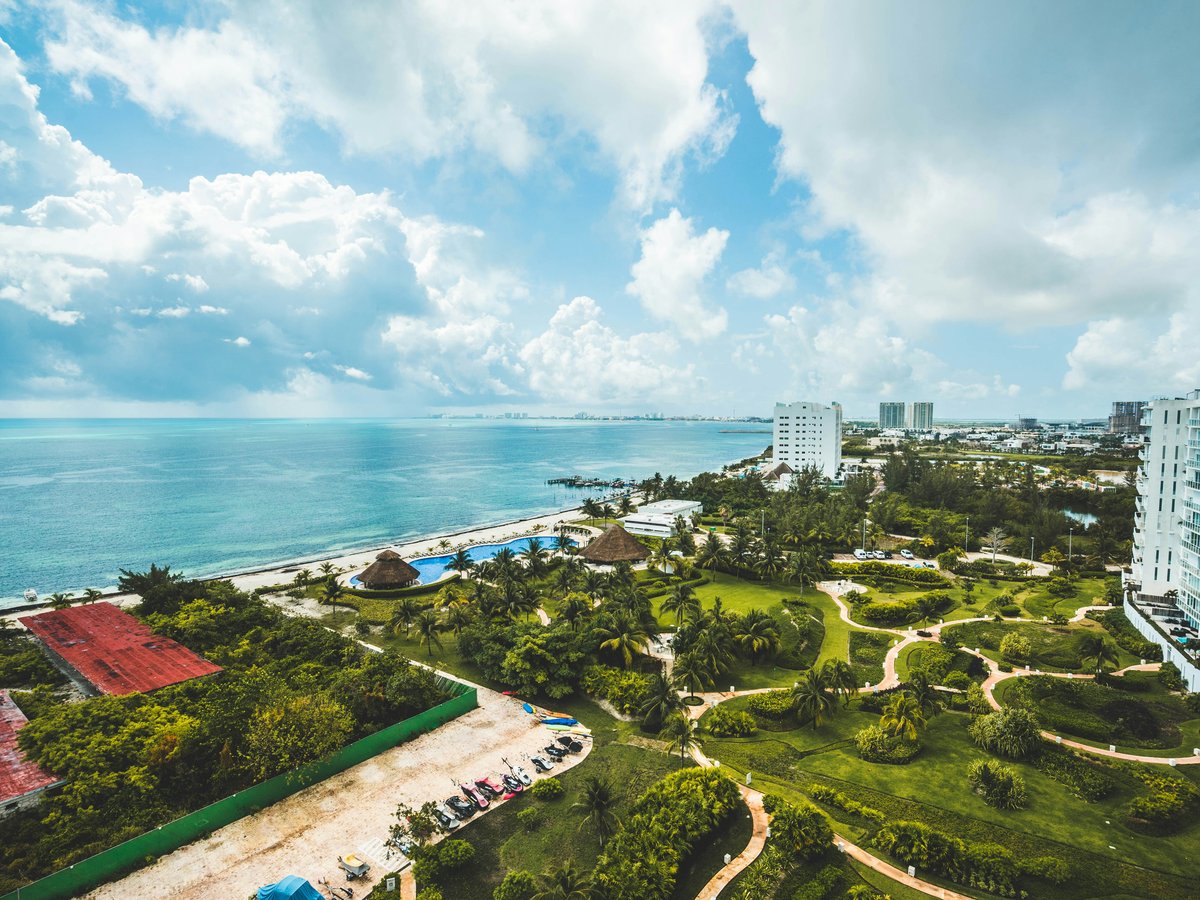
What should I avoid in Cancun?
Skip timeshare presentations at CUN airport, Hotel Zone restaurants charging 3-4× El Centro prices, and taxis without pre-agreed fares. Avoid red- or black-flag beaches where riptides form between sandbars. Hurricane season runs June through November. Sargassum seaweed blankets east-facing beaches April to August. The waterline becomes a sulfur-smelling wall of brown algae.
The single biggest trap in Cancun is the timeshare pitch. Representatives wait at Cancun International Airport arrivals, at Hotel Zone malls like La Isla Shopping Village and Kukulcan Plaza, and in the lobbies of resorts along Boulevard Kukulcan. They offer free snorkeling trips, discounted Xcaret park tickets, or $50-100 in resort credit for 90 minutes of your time. The 90 minutes stretches to 4-5 hours. The sales team rotates through 3 closers, each more aggressive than the last. The air conditioning is kept cold enough that you smell the industrial carpet cleaner, and the complimentary orange juice is warm by the second hour. You can say no and walk out at any point, but you lose a half-day of vacation to the experience. The better move is to say "no, gracias" at the airport and keep walking toward the ADO bus counter or your pre-booked transfer.
Hotel Zone restaurants along Boulevard Kukulcan charge 200-400 pesos for tacos that cost 40-80 pesos in El Centro's Parque de las Palapas area. The worst offenders sit between the Convention Center and Punta Cancun, where dinner for two with drinks can reach 2,500-3,500 pesos, around $145-200 USD at the current rate of roughly 17.3 MXN per dollar. Many of these places serve the same frozen shrimp you'd get at a chain restaurant in Texas. For actual Yucatecan food, take an R-1 or R-2 bus (12 pesos, about $0.70) 20 minutes into El Centro and find Tacos Rigo on Avenida Tulum or Pescaditos near Mercado 28. The cochinita pibil at a proper El Centro taqueria has that slow-roasted, achiote-stained pork falling apart on a handmade tortilla still hot from the comal. You'll spend 150 pesos for a full meal.
Cancun's east-facing beaches get powerful currents. Playa Delfines, the most popular public beach at Km 17.5 of Boulevard Kukulcan, posts colored flags daily. Red means strong currents. Black means stay out entirely. Tourists drown here every year, often within 50 meters of shore, pulled by riptides that form between the sandbars. If you feel the pull, swim parallel to the beach, not toward it. Lifeguard stations close around 5pm. Worth noting, the beaches near Punta Nizuc at the southern end of the Hotel Zone tend to be calmer than those around Km 9-12 near Punta Cancun, where the Caribbean side meets the open Gulf current. Don't snorkel alone off the hotel beaches without checking conditions with a local dive shop first.
June through November is hurricane season, with peak risk between August and October. Cancun took a direct hit from Hurricane Wilma in October 2005 and Hurricane Delta in October 2020. Travel insurance matters during these months. The other seasonal problem is sargassum, the brown seaweed that washes onto east-facing beaches in thick, sulfur-smelling mats from roughly April through August. Some days the beach smells like rotten eggs and the waterline is a 2-meter wall of warm, decaying plant matter. Hotels rake their sections of beach daily, but the cleanup can lag behind heavy arrivals. North-facing beaches on Isla Mujeres, a 20-minute ferry from Puerto Juárez at 300 pesos round trip, tend to get less sargassum. Check current conditions on the Red de Monitoreo de Sargazo before booking a beach-heavy trip between May and July.
Cancun taxis have no meters. The fare from the airport to the Hotel Zone runs 600-900 pesos ($35-52 USD) depending on which zone your hotel sits in. Drivers at the official airport taxi stand quote the posted zone rate, but freelance drivers outside the terminal may try 1,200-1,500 pesos. The ADO airport bus costs 100 pesos to downtown. Within the Hotel Zone, the R-1 and R-2 buses run along Boulevard Kukulcan every few minutes for 12 pesos. They're air-conditioned, reliable, and stop at every major hotel entrance. There is no reason to take a taxi within the Hotel Zone unless you're traveling after midnight. Uber operates in Cancun but faces resistance from the taxi union. Drivers sometimes cancel if they see the pickup is near a taxi stand, so walk a block before requesting.
Tourist traps to skip
- Timeshare presentations disguised as 'tourist information' desks at CUN airport arrivals
- Hotel Zone restaurants between the Convention Center and Punta Cancun, charging 200-400 pesos for tacos that cost 40-80 in El Centro
- Coco Bongo's 'gold' and 'platinum' ticket packages at $120-180 when the basic $70-85 open-bar ticket gets you the same show
- Señor Frog's and similar spring-break chain bars on Boulevard Kukulcan
- Mercado 28 souvenir stalls where opening prices are 3-4× the expected final price with high-pressure haggling
- Resort-based 'authentic Mayan ceremony' shows that have no historical basis
- Jet ski rentals on Hotel Zone beaches at $60-80 per 30 minutes, nearly double what operators in El Centro charge
Common scams
- Timeshare reps at CUN airport wearing lanyards labeled 'Tourist Information' or 'Transportation Assistance' who steer you away from the real ADO counter
- Taxi drivers quoting 1,200-1,500 pesos from the airport when the posted zone rate is 600-900 pesos
- Beach vendors tying 'free' woven bracelets on your wrist, then demanding 200-500 pesos
- Currency exchange booths at CUN airport giving rates 15-20% below the market rate of 17.3 MXN per dollar
- Waiters adding a second gratuity line to bills already marked 'propina incluida'
- Rental car agencies at the airport insisting on 'mandatory' Mexican liability insurance at $25-40/day on top of your existing coverage
- Beach vendors selling 'silver' jewelry made from alpaca metal worth a fraction of the asking price
Seasonal hazards
- Hurricane season runs June through November, with peak activity August to October. Hurricane Wilma (2005) and Hurricane Delta (2020) both made direct hits on Cancun.
- Sargassum seaweed blankets east-facing beaches from April through August. The decomposing algae releases hydrogen sulfide gas that smells like rotten eggs.
- UV index regularly reaches 11+ (extreme) between 10am and 3pm. Expect sunburn in under 15 minutes without SPF 50+.
- Daily afternoon thunderstorms June through September, typically lasting 30-60 minutes with heavy rain and lightning.
- Current conditions as of June 2026: 30.7°C (feels like 34.9°C), 69% humidity, with thunderstorms and hail reported.
Last verified by automated review (v1.7.2) on June 21, 2026. What is automated review?