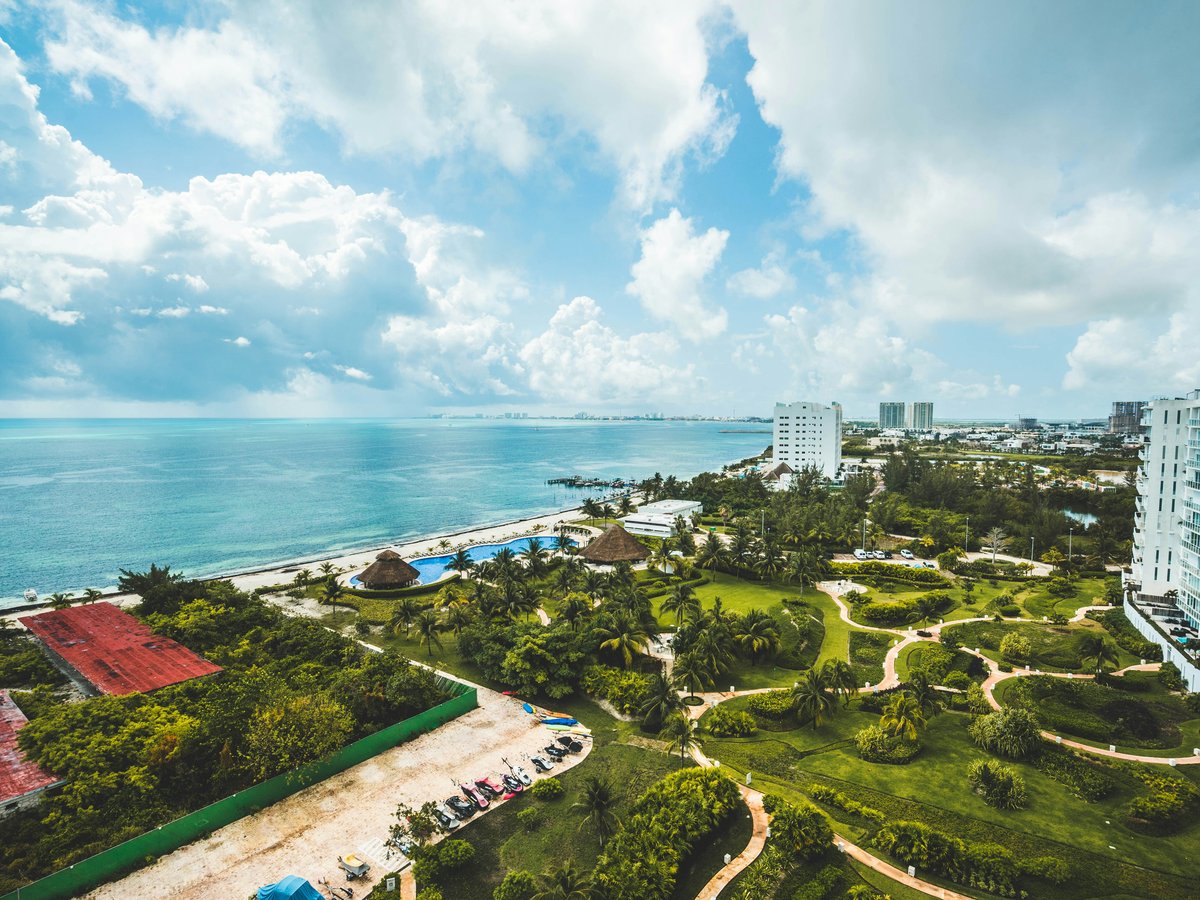
Cancun sits on a narrow strip of sand between the Caribbean Sea and the Nichupté Lagoon, roughly 21 kilometers of Hotel Zone curving like a "7" off the mainland. The geography is flat. Relentlessly flat. The highest natural point in the entire Yucatán Peninsula reaches maybe 40 meters above sea level somewhere inland, and Cancun itself barely clears 10. That means no mountain trails, no ridge scrambles, no elevation gains worth logging on a fitness tracker. What it does have is water. The Caribbean side runs turquoise over white sand, the lagoon side holds still and warm and brackish, and underground, the whole limestone shelf is Swiss-cheesed with cenotes, flooded cave systems, and subterranean rivers. The dry season runs from November through April, with temperatures around 25 to 30 Celsius. May to October brings humidity north of 80 percent and afternoon thunderstorms that roll in fast and dump rain for 45 minutes before clearing. Hurricane season peaks in September and October. Most outdoor activity revolves around the coast, the lagoon, and the scrubby low jungle that covers the mainland portions of Quintana Roo.
Outdoor activities
-
Zip-lining at Selvatica
Selvatica operates about 40 minutes west of the Hotel Zone, near the town of Puerto Morelos. The longest line runs roughly 700 meters over the jungle canopy, and you'll do 10 to 12 lines over about 2 hours. The cenote at the end is cold, maybe 22 Celsius, and deep enough to cliff-jump into from a 5-meter platform. Expect to pay around 100 to 130 USD per person. The operation seems well-maintained, with dual-cable safety systems. Worth noting, mornings tend to be less crowded than the 11 a.m. rush from the Hotel Zone shuttles.
- Difficulty
- Easy to moderate (no fitness requirement, but you do climb platforms)
- Duration
- 3 to 4 hours including transport
- Best season
- November through April, when humidity is lower and afternoon storms are rare
-
ATV tours along the Ruta de los Cenotes
The Ruta de los Cenotes runs westward from Puerto Morelos along a paved road dotted with cenote parks every kilometer or so. Several operators run ATV excursions on dirt tracks through the surrounding jungle, typically 1 to 2 hours of riding, with stops at 2 or 3 cenotes for swimming. The trails are muddy from June through October and dusty the rest of the year. Prices hover around 60 to 90 USD. You'll get dirty. Wear clothes you don't care about.
- Difficulty
- Easy (guided, flat terrain)
- Duration
- 3 to 4 hours
- Best season
- December through March for the driest trails
-
Kiteboarding at Isla Blanca
Isla Blanca sits about 30 minutes north of downtown Cancun, a long sandy spit between the Caribbean and the Chacmuchuch Lagoon. The lagoon side stays shallow and relatively flat, which makes it popular for beginners. Wind picks up from March through June, with consistent 15 to 25 knot days. A 3-hour beginner lesson runs around 200 to 250 USD. The beach has almost no infrastructure, so bring your own water and food. It still feels like a local spot, not a resort experience.
- Difficulty
- Moderate to difficult (requires instruction for beginners)
- Duration
- Half day to full day sessions
- Best season
- March through June for reliable trade winds
-
Snorkeling at MUSA (Museo Subacuático de Arte)
MUSA sank over 500 sculptures onto the seabed between Cancun and Isla Mujeres starting in 2009. The Salon Manchones gallery sits at about 8 meters depth, which means it's better for scuba, but the Punta Nizuc gallery holds pieces at 3 to 4 meters, accessible by snorkel. Visibility tends to be best from May through September, oddly enough, when currents shift. Boat tours run from 35 to 50 USD per person and last about 2 hours. The coral growth on the older pieces is genuinely interesting to see up close.
- Difficulty
- Easy (basic swimming ability required)
- Duration
- 2 to 3 hours with boat transfer
- Best season
- May through September for clearer water at the reef
-
Cycling the Ciclopista of the Hotel Zone
Cancun laid a dedicated bike lane along most of Kukulcán Boulevard, running roughly 20 kilometers from the northern end of the Hotel Zone down to Punta Nizuc. The path is flat, paved, and separated from traffic in most sections. Bike rentals are available near Playa Tortugas and cost about 150 to 200 MXN for a half day. Early morning rides before 8 a.m. beat the heat and the bus traffic. The stretch near Kilometer 9 passes Playa Delfines, where the big "Cancun" sign sits. That said, some sections near the southern end share the road shoulder, so stay alert.
- Difficulty
- Easy
- Duration
- 1.5 to 3 hours depending on stops
- Best season
- November through February, when morning temperatures sit around 24 Celsius
-
Parasailing over the Caribbean
Multiple operators launch from the beaches near Kilometer 4 to 9 of the Hotel Zone. You'll go up about 60 to 80 meters and float for 10 to 12 minutes over turquoise water. On clear days you can see the bottom of the lagoon on one side and the reef shadow on the other. Prices range from 50 to 80 USD per person. The winch-boat operators at Playa Tortugas and Playa Langosta have been running for years. Mornings are calmer. Afternoon sessions get bouncier when the onshore breeze picks up.
- Difficulty
- Easy (no physical effort required)
- Duration
- 30 to 45 minutes total, including prep
- Best season
- Year-round, though November through April has the calmest winds
Day hikes
-
Punta Nizuc coastal walk
The southern tip of the Hotel Zone tapers to Punta Nizuc, where you can walk along the rocky shoreline past the reef break. The terrain is flat, over coral rock and sand, with mangrove on one side and reef on the other. It's not a marked trail, more of a fisherman's path. The distance is short, maybe 2 to 3 kilometers out and back, but the footing on wet coral rock gets tricky. Bring water shoes. You'll see hermit crabs in the tide pools and frigate birds circling. Mind you, access can be awkward since the Club Med resort sits nearby and signs may suggest the area is private. The shoreline itself is federal zone.
- Difficulty
- Easy to moderate (flat but uneven coral rock)
- Duration
- 1 to 2 hours
- Best season
- November through April, when seas are calmer and the reef is more visible from shore
-
Sian Ka'an Biosphere Reserve (from the Tulum entrance)
Sian Ka'an covers 528,000 hectares of wetland, jungle, and coast about 2 to 2.5 hours south of Cancun. The most accessible entry is the Muyil entrance near Tulum, where a boardwalk runs about 500 meters through the jungle to the Muyil Lagoon. From the lagoon, boat tours float you through channels between Muyil and Chunyaxché lagoons. The walking portion is flat and easy. The heat and humidity from May through October make it feel much harder than it is. Entry fee runs around 50 MXN, plus 150 to 200 MXN for the boat. Howler monkeys call from the trees most mornings, a deep resonant sound you feel in your chest more than hear.
- Difficulty
- Easy (boardwalk, flat terrain)
- Duration
- Full day including the 2-hour drive each way
- Best season
- December through March for cooler temperatures and fewer mosquitoes
-
Ruta de los Cenotes nature walks
The road running west from Puerto Morelos passes 20 or more cenote parks along roughly 30 kilometers. Several of these parks have short jungle trails, 1 to 3 kilometers, connecting open-air cenotes through low dry forest. Cenote Verde Lucero and Cenote Siete Bocas both have walking paths with moderate shade. The trails are dirt, flat, and unsigned in places. Not wilderness hiking by any measure, but you're walking through real Yucatán jungle, and you'll see leaf-cutter ant highways crossing the paths. Cenote entry fees range from 200 to 350 MXN per park. Wear bug spray. The mosquitoes in the shaded sections are persistent.
- Difficulty
- Easy
- Duration
- Half day for 2 to 3 cenote stops
- Best season
- November through April (trails get muddy and mosquitoes multiply in the rainy season)
-
Isla Contoy day trip with beach walk
Isla Contoy is a protected island about 30 kilometers north of Isla Mujeres. Only 200 visitors per day are allowed. Day trips depart from Isla Mujeres or Puerto Juárez and cost around 1,200 to 1,800 MXN, including the park fee, snorkeling stop, and lunch. On the island, a 1.5-kilometer nature trail leads to a 20-meter observation tower overlooking the nesting colonies. Frigate birds, brown pelicans, and double-crested cormorants nest here between April and August. The beach at the south end is white powder sand with no footprints. The whole island smells like guano and salt. It's magnificent.
- Difficulty
- Easy (flat trail, maintained path)
- Duration
- Full day including 45-minute boat ride each way
- Best season
- April through August for peak bird nesting activity
Water activities
-
Kayaking the Nichupté Lagoon
The Nichupté Lagoon sits between the Hotel Zone and downtown Cancun, covering about 3,000 hectares. Several tour operators launch from docks near Kilometer 12 to 16. Morning paddles through the mangrove channels are the best way to do it. The water is calm, shallow in the mangrove fringes, maybe half a meter to 1.5 meters deep. You'll see herons, egrets, and occasionally a crocodile resting in the roots. Guided tours run about 40 to 60 USD for 2 hours. The lagoon smells brackish and organic, especially near the mangroves. Afternoon wind from the east can make the return paddle harder than expected.
- Difficulty
- Easy to moderate
- Duration
- 2 to 3 hours
- Best season
- November through April for calmer winds and less rain
-
Swimming in Caribbean cenotes along the Ruta de los Cenotes
The cenotes along the Puerto Morelos route range from open-air sinkholes to partially enclosed caverns. Water temperature holds steady around 24 to 25 Celsius year-round. Cenote Kin Ha has a large open pool with a wooden platform for jumping. Cenote Las Mojarras is shallower, better for floating. The water in most cenotes is strikingly clear, maybe 15 to 20 meters of visibility, because it's filtered through limestone for years. That first step into the water is a jolt. After the 35-degree surface heat, 24-degree water feels properly cold. Each cenote charges its own entry, typically 200 to 350 MXN.
- Difficulty
- Easy (swimming ability required, no current)
- Duration
- Half day for 2 to 3 cenotes
- Best season
- Year-round (water temperature stays constant, but rainy season June through October raises water levels and reduces visibility slightly)
-
Stand-up paddleboarding at Playa Norte, Isla Mujeres
The ferry from Puerto Juárez takes about 15 minutes and costs around 300 MXN round trip. Playa Norte on Isla Mujeres has calm, shallow water that extends 30 to 40 meters from shore, rarely above waist depth. Board rentals go for about 300 to 400 MXN per hour from shops along the beach. Mornings before 10 a.m. are glassy. By noon the breeze picks up and the tour boats arrive, adding wake chop. The water over the sand bars is that pale green color you see in photographs, and yes, it actually looks like that in person.
- Difficulty
- Easy
- Duration
- 1 to 2 hours on the water, plus ferry time
- Best season
- November through April for calmest conditions
-
Snorkeling the Puerto Morelos reef
Puerto Morelos sits 20 minutes south of Cancun, and its reef runs parallel to shore about 500 meters out. The reef is part of the Mesoamerican Barrier Reef, the second-longest in the world. Snorkel trips launch from the town pier and cost 500 to 700 MXN for about 90 minutes in the water. You'll see elkhorn coral, parrotfish, sergeant majors, and occasionally a nurse shark resting on the sand. The reef is a national marine park, so you'll need biodegradable sunscreen. Guides enforce this, and some boats carry their own supply. Visibility tends to be 10 to 20 meters depending on recent weather.
- Difficulty
- Easy
- Duration
- 2 to 3 hours including boat transit
- Best season
- May through September for best visibility, though it's decent year-round
-
Scuba diving the underwater caverns at Dos Ojos
Dos Ojos cenote lies about 1.5 hours south of Cancun, near Tulum. Two connected sinkholes open into a cave system that extends for kilometers underground. The cavern dive stays within natural light range and goes to about 8 to 10 meters depth. Water temperature is 24 to 25 Celsius. A 2-tank cavern dive runs around 150 to 180 USD with transport from Cancun. You'll need an open-water certification at minimum. The light beams cutting through the cavern ceiling are genuinely striking, especially between 10 a.m. and noon when the sun angle is right. Stalactites hang from the ceiling, formed when the caves were dry during the last ice age.
- Difficulty
- Moderate (requires open-water scuba certification)
- Duration
- Full day including 1.5-hour drive each way
- Best season
- Year-round (underground conditions are stable, but roads are better November through April)
Parks & gardens
-
Parque Urbano Kabah
FreeParque Kabah sits on Avenida Nichupté in the SM 22 district of downtown Cancun. It covers about 40 hectares of remnant jungle, fenced off from the surrounding urban sprawl. Paved paths loop through the trees, and the place is full of coatis. Dozens of them. They're used to people and will approach looking for food, though feeding them is discouraged. You'll also spot iguanas basking on the concrete and hear mot-mots calling from the canopy. The park opens at 6 a.m., and early mornings bring joggers and dog walkers from the nearby colonias. It smells like damp leaf litter and earth, especially after rain.
Highlights: Resident coati population, mot-mot birds, jogging paths, shaded benches, small archaeological ruin fragments
-
Parque de las Palapas
FreeThe main public square in downtown Cancun, Parque de las Palapas fills up on weekend evenings with food vendors, families, and occasional live music. The space is open and paved, ringed by palapa-roofed shelters. Street food stalls sell marquesitas (crispy rolled crepes filled with Edam cheese and Nutella) for 30 to 50 MXN and esquites (corn in a cup with lime, chile, and mayo) for about 35 MXN. Not a garden in any botanical sense, but the closest thing to civic outdoor life in a city largely built for tourists.
Highlights: Weekend food market, live music on Friday and Saturday evenings, marquesita vendors, community gathering point
-
Jardín Botánico Dr. Alfredo Barrera Marín
Located 35 minutes south of Cancun in Puerto Morelos, this 65-hectare botanical garden runs through coastal mangrove and semi-deciduous jungle. A 3-kilometer elevated boardwalk threads through the property, passing labeled native species, a small archaeological site, and a section of epiphytes and bromeliads growing thick on the older trees. Admission currently runs about 120 MXN for adults. Spider monkeys live in the canopy, and if you visit early, around 8 a.m. opening, you'll hear them before you see them. The air in the mangrove sections smells brackish, almost sulfurous in spots.
Highlights: 3 km boardwalk through mangrove and jungle, spider monkey habitat, labeled native medicinal plants, small Maya ruin, epiphyte section
-
Parque Centenario Cancún
FreeA small neighborhood park in the SM 27 area near Avenida Tulum, Parque Centenario offers shade trees, a basketball court, and concrete paths. It's not a destination park, but if you're walking downtown Cancun and need 20 minutes under a tree with a bottle of water, this works. Local families use it in the late afternoon once the worst of the heat breaks, usually after 5 p.m.
Highlights: Shaded walkways, basketball court, street vendors selling fruit cups with chili and lime on weekends
Practical tips
- Sun protection
- Cancun sits at latitude 21 degrees north. UV index regularly hits 11 or 12 between 10 a.m. and 3 p.m. from March through September. Wear SPF 50 minimum, reapply every 90 minutes, and bring a hat with a brim. For water activities, biodegradable reef-safe sunscreen is legally required in cenotes and marine parks across Quintana Roo. Pharmacies in the Hotel Zone stock Mexican brands like Protextrem for about 180 to 250 MXN. You will burn faster than you expect, even on cloudy days.
- Hydration
- Carry at least 2 liters per person for any half-day outdoor activity. Tap water in Cancun is not safe to drink. Bottled water from OXXO convenience stores costs about 15 to 20 MXN for 1.5 liters. For full-day trips to Sian Ka'an or the Ruta de los Cenotes, pack 3 liters minimum. Electrolyte packets (sold as "suero" at pharmacies for about 12 MXN each) help when the humidity makes you sweat through your shirt within 20 minutes.
- Footwear
- Water shoes are essential for cenotes and rocky shoreline walks. Coral rock shreds bare feet quickly. For jungle paths and the Ruta de los Cenotes trails, closed-toe hiking sandals or light trail shoes work. Full hiking boots are overkill for the flat terrain and will overheat your feet. Bring footwear that can get wet and dry fast. Nothing leather.
- Mosquitoes and insects
- Mosquitoes are worst from May through November, peaking after rain. Mangrove areas and shaded cenote trails get heavy. Bring DEET-based repellent, at least 25 percent concentration. The natural citronella sprays sold at hotel gift shops are largely ineffective. Apply repellent to ankles, wrists, and the back of your neck. If you're doing a lagoon kayak trip, spray your legs before getting in the kayak. Dengue and chikungunya are present in Quintana Roo, so this is not optional.
- Transportation to outdoor sites
- Most outdoor destinations beyond the Hotel Zone require a car or organized tour. ADO buses run south to Puerto Morelos (25 MXN, 30 minutes) and Tulum (220 to 280 MXN, 2 hours) from the downtown bus terminal on Avenida Tulum. For the Ruta de los Cenotes, a rental car gives you flexibility to stop at multiple parks. Rental rates start around 500 to 700 MXN per day from agencies on Avenida Bonampak. Colectivo vans on Highway 307 cost 20 to 40 MXN for short hops but won't turn off the highway to reach cenote parks.
- Seasonal weather planning
- The dry season from November through April brings 25 to 30 Celsius days with low humidity and rare rain. This is peak tourist season, so expect higher prices and crowded cenotes, especially during Semana Santa in March or April. The rainy season from May through October means afternoon downpours, 33 to 35 degree highs, and thick humidity. Mornings are usually clear, so start outdoor activities by 7 or 8 a.m. Hurricane season runs June through November, with the highest risk in September and October. Check CONAGUA forecasts, not just American weather apps, for local accuracy.
FAQ
Is Cancun a good destination for hiking and outdoor activities?
Cancun is primarily a water-sports destination, not a hiking one. The Yucatán Peninsula is flat limestone with no mountains or significant elevation changes. The outdoor appeal here comes from cenotes, lagoon kayaking, reef snorkeling, and coastal walks rather than trail hiking. If you want elevation, Oaxaca or the Copper Canyon in Chihuahua are better bets. But if you're drawn to water, mangroves, and low jungle, Cancun and the surrounding Riviera Maya deliver.
What is the best time of year for outdoor activities around Cancun?
November through April is the most comfortable window. Temperatures sit around 25 to 30 Celsius, humidity is manageable, rain is rare, and hurricane risk is negligible. That said, this is high season, so expect more people at cenotes and higher prices for tours. May and June can work well if you start mornings early and tolerate afternoon storms. September and October are risky due to hurricanes and not ideal for anything requiring open water.
Do I need a guide for cenote visits near Cancun?
Most cenote parks along the Ruta de los Cenotes are independently accessible. You pay an entry fee, typically 200 to 350 MXN, and swim on your own. Cenotes with cave or cavern diving require a certified dive guide by law. For open-air cenotes used for swimming, no guide is needed, but life jackets are mandatory at many parks regardless of your swimming ability. Guided tours from Cancun bundle 2 to 3 cenotes for 1,000 to 1,500 MXN per person and handle transport.
Is it safe to swim in the Nichupté Lagoon?
Most people don't swim in the Nichupté Lagoon. Crocodiles live there, the water is murky compared to the Caribbean, and the bottom is silty. Kayaking and paddleboarding are the standard lagoon activities, and you stay in or on your vessel. Tour operators know the channels well and keep to routes where crocodile encounters are rare. The Caribbean side of the Hotel Zone is where swimming happens.
How much should I budget for a day of outdoor activities in Cancun?
A self-guided day hitting 2 to 3 cenotes on the Ruta de los Cenotes costs roughly 600 to 1,200 MXN per person (entry fees plus transport). An organized adventure tour, like zip-lining at Selvatica or a jungle ATV ride, runs 1,500 to 3,000 MXN. Snorkeling at Puerto Morelos or MUSA costs 700 to 1,200 MXN with a boat tour. Budget travelers can kayak the lagoon for about 800 to 1,200 MXN with a guided group, or rent a bike in the Hotel Zone for 150 to 200 MXN and ride the Ciclopista for free.
What gear should I bring versus buy locally in Cancun?
Bring your own reef-safe sunscreen, DEET insect repellent, and water shoes, since quality options are marked up 30 to 50 percent in the Hotel Zone. Snorkel gear is provided on nearly all boat tours, so you don't need your own unless you're particular about mask fit. Walmart on Avenida Kabah and the Chedraui on Avenida Tulum sell basic water shoes for 200 to 300 MXN and dry bags for about 150 MXN. Don't bother packing heavy hiking gear. You won't need it.
Outdoor experiences in Cancun
 Free cancellation
 Tulum, Reef Snorkeling, Cenote & Mayan Ceremony
Outdoor experience — free cancellation.
via Viator Free cancellation
 Half-Day Sea Turtle and Cenote Snorkeling Tour from Cancun & Riviera Maya
Outdoor experience — 5 hours, free cancellation.
via Viator Free cancellation
 Cancun speedboat and snorkel tour: shared speedboat
Outdoor experience — 2 hours, free cancellation.
via Viator Free cancellation
 Hidden Cenote Swim: Snorkeling, Sea Turtles and Beachside Lunch
Outdoor experience — 4.5 hours, free cancellation.
via Viator Free cancellation
 Jungle Buggy Tour from Playa del Carmen Including Cenote Swim
Outdoor experience — 3 hours, free cancellation.
via Viator Free cancellation
 Hidden Cenote Swim & ATV Jungle Adventure with Transportation
Outdoor experience — 3 hours, free cancellation.
via Viator Free cancellation
 Rio Secreto Underground River Tour with Crystal Caves
Outdoor experience — free cancellation.
via Viator Free cancellation
 Cancun ATV, Ziplines, Cenote, Lunch & Tequila Tasting Included
Outdoor experience — 4 hours, free cancellation.
via Viator Free cancellation
 Xel-Ha Tickets with Transportation included
Outdoor experience — free cancellation.
via Viator Free cancellation
 Xplor Park Day Trip with Lunch and Transportation
Outdoor experience — 6 hours, free cancellation.
via Viator Free cancellation
 Extreme Horses Adventure with ATV, Ziplines & Cenote
Outdoor experience — 5 hours, free cancellation.
via Viator Free cancellation
 Best ATV Tour, Horseback Riding, Zip Lines, Cenote Swim, Tequila Tasting
Outdoor experience — 4 hours, free cancellation.
via ViatorLast verified by automated review (v1.7.2) on June 21, 2026. What is automated review?