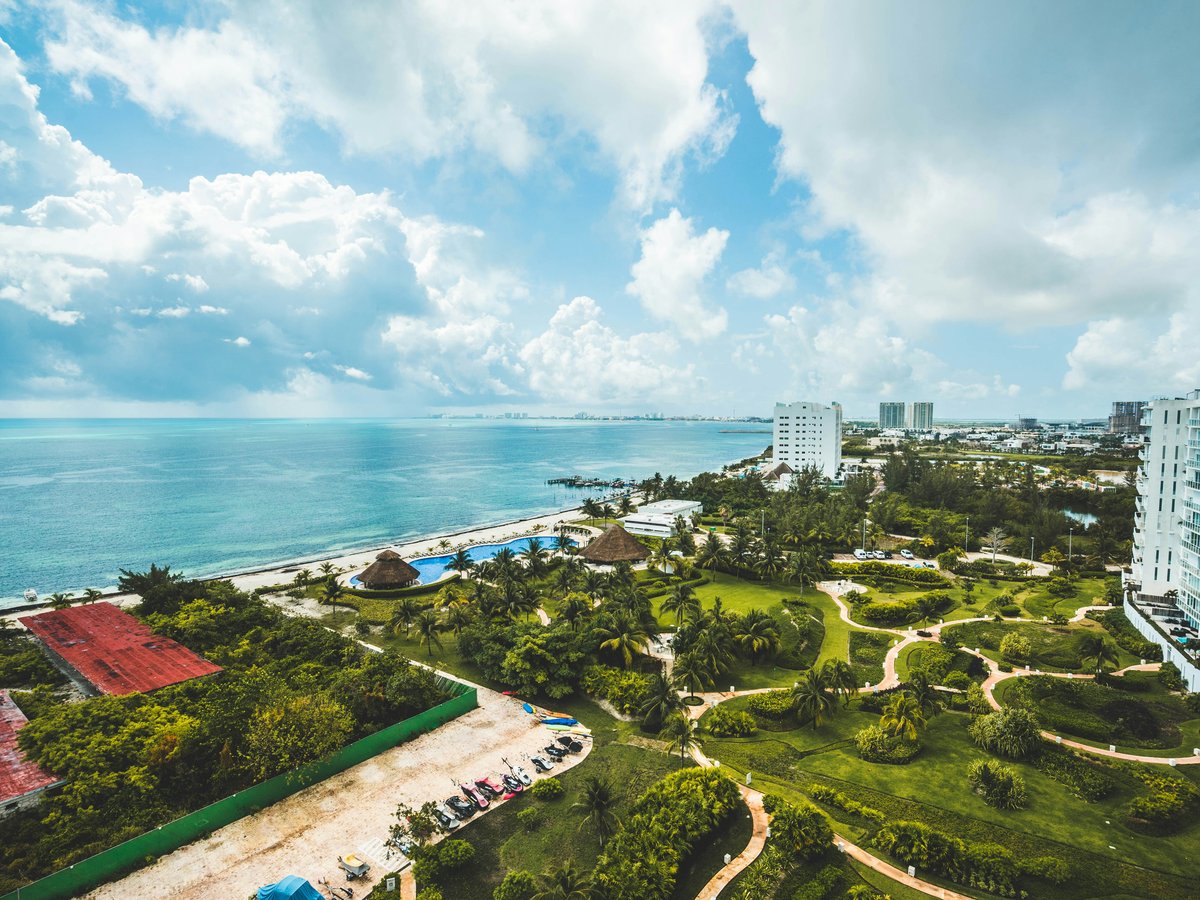
Cancun splits into two distinct worlds separated by about 20 minutes of road. The Zona Hotelera is a narrow 23-kilometer sand barrier shaped like the number 7, with the Caribbean Sea on one side and Laguna Nichupté on the other. Bulevar Kukulcán runs its entire length, and hotel addresses use kilometer markers instead of street numbers. Then there is El Centro, the actual city, where roughly 900,000 people live in a grid of numbered supermanzanas (city blocks labeled SM-1, SM-2, and so on). Most first-time visitors never leave the Hotel Zone. That is a shame, because the taco stands near Parque de las Palapas are better than anything on Kukulcán, and they cost about 80% less. The two zones connect at Km 0 near the Cancún bus terminal, where Avenida Tulum meets the bridge to the Hotel Zone. Puerto Juárez sits north of downtown, a quieter stretch of waterfront where the Isla Mujeres ferries depart every 30 minutes. And Puerto Cancún, a newer marina development between downtown and the Hotel Zone, has been filling in with restaurants and residences since about 2018. The layout is simple once you get the L-shape in your head. North-south along the Hotel Zone's long arm, then a sharp bend east at Punta Cancún around Km 9, and the strip continues south to Punta Nizuc at Km 22.
Neighborhoods
-
Zona Hotelera Norte (Km 1-9)
The northern arm of the Hotel Zone runs from the bridge at Km 0 to the bend at Punta Cancún. The beaches here face Bahía de Mujeres, so the water tends to stay calm, almost lake-flat on still mornings. Hotels along this stretch are generally older, built in the 1980s and 1990s, with lower profiles than the towers further south. The sand is white but narrower than the eastern beaches. You can hear jet skis during the day, but by 9 PM the noise dies down. Playa Linda, around Km 4, serves as the main departure point for boat tours to Isla Mujeres. The air smells like sunscreen and salt, with occasional wafts of grilled seafood from the hotel pool bars.
- Best for
- Couples and families who want swimmable beaches without the party-zone noise of Punta Cancún. Budget-conscious visitors will find slightly lower hotel rates here compared to the southern strip.
- Key streets
- Bulevar Kukulcán from Km 2 to Km 8. Playa Tortugas at Km 6 has a public beach access point with a small cluster of restaurants. Playa Caracol near Km 8.5 sits right before the bend.
-
Punta Cancún (Km 9)
This is the bend in the 7. Punta Cancún packs the highest density of nightclubs, bars, and chain restaurants into about a 1-kilometer radius. Coco Bongo sits here, along with the Forum by the Sea shopping plaza. The noise level after 10 PM is considerable. Bass thumps from multiple clubs overlap, and promoters work the sidewalks along Kukulcán offering drink specials. During the day, the area has a hungover quiet to it. The beach at Playa Gaviota Azul is narrow and the waves hit harder here than on the northern arm because the shoreline starts facing the open Caribbean. Hotel towers crowd the point, most of them 15 to 20 stories. The concrete and glass feel a bit like a small Miami Beach compressed into a few blocks.
- Best for
- Groups in their 20s and 30s looking for nightlife within walking distance. Spring breakers. Anyone who wants Coco Bongo, The City, or Mandala without paying for a taxi back.
- Key streets
- Bulevar Kukulcán between Km 8.5 and Km 10, with the Forum by the Sea plaza and the Party Center strip. The walkway connecting Forum to Coco Bongo fills up around midnight on weekends.
-
Zona Hotelera Sur (Km 10-22)
South of the bend, the Hotel Zone stretches another 12 kilometers down to Punta Nizuc. This is where the mega-resorts sit. The Ritz-Carlton at Km 13.5, JW Marriott at Km 14.5, and the Nizuc Resort near Km 21 anchor this stretch. Beaches face east into the open Caribbean, so the surf is rougher. Red-flag days are common, especially between November and March. The sand is wider down here, sometimes 30 meters deep at low tide. The atmosphere is quieter than Punta Cancún. You hear waves and wind more than music. The hotels are spaced further apart with more landscaping between them. A faint sulfur smell sometimes drifts from the mangrove patches along the lagoon side, especially after rain. Playa Delfines, the most photographed beach in Cancún, sits at Km 17.5 with its large CANCUN sign letters.
- Best for
- Resort travelers who want space, newer properties, and don't mind being 15 to 20 minutes from downtown by taxi. Families with young children should note the stronger currents, though most resorts have calm pool areas.
- Key streets
- Bulevar Kukulcán from Km 12 to Km 22. The stretch between Km 14 and Km 16 has the densest cluster of high-end resorts. Playa Delfines at Km 17.5 is the only truly public beach with its own parking lot on this strip.
-
El Centro (Downtown)
This is the real Cancún. The grid around Avenida Tulum and Avenida Uxmal holds taquerías, farmacias, cell phone repair shops, and buses belching diesel. Parque de las Palapas, the main public square off Calle Margaritas, fills up after 6 PM with families, balloon sellers, and food carts selling marquesitas (crispy rolled crepes filled with Edam cheese and Nutella, typically 40 to 50 pesos). The architecture is mostly low-rise concrete, 2 to 4 stories, painted in sun-faded pastels. Some blocks smell like roasting corn and lime. Others smell like motor oil. The pace is faster than the Hotel Zone in a different way. Not tourist-rush fast, but working-city fast. People are heading somewhere specific. Supermanzana 22 through 28, clustered around Mercado 28, form the densest commercial area. Avenida Yaxchilán runs parallel to Tulum one block east and has a strong restaurant and bar scene that locals actually use.
- Best for
- Budget travelers, long-stay visitors, anyone who wants to eat where locals eat. Spanish helps here more than in the Hotel Zone, though plenty of downtown businesses speak English around the tourist markets.
- Key streets
- Avenida Tulum from the bus terminal south to Parque de las Palapas. Avenida Yaxchilán for restaurants and nightlife. Calle Margaritas for the Palapas square. Mercado 28 on Avenida Xel-Há near SM-28 for souvenirs and upstairs lunch counters.
-
Puerto Juárez
North of El Centro, Puerto Juárez is a thin waterfront strip where the Ultramar and Magaña Express ferries depart for Isla Mujeres every 30 minutes from about 5:30 AM to 11:30 PM. The ferry terminal area has been rebuilt and modernized, but walk 3 blocks south along the waterfront road and the neighborhood becomes residential, with concrete houses, corner tiendas, and dogs sleeping in the shade. The water in the harbor is murky green, not the turquoise you see on postcards. Pelicans sit on the dock pilings. The breeze carries a fishy, marine-diesel smell. A few seafood restaurants line the approach road, and they tend to be cheaper than their Hotel Zone equivalents by 30 to 40 percent. The pace here is slow. This is a transit point for most visitors, but the area around the Gran Puerto terminal has a sleepy port-town feel.
- Best for
- Travelers heading to Isla Mujeres frequently, or anyone who wants proximity to both downtown and the ferry without paying Hotel Zone prices. A handful of small hotels and Airbnbs have appeared in the last few years.
- Key streets
- Avenida López Portillo running north from downtown past the Ultramar terminal. The waterfront road Avenida Rueda Medina begins here and continues on Isla Mujeres itself.
-
Puerto Cancún
Puerto Cancún is the newest district, a planned marina development sitting on the lagoon between El Centro and the northern tip of the Hotel Zone. Construction started around 2005, and the area has been filling in gradually. The marina holds maybe 200 slips, lined with condominiums that look like they were transplanted from Dubai. A shopping and dining complex called Marina Town Center opened in phases over the last several years, with restaurants like Lorenzillo's Live Lobster House and Harry's Prime Steakhouse anchoring the higher-end dining. The feel is polished, quiet, and a bit sterile compared to downtown. Sidewalks are clean. The landscaping is maintained. You hear boat rigging clinking against masts. On weeknights, the restaurants are half-empty, which makes it a good place for an unhurried dinner.
- Best for
- Travelers who want newer, quieter accommodations outside the Hotel Zone but still close to both beaches and downtown. Families with rental cars, since the area is more spread out and less walkable than El Centro.
- Key streets
- Bulevar Puerto Cancún, the main loop through the development. Marina Town Center for dining. The bridge at Km 1 of Kukulcán connects to the Hotel Zone in about 5 minutes by car.
-
Avenida Bonampak Corridor
Avenida Bonampak runs north-south through the newer commercial part of downtown, roughly parallel to Avenida Tulum but a few blocks west. This stretch has filled in with mid-rise office buildings, big-box stores like Walmart and Costco, car dealerships, and chain restaurants over the last 15 years. Plaza Las Américas, Cancún's biggest mall, sits at the intersection of Bonampak and Avenida Sayil. The area feels more like a Mexican suburban commercial strip than a walkable neighborhood. Wide roads, parking lots, air-conditioned interiors. Not much street life. But for practical purposes, the Bonampak corridor is where locals go for everyday shopping, banking, and medical appointments. Several mid-range business hotels cluster here, often running rates 40 to 50 percent below Hotel Zone equivalents.
- Best for
- Business travelers, medical tourists heading to clinics in the hospital district nearby, and budget-minded visitors who want a comfortable hotel with a car and don't need beach-adjacent lodging.
- Key streets
- Avenida Bonampak from its junction with Avenida Kabah south to Plaza Las Américas. Avenida Sayil connects Bonampak to the Hotel Zone via the Nichupté bridge. Avenida Nichupté runs along the lagoon's western shore.
FAQ
Is it worth staying downtown in Cancún instead of the Hotel Zone?
It depends on what you want. Downtown hotels and Airbnbs can run 60 to 70 percent cheaper than comparable Hotel Zone options. You'll eat better for less, and Parque de las Palapas has more atmosphere than any hotel lobby. The trade-off is that the beach is a 20 to 30-minute bus ride away on the R-1 or R-2 route (currently 12 pesos per ride). If you plan to spend most days at the beach, the commute might wear on you by day 4. If you're exploring cenotes, archaeological sites like Chichén Itzá, or heading to Isla Mujeres, downtown is actually a more central base.
How do you get between the Hotel Zone and downtown Cancún?
The R-1 and R-2 buses run along Bulevar Kukulcán through the Hotel Zone and down Avenida Tulum in El Centro. They operate from roughly 5:30 AM to midnight and cost 12 pesos (exact change helps). Taxis between downtown and mid-Hotel Zone run about 250 to 400 pesos depending on the kilometer marker, and they do not use meters, so agree on a price before getting in. Uber operates in Cancún but faces periodic resistance from taxi unions, so availability can be inconsistent, especially at the airport and some Hotel Zone hotel entrances.
Which part of the Hotel Zone has the calmest beaches?
The northern arm from Km 1 to Km 9 faces Bahía de Mujeres and is sheltered from the open Caribbean. Playa Langosta at Km 5 and Playa Tortugas at Km 6 tend to stay calm enough for small children most of the year. South of the bend at Punta Cancún, from Km 10 onward, the beaches face east into open water, and the undertow is noticeably stronger. Red-flag days are common on the southern stretch during winter months, roughly November through March. If calm water matters to you, book north of Km 9.
Is Cancún safe for walking around at night?
The Hotel Zone's Kukulcán strip is well-lit and heavily patrolled, so walking between hotels and restaurants at night is generally low-risk. In El Centro, the area around Parque de las Palapas and Avenida Yaxchilán stays busy and feels safe until about 11 PM. Further from these main corridors, some residential supermanzanas are poorly lit. Standard precautions apply. Avoid flashing expensive electronics, skip unlit side streets after dark, and use ATMs inside banks or convenience stores like Oxxo rather than standalone machines.
When is the best time to visit Cancún for fewer crowds?
The quietest months tend to be September and October, which are also peak hurricane season, so there is a trade-off. Hotel rates in the Hotel Zone can drop 40 to 50 percent compared to December and January highs. Late April through mid-June is a middle ground. Spring break crowds clear out after Easter, hurricane season has not started yet, and temperatures hover around 30 to 33 degrees Celsius. Water visibility for snorkeling is often at its best in May and June before summer storms churn things up.
Last verified by automated review (v1.7.2) on June 21, 2026. What is automated review?