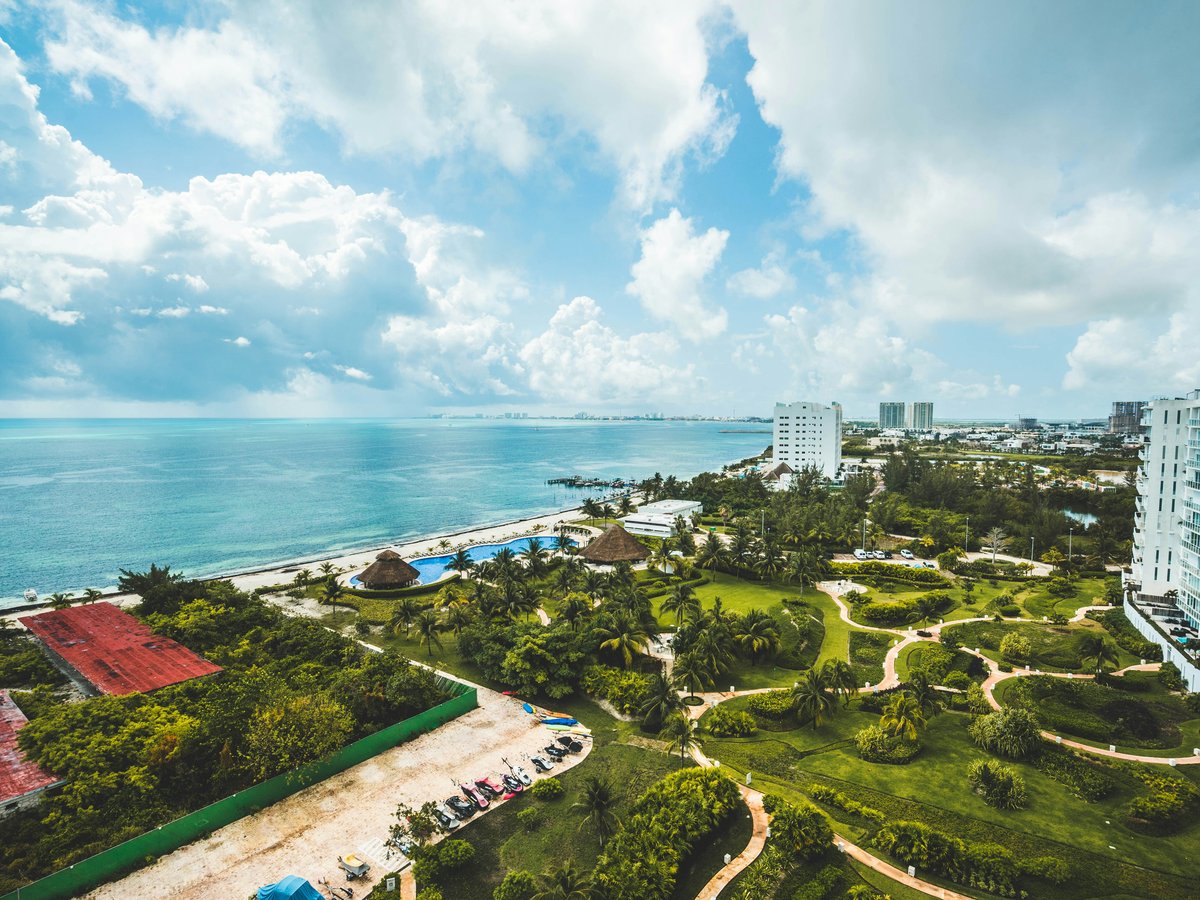
Cancún splits into two cities that barely know each other. The Zona Hotelera runs 23 kilometers along a narrow barrier island between Laguna Nichupté and the Caribbean Sea. El Centro, the working downtown, holds around 900,000 residents in a grid of numbered supermanzanas. Most Zona Hotelera visitors assume the beach belongs to the resorts, but Mexican federal law classifies every grain of sand as zona federal marítimo-terrestre, open to all. You can walk onto the same stretch fronting a $600-a-night resort at Playa Delfines and pay nothing for it. The downtown Parque de las Palapas puts on free live music most Friday and Saturday evenings. Mercado 23 and Mercado 28 cost nothing to wander through. Parque Ecológico Kabah protects roughly 63 hectares of subtropical jungle inside city limits, no ticket required. You could spend a full week in Cancún and never pay admission to a single attraction.
Free attractions
-
Playa Delfines
The widest public beach in the Zona Hotelera, at Kilometer 17.5 of Boulevard Kukulcán. The sand here is coarser than the powdery strips further north, with a noticeable crunch underfoot. Waves tend to be stronger than at Playa Langosta or Playa Tortugas, so conditions lean toward body-surfing rather than floating. The mirador above the beach holds the large painted CANCUN letters, which currently draw lines of 20 to 30 people on weekend mornings. No entrance fee at Playa Delfines. Palapas are first-come, first-served. The wind off the water carries salt and the low hum of breakers even when you're up at the viewpoint.
Zona Hotelera, Km 17.5Beach and viewpoint -
Parque de las Palapas
The social heart of El Centro, a broad open plaza in Supermanzana 22 surrounded by food vendors, small shops, and a performance stage. On weekday afternoons, the park fills with families buying marquesitas from the carts along the perimeter. The smell of warm Nutella and Edam cheese from those crispy rolled crepes tends to hit you before you even reach the benches. Weekend evenings bring free concerts, folkloric dance, and occasionally film screenings projected against a portable screen. The park has no entrance gates and no closing time.
El Centro, Supermanzana 22Park and cultural space -
Parque Ecológico Kabah
A roughly 63-hectare patch of protected subtropical jungle sitting between Avenida Nichupté and the residential neighborhoods near Avenida Yaxchilán. Walking trails loop through low canopy where you'll likely see coatis rooting through leaf litter and green iguanas sunning on fallen trunks. The park has a small botanical identification area near the main entrance. No admission charge, though the park closes at dusk. Bird watchers report over 150 species here, including motmots and great kiskadees whose calls carry through the humid air.
El Centro, near SM 43Ecological reserve -
Mercado 28
A covered market at the corner of Avenida Xel-Há and Avenida Sunyaxchén in Supermanzana 28. The stalls sell hammocks, silver jewelry, embroidered huipiles, and painted ceramics. Browsing costs nothing, and the vendors generally let you handle the goods without pressure if you make eye contact and say buenos días first. The food court at the rear serves cochinita pibil tacos running around 25 to 35 pesos each, though eating is obviously not free. The market opens by 9:00 and most stalls close around 18:00.
El Centro, Supermanzana 28Market -
Mercado 23
Older and less tourist-oriented than Mercado 28, this market in Supermanzana 23 caters to Cancún residents buying produce, herbs, piñatas, and household goods. The aisles smell of fresh cilantro and dried chiles. You'll hear more Yucatec Maya spoken here than at most places in the city. Browsing is free, and the atmosphere gives a clearer picture of daily life than the Zona Hotelera ever could. Open daily from roughly 7:00 to 17:00, though some stalls keep shorter hours.
El Centro, Supermanzana 23Market -
Iglesia de Cristo Rey
The main Catholic church in downtown Cancún, on Avenida Yaxchilán near Parque de las Palapas. The interior is modest compared to colonial churches in Mérida or Valladolid, but the stained glass panels catch afternoon light in blocks of deep blue and red. Free to enter, like most Catholic churches in Quintana Roo. Sunday Mass draws a crowd that sometimes spills onto the front steps.
El CentroChurch -
Museo Maya de Cancún
Designed by architect Alberto Kalach, this INAH museum at Km 16.5 of Boulevard Kukulcán houses over 400 Mayan artifacts across 2 permanent halls and a rotating exhibition space. It is not free for foreign visitors, who currently pay around 95 pesos admission. However, Mexican nationals and permanent residents with a valid INE or residency card enter free on Sundays, per standing INAH policy. The museum's grounds include access to the adjacent Zona Arqueológica de San Miguelito, a cluster of Late Postclassic structures partially visible from the museum terrace.
Zona Hotelera, Km 16.5Museum (free Sundays for nationals and residents) -
Casa de la Cultura de Cancún
A municipal cultural center on Prolongación Avenida Bonampak in Supermanzana 25, hosting rotating art exhibitions, photography shows, and occasional sculpture displays. Exhibitions are typically free to enter. The center also runs free workshops in painting and music at various points throughout the year, though schedules shift season to season. Worth checking the notice board at the entrance or the Cancún municipal culture pages on social media for current programming.
El Centro, Supermanzana 25Cultural center and gallery (generally free) -
Playa Langosta
A calmer beach at Km 5 of Boulevard Kukulcán, where the water sits in a more sheltered cove than at Playa Delfines. Families with small children tend to favor Playa Langosta for the gentler waves. A public access path leads down from the road near the Embarcadero area. Free, with restroom facilities available at the nearby commercial pier for a small tip.
Zona Hotelera, Km 5Beach -
Malecón Tajamar
A waterfront boardwalk along the lagoon side of Boulevard Kukulcán near the transition between the Zona Hotelera and El Centro. The path runs roughly 1.5 kilometers and faces west over Laguna Nichupté, which makes it one of the better free sunset spots in the city. The water here goes from grey-green to copper as the sun drops behind the mangrove fringe. Mind you, the surrounding development area has been controversial due to past mangrove clearing, but the boardwalk itself remains open and free to walk.
Between Zona Hotelera and El CentroWaterfront promenade and green space
Free activities
-
Zona Hotelera beach walk from Playa Tortugas to Playa Delfines
A roughly 14-kilometer walk along the Caribbean shore, entirely on public sand. You can start at Playa Tortugas near Km 6 and work south to Playa Delfines at Km 17.5, passing Playa Caracol, Playa Forum, Playa Gaviota Azul, Playa Marlín, and Playa Ballenas along the way. The sand shifts from soft and white in the north to coarser and more windswept near Delfines. Bring at least a liter of water. There's no shade for most of the route, and the midday sun on exposed sand in Cancún reaches temperatures that make bare feet uncomfortable by 11:00. Early morning, before 8:00, works better, when the sand still has a cool firmness and the light runs gold over flat Caribbean water.
Zona HoteleraWalking route -
El Centro supermanzana walk
Downtown Cancún is laid out in a grid of superblocks numbered in the teens through fifties, each with its own internal park or gathering spot. A 2-hour loop through SM 22, SM 23, SM 24, and SM 28 connects Parque de las Palapas, Mercado 23, Mercado 28, and several taco stands where you can at least smell the al pastor without paying for it. The sidewalks in El Centro are uneven in places, and you'll hear banda music from parked cars, the clatter of dominoes from open doorways, and vendors calling out prices for fresh mamey and zapote.
El CentroWalking route -
Bird watching at Parque Ecológico Kabah
The park's marked trails wind through low jungle canopy where over 150 bird species have been documented. Early morning, before 8:00, tends to be the most productive window. You might spot turquoise-browed motmots, social flycatchers, or the occasional Yucatán woodpecker. The park is free, and binoculars are the only equipment that matters. The humidity inside the tree cover sits noticeably higher than on the street, with a damp-earth smell that intensifies after overnight rain.
El CentroNature activity -
Sunset watching at Malecón Tajamar
The Caribbean-facing beaches in the Zona Hotelera look east, so they don't get direct sunset views over the water. For a proper westward sunset, the Malecón Tajamar boardwalk faces Laguna Nichupté and gets the full color drop. Playa Delfines, at the southern curve of the Zona Hotelera, catches late-afternoon light that turns the sea from turquoise to deep indigo. Both spots are free and currently open until dark.
Zona Hotelera and El CentroScenic activity -
Swimming at Playa Tortugas
At Km 6.5 in the Zona Hotelera, this beach sits on the calmer, north-facing bay side of the barrier island. The water is warm year-round, hovering between 26°C and 29°C, and the waves rarely top 30 centimeters. Free public access, with a few palapa-style shelters on the sand. Playa Tortugas tends to be busier than Playa Delfines because of its proximity to the public bus stops on Boulevard Kukulcán. The R-1 and R-2 buses run from El Centro to Playa Tortugas for around 12 pesos each way.
Zona Hotelera, Km 6.5Beach activity
Free events
-
Live music and dance at Parque de las Palapas
Most Fridays and Saturdays, typically from 19:00The park's central stage hosts free performances most Friday and Saturday evenings, typically starting around 19:00 or 20:00. Programming rotates between regional bands, cumbia groups, ballet folklórico troupes, and solo guitarists. The crowd is overwhelmingly local, with families spreading blankets on the concrete or buying elotes from the surrounding carts. Some nights you'll catch a jaranero ensemble from inland Yucatán, other nights a DJ with a borrowed speaker system. The Cancún municipal culture pages on social media sometimes post weekly lineups, though the schedule is not always available in advance.
Parque de las Palapas, El Centro -
Día de los Muertos celebrations
October 31 through November 2, annuallyFrom roughly October 31 through November 2, downtown Cancún puts up community ofrendas in Parque de las Palapas, the Casa de la Cultura, and along Avenida Tulum. Local schools and civic groups build altars decorated with cempasúchil marigolds, sugar skulls, pan de muerto, and photographs of the deceased. A candlelit procession with face-painted participants has been held through El Centro on the evening of November 1 in recent years. The flower-and-copal smoke smell is thick enough to follow from 2 blocks away. All events and altar viewings are free.
Parque de las Palapas, Casa de la Cultura, Avenida Tulum -
Carnaval de Cancún
4 to 5 days in February or early March, before Ash WednesdayCancún's Carnaval typically runs for 4 to 5 days in February or early March, timed to the week before Ash Wednesday. The main parade moves along Avenida Tulum with floats, comparsas, brass bands, and costumed dancers. Viewing from the sidewalk is free. The route tends to draw the biggest sidewalk crowds near the main glorietas along Avenida Tulum. Food vendors line the route selling churros and aguas frescas.
Avenida Tulum, El Centro -
Fiestas Patrias (Mexican Independence celebrations)
September 15 (El Grito) and September 16 (parade), annuallyOn the evening of September 15, the municipal government holds the Grito de Independencia ceremony in the main plaza area near Parque de las Palapas. A public official reenacts the call to independence, followed by fireworks and live music that often runs past midnight into September 16. The following day brings a civic parade along Avenida Tulum. Both events are free, and the fireworks over El Centro have been visible from parts of the Zona Hotelera in recent years.
Parque de las Palapas and Avenida Tulum, El Centro -
Sunday cultural programming at Parque de las Palapas
Sundays, typically morning through early afternoonSunday mornings and early afternoons at Parque de las Palapas tend to include informal cultural activities, from children's theater and puppet shows to art workshops set up by local instructors. The Cancún municipal culture department appears to organize the programming on a rotating basis, so the specific offering changes week to week. Admission is free, and a marquesita from the surrounding carts runs about 30 pesos if you give in.
Parque de las Palapas, El Centro
Mexican beach law and your rights
Every beach in Mexico falls under the Zona Federal Marítimo Terrestre, a 20-meter strip measured from the high-tide line that is classified as federal property under the Ley General de Bienes Nacionales. No hotel, resort, or private entity can legally block you from walking on this strip. In Cancún's Zona Hotelera, that means you can access the water at Playa Caracol, Playa Forum, Playa Marlín, or any other beach by finding a public access point, usually marked with a small blue sign reading 'Acceso a Playa.' Some resort staff might tell you the beach is private, but it isn't under Mexican federal law. That said, the lounge chairs and palapa umbrellas set up by the hotels are their property, so those you cannot use without being a guest or paying a rental fee. Bring a towel, claim your 20 meters of federal sand, and swim in the same Caribbean water.
Getting around Cancún cheaply
The R-1 and R-2 public buses run between El Centro and the Zona Hotelera along Boulevard Kukulcán for around 12 to 15 pesos per ride. R-1 runs the full length of the hotel zone toward Punta Nizuc, while R-2 covers the northern stretch. Buses start around 5:30 and the last ones pass through between 22:30 and 23:00. They're not free, but at roughly $0.70 USD per trip, they're close enough. The ride from the ADO bus terminal downtown to Playa Delfines takes about 40 minutes depending on traffic. Have coins or bills under 50 pesos ready, as drivers may not carry change for larger notes. Within El Centro, most free attractions sit within a 20-minute walk of Parque de las Palapas in the SM 22 to SM 28 cluster.
Places that aren't free, despite appearing on budget lists
A few places show up on zero-budget lists for Cancún but actually charge admission. The Zona Arqueológica El Rey at Km 18 in the Zona Hotelera and the Zona Arqueológica El Meco north of Puerto Juárez both carry INAH admission fees, currently around 75 to 95 pesos for foreign visitors. They are free on Sundays for Mexican nationals and residents, same as the Museo Maya de Cancún. The underwater sculpture museum MUSA requires a boat trip or snorkel/dive tour starting at $50 to $70 USD per person. The Xcaret, Xel-Há, and Xplor eco-parks south of Cancún have never been free, despite sometimes being grouped with budget activities. Be skeptical of any Cancún guide that includes them among free attractions.
FAQ
Are all beaches in Cancún really free to access?
Yes. Mexican federal law designates the first 20 meters from the high-tide line as zona federal, which means public access cannot be legally restricted. In the Zona Hotelera, look for blue 'Acceso a Playa' signs between the resorts. The beaches at Playa Delfines, Playa Tortugas, and Playa Langosta have the most visible public entry points. You won't be able to use resort chairs or umbrellas, but the sand and water are open to everyone.
Is downtown Cancún safe for walking around?
To be fair, El Centro gets a worse reputation than it deserves among Zona Hotelera visitors who never leave the strip. The tourist-frequented areas, particularly Supermanzanas 22 through 28 and along Avenida Tulum and Avenida Yaxchilán, are generally safe during the day and busy evening hours. Parque de las Palapas and the market areas see heavy foot traffic from local families. Like any Mexican city approaching a million residents, stay aware of your surroundings after dark and stick to well-lit blocks.
How do I get from the Zona Hotelera to El Centro on a budget?
The R-1 and R-2 public buses run along Boulevard Kukulcán between the hotel zone and El Centro for around 12 to 15 pesos per ride, which works out to roughly $0.70 USD. Buses operate from about 5:30 to 23:00 daily. Have coins or small bills ready, as drivers may not carry change for a 200-peso note. A taxi between the same two points tends to run 200 to 400 pesos depending on the exact pickup and drop-off locations.
Is the Museo Maya de Cancún free?
For foreign visitors, no. The admission currently sits around 95 pesos. However, Mexican nationals and permanent residents with a valid INE or residency card enter free on Sundays, under INAH's national policy for all federal museums and archaeological sites. The ticket includes access to the adjacent San Miguelito archaeological zone. The museum is closed on Mondays.
What is the best time of year for free outdoor activities in Cancún?
November through April tends to have the most comfortable weather for walking and beach days, with temperatures between 24°C and 30°C and relatively lower humidity. The rainy season from June through October brings afternoon downpours that usually last 1 to 2 hours, though the sky typically clears quickly. September and October carry the highest hurricane risk. The Día de los Muertos events in early November and Carnaval in February add free programming to the calendar during the drier months.
Can I snorkel for free at Cancún beaches?
If you bring your own mask and snorkel, you can enter the water at any public beach for free. Playa Tortugas and the northern bay-side beaches tend to have calmer conditions for shore snorkeling. That said, the reef systems and MUSA underwater sculptures require a boat or guided tour that typically starts at $50 to $70 USD per person. The free beach snorkeling at spots like Playa Tortugas might turn up small tropical fish and sea fans, but it won't match what you'd see on a reef or cenote tour.
Last verified by automated review (v1.7.2) on June 21, 2026. What is automated review?