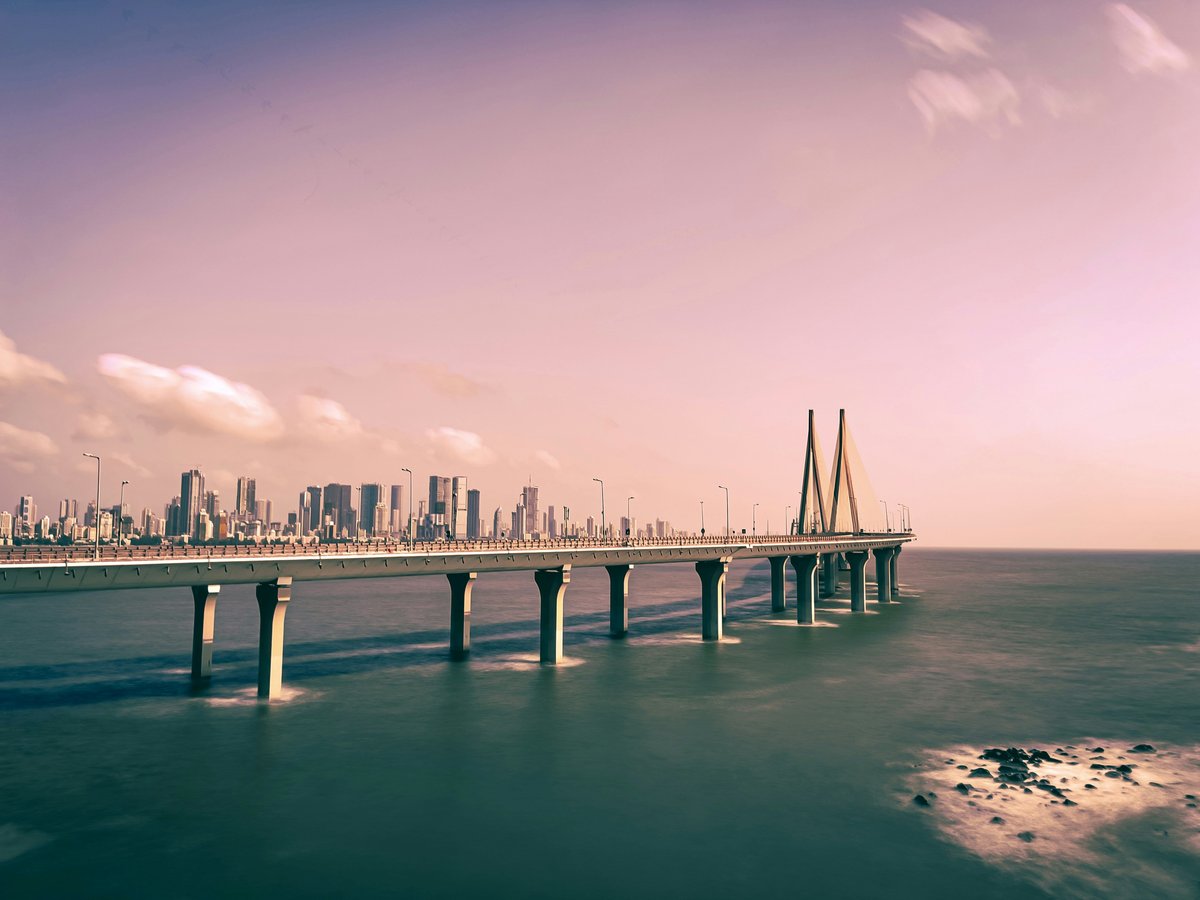
Stay in Mumbai in July
77 hotels in the Trip.com pool for Mumbai, from US$10 a night.
Opens Trip.com on Fri 2 Jul to Sun 4 Jul 2027; change the dates there.
July is the wettest month of the year in Mumbai. The city records roughly 856mm of rain across 31 days. Every single one of those days brings some form of rainfall. Temperatures sit around 28°C (82°F) by day and 25°C (78°F) at night, which is mild by Indian summer standards. The 88% humidity is what gets you. The air around Marine Drive feels heavy enough to drink, and a persistent dampness works its way into your clothes, your camera bag, your hotel room.
Mumbai still functions during monsoon, but on altered terms. Low-lying areas around Hindmata junction, Sion, and parts of Dadar flood regularly, sometimes waist-deep within 2-3 hours of continuous downpour. The suburban railway network, which carries roughly 7.5 million commuters each day, shuts down when tracks go underwater. Flights at Chhatrapati Shivaji Maharaj International Airport get delayed or diverted for hours at a stretch. That said, if you can handle being genuinely wet for long stretches, monsoon Mumbai has a quality that November and December cannot replicate. The Western Ghats, visible from Borivali, turn an almost electric green by mid-July. Marine Drive during a proper storm, with waves clearing the sea wall and the Queen's Necklace lights blurred through sheets of rain, might be one of the more dramatic urban views in South Asia. Street vendors along Juhu Beach fire up their bhutta stalls, and the smell of corn roasting over charcoal, squeezed with lime and dusted with red chili, drifts through the salt air.
If predictable weather matters to your trip, visit between November and February instead. If you're already committed to July, this guide will help you work around the rain and find what's genuinely worth doing. Hotel rates across Bandra and Colaba tend to drop 30-40% from peak-season levels. Tourist crowds at the Gateway of India thin out considerably. You will get rained on. Repeatedly. But a week in Mumbai in July likely costs less than 4 days in December.
Why visit in July
- Hotel rates across South Mumbai and Bandra drop 30-40% from the November-February peak, making 4-star and 5-star properties significantly more affordable.
- Tourist crowds at major sites like the Gateway of India, Elephanta Caves, and CSMVS museum thin out dramatically. You can walk through spaces that feel gridlocked in December.
- The Western Ghats within 100km of Mumbai transform into lush green valleys with seasonal waterfalls. Treks to Lohagad Fort and Rajmachi Fort are at their most scenic from July through September.
- Monsoon street food is a distinct culinary season in Mumbai. Roasted bhutta, kanda bhaji, and hot cutting chai at corner tapris during a downpour are experiences that do not exist outside the June-September window.
- The light over the Arabian Sea between rain bands is soft and diffused. Photographers working in Worli, Bandstand, and along Marine Drive get atmospheric conditions impossible to find in the dry months.
Worth knowing
- 856mm of rain across 31 days means you will get soaked. There is no "dry day" in July Mumbai. Outdoor plans require constant flexibility and a tolerance for sudden cancellations.
- Urban flooding disrupts transport across the city. The Hindmata-Sion-Dadar corridor floods routinely, and local trains stop running when tracks go under. Airport delays of 2-6 hours are common during heavy spells.
- Leptospirosis, dengue, and waterborne infections spike during July. Mumbai hospitals report increased cases every monsoon. Wading through standing floodwater, which many streets require, carries genuine health risk.
- Humidity at 88% makes even 28°C feel oppressive. Clothes, towels, and shoes struggle to dry. Mold appears on leather goods left in hotel rooms for more than a day or two.
Best for
Think twice if
July sits at the absolute peak of Mumbai's southwest monsoon. The city records roughly 856mm of rain, the highest monthly total of the year, distributed across all 31 days. Temperatures are surprisingly mild at 28°C (82°F) highs and 25°C (78°F) lows, but the 88% average humidity makes even those moderate numbers feel stifling. Expect continuous overcast skies with alternating phases of drizzle and heavy downpour. Some afternoons bring 50-100mm in a 2-3 hour window. Brief dry spells of 1-4 hours appear between rain bands, often in the mornings between 6 and 10 AM. The Arabian Sea is rough, with high waves along the entire western coastline from Nariman Point to Marve Beach.
Seasonal caution
- Urban flooding is nearly guaranteed in July. Low-lying areas including Hindmata junction, Sion, Milan Subway, and King's Circle can flood waist-deep within 2-3 hours of sustained heavy rain. In 2005, Mumbai recorded 944mm in a single 24-hour period on July 26, and while that was extreme, days exceeding 200mm still occur in modern Julys.
- Local train disruption affects the entire city. When tracks at Sion, Matunga, or Parel go underwater, the Central and Harbour lines stop completely. The Western line floods less frequently but still faces delays. Millions of commuters get stranded, and auto-rickshaws and taxis become scarce within minutes.
- Leptospirosis risk from contaminated floodwater is a documented July hazard. Mumbai's BMC issues annual advisories. Avoid wading through standing water when possible, especially with open cuts or abrasions on your feet.
- Landslide risk increases on the Ghat roads between Mumbai and hill stations like Lonavala, Matheran, and Mahabaleshwar. If planning a day trip, check Maharashtra State Road Transport Corporation advisories on the morning of travel.
Year-round climate
Averages from the last 5 years.
| Month | Avg high (°C) | Avg low (°C) | Rainfall (mm) |
|---|---|---|---|
| Jan | 30 | 19 | 2 |
| Feb | 32 | 20 | 0 |
| Mar | 34 | 23 | 3 |
| Apr | 34 | 25 | 1 |
| May | 33 | 27 | 97 |
| Jun | 30 | 26 | 461 |
| Jul | 28 | 25 | 856 |
| Aug | 28 | 25 | 413 |
| Sep | 28 | 25 | 478 |
| Oct | 31 | 24 | 95 |
| Nov | 33 | 22 | 7 |
| Dec | 31 | 21 | 20 |
Best things to do in July
Storm-watching at Marine Drive
sightseeingThe 3.6km arc of Marine Drive from Nariman Point to Girgaon Chowpatty becomes a natural amphitheater during monsoon storms. Waves crash over the concrete tetrapods and sea wall, sometimes reaching the road itself. Locals line the promenade to watch, often with bhutta and chai from nearby vendors. The Queen's Necklace lights reflecting off wet pavement at dusk add a visual layer that does not exist in dry months.
July's peak monsoon brings the highest waves and most dramatic storms of the year. The Arabian Sea is at its roughest, and the Marine Drive spectacle peaks this month.Booking tipNo booking needed. Go during high tide for the best wave action. The BMC sometimes closes sections of the promenade during severe storms, so check before heading out.
Monsoon trek to Lohagad Fort
trekkingLohagad Fort sits about 100km southeast of Mumbai near Lonavala, at an elevation of roughly 1,033 meters. The 3-4km trek from Malavli railway station passes through green valleys and seasonal streams that only flow during monsoon. The fort itself, dating to the Maratha period, offers panoramic views of the rain-soaked Sahyadri range. Cloud cover drifts through the ramparts, sometimes reducing visibility to 10 meters.
The seasonal waterfalls, green valleys, and cloud-level trekking conditions exist only from late June through September. July is the peak of this window.Booking tipTake an early morning local train from Mumbai CST to Malavli station, about 2.5 hours. Start the trek by 7 AM to avoid afternoon downpours on the trail. No booking required, but weekends get crowded with groups from Mumbai and Pune.
Kanheri Caves and monsoon waterfalls in Sanjay Gandhi National Park
sightseeingThe 109 Buddhist rock-cut caves at Kanheri, carved between the 1st century BCE and 10th century CE, sit inside Sanjay Gandhi National Park in Borivali. During monsoon, seasonal waterfalls appear across the hillside around the caves, and the forest canopy turns dense green. The combination of ancient stone carvings and falling water surrounded by tropical forest is specific to the July-September window.
The monsoon waterfalls at Kanheri only flow from late June through early October. July's heavy rainfall keeps them at full volume.Booking tipThe park charges a small entry fee per person plus a vehicle fee. Go on a weekday morning. The road from the park entrance to Kanheri is about 6km and can be walked or driven. Leeches are active on the forest trails during monsoon, so wear covered shoes for the walk.
Rainy-day museum visit at CSMVS
cultureChhatrapati Shivaji Maharaj Vastu Sangrahalaya in the Fort district, formerly the Prince of Wales Museum, houses over 50,000 artifacts across its Mughal-era miniatures, Indus Valley archaeology, and natural history sections. The Indo-Saracenic building itself, completed in 1922, is worth the visit for its dome and garden. When it is pouring outside and the streets are flooded, this is one of the best places to spend 3-4 hours in South Mumbai.
July's continuous rain makes indoor attractions essential. CSMVS is rarely crowded in July because tourist numbers drop, so you can examine collections at your own pace without the December crowds.Booking tipBook tickets online to skip the entry queue. Audio guides are available for rent at the front desk. Photography is allowed in most galleries. The museum cafe in the garden courtyard is a good spot for a break between wings.
Monsoon street food crawl through Mohammed Ali Road
foodMohammed Ali Road in South Mumbai is one of the city's densest street food corridors. During monsoon, the narrow lanes fill with the smell of frying pakoras, kebabs on charcoal grills, and sweet malpua being prepared in huge kadais. Stalls stay open late, often until midnight, and eating under a tarpaulin canopy while rain hammers the street outside is a specific sensory combination that July delivers.
Monsoon is when Mumbai's street food culture shifts gear. The rain-and-fried-food pairing is culturally central, and the cooler evenings at 25°C make standing and eating outside comfortable rather than sweaty.Booking tipNo booking needed. Go after 8 PM when the full range of stalls is open. Wear waterproof sandals, as the street floods during heavy rain. Tuesdays tend to be quieter than weekends.
Wave-watching at Bandstand Promenade in Bandra
sightseeingThe Bandstand Promenade runs along the rocky coast in Bandra West, with views south toward the Bandra-Worli Sea Link. During July storms, waves hit the rocks and spray 5-10 meters into the air. Bandra Fort, a 17th-century Portuguese structure at the northern end of the promenade, is the best vantage point for watching the Sea Link disappear and reappear through curtains of rain.
July's rough Arabian Sea produces the most dramatic wave action of the year. The spray, the sound of water hitting basalt rock, and the low cloud cover over the Sea Link create conditions unique to peak monsoon.Booking tipFree and open. Walk from Bandra station, about 15 minutes downhill. Avoid standing too close to the rocks during high tide. The promenade path gets slippery when wet.
Gallery hopping in Kala Ghoda
cultureThe Kala Ghoda district in South Mumbai, between the Fort area and Colaba, houses a cluster of galleries and cultural institutions within walking distance. The Jehangir Art Gallery hosts rotating exhibitions by Indian artists. The National Gallery of Modern Art occupies a restored heritage building on MG Road. Between galleries, the neighborhood's cafes offer shelter during rain bursts.
July rain makes outdoor sightseeing unreliable, so indoor cultural spaces become the natural alternative. Gallery crowds are lighter in monsoon, and the district's covered walkways make it one of the more navigable neighborhoods during downpours.Booking tipJehangir Art Gallery is free and open Tuesday through Sunday. NGMA charges a nominal entry fee. Check exhibition schedules online before going, as some galleries close between shows.
Catching a play at Prithvi Theatre
culturePrithvi Theatre in Juhu has been a center for Hindi and Marathi theatre since 1978. The intimate 200-seat space stages plays almost every evening, often by well-known Mumbai theatre groups. The theatre's cafe, set in a tree-shaded courtyard, serves Irish coffee and snacks that have their own following. On a rainy July evening, a play at Prithvi followed by coffee in the courtyard is a distinctly local experience.
Mumbai's theatre season stays active through monsoon while outdoor entertainment shuts down. July evenings, with 25°C temperatures and rain on the courtyard trees, make Prithvi's open-air cafe particularly atmospheric.Booking tipCheck the schedule on Prithvi's website and book in advance for weekend shows, which sell out. Weeknight performances are usually available same-day. Ticket prices are kept intentionally low, often under a few hundred rupees.
What to eat in July
In season: fruit
Jackfruit (phanas)
Raw and ripe jackfruit peaks across Maharashtra from June through August. In Dadar's flower market area, vendors sell ripe jackfruit pods with their thick, sweet flesh and a distinctive tropical smell that is impossible to miss. Unripe jackfruit goes into curries and stir-fries at Maharashtrian restaurants across Parel and Lower Parel.
On menus now
Aamras with puri
Thick, sweet Alphonso mango pulp served alongside hot fried puris. July is the tail end of mango season in Maharashtra, so this is your last chance to eat proper aamras until the following April. Restaurants in Girgaum and Matunga serve it as a dessert or a full meal. By early August, Alphonso supply dries up and the dish disappears from menus.
Pithla bhakri
A thick, spiced chickpea-flour curry served with jowar or bajra millet flatbread. This Maharashtrian staple appears on monsoon menus at local restaurants in Dadar and Parel, where it's treated as comfort food for damp, cooler evenings. The earthy, peppery warmth of the pithla with a rough-textured bhakri is made for 25°C nights and the sound of rain on tin roofing.
Street food peaks
Bhutta (roasted corn on the cob)
Mumbai's signature monsoon street food. Vendors appear along Marine Drive, Juhu Beach, and Carter Road the moment the rains arrive in June and stay through September. Each cob is roasted over charcoal until lightly charred, then rubbed with a wedge of lime dipped in salt and Kashmiri red chili powder. The smoky, sour, spicy combination eaten while watching waves crash at Marine Drive is a sensory experience tied specifically to the monsoon months.
Kanda bhaji (onion pakoras)
Thin-sliced onion rings dipped in spiced chickpea batter and deep-fried until crisp. Every corner tapri in Dadar, Matunga, and Fort starts frying these the moment clouds roll in. They're served on newspaper with green chutney and a glass of cutting chai. Locals consider kanda bhaji and rain inseparable, and the smell of them frying in hot oil is the unofficial scent of Mumbai's monsoon.
What to drink
Sol kadhi
A cold, pink drink made from kokum fruit and coconut milk, common across Konkani restaurants in Girgaon and Dadar. It has a tart, slightly sour taste with a cooling coconut finish that cuts through the humidity. Traditionally served at the end of a meal as a digestive, though many Mumbaikars drink it on its own during monsoon months.
Regular events in July
Guru PurnimaFree
The Hindu festival honoring spiritual teachers and gurus, observed on the full moon day of the month of Ashadha. Temples across Mumbai, particularly the Siddhivinayak Temple in Prabhadevi and ISKCON Juhu, hold special prayer ceremonies and cultural programs. Schools and music academies organize events where students pay respects to their teachers. The festival has deep roots in Maharashtra's tradition of saint-poets.
Mid-July, varies annually by the Hindu lunar calendarAshadhi Ekadashi and the Pandharpur WariFree
One of Maharashtra's largest religious observances. Hundreds of thousands of Warkari pilgrims walk from temples across the state to the Vitthal temple in Pandharpur, carrying the palanquins of saints Tukaram and Dnyaneshwar. The procession passes through parts of Greater Mumbai, particularly Dadar and Parel, where large crowds gather to see the palkhi. The energy along the route, with devotional songs (abhang) sung by walking groups, is specific to this period.
Late June to mid-July, the 11th day of the bright half of Ashadha month in the Hindu calendarKargil Vijay DiwasFree
A national day of remembrance on July 26 marking the end of the 1999 Kargil War. In Mumbai, commemorative events are held at military installations and public spaces. The Indian Navy, which has a significant presence in Mumbai, typically holds observances at the naval dockyard area in South Mumbai. Schools and civic organizations also mark the occasion.
July 26 every yearNag PanchamiFree
A festival honoring snakes, observed on the 5th day of the Shravana month. Temples across Mumbai, especially older neighborhood temples in Girgaon and Dadar, perform rituals with snake imagery and offer milk. In some areas of Greater Mumbai, live snake charmers still appear, though the practice has been restricted in recent years. The date shifts between late July and early August depending on the lunar calendar.
Late July to early August, varies by Hindu lunar calendarBest places this July
Marine Drive
promenadeThe 3.6km promenade from Nariman Point to Girgaon Chowpatty is at its most dramatic in July. Waves crash over the Art Deco sea wall, and the curved sweep of streetlights reflecting on wet concrete earned it the Queen's Necklace nickname. Come during high tide for the best wave action, or at dusk when the lights switch on through the rain.
Marine LinesSanjay Gandhi National Park and Kanheri Caves
parkThe 104-square-km national park in Borivali transforms during monsoon. The forest canopy thickens, seasonal streams appear, and waterfalls cascade around the ancient Kanheri Caves. The 109 rock-cut Buddhist caves, some dating to the 1st century BCE, are surrounded by falling water from July through September. The park is also home to leopards, though sightings are rare on the tourist trails.
BorivaliChhatrapati Shivaji Maharaj Vastu Sangrahalaya (CSMVS)
museumMumbai's principal museum, housed in a 1922 Indo-Saracenic building in the Fort area. Over 50,000 artifacts spread across archaeology, art, and natural history galleries. The building's central dome and garden courtyard are architecturally striking even without the collections. July's reduced tourist traffic means you can stand in front of the Mughal miniatures or the Gandhara sculptures without being jostled.
FortKala Ghoda Art District
neighborhoodA cluster of galleries, cafes, and heritage buildings wedged between the Fort area and Colaba. The Jehangir Art Gallery and National Gallery of Modern Art anchor the neighborhood. Between them, covered walkways and narrow lanes with restaurants like Kala Ghoda Cafe offer shelter during downpours. The area is walkable in 10-minute segments between rain bursts.
FortWorli Sea Face
promenadeThe coastal road in Worli offers unobstructed views of the Arabian Sea, and during July storms the waves here are even more exposed than at Marine Drive. The promenade runs south toward Haji Ali Dargah, the 15th-century mosque built on an islet that becomes inaccessible during high tide. Watching the causeway to Haji Ali disappear under rising water is a monsoon-specific sight.
WorliBandstand Promenade and Bandra Fort
promenadeThe rocky shoreline walk in Bandra West leads to a crumbling 17th-century Portuguese fort overlooking the Bandra-Worli Sea Link. During monsoon storms, wave spray from the basalt rocks reaches several meters high. The fort itself is small but the south-facing view of the Sea Link in rain and mist is worth the walk from Bandra station, roughly 15 minutes downhill.
BandraPrithvi Theatre
theatreA 200-seat theatre in Juhu that has staged Hindi and Marathi plays since 1978. The tree-shaded courtyard cafe, known for its Irish coffee, is a gathering point for Mumbai's theatre crowd. On rainy July evenings, the combination of live theatre, coffee in a candlelit courtyard, and the sound of rain on leaves overhead is specific to this season.
JuhuMahalaxmi Dhobi Ghat
landmarkThe open-air laundry where roughly 700 dhobis wash clothes in concrete troughs has been operating since 1890. During monsoon, steam rises from the hot water into the humid air, and the rows of hanging fabric against grey skies have a visual quality that dry-season photography cannot replicate. View from the bridge near Mahalaxmi station. Worth noting that this is a working laundry, not a tourist setup.
Mahalaxmi
Your packing checklist
Tick items off as you pack. Your progress saves in this browser.
All packed — have a great trip.
Insider tips
Download the m-Indicator app before you arrive. It shows live Mumbai local train status during monsoon disruptions, and Mumbaikars check it reflexively on heavy rain mornings before leaving the house. If the Harbour or Central line shows red, rethink your route or stay put.
For the best kanda bhaji, skip restaurants. During a downpour, find any corner tapri stall with 5-6 locals standing under an awning eating off newspaper. That is your indicator. The smaller and more improvised the stall, the fresher the batch tends to be.
If you're staying in South Mumbai and need to reach the airport during heavy rain, leave at least 4 hours early. The Western Express Highway near Andheri floods regularly, and what's normally a 40-minute taxi ride from Colaba can stretch to 3 hours. Some locals take a train to Vile Parle and then an auto for the final stretch.
The morning window between 6 and 10 AM often has lighter rain than the afternoon. If you have one outdoor activity planned for the day, schedule it early. By 2 PM, the likelihood of a heavy 2-3 hour downpour increases sharply.
Uber and Ola surge pricing during heavy rain can reach 3-4 times the normal fare. Keep some cash on you for kaali-peeli taxis, which run on meters. They are harder to find in the rain, but they do not surge-price you.
Avoid these mistakes
- Booking outdoor activities for the afternoon with no backup plan. July afternoons in Mumbai can dump 50-100mm of rain in a 2-3 hour window. Temple visits, walking tours, and Elephanta Island trips need to be morning-first, with an indoor afternoon alternative ready.
- Wearing leather shoes, suede, or canvas sneakers. They will be ruined within 1-2 days and will not dry in your hotel room. Every July, tourists can be spotted in waterlogged white sneakers while locals are in sandals or gumboots. Pack accordingly.
- Assuming the Elephanta Island ferry runs every day. The boats operate from the Gateway of India, but services get suspended when the Arabian Sea is rough, which happens frequently in July. Check the morning of your planned visit, not the day before.
- Walking through knee-deep floodwater in open sandals or barefoot. Leptospirosis is a documented monsoon risk in Mumbai, and the bacteria enter through cuts or abrasions on the feet. If you must wade, cover your feet and wash them with clean water and soap as soon as possible. Mumbai hospitals see a spike in cases every July and August.
Practical tips for July
Book hotels and flights with free cancellation where possible. July weather in Mumbai is unpredictable on a day-to-day basis, and airport delays or diversions can push your schedule by 6-12 hours. Carry a portable phone charger, because you will use your phone for weather radar, train status apps, and ride-hailing constantly. The BMC posts flood warnings on social media, and local Twitter accounts like those tracking Mumbai rains are worth following during your stay. Dress code is relaxed everywhere in July since everyone is dealing with the same conditions. Even upscale restaurants in Bandra and Colaba understand if you arrive slightly damp. For currency, keep small denomination notes and coins on hand. Waterlogged ATMs occasionally go offline, and street food vendors deal in cash only. If you are visiting religious sites like Siddhivinayak Temple, modest clothing is expected, but temples also understand monsoon practicalities. The Konkan Railway to Goa and points south runs through July but faces occasional delays from waterlogging on tracks. If you are connecting onward, build in buffer time. Pharmacies in Mumbai stock oral rehydration salts, basic antibiotics, and antifungal creams over the counter, which is useful if you develop any monsoon-related stomach or skin issues.
FAQ
Is July a good time to visit Mumbai?
Honestly, no. July is the single wettest month of the year in Mumbai, with 856mm of rain falling across all 31 days. The city floods, trains shut down, flights get delayed, and outdoor sightseeing is unreliable. That said, there are reasons some travelers come anyway. Hotel rates drop 30-40% from peak season. Tourist crowds thin dramatically. The monsoon street food scene, from bhutta to kanda bhaji, is a distinct culinary experience. And the Western Ghats within day-trip distance are at their most scenic. If you can handle being wet and flexible, there is something here. But if this is your first trip to India and you want reliable conditions, November through February is a far safer bet.
Does it rain every day in Mumbai in July?
Yes. Historically, all 31 days of July record some rainfall. The pattern is not constant, though. Mornings, particularly between 6 and 10 AM, tend to be lighter, with drizzle or breaks. Afternoons and evenings bring the heavier spells, sometimes 50-100mm in a few hours. There are dry windows of 1-4 hours most days when you can move around the city, eat outdoors, or visit sites. But there is no full dry day. Plan for indoor flexibility, and move your outdoor activities to the morning.
Do Mumbai local trains run during monsoon in July?
They try to, but disruptions are frequent. The suburban railway carries over 7 million commuters daily and is the backbone of the city. When tracks flood at low-lying points like Sion, Matunga, or Parel, services on the Central and Harbour lines stop completely. The Western line floods less often but still sees delays. Disruptions can last anywhere from 2 hours to a full day during extreme events. Check the m-Indicator app for live status before traveling. If trains are down, auto-rickshaws, taxis, and ride-hailing surge in demand and price. Many locals simply wait it out.
What should I wear in Mumbai in July?
Quick-dry synthetic clothing, waterproof sandals with grip soles, and a rain jacket. Skip cotton entirely. It absorbs water and does not dry in 88% humidity. Leather shoes, suede, and canvas sneakers will be destroyed within days. Most Mumbaikars switch to waterproof sandals or gumboots for the monsoon months. Dress codes are relaxed across the city during monsoon. Even in upscale areas like Bandra and Colaba, arriving slightly damp is understood. For temple visits, carry a modest cover-up in your bag.
Is it safe to visit Mumbai during the July monsoon?
Mumbai functions through the monsoon, and millions of residents go about their daily lives. The main risks are health-related, not safety-related. Leptospirosis from floodwater, dengue from mosquitoes, and waterborne infections all spike in July. Avoid wading through standing floodwater, use mosquito repellent in the evenings, and drink bottled or purified water. Traffic flooding can strand you for hours, so carry snacks, a charged phone, and some cash. The BMC and local news outlets issue flood warnings during heavy spells. With basic precautions, the risks are manageable. The city does not shut down, it adapts.
Things to Do in Mumbai in July
 Free cancellation
 Dharavi slum tour in Mumbai by Female tour guides of the slum
Day trip: free cancellation.
via Viator Free cancellation
 Private Mumbai Sightseeing Tour (Traveller's Choice Award Winner)
Day trip: free cancellation.
via Viator Free cancellation
 Elephanta Caves & Island Guided Private Tour
Day trip: free cancellation.
via Viator Free cancellation
 Highlights of Mumbai Sightseeing Tour: TRAVELLERS CHOICE AWARDED
Day trip: free cancellation.
via Viator Free cancellation
 The Original Mumbai by Dawn - Recommended by Nigella Lawson & Nat Geo Traveller!
Day trip: 3 hours, free cancellation.
via Viator Free cancellation
 Private Mumbai Sightseeing Tour(Travellers Choice Award Winner)
Day trip: free cancellation.
via ViatorFind a flight to Mumbai
Live fares to Mumbai appear here once cookies are accepted.
Last verified by automated review (v1.7.2) on . What is automated review?