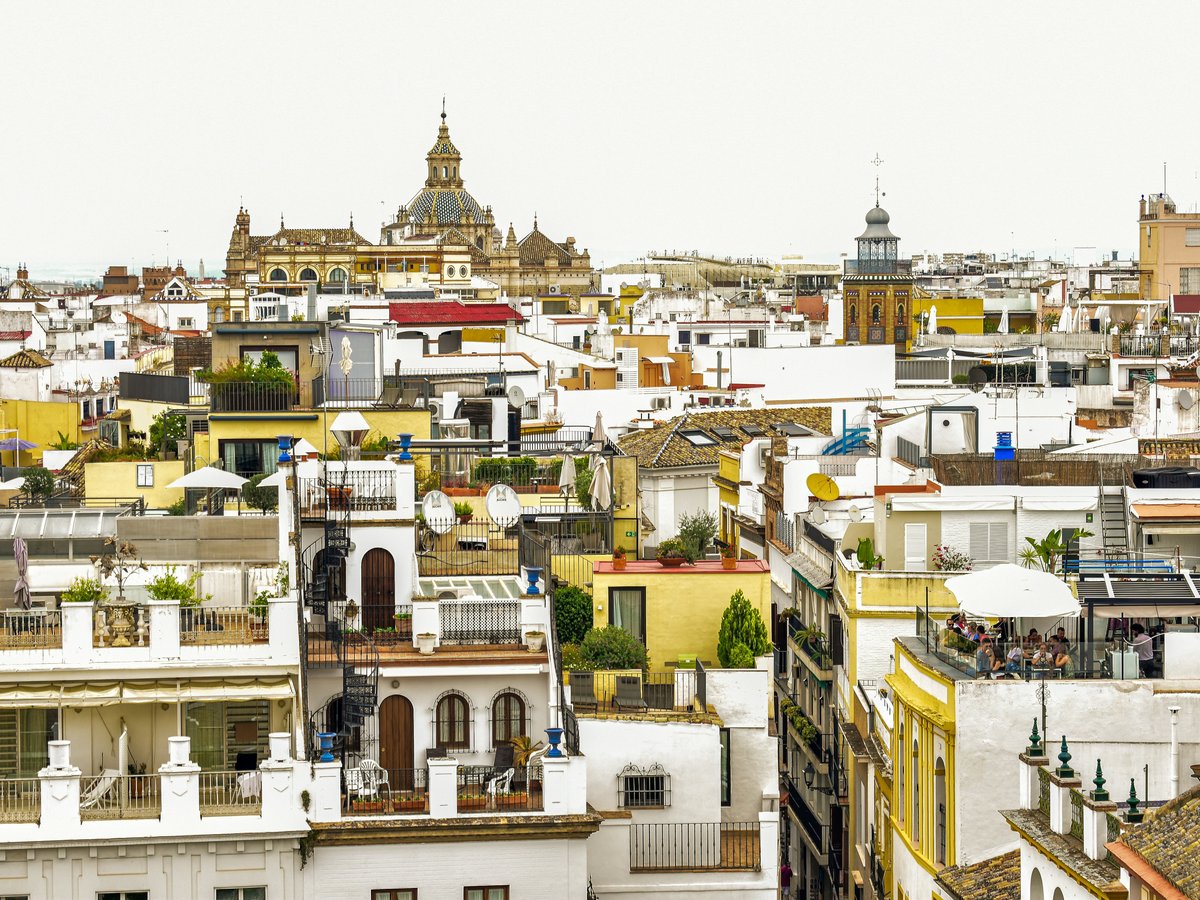
Seville folds out from the Guadalquivir River in a pattern that still follows its medieval walls, even though most of those walls are long gone. The old city sits on the east bank, compact enough to walk end to end in about 40 minutes if you don't stop. You will stop. The neighborhoods radiate roughly outward from the Cathedral and the Alcázar, with Santa Cruz pressed tight against those monuments, then the commercial Centro spreading north toward Plaza de la Encarnación, and the working-class quarters of Macarena and San Lorenzo filling in further out. West across the river, Triana operates like its own small town, historically home to potters, sailors, and flamenco families. The whole centro histórico covers maybe 4 square kilometers. Most visitors never need a bus. That said, each barrio has a genuinely different pace, different noise level, different relationship with tourism. Picking the right one for your base matters more here than in most Spanish cities, because Seville's summer heat means you'll spend a lot of midday time in your neighborhood rather than trekking across town.
Neighborhoods
-
Santa Cruz
Narrow alleys, some less than 2 meters wide, wind between whitewashed houses with wrought-iron balconies trailing jasmine and bougainvillea. The smell of orange blossom hits you on Calle Agua in March and April. It's beautiful and it knows it. Tourist foot traffic stays heavy until about 11pm in high season, concentrated on the routes between the Cathedral and Plaza de los Venerables. Step one block off those arteries and you'll find yourself alone on a cobblestone passage with nothing but the sound of a television through an open window.
- Best for
- First-time visitors who want to be within a 3-minute walk of the Cathedral and Alcázar, and couples willing to pay a premium for atmosphere over space
- Key streets
- Calle Mateos Gago for tapas bars and cold beers, Plaza de Doña Elvira for a quiet sit-down, Calle Agua running along the Alcázar wall, Callejón del Agua for the postcard shot, and Plaza de Santa Cruz where an iron cross marks the site of the original parish church demolished in 1810
-
Centro (Alfalfa / Encarnación)
This is Seville's commercial heart, louder and more functional than Santa Cruz. The streets widen enough for delivery trucks to squeeze through in the morning, and the buildings climb to 4 or 5 stories with small apartment balconies. Plaza de la Encarnación holds the Metropol Parasol, that massive wooden mushroom structure that locals still call Las Setas, finished in 2011 after years of delays and budget overruns. The Alfalfa end feels more residential and slightly scruffy. You'll hear motorcycles, shop shutters rolling up around 10am, and the metallic clatter of tapas plates stacking at Bar Eslava on Calle Eslava.
- Best for
- Travelers who want to eat well without hunting for it, shoppers, and anyone who prefers a neighborhood that functions as an actual city rather than a museum piece
- Key streets
- Calle Sierpes and Calle Tetuán for shopping, Plaza del Salvador for afternoon beers at the terrace bars, Plaza de la Alfalfa for the small morning market, Calle Pérez Galdós for local restaurants without tourist menus, and Calle Regina heading toward the Alameda
-
Triana
Cross the Puente de Isabel II and Seville changes. Triana was historically separated from the city proper by the river, and it still carries that independence. The buildings are a little rougher, painted in deeper ochres and faded reds. Calle Betis runs along the riverbank with a full view back toward the Torre del Oro, and on weekend nights it gets loud with bar terraces and music until 3am. Go deeper into the neighborhood, past the Mercado de Triana, and the noise drops off fast. By Calle Alfarería you're in a residential grid where ceramic workshops still operate behind unmarked doors. The flamenco connection is real, not performed. The barrio produced many of the great flamenco dynasties.
- Best for
- Repeat visitors, anyone who wants a local-feeling base with strong food and nightlife within walking distance, and flamenco enthusiasts who want to catch unannounced peñas rather than ticketed shows
- Key streets
- Calle Betis for river views and late-night bars, Calle San Jacinto as the neighborhood's main commercial artery, Calle Alfarería for the remaining ceramic workshops, Calle Pureza for the Capilla de los Marineros where Triana's brotherhood stores its Semana Santa pasos, and the Mercado de Triana built on the old Castillo de San Jorge site
-
Alameda de Hércules
The Alameda was rough 20 years ago. Now it's Seville's most openly progressive neighborhood, with LGBTQ+ bars, natural wine shops, and vintage furniture stores occupying former warehouses. The rectangular plaza itself stretches about 500 meters and has Roman columns at each end. On weekday mornings it's quiet, with dogs and joggers. By Thursday night, the terrace bars fill and the noise carries. The buildings around the plaza tend toward 18th and 19th century, many with crumbling plaster that nobody seems in a rush to fix. It feels more Madrid or Barcelona than traditional Seville, which is either the appeal or the drawback depending on what you're after.
- Best for
- Younger travelers, solo visitors, people who want late-night options beyond flamenco and tourist bars, and anyone comfortable with a neighborhood that's still a little rough around the edges
- Key streets
- The Alameda de Hércules plaza itself, Calle Amor de Dios for flamenco schools and small performance spaces, Calle Feria for the Thursday morning flea market (El Jueves, running since the 1200s), and Calle Trajano connecting south toward the Centro
-
Macarena
North of the Centro, Macarena is where Seville's remaining medieval walls are most intact. The Arco de la Macarena gate still stands, and beside it sits the Basílica de la Macarena, home to the weeping Virgin that draws Semana Santa crowds of 50,000 or more. Behind the basilica, the neighborhood turns residential and working-class fast. The streets are wider, the buildings plainer, and the rents noticeably lower. You'll hear more Spanish spoken in the bars here. The pace slows down. Tourists tend to visit the basilica and leave. That's a mistake.
- Best for
- Budget-conscious travelers, anyone staying longer than a week who wants cheaper accommodation without leaving the old city, and people interested in Semana Santa culture beyond the processions
- Key streets
- Calle San Luis for its sequence of baroque churches (San Luis de los Franceses has a ceiling fresco worth the 4 euro entry alone), Calle Feria in its northern stretch past the Alameda, the city wall walk from the Arco de la Macarena toward the Puerta de Córdoba, and Plaza de los Terceros for quiet morning coffee
-
San Lorenzo / San Vicente
These twin barrios between the Centro and the river feel like Seville before the tourist boom. The Palacio de las Dueñas, still owned by the Alba family, sits on Calle Dueñas behind high walls. Plaza de San Lorenzo anchors the neighborhood around its church, the home parish of Seville's other great Semana Santa figure, the Gran Poder. The streets are residential, lined with small grocery shops and bars that don't have English menus. Laundry hangs from upper floors. Older residents still drag chairs onto the sidewalk in the evening. The architecture is a mix of 17th and 18th century townhouses, some beautifully maintained, others not.
- Best for
- Travelers who want a quiet residential base within a 10-minute walk of the Cathedral, families with small children who need a calmer environment, and anyone trying to avoid tourist pricing on meals
- Key streets
- Plaza de San Lorenzo for the Jesús del Gran Poder basilica, Calle Dueñas for the Palacio de las Dueñas (Antonio Machado was born in a rented apartment inside the palace grounds in 1875), Calle Torneo along the old river channel, and Calle San Vicente connecting south toward the Museo de Bellas Artes
-
Nervión
East of the old city, past the Jardines de Murillo, Nervión is modern Seville. The streets run in a grid, the buildings are mid-20th century apartment blocks, and the Estadio Ramón Sánchez-Pizjuán, home to Sevilla FC, dominates the skyline with a capacity of about 43,000. The Nervión Plaza shopping center draws local families on weekends. This is where Sevillanos live and shop. The tapas bars here serve locals, not tourists, which means the quality stays high and the prices stay about 30% lower than Santa Cruz. You'll hear the roar from the stadium on match nights from several blocks away.
- Best for
- Sports fans, families who prefer modern apartments with air conditioning and elevators, business travelers near the Santa Justa train station, and anyone who wants Seville prices rather than Seville-tourist prices
- Key streets
- Avenida de Kansas City leading to the train station, Calle Luis de Morales for everyday shopping, the area around the Estadio Sánchez-Pizjuán on match days, and Avenida de Eduardo Dato connecting west toward the old city (about a 15-minute walk to Plaza de la Encarnación)
-
Los Remedios
South of Triana, across the river, Los Remedios is a planned residential neighborhood built mostly in the 1950s and 1960s. The streets are wide and tree-lined, the apartment buildings have doormen, and the overall feel is upper-middle-class and quiet. During the Feria de Abril, held on the fairgrounds at the neighborhood's southern edge, the whole area transforms for a week. The rest of the year it's calm to the point of sleepy. The riverfront Paseo de las Delicias offers a long, flat walk south toward the Parque de María Luisa.
- Best for
- Visitors during Feria de Abril who want to walk to the fairgrounds, families who want wide sidewalks and a calm environment, and anyone who prefers predictable residential quiet over old-city character
- Key streets
- Calle Asunción as the main commercial street with bakeries and pharmacies, the Paseo along the river looking across at the Torre del Oro, Calle Virgen de Luján heading toward the Feria grounds, and Plaza de Cuba at the bridge crossing into the Centro
FAQ
Which neighborhood in Seville is best for a first visit of 3 to 4 days?
Santa Cruz or Centro puts you within walking distance of the Cathedral, the Alcázar, and Plaza de España without needing transport. Santa Cruz is prettier but pricier and more touristic. Centro around Plaza de la Encarnación tends to offer better value on apartments and easier access to restaurants that locals use. Either way, the old city is compact enough that you can reach most sites in 15 minutes on foot from either base. Budget roughly 100 to 150 euros per night for a decent apartment in Santa Cruz, or 70 to 110 in Centro during shoulder season.
Is Triana safe for tourists and worth staying in?
Triana is generally safe and has been gentrifying steadily since the early 2000s. The riverfront along Calle Betis gets rowdy late on weekend nights, so if noise bothers you, book a place on a quieter interior street like Calle Alfarería or Calle Pagés del Corro. The walk across the Puente de Isabel II to the Cathedral takes about 12 minutes. Triana's main advantage as a base is the food scene, which tends to be more local and roughly 20% cheaper than equivalent quality in Santa Cruz. The main drawback is that you'll cross the bridge multiple times a day to see the major monuments.
When is the best time of year to visit Seville?
March and April bring the orange blossom scent, comfortable temperatures around 20 to 25 degrees Celsius, and Semana Santa followed by the Feria de Abril. That's peak season, though, so expect higher prices and full hotels. October and November offer similar weather without the crowds. July and August regularly hit 40 degrees Celsius or above, and many smaller restaurants close for part of August. Locals leave. If you do visit in summer, plan your sightseeing before 11am and after 7pm, and stay somewhere with proper air conditioning, not a fan.
How do Seville's neighborhoods compare on accommodation prices?
Santa Cruz runs the highest, with 1-bedroom apartments typically at 100 to 160 euros per night in spring. Centro and Alameda sit around 70 to 120. Triana and San Lorenzo tend to fall in the 60 to 100 range. Macarena and Nervión are the budget options within reasonable walking distance, often 50 to 80 euros. Los Remedios prices spike during Feria de Abril week, sometimes doubling. These are approximate 2024 to 2025 ranges for decent private apartments. Hotels add roughly 30 to 50% on top. Winter rates across all neighborhoods drop by about a third.
Can you get around Seville without public transport?
Within the old city, yes. The historic center from Santa Cruz to the Alameda covers about 2 kilometers north to south. Triana adds another kilometer west across the river. Most visitors walk everywhere for the first 3 or 4 days. The Tussam bus network and the single metro line (Line 1) help if you're staying in Nervión or need to reach the Santa Justa train station, which sits about 1.5 kilometers east of the old walls. Seville also has a bike-share system called Sevici with over 250 stations, though summer heat makes cycling unpleasant between noon and 6pm from June through September.
Which Seville neighborhoods have the best food scenes?
Triana and the Centro around Alfalfa currently have the strongest concentration of quality tapas bars at local prices. Triana's Mercado de Triana is worth a morning visit. In Centro, the streets between Plaza de la Encarnación and Plaza del Salvador pack in maybe 15 good tapas spots within a 3-minute radius. The Alameda has the city's best natural wine and cocktail bars, plus more experimental cooking. Santa Cruz has good food too, but you'll pay 20 to 30% more and deal with more tourist-oriented menus. For a specific dish, try the carrillada (braised pork cheek) at almost any traditional bar in San Lorenzo. It tends to run 4 to 5 euros as a tapa.
Last verified by automated review (v1.7.2) on . What is automated review?