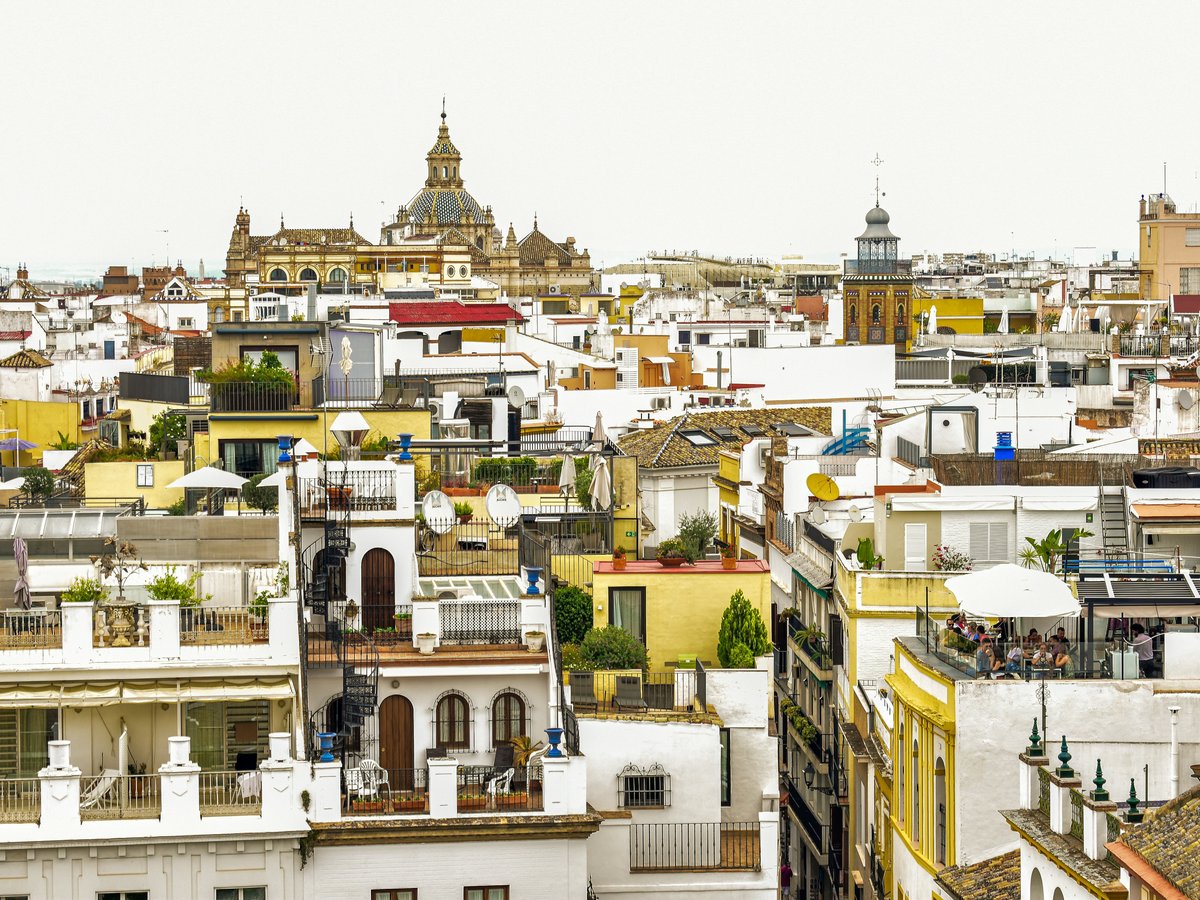
This is Seville at its most monumental: royal and noble palaces, a cathedral that was formerly a mosque, churches, a tower, a bullring, an opera house, and an ancient city of Hispania Baetica out at a Santiponce address. The Reales Alcázares and Seville Cathedral are each part of a UNESCO World Heritage Site, and eight more entries carry Bien de interés cultural protection. The dates run from 1198 for the Giralda to 1991 for the Teatro de la Maestranza, which means a few days of walking can cover several centuries of the city. We've put this together for first-time visitors who want the essentials done properly, and for returning visitors who skipped the house-museums the first time. Opening hours change with the season and the day of the week, and Sundays are the main trap, so read the hours in each entry before you plan the day. The order is a ranking, not a route.
-
1 Reales Alcázares
Patio de BanderasA royal palace dating from 1364 that is part of a UNESCO World Heritage Site
The gates on Patio de Banderas open at 09:30, closing at 17:00 from October to March and at 19:00 from April to September. This is a royal palace with a recorded date of 1364 and part of a UNESCO World Heritage Site, so you will not have it to yourself. Skip the late-morning slot when everyone else turns up and take the first hour instead, while the courtyards are still quiet enough to hear yourself think. Buy tickets through the official site, alcazarsevilla.org, rather than gambling on a queue at the gate. In winter, the 17:00 close comes sooner than you expect, so get inside early in the afternoon and give the palace the time it needs.
Dates from 1364 · Part of a UNESCO World Heritage Site
-
2 Seville Cathedral
A Catholic cathedral that was formerly a mosque, part of a UNESCO World Heritage Site
Formerly a mosque and now a Catholic cathedral, Seville Cathedral carries two chapters of the city's history in a single building, and it sits within a UNESCO World Heritage Site. The hours catch people out: 11:00 to 17:00 Monday to Saturday, with Sunday compressed to 14:30 to 18:00. A Sunday-morning visit is not possible; the doors stay shut until 14:30. On a weekday, arriving close to 11:00 gives you the full run before the 17:00 close. Check catedraldesevilla.es before you head out. Give it more time than you think you need; a building with this much history is wasted on a quick lap.
Part of a UNESCO World Heritage Site
Hours: Mo-Sa 11:00-17:00; Su 14:30-18:00
-
3 Italica
Avenida de Extremadura 2, 41970 Santiponce (Sevilla)The site of an ancient city of Hispania Baetica
At Avenida de Extremadura 2, in the 41970 postal area of Santiponce, Italica is the one entry on this list with an address outside Seville itself. It is the site of an ancient city of Hispania Baetica and is protected as a Bien de interés cultural. Skip the coach-tour packages that hurry you through in an hour; a place like this rewards a slow walk and some imagination, so bring water, wear proper shoes, and leave space in the day. The 41970 postcode tells you this is a separate trip from the palace and cathedral circuit. Give it a morning of its own.
Bien de interés cultural
-
4 Plaza de toros de la Maestranza
12 Paseo de Cristóbal Colón, Sevilla, 41001A bullring dating from 1881 with Bien de interés cultural status
The Plaza de toros de la Maestranza, at 12 Paseo de Cristóbal Colón in the 41001 postal area, dates from 1881, is listed as a cultural property in Sevilla, and holds Bien de interés cultural status. What you think of the events held in the ring is your own business, but the building is worth seeing on its own terms. If architecture is what draws you, there is no need to scramble for a seat. Check realmaestranza.com to see what is open on the day you are in town, and plan around that rather than turning up and hoping.
Dates from 1881 · Bien de interés cultural
-
5 Casa de Pilatos
1 Plaza de Pilatos, Sevilla, 41003A house dating from 1483 that now runs as a museum
Casa de Pilatos, dating from 1483, sits at 1 Plaza de Pilatos in the 41003 postal area and runs today as a museum. The doors are open 09:00 to 18:00, a generous span that lets you slot it around visits with less predictable schedules, and it carries Bien de interés cultural protection. If crowds at the big palaces frustrate you, this is the alternative: rooms you can linger in, at your own pace, without being nudged forward. The official page is at fundacionmedinaceli.org. We'd arrive at 09:00, before the heat builds, and treat the place as somewhere to spend the morning rather than tick off a list.
Dates from 1483 · Bien de interés cultural
Hours: 09:00-18:00
-
6 Giralda
Plaza Virgen de los ReyesA monument dating from 1198
Late in the day, the Giralda catches the light above Plaza Virgen de los Reyes, and that is the hour to stand in the square and look up. Its recorded date is 1198. The official description calls it simply a monument in Seville, which undersells it badly. Skip the postcard angle that everyone shoots from the same corner, walk the square slowly, look at it from several sides, and come back in a different light if you can. A structure dating from 1198 deserves more than one glance, and it changes in character as the sun moves.
Dates from 1198
-
7 Teatro de la Maestranza
22 Paseo de Cristóbal ColónOpera at the city's opera house, open since 1991
Opera is what brings people to 22 Paseo de Cristóbal Colón, where the Teatro de la Maestranza works as an opera house. It dates from 1991, so come for what is on the stage, not for old stone: the locals know the programme matters far more than the facade. Look at the season on teatrodelamaestranza.es before you fix your dates, and build one evening around a performance. Most visitors spend their days in Seville on monuments. A night at the opera at number 22 shows you a city that is still making culture, not merely preserving it.
Dates from 1991
-
8 Palacio de las Dueñas
Calle DueñasA fifteenth-century historical monument with Bien de interés cultural status
The Palacio de las Dueñas, entered from Calle Dueñas, is a fifteenth-century monument carrying Bien de interés cultural protection. Standard hours run 10:00 to 18:00, but if you visit over the holidays, the schedule changes: the palace closes entirely on 1 January, 6 January, and 25 December, and on 24 December, 31 December, and 5 January it opens 10:00 to 14:15. Don't squeeze it in at the end of a day of sights. Give it a morning, and confirm the hours at lasduenas.es before you go.
Bien de interés cultural
-
9 Church of St Mary Magdalene and chapel of Nuestra Señora de Montserrat
Calle BailénA church building dating from 1694 with Bien de interés cultural status
Footsteps echo inside the Church of St Mary Magdalene and chapel of Nuestra Señora de Montserrat on Calle Bailén, a building dating from 1694 with Bien de interés cultural status. Locals come here when the headline monuments are packed, and they have a point: you can sit, look, and think without a tour group pushing past you. Check rpmagdalena.org for access before you go, use it as a pause between bigger sights, and stay longer than you planned.
Dates from 1694 · Bien de interés cultural
-
10 Torre del Oro
41001 Paseo de Cristóbal ColónA tower dating from 1221
The Torre del Oro stands on Paseo de Cristóbal Colón in the 41001 postal area, dates from 1221, and carries Bien de interés cultural protection. Its official description is just a tower in Seville. Don't build a whole morning around it: it works best as a strong single stop, seen on foot as you pass along the Paseo, giving you a fixed point for finding your way. Stand back far enough to take in the whole structure, then move on. A building from 1221 makes its point without needing you to linger.
Dates from 1221 · Bien de interés cultural
-
11 Iglesia del Divino Salvador
Plaza de Jesus de la PasiónA church building dating from 1679 with Bien de interés cultural status
The Iglesia del Divino Salvador on Plaza de Jesus de la Pasión opens Monday to Saturday from 10:15 to 17:30, and on Sunday from 14:30 to 19:00. The church building dates from 1679 and holds Bien de interés cultural status. Don't save it for whatever time is left at the end of the day: on a weekday, the 17:30 close arrives faster than expected, while on Sunday the late 19:00 close offers a calm evening visit when most other doors have already shut. Check iglesiadelsalvador.es before you go.
Dates from 1679 · Bien de interés cultural
Hours: Mo-Sa 10:15-17:30; Su 14:30-19:00
-
12 Palacio de la Condesa de Lebrija
Calle Cuna, Sevilla, 41003A Spanish house-museum with Bien de interés cultural status
The Palacio de la Condesa de Lebrija on Calle Cuna, in the 41003 postal area, is one of those places where the house itself is the exhibit: a Spanish house-museum protected as a Bien de interés cultural. From September to June it opens daily from 10:00 to 18:00, but in July and August the hours run from 10:00 to 15:00, so if you're visiting in summer, come in the morning. The domestic scale means you can move at your own pace, which is why we'd take it over the big-ticket palaces for a quieter hour. Confirm the hours on palaciodelebrija.com before you walk over.
Bien de interés cultural
Last verified by automated review (v1.7.2_regen1014c-1014-2343-20261014121227) on . What is automated review?