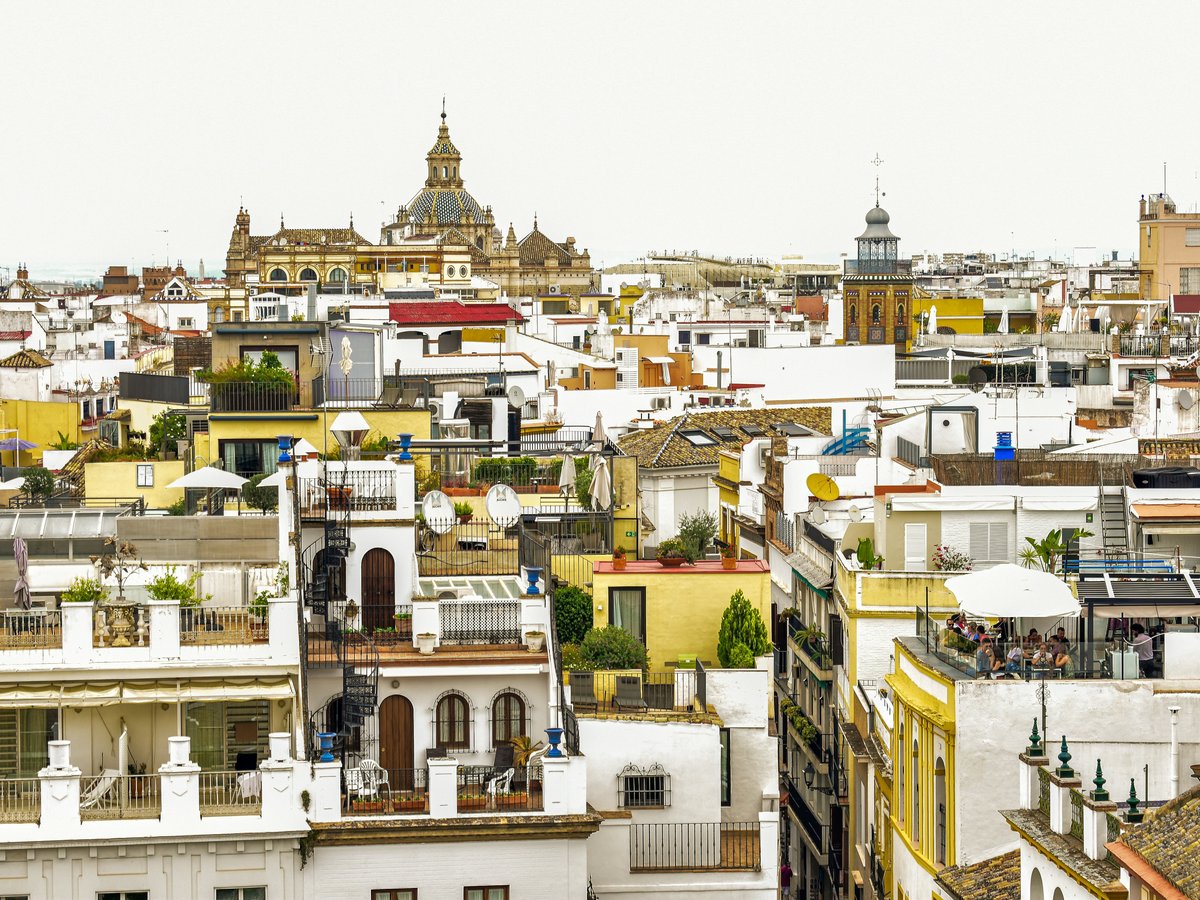
Seville runs on public life. The city's finest plaza, Plaza de España, costs nothing to enter. Its most important archive, the Archivo General de Indias, charges no admission. The 34-hectare Parque de María Luisa stays open year-round without a ticket. You could fill 3 or 4 full days here on a zero budget and still leave entire neighborhoods for next time. Seville averages around 300 days of sunshine per year, with annual temperatures hovering near 19°C. That warmth pushes life outdoors, into plazas and along the Guadalquivir riverfront, where the city itself becomes the main event. Semana Santa processions fill the streets for a full week each spring, and the Feria de Abril opens its gates without a cover charge. Even the quieter months reward a slow walk through the Barrio de Santa Cruz or an afternoon on the Alameda de Hércules, where a pair of Roman columns have stood since 1574.
Free attractions
-
Plaza de España
Architect Aníbal González designed this semicircular plaza for the 1929 Ibero-American Exposition. It spans roughly 50,000 square metres. The 48 tiled alcoves along its base each represent a Spanish province, with hand-painted ceramic scenes from local history. A canal wraps the plaza floor, crossed by 4 bridges styled after the old Spanish kingdoms. It tends to be quieter before 10am and after sunset. Always free.
Parque de María LuisaPlaza -
Parque de María Luisa
Seville's main park stretches across 34 hectares along the southern bank of the Guadalquivir. The Infanta María Luisa donated half the San Telmo Palace gardens to the city in 1893, and French landscape designer Jean-Claude Nicolas Forestier reshaped them before the 1929 Exposition. You'll find wide promenades lined with orange trees, tiled fountains, and a pair of smaller plazas (Plaza de América hosts two museums, both ticketed). The park stays open from around 8am until 10pm in summer. Always free.
South of the historic centerPark -
Archivo General de Indias
The Archivo General de Indias occupies the 16th-century Lonja de Mercaderes, a merchants' exchange designed by Juan de Herrera. It holds roughly 43,000 legajos (document bundles) covering 3 centuries of Spain's administration across the Americas and the Philippines. The ground-floor exhibition rotates selections from the archive, and the building shares its UNESCO World Heritage listing with the Cathedral and the Alcázar, designated in 1987. Carlos III established the archive here in 1785. Entry to the exhibition area has always been free.
CentroArchive and museum -
Alameda de Hércules
This tree-lined promenade in the north of the old city dates to 1574, which likely makes it one of the oldest public gardens in Europe. Two Roman columns from a temple on nearby Calle Mármoles stand at the south end, moved here on the orders of the Conde de Barajas. The Alameda runs about 550 metres long and sits slightly below street level. On weekday mornings it's mostly locals with dogs and coffee. Weekend nights bring a livelier crowd to the surrounding bars and terrazas. Always free.
Feria-AlamedaPublic garden and promenade -
Jardines de Murillo
These gardens sit along the eastern edge of the Barrio de Santa Cruz, between the old city walls and the Alcázar. They're named after the painter Bartolomé Esteban Murillo, who lived nearby on Calle Santa Teresa. The paths are short (you could walk end to end in 10 minutes) but shaded by tall palms and jacarandas. A good resting spot after the narrow lanes of Santa Cruz get too warm in the afternoon. Always free.
Santa CruzGarden -
Parque del Alamillo
Seville's largest green space covers roughly 47 hectares on Isla de la Cartuja, north of the river. The park was developed as part of the Expo '92 site and opened fully in the late 1990s. It's flatter and more open than María Luisa, with running paths, picnic areas under pine trees, and a small lake. Locals use it heavily on weekends, but it empties out on weekday mornings. Always free.
Isla de la CartujaPark -
Real Fábrica de Tabacos (Universidad de Sevilla)
The University of Seville's main building started as the Royal Tobacco Factory, completed in the 1770s. It was the largest industrial building in Spain at the time, and the workplace that inspired the character of Carmen in Bizet's 1875 opera. You can walk into the ground-floor patios and corridors during university hours, typically 8am to 8:30pm on weekdays. The courtyards of the old Fábrica still feel more like a palace than a lecture hall. Free during opening hours.
El PradoHistoric building -
Museo de Bellas Artes de Sevilla
Considered one of Spain's most important fine arts museums after the Prado, the Bellas Artes occupies the former Convento de la Merced Calzada, a 17th-century building on Plaza del Museo. The collection leans heavily on Sevillian Baroque, with major works by Murillo, Zurbarán, and Valdés Leal. EU citizens and residents enter free (bring ID). Non-EU visitors currently pay 1.50€. Room 5, the former convent church, has some of the most striking ceiling work in the city.
MuseoArt museum -
Torre del Oro
This 13-sided watchtower on the Guadalquivir bank dates to 1220, when the Almohad caliphate built it as part of the city's river defenses. The small Museo Naval inside covers Seville's maritime history. Entry has been free on Mondays. On other days, the fee runs around 3€ (1.50€ for students). The roof terrace offers a solid view of the river and the Puente de San Telmo. Mind you, the museum itself is compact. Most visitors finish in 20 to 30 minutes.
ArenalHistoric tower and museum -
Centro Andaluz de Arte Contemporáneo (CAAC)
The CAAC sits inside the old Monasterio de Santa María de las Cuevas on Isla de la Cartuja. The monastery has a tangled history. Columbus prepared for his voyages here, and his remains were stored in the crypt for about 30 years. The contemporary art collection rotates regularly, mixing Andalusian and international work. EU citizens and residents enter free. Non-EU visitors currently pay around 1.80€, though Tuesday evenings (typically 7pm to 9pm) have been free for everyone. The cloister gardens alone are worth the trip across the river.
Isla de la CartujaContemporary art museum
Free activities
-
Walking the Barrio de Santa Cruz
The old Jewish quarter fills the blocks between the Cathedral and the Jardines de Murillo, with lanes narrow enough that you can touch both walls at once. Plaza de Santa Cruz sits at the center, marked by a 17th-century iron cross. The route from the Cathedral's Puerta del Perdón through Calle Agua and into Plaza de los Venerables takes about 20 minutes at a slow pace. Morning light is best, before the tour groups fill the alleys around noon.
Santa CruzWalking route -
Browsing the Mercado de Triana
The Mercado de Triana sits on the west bank of the Guadalquivir, on the former site of the Castillo de San Jorge (the old Inquisition headquarters). The ground floor still operates as a fresh food hall, with stalls selling Iberian ham, olives, and seasonal produce. Below, a free exhibition covers the history of the Inquisition in Seville, with archaeological remains of the castle visible through glass panels. The market opens early, typically by 9am, and the best energy is weekday mornings when the neighborhood shops for the day's cooking.
TrianaMarket -
El Jueves flea market
Seville's oldest street market has been running on Calle Feria every Thursday since at least the 13th century. Some sources trace it to 1252, when King Fernando III reportedly granted the charter. The stalls spread out from Plaza del Jueves into the surrounding streets, selling secondhand books, vinyl records, old prints, and assorted odds and ends. Quality varies wildly, and you might need to pick through a fair amount of miscellaneous stuff to find anything interesting. The market winds down by early afternoon, so earlier is better. Free to browse.
FeriaFlea market -
Walking the Guadalquivir waterfront
Start at the Puente de Isabel II (everyone calls it Puente de Triana) and walk south along the east bank on Paseo de Cristóbal Colón. The stretch between the bridge and the Torre del Oro runs about 700 metres and passes the old bullring, the Plaza de Toros de la Real Maestranza. Cross to the Triana side for Calle Betis, where the terrace bars line the riverfront and the views back toward the city center include the Giralda and the Cathedral's flying buttresses. The full loop from Puente de Triana south to Puente de San Telmo and back across runs about 3 kilometres.
Arenal and TrianaWalking route -
Triana ceramic tile trail
Triana has been producing azulejos (painted ceramic tiles) since at least the 15th century. The neighborhood's workshop facades still show off the tradition. The Centro Cerámica Triana on Calle Callao is ticketed at around 2.10€, but the free part is the streets themselves. The facades along Calle San Jacinto and Calle Pureza feature tilework from different periods. The retablo on the Capilla del Carmen at the foot of the Puente de Triana is one of the more photogenic examples. Free on the street.
TrianaWalking route and street art
Free events
-
Semana Santa processions
Palm Sunday through Easter Sunday (March or April)Seville's Holy Week processions run from Palm Sunday through Easter Sunday, with over 60 brotherhoods (hermandades) carrying pasos through the streets. The carrera oficial runs from Plaza de la Campana to the Cathedral. Street-side viewing is free anywhere along the route or on the surrounding streets. Seated sections in the carrera oficial sell for 50€ to 200€ per chair, but standing in the side streets costs nothing. The sound of saetas (spontaneous flamenco hymns sung from balconies) is one of the more striking moments. The Madrugá, during the early hours of Good Friday, draws the largest crowds, with several of the most revered brotherhoods processing between midnight and noon.
City center, carrera oficial from Plaza de la Campana to the Cathedral -
Feria de Abril
6 days in April or early May, typically 2 weeks after EasterThe April Fair runs for 6 days, typically 2 weeks after Easter, on the fairground (recinto ferial) in the Los Remedios district. Entry to the fairground is free. The casetas (tent-like pavilions) line the streets inside, though most are private and require an invitation. The public casetas near the main entrance are open to everyone. The daily horse parade (paseo de caballos) moves through the fairground each afternoon and costs nothing to watch. Food and drink are priced separately, but the spectacle of traje de gitana dresses and horse-drawn carriages works well as pure street theater.
Recinto ferial, Los Remedios district -
La Noche en Blanco Sevilla
One night in October (typically a Saturday)Seville's annual culture night opens museums, galleries, and public buildings after dark with free entry, live performances, and art installations across the city. The event has typically been held on a Saturday night in October, running from around 8pm until 2am. Past editions have included free entry to the Archivo de Indias, open-air concerts on the Alameda de Hércules, and light projections on the facades of historic buildings. Exact programming varies each year, so check the Ayuntamiento de Sevilla website closer to the date.
Various venues across the city center -
Velá de Santa Ana
Late July, around July 26Triana's summer street festival takes place along Calle Betis and the waterfront around the Capilla del Carmen, near the foot of the Puente de Triana. The velá has roots going back to the Middle Ages and centers on the feast of Santa Ana around July 26. Expect live music on small stages, food stalls selling pescaíto frito, and fireworks over the Guadalquivir on the final night. The smell of frying fish and the sound of sevillanas carry along the riverbank for blocks. Street access is free.
Calle Betis and the Triana waterfront -
Corpus Christi procession
60 days after Easter (typically late May or June)One of Seville's oldest religious celebrations, the Corpus Christi procession has been held annually since the 14th century. The outdoor procession through the city center streets is free to watch. Flower petals and aromatic herbs are scattered along the route, and the smell of rosemary and thyme lingers for hours in the heat. The Seises (a group of young choirboys from the Cathedral) traditionally perform a dance on the feast day, though Cathedral access for indoor ceremonies follows its own rules.
Cathedral and city center streets
When Paid Sites Offer Free Entry
Several of Seville's ticketed attractions open their doors for free during limited windows. The Catedral de Sevilla has historically offered free entry on Monday afternoons, typically from 4:30pm to 6:00pm, though this schedule has shifted in recent years and is worth confirming at the ticket office before you plan around it. The Real Alcázar has offered free entry to Seville residents (empadronados) on Monday evenings, from 6pm in the October-to-March period and from 7pm between April and September. This applies to registered local residents, not to general tourists. Non-residents pay the standard admission of around 14.50€. The Metropol Parasol (locally called Las Setas) charges around 5€ for the rooftop walkway, which includes a drink voucher, but the ground-level Plaza de la Encarnación beneath it is free. Policies shift with the season. The Junta de Andalucía's museum portal has the most current free-entry schedules for the regional sites like the Museo de Bellas Artes and the CAAC.
Free Viewpoints Across the City
Seville sits on a flat plain along the Guadalquivir, so there are no hilltop panoramas like in Lisbon or Granada. The best free elevated views come from the bridges. Puente de Triana (Puente de Isabel II) gives you the classic postcard angle of the Torre del Oro and the Giralda against the evening sky. Puente de San Telmo, about 800 metres south, offers a wider view of the riverfront and the Palacio de San Telmo. At street level, Plaza Virgen de los Reyes provides a straight-on perspective of the Giralda from about 50 metres away. On the Triana side, Calle Betis is where photographers set up for sunset shots of the city skyline reflected in the river. The Giralda tower itself requires Cathedral admission, and the Metropol Parasol viewpoint costs around 5€, so neither makes this list.
Free Seville After Dark
The paseo (evening stroll) is still the main event most nights in Seville. The Alameda de Hércules fills up after 9pm, with bar terraces spilling onto the promenade and a loose crowd of families, couples, and groups drifting between the Roman columns. The public benches along the promenade are fair game without any purchase. In summer, the city government sometimes organizes Noches de Verano, free concert series in parks and plazas. Past editions have been held in the Jardines del Prado de San Sebastián. The Triana waterfront along Calle Betis is another natural free evening walk, with the old city lit up across the Guadalquivir. During Semana Santa (March or April), the nighttime processions are arguably more atmospheric than the daytime ones. The Madrugá on the night before Good Friday draws tens of thousands into the streets between midnight and dawn. Outside of festival periods, a reliable free evening is the walk from the Cathedral through the quiet lanes of Santa Cruz to the Jardines de Murillo, which stay open until roughly 10pm in warm months.
FAQ
Is the Real Alcázar ever free to visit?
The Real Alcázar has offered free entry to registered residents of Seville (empadronados) on Monday evenings, typically from 6pm in winter and 7pm in summer. This does not extend to tourists or visitors from other Spanish cities. The standard adult ticket is currently around 14.50€. Online booking is recommended, since the Alcázar limits daily visitors and time slots sell out, particularly between March and June.
When is the best time of year for free outdoor activities in Seville?
October and November tend to be the sweet spot. Summer temperatures in Seville regularly hit 40°C in July and August, which makes extended walking uncomfortable between about 1pm and 7pm. Spring (March through May) is pleasant but coincides with peak tourist season, Semana Santa, and the Feria de Abril, so streets and plazas are more crowded. Autumn brings warm but bearable temperatures, typically 18°C to 25°C in October, with fewer visitors and nearly all outdoor attractions still fully accessible.
Are the Semana Santa processions really free to watch?
Street-side viewing is free everywhere along the route and on side streets. The only paid seats are in the carrera oficial (the official processional route from Plaza de la Campana to the Cathedral), where chair rentals run from roughly 50€ to 200€ depending on the day and location. The side streets and unofficial viewing spots cost nothing, and in many cases the closer, more spontaneous street-level experience feels more immediate than the formal seated sections. Arrive early for popular brotherhoods, particularly during the Madrugá on Good Friday morning.
Can I see flamenco for free in Seville?
Genuine free flamenco is uncommon, but it exists. Some peñas flamencas (private flamenco clubs) hold open nights or donation-based performances, particularly in Triana. These tend to be irregular and announced locally rather than online. Commercial tablaos in the tourist areas charge between 25€ and 45€ per show. During the Bienal de Flamenco (held every 2 years, most recently in 2024), some outdoor performances in the official program are free. Outside those occasions, your best bet might be catching someone performing informally in a Triana bar, which happens more often there than anywhere else in the city.
Do I need public transport, or can I walk to everything for free?
The historic center of Seville is compact. The walk from the Alameda de Hércules in the north to Parque de María Luisa in the south takes about 25 minutes. East to west, from the Barrio de Santa Cruz to Triana across the Puente de Isabel II, is roughly 20 minutes. Most of the free attractions listed here fall within that walkable zone. The Parque del Alamillo and the CAAC on Isla de la Cartuja are the main exceptions, sitting about 2.5 kilometres from the center, reachable on foot in 30 minutes or by Tussam bus for around 1.40€ per trip.
Last verified by automated review (v1.7.2) on . What is automated review?