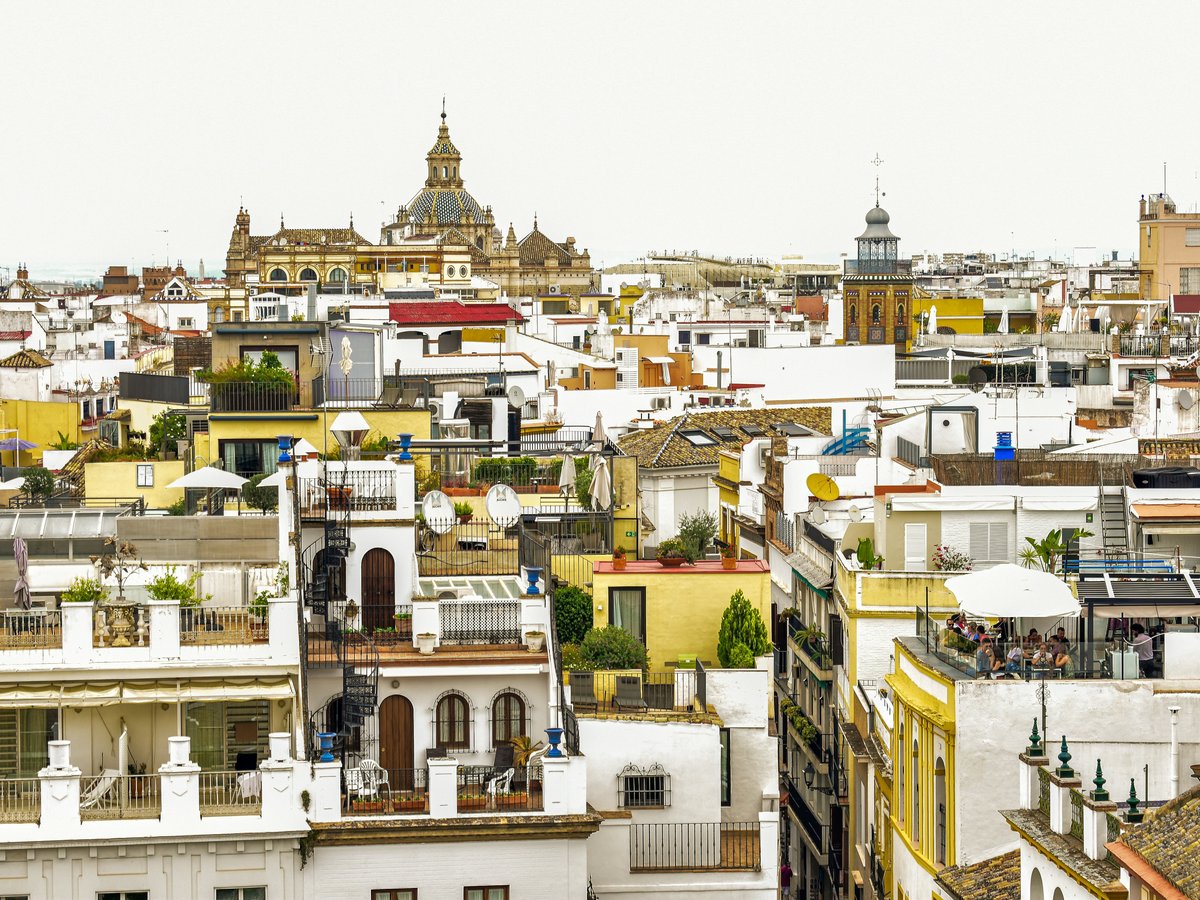
How do I get around Seville?
Walk. Seville's centro histórico is flat and compact, about 2.5 km from the Alameda de Hércules to Plaza de España. Beyond walking range, TUSSAM buses and the Sevici bike-share cover gaps at under 1.50 EUR per ride. Taxis run metered at roughly 0.90 EUR per kilometer. Bolt and Uber both operate but tend to match cab fares.
Book the connection
One search across trains, buses & flights: live times and prices for Seville.
Seville's old center sits on flat ground, and the walk from the Alameda de Hércules south through the Barrio de Santa Cruz to Plaza de España covers about 2.5 km. Wide sidewalks line Avenida de la Constitución, and most side streets get enough shade from the orange trees that the worst of the sun stays off your shoulders. The catch is heat. From June through September, afternoon temperatures regularly reach 40°C, and the stone underfoot holds that warmth well past sundown. You'll feel the pavement through your shoes by 14:00. Plan your walking for mornings before 11:00 and evenings after 19:30. Between those hours, step into the courtyards of the Reales Alcázares or find a bar in Triana for a cold tinto de verano at around 2.50 EUR and wait it out.
The Sevici bike-share system runs about 260 docking stations across the city with roughly 2,600 bikes. A 7-day subscription costs around 14 EUR, and the first 30 minutes of each trip are free. The dedicated lanes along the Guadalquivir toward the Expo '92 grounds and through Parque de María Luisa make cycling feel safe, with the river breeze cutting through the dry heat. Skip the bike in the Santa Cruz quarter, though. The alleys narrow to under 2 meters in places, and you'll spend more time walking the bike around pedestrians than riding it. The MetroCentro tram, Line T1, covers a short 2.2 km from Plaza Nueva past the Cathedral to San Bernardo rail station. A single ride costs 1.40 EUR with a contactless card. Mind you, the route is so short that walking it takes about 12 minutes.
TUSSAM buses handle anything beyond the old center. The C3 and C4 circular routes loop through the historic core and connect Triana, Macarena, and Nervión without transfers. A single ride is 1.40 EUR in cash, but the rechargeable tarjeta multiviaje drops that to about 0.69 EUR per trip. Buy the card at any estanco for 1.50 EUR and load 7 EUR for 10 rides. Taxis are white with a yellow diagonal stripe. The meter starts at roughly 1.35 EUR during the day and runs about 0.90 EUR per kilometer. A ride from Santa Justa station to the Cathedral area should read 6-8 EUR. Bolt and Uber both operate in Seville but tend to match or slightly beat metered taxi fares, so the advantage is mostly convenience after 02:00 when street hails dry up. Download Bolt before you arrive. It currently has better driver coverage in Seville than Uber.
Seville's Metro Line 1 opened in 2009 and runs 18 km through the southern suburbs. It is built for commuters, not visitors. No station sits inside the historic center, and the closest stop to the old town is Puerta de Jerez at the southern edge near Torre del Oro. Unless your hotel is in Nervión, near the Ramón Sánchez Pizjuán Stadium, you can likely ignore the metro for your entire trip. Worth noting, the horse-drawn carriages lined up outside the Cathedral charge 45-50 EUR for a 45-minute loop. You'll hear the drivers calling fares from half a block away. They are overpriced for what amounts to a slow circle past Plaza de España and back along the same streets. Walk the route in 25 minutes and stop for a caña at any bar along Calle Mateos Gago for about 1.50 EUR.
On-the-ground: metro available · ride-hail apps work.
Primary modes of transit
- Walking
- TUSSAM bus
- Sevici bike-share
- Taxi
- Bolt / Uber
- MetroCentro tram
Seville's network by the timetable
Read from the published timetables, not from memory: 0 operators, 0 routes and 17 stops within 13 km of the centre.
- Operators, by routes here
- Routes by mode
- Weekday service
- 05:08 to 24:26 (00:26 the next morning)
- Fares in the timetable
- not published
- Timetables valid
- not published
Read 2026-09-14, from one feed:
- Renfe commuter trains (Cercanias) (the operator's own national feed, Mobility Database source 2653). Licence
Popular connections from Seville
Lowest fares and fastest times for the most-booked departures, as observed on Omio in August 2025. Live prices vary.
Seville to Madrid
Check times & book on Omio →Mode Fare from Fastest Train Most booked from £13.00 2 h 42 min Bus from £23.49 6 h 20 min Flight from £18.07 1 h 5 min Seville to Granada
Check times & book on Omio →Mode Fare from Fastest Train from £20.46 2 h 32 min Bus Most booked from £16.47 3 h Flight from £153.70 4 h 55 min Seville to Málaga
Check times & book on Omio →Mode Fare from Fastest Train Most booked from £2.17 1 h 59 min Bus from £15.26 2 h 45 min Flight from £151.98 6 h 5 min Seville to Barcelona
Check times & book on Omio →Mode Fare from Fastest Train Most booked from £47.41 5 h 48 min Bus from £92.51 16 h Flight from £53.43 1 h 40 min Seville to Cádiz
Check times & book on Omio →Mode Fare from Fastest Train Most booked from £1.45 1 h 35 min Bus from £15.13 1 h 45 min Seville to Cordoba
Check times & book on Omio →Mode Fare from Fastest Train Most booked from £7.80 42 min Bus from £8.58 1 h 45 min
Ready to book the connection?
Compare trains, buses & flights to and around Seville on Omio: live times & prices in one search.
Compare on Omio →More transport questions
How do I get from the airport to Seville?
Take a fixed-fare taxi from San Pablo Airport (SVQ), 10 km northeast of central Seville. The regulated fare is around €23 daytime (roughly $26), and the ride to Santa Cruz or Triana takes 15-20 minutes. The EA airport bus runs every 20-30 minutes for €4 to Plaza de Armas and Santa Justa station.
Full answerHow do I get to Seville?
Seville's San Pablo Airport (SVQ) sits 10 km from the city center, with direct flights from London, Paris, Amsterdam, and Rome on Ryanair, Vueling, and easyJet. From North America, connect through Madrid or Lisbon. Spain's AVE high-speed train from Madrid reaches Seville Santa Justa station in 2 hours 30 minutes, often beating the connecting flight on price and convenience.
Full answerWhat are the best day trips from Seville?
Córdoba tops the list. The AVE high-speed train from Santa Justa reaches Córdoba in 45 minutes for €12-24 each way, and the Mezquita alone is worth the fare. Ronda's El Tajo gorge is more dramatic but needs a 2-hour bus ride each way. Cádiz adds an Atlantic beach day. Italica's Roman amphitheatre sits 9 km from Seville for a lazy half-day.
Full answerLast verified by automated review (v1.7.2) on . What is automated review?