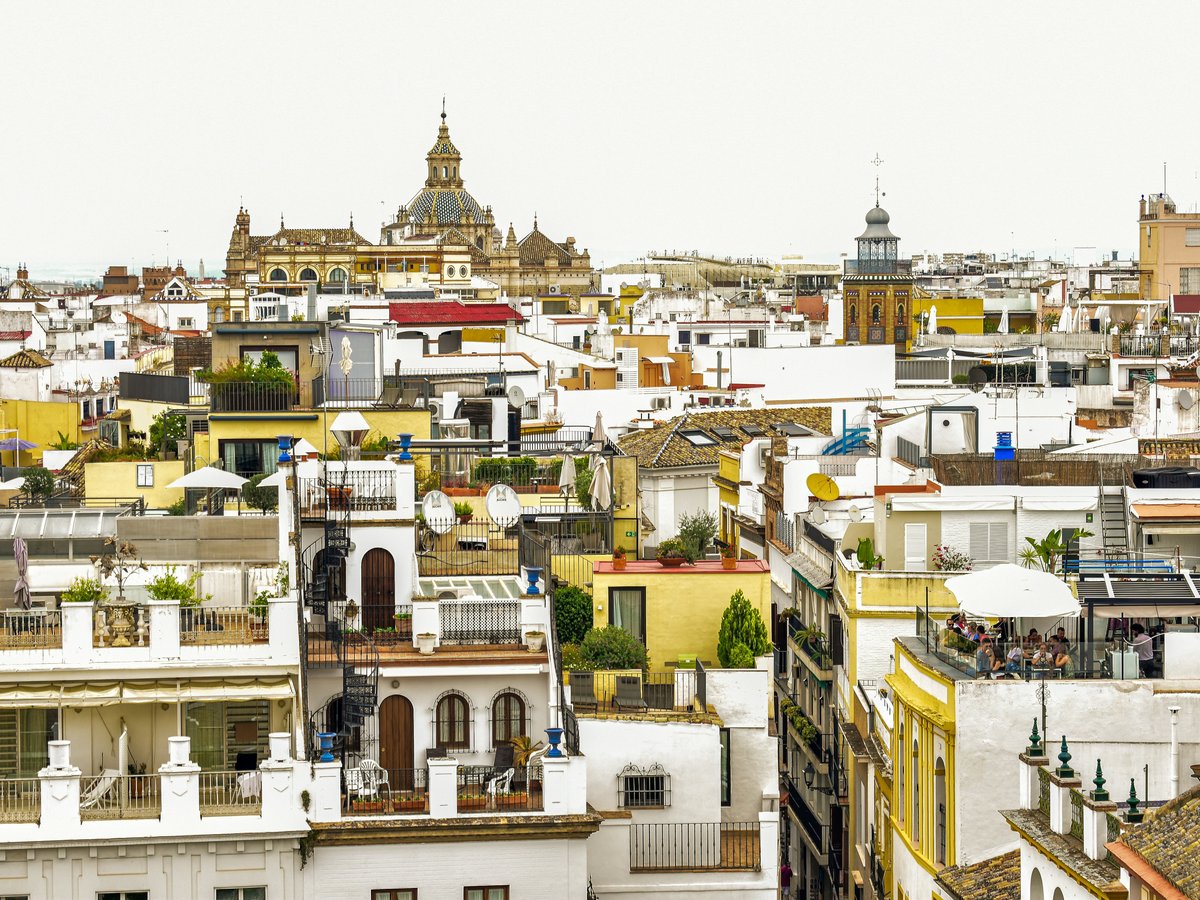
Best Time to Visit Seville, by Season
Seville's 37.8°C July peaks and 16.0°C January lows create two different cities across 12 months. This guide maps each month's weather against crowd pressure and pricing, then names the single best window for five kinds of traveller.
Published · Updated
1 January and February Average Below 19°C, and That Is Exactly Why Budget Travellers Should Book
The orange trees along Calle Sierpes still hold their fruit in January, and the morning air carries a clean mineral edge that sharpens the Giralda's profile against Seville's pale winter sky. January's average high reaches 16.0°C with lows around 7.0°C. For visitors arriving from London or Berlin, those numbers feel almost spring-like.
February warms to an average high of 18.8°C and a low of 8.5°C. That 2.8-degree rise from January is the sharpest month-over-month jump in Seville's cooler half. February afternoons at 18.8°C bring early-spring warmth to the Barrio de Santa Cruz. Sunlight pools between the whitewashed walls and warms the limestone underfoot.
The Real Alcázar, which can feel like rush-hour transit in April, has breathing room in January and February. The Catedral de Sevilla's nave feels cavernous rather than congested. Plaza de España, busy from March through October, empties enough in February to sit on the curved bench along its canal and watch the light move across the tile work. That seat is too cold in January at 16.0°C and impossible to claim in April at 24.2°C.
January's 7.0°C lows push dining indoors after sunset. May's lows, at 15.7°C, allow shirtsleeve evenings on a Triana terrace at 10 PM. February's 8.5°C lows still require layers once the sun drops.
The 1.4-degree gap between February's 18.8°C and March's 20.2°C is barely perceptible on a walking day. The gap in Seville's hotel pricing between those same two months tends to be much wider. February is the pick for budget travellers who want mild weather and near-empty landmarks. January at 16.0°C is the runner-up, suited to anyone who prefers solitude and does not mind the cooler ceiling. December's 16.6°C high offers similar warmth to January but falls in the holiday-travel window, which tends to push December pricing back up.
The 1.4-degree gap between February and March is barely perceptible. The gap in hotel pricing tends to be much wider.
2 March Warms to 20°C and Stays Quiet, but April's 24°C Brings Semana Santa and Peak Pricing
The scent of orange blossom thickens across Seville in March. The trees along the Guadalquivir are in full flower, and the air in the Barrio de Santa Cruz turns sweet and heavy by late afternoon. March averages a high of 20.2°C and a low of 10.1°C. You can walk from the Real Alcázar to the Puente de Isabel II and back without thinking about shade or heat.
April pushes higher. The average high reaches 24.2°C, with lows of 12.7°C. On paper, April in Seville looks ideal. In practice, April is when Seville's two largest events reshape the city. Semana Santa fills the streets with religious processions, candle wax, incense, and crowds that can make the old quarter impassable for hours. The Feria de Abril follows within weeks. April is Seville's highest-demand month, and hotel pricing reflects it.
The 4.0-degree gap between March's 20.2°C and April's 24.2°C is noticeable but not dramatic. Both months are comfortable for walking Seville on foot. What changes between March and April is the crowd pressure. March at 20.2°C still feels like shoulder season at the Real Alcázar. The Calle Sierpes has browsing pace rather than Semana Santa foot traffic. February's 18.8°C sits only 1.4 degrees below March, so the warming trend into spring is gentle.
A morning at the Real Alcázar in March at 20.2°C feels different from April at 24.2°C. The gardens are the same, but March allows you to linger in the sunlit courtyards of the Patio de las Doncellas without competing for space. April's Semana Santa weeks fill those same courtyards with tour groups.
Mind you, March is not empty. The 20.2°C weather draws early-season visitors from across Europe. But the scale differs from April's Semana Santa crowds. For travellers who want to see the processions, April is non-negotiable despite the premium. For everyone else, March delivers 20.2°C, moderate visitor numbers, and shoulder-season rates. October at 27.4°C offers warmer weather with fewer visitors but without the orange-blossom scent that makes March along Seville's Guadalquivir distinctive.
3 May at 28.9°C Is the Last Month You Can Walk Seville All Day Without Planning Around Heat
May mornings in Seville carry a specific warmth. The air reaches your forearms by 9 AM, and the shade beneath the trees along Avenida de la Constitución feels cool rather than cold. May's average high reaches 28.9°C. The average low sits at 15.7°C. These numbers mark a threshold in Seville's annual cycle.
Below 30°C, Seville remains a walking city. You leave your hotel at 10 AM, visit the Real Alcázar, cross the Puente de Isabel II into Triana, eat lunch, walk back for the Catedral de Sevilla, and still have energy for the evening along the Guadalquivir. June at 33.2°C changes that equation. The 4.3-degree jump from May to June is where Seville crosses from warm to restructure-your-day hot.
May's 15.7°C lows make evenings genuinely comfortable outdoors. Compare that to March, where 10.1°C lows mean reaching for a jacket at dinner, or January, where 7.0°C pushes dining indoors entirely. May sits below the June-through-September window, where nighttime lows range from 19.0°C in September to 22.5°C in August. But 15.7°C on a Triana terrace at 10 PM is warm enough for shirtsleeves.
The difference between May at 28.9°C and April at 24.2°C is 4.7 degrees. April is comfortable but carries peak-season pricing from Semana Santa and the Feria de Abril. May trades a few degrees of warmth for a significant drop in crowd pressure across Seville.
May is the pick for travellers who want warm Seville without the heat restructuring that June at 33.2°C demands. Late September at 31.2°C is the runner-up. September sits 2.3 degrees warmer than May but has passed the worst of July's 37.8°C and August's 37.3°C.
The 4.3-degree jump from May to June is where Seville crosses from warm to restructure-your-day hot.
4 June Through August Breaks 33°C, and Seville Becomes a Different City After 2 PM
Step outside the Catedral de Sevilla at 3 PM in late July and the heat hits like an open oven. The stone plaza radiates warmth from below. The air above Seville is dry and still and bright enough to make you squint. July's average high reaches 37.8°C, the hottest month in the record. August follows at 37.3°C. June opens the summer season at 33.2°C.
The nighttime lows matter as much as the highs in Seville's summer. July's average low sits at 22.2°C. August holds at 22.5°C, the warmest nighttime reading of any month. June's low of 19.6°C offers slightly more relief after dark. Between June and August, Seville does not truly cool off overnight.
The heat reshapes how you move through the city. Mornings before noon are the productive window for the Real Alcázar, the Catedral, and the Barrio de Santa Cruz. The hours between 2 PM and 6 PM belong to air-conditioned museums, siestas, or hotel pools. Seville comes alive again after 8 PM. Dinner at 10 PM on a Triana terrace is practical, not theatrical, when daytime highs hit 37°C. The Guadalquivir riverbank fills with people after dark. Families and groups from across the city settle onto benches and bar terraces once the temperature drops toward July's 22.2°C low.
To be fair, summer pricing in Seville tends to drop from April's 24.2°C Semana Santa peak. A hotel room at peak-season April rates might reach its annual low at July's 37.8°C. Fewer European tourists visit in July and August. Many Sevillanos themselves leave for the coast.
June at 33.2°C is the compromise month for anyone who wants summer atmosphere without July's full 37.8°C. June's 19.6°C low drops 2.6 degrees below July's 22.2°C, and those 2.6 degrees matter at midnight along the Guadalquivir. August at 37.3°C closely mirrors July and is the emptiest month in Seville, as many locals leave the city entirely.
5 September and October Deliver Spring Temperatures Without Spring Crowds
Early October evenings along Seville's Guadalquivir carry the smell of cooling stone and jasmine. July's 37.8°C burns these scents away, but October at 27.4°C lets them return. The copper light catches the water, and the Parque de María Luisa is quiet enough to hear gravel underfoot.
October's average high sits at 27.4°C, with lows of 16.8°C. May averages 28.9°C high and 15.7°C low. The 1.5-degree gap between those two months is barely perceptible on a walking day through the Barrio de Santa Cruz.
September runs warmer at a 31.2°C average high and a low of 19.0°C. Early September still carries echoes of summer heat. By late September, temperatures in Seville begin to approach October's profile. September's 31.2°C average reflects a mix of hot early weeks and comfortable later ones.
The October-to-May comparison is the key insight for planning a Seville trip. May at 28.9°C sits at the front edge of high season. It carries momentum from Semana Santa and the Feria. October at 27.4°C sits on the back edge of shoulder season, after the summer emptied the city. The 1.5-degree temperature difference is invisible on a walking day along the Triana riverfront. The difference in crowd density and Seville hotel pricing tends to be much wider.
October's 16.8°C lows keep evenings on Triana's terraces comfortable without the nighttime heat of July at 22.2°C or August at 22.5°C. You can eat outdoors at the Real Alcázar end of the city at 9 PM and feel pleasantly warm rather than overheated.
For heat-averse travellers who still want warm weather in Seville, October is the pick. The 27.4°C high allows comfortable outdoor exploration from morning into evening. September is the runner-up, particularly late September as the 31.2°C average begins to taper. November at 20.1°C drops 7.3 degrees below October and enters a different temperature tier entirely.
May averages 28.9°C at the front edge of high season. October averages 27.4°C at the back edge of shoulder season. The 1.5-degree gap is invisible on foot.
6 November Mirrors March at 20°C With None of March's Build Toward Peak Season
November rain in Seville sounds different from northern rain. It falls in brief, heavy bursts against tile and limestone, then stops. The streets of the Barrio de Santa Cruz dry fast, and the wet stone smells of earth and orange peel. November's average high reaches 20.1°C, with lows of 11.0°C. March averages 20.2°C and 10.1°C. The difference between these mirror months is 0.1 degrees on the highs and 0.9 degrees on the lows.
The similarity is striking, but the tourism trajectories in Seville run opposite. March is warming toward April's 24.2°C and Semana Santa crowds. November is cooling from October's 27.4°C toward December's 16.6°C. March sits on the demand upslope. November sits on the downslope. Pricing and availability in Seville follow the trajectory, not the day's thermometer reading.
November is likely Seville's most undervalued month. The 20.1°C high is comfortable for all-day walking along the Guadalquivir, through the Real Alcázar gardens, and across the Puente de Isabel II into Triana. The Catedral de Sevilla is accessible without the spring-season booking pressure that builds from March's 20.2°C onward through April's 24.2°C peak.
December drops to a 16.6°C high and an 8.3°C low. That 3.5-degree fall from November to December is the sharpest cooling step in Seville's transition from autumn to winter. December's 16.6°C still matches January's 16.0°C for walkable daytime conditions, but the holiday-travel window typically lifts December pricing above November's.
November is the pick for the traveller who looked at March's 20.2°C and liked the temperature but not the building crowd momentum. December at 16.6°C is the runner-up for anyone who prefers cooler weather and does not mind shorter days. November at 20.1°C remains the last month above 20°C before Seville drops to 16.6°C in December and 16.0°C in January.
7 The Best Window for Five Kinds of Traveller, Named and Defended
The Giralda catches morning sun differently in every season. In February it glows pale gold against grey cloud. In July it stands blinding white against deep blue. Which version of Seville you want depends on what you value most.
The budget traveller should visit Seville in February. The average high of 18.8°C and low of 8.5°C are cool but walkable. February sits before the spring price escalation, and the gap to March's 20.2°C is only 1.4 degrees. January at 16.0°C is cheaper still but meaningfully cooler.
The heat-averse traveller should visit in October. The 27.4°C average high and 16.8°C low mirror May's comfort range without May's proximity to Seville's peak season. November at 20.1°C is the runner-up for anyone who prefers genuinely mild over warm, with near-identical weather to March at 20.2°C.
The culture traveller who wants Semana Santa should visit Seville in April and accept the 24.2°C heat along with the crowds and the premium pricing. No other month offers this experience. The Feria de Abril follows Semana Santa within weeks, so April delivers both of Seville's signature spring festivals.
The summer-night traveller should visit in June. The 33.2°C average high sits 4.6 degrees below July's 37.8°C, and June's 19.6°C low allows some evening relief on the Triana riverfront. July and August at 37.8°C and 37.3°C suit committed heat-lovers who want Seville at its emptiest and cheapest.
The all-around traveller who wants the single best month should visit Seville in May. The 28.9°C high sits below June's 33.2°C heat threshold. The 15.7°C low keeps evenings warm on the Guadalquivir terraces. Semana Santa and Feria crowds have passed. Seville has not shifted to its summer siesta rhythm. May is not the cheapest month or the quietest, but it offers the best overlap of walkable heat, long daylight, and moderate crowd density in Seville. October at 27.4°C is the closest runner-up, particularly for travellers who prefer 1.5 fewer degrees and shoulder-season pricing.
May is not the cheapest month or the quietest, but it offers the best overlap of walkable heat, long daylight, and moderate crowd density in Seville.
Last verified by automated review (v1.7.0_onboard-seville-flagship-2026-06-19) on . What is automated review?