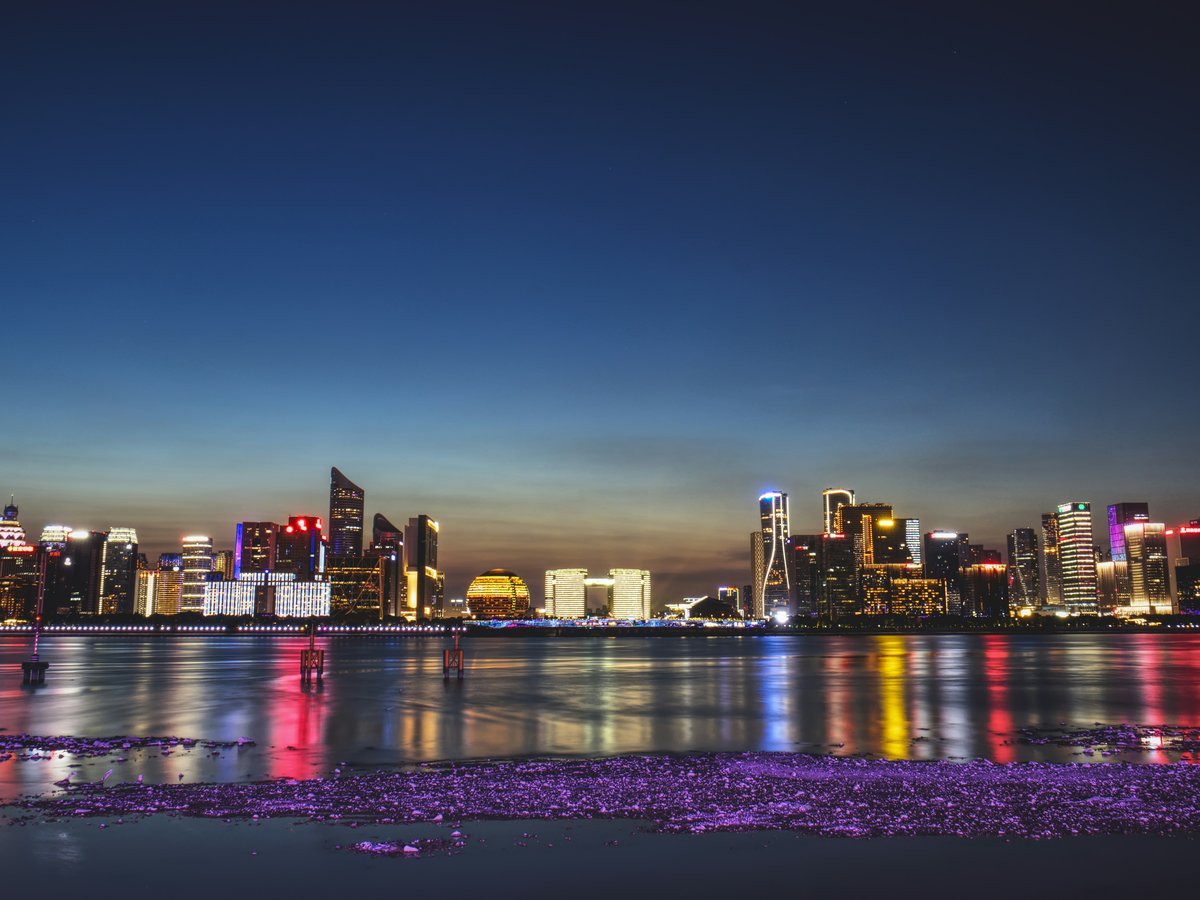
Stay in Hangzhou in August
94 hotels in the Trip.com pool for Hangzhou, from US$13 a night.
Opens Trip.com on Fri 6 Aug to Sun 8 Aug 2027; change the dates there.
August is the hottest month of the year in Hangzhou, and the city earns every degree of its reputation as one of eastern China's summer furnaces. Daily highs average 34.7°C (94°F) with humidity sitting around 74%, producing a thick, sticky heat that settles into the basin formed by the hills surrounding West Lake. You feel it immediately. The air barely moves in Shangcheng's narrow lanes, and the pavement along Nanshan Road radiates warmth well past sundown. On the worst afternoons, temperatures can push above 38°C (100°F), and the locals have a word for it. They call Hangzhou one of the 'four stoves' of the Yangtze Delta, and in August, you understand why.
This is also peak domestic tourism season. Chinese schools let out in early July, and families from Shanghai, Nanjing, and across Zhejiang province crowd into West Lake's causeways, Lingyin Temple's courtyards, and Hefang Street's souvenir shops through late August. Hotel rates in the Xihu district typically run 20-30% above the autumn average. The tradeoff for enduring the heat and crowds is genuine, though. Lotus blooms cover the inner basins of West Lake at their fullest, particularly around Qu Yuan Feng He, where the pink-and-white displays peak in early-to-mid August. The tea hillsides around Longjing Village are deep green and largely tourist-free on weekday mornings. And summer-only dishes like chilled lotus root salad and mung bean tangshui appear at restaurants across the Gongshu and Wulin districts.
If your dates are flexible, October and November are Hangzhou's best months by a wide margin. Cool air, spectacular foliage around the lake, and thinner crowds. If August is your window, structure your days around early mornings and evenings. The stretch between 11:00 and 15:00 is genuinely difficult outdoors, and every local you meet will confirm that.
Why visit in August
- West Lake's lotus blooms reach their fullest in early-to-mid August at Qu Yuan Feng He, with over 100 varieties on display across the Ten-Li Lotus area.
- Summer produce season brings Zhejiang white peaches, fresh lotus seeds, and water shield (莼菜) to markets and restaurants across the city.
- Extended daylight, with sunset around 18:45, gives you long evenings for West Lake boat rides and walks along the Su Causeway without midday heat.
- Typhoon-disrupted weekdays can empty West Lake of domestic tour groups entirely, giving you the rare experience of the causeways at half capacity.
Worth knowing
- Average highs of 34.7°C (94°F) with 74% humidity make midday outdoor sightseeing genuinely uncomfortable, and occasional spikes above 38°C (100°F) push into dangerous territory.
- Peak domestic tourism season fills the Su and Bai causeways, Lingyin Temple, and Hefang Street with dense crowds, particularly on weekends and around Qixi Festival.
- Afternoon thunderstorms hit roughly every other day, with 182mm of total rainfall across 16 rainy days. The storms are brief but intense.
- Hotel rates in Shangcheng and the Xihu district run 20-30% above shoulder-season averages, with availability tight on weekends.
Best for
Think twice if
Hangzhou's August is the hottest month of the year. The basin geography traps warm, humid air between the hills west and south of West Lake. Mornings typically start around 26°C (79°F) with thick humidity, and temperatures climb steadily through the morning to an average high of 34.7°C (94°F). Afternoon thunderstorms roll in roughly every other day, dropping heavy rain for 20-40 minutes before clearing. The storms cool the air temporarily, but humidity tends to spike right after. Evenings remain warm, rarely dropping below 26°C until well after midnight. On heat-wave days, which occur several times each August, the mercury can reach 38-40°C (100-104°F).
Seasonal caution
- Extreme heat days exceeding 38°C (100°F) occur several times in a typical August, sometimes in multi-day stretches. The Hangzhou Meteorological Bureau issues orange or red heat warnings when this happens. Limit outdoor activity to before 09:00 and after 17:00 on these days.
- Typhoon season runs July through September along the Zhejiang coast. While Hangzhou sits 170km inland from Ningbo, peripheral typhoon bands can bring 24-48 hours of continuous heavy rain, flooding low-lying areas around the Grand Canal in Gongshu. Flights at Hangzhou Xiaoshan International Airport (HGH) may be delayed or cancelled.
- Afternoon thunderstorms can produce brief but intense downpours with limited visibility. Lightning is common over the lake area during these cells.
Year-round climate
Averages from the last 5 years.
| Month | Avg high (°C) | Avg low (°C) | Rainfall (mm) |
|---|---|---|---|
| Jan | 11 | 1 | 51 |
| Feb | 12 | 3 | 100 |
| Mar | 18 | 8 | 116 |
| Apr | 23 | 13 | 121 |
| May | 27 | 17 | 162 |
| Jun | 29 | 22 | 341 |
| Jul | 34 | 26 | 196 |
| Aug | 35 | 26 | 182 |
| Sep | 30 | 23 | 149 |
| Oct | 24 | 16 | 65 |
| Nov | 19 | 10 | 71 |
| Dec | 12 | 3 | 29 |
Best things to do in August
Sunrise lotus photography at Qu Yuan Feng He
photographyThe Ten-Li Lotus area at Qu Yuan Feng He holds over 100 lotus varieties across connected ponds on West Lake's western shore. Arrive by 05:30 to catch the blooms opening in soft golden light, with mist still clinging to the water surface. The pink-and-white flowers against the dark green pads photograph best before 07:00, when the harsh overhead sun hasn't yet flattened the contrast.
Peak lotus bloom occurs in the first two weeks of August. By September, the flowers begin dropping petals.Booking tipNo reservation needed, but the Qu Yuan Feng He park gates open at 06:00. The southern entrance near the Yang Gong Causeway is less crowded than the main north gate.
Night cruise on West Lake
sightseeingElectric boats circle the inner lake on a 45-minute route that passes the Three Pools Mirroring the Moon (三潭印月) and the illuminated Leifeng Pagoda. The water is calm in the evenings, and the pagoda's golden lighting reflects off the surface. The temperature drops to around 28-29°C on the water, which in August feels genuinely pleasant compared to the daytime heat on shore.
August's extended daylight means the 19:00 departure catches the sunset transition, and the heat makes evening activities far more appealing than daytime ones.Booking tipBuy tickets at the Hubin or Yue Fei Temple docks. Weekend evenings sell out by late afternoon in August, so purchase early in the day.
Xixi National Wetland Park morning walk
natureXixi Wetland covers 11.5 square kilometers of waterways, reed beds, and persimmon groves west of the city center. The wooden boardwalks wind through dense vegetation that provides shade even in August. You'll hear cicadas, frogs, and the occasional kingfisher. The humidity here is thick, but the shade and water lower the perceived temperature by several degrees compared to the exposed lakeside.
Summer is peak biodiversity season in the wetland. Water lilies bloom across the channels, and egrets and herons are active at the fish ponds in early morning.Booking tipEnter through the less-visited Wenhui Road gate on the wetland's south side. The main Zhoujiacun entrance draws the tour bus crowds.
Tea village walk at Longjing
cultureThe hillsides above Longjing Village are terraced with Dragonwell tea plants, deep green and lush in August. The path from Longjing Village up to Shi Feng (狮峰山) takes about 40 minutes and passes through the original Dragonwell tea gardens. Weekday mornings are quiet. The tea houses in the village serve summer-harvested tea, which is less prized than the spring Mingqian picking but still fresh and grassy.
The hills are at their greenest, and the summer crop means tea houses are actively processing leaves. You might catch the faint roasted-chestnut scent of tea being wok-fired as you walk through the village.Booking tipStart the walk before 08:00 to avoid both heat and crowds. The trail has exposed sections with no shade above 300 meters.
Escape the heat at the China National Silk Museum
cultureOne of the better-designed museums in Hangzhou, covering 5,000 years of Chinese silk production with original looms, Silk Road artifacts, and contemporary textile art. The building is fully air-conditioned, which alone makes it attractive in August. Located on Yuhuangshan Road near the southern end of West Lake, it rarely draws the dense crowds of Lingyin Temple or Hefang Street.
August's midday heat makes outdoor sightseeing impractical from 11:00 to 15:00. This museum fills that gap with genuinely interesting exhibits in a cool building.Booking tipFree admission. Weekday mornings are the emptiest. The hands-on weaving demonstrations typically run at set times, posted at the entrance.
Wushan Night Market food crawl
foodWushan Night Market sits on the hill behind Hefang Street and sprawls down the slope with stalls selling stinky tofu, grilled squid, scallion pancakes, and chilled desserts. The smell of frying oil and fermented tofu hits you from the top of the steps. In August, the market extends its hours past 22:00, and the temperature drops enough by 20:00 to make the walk pleasant. The crowd is almost entirely local.
Summer night markets run extended hours, and the heat pushes Hangzhou's evening food culture into full swing. Chilled mung bean soup, iced plum juice, and cold noodle dishes are summer-only additions to the stall menus.Booking tipNo booking needed. Come after 20:00 for the fullest selection and the most tolerable temperatures.
Grand Canal heritage walk in Gongshu
cultureThe Hangzhou section of the Grand Canal runs through the Gongshu district past the Gongchen Bridge (拱宸桥), a 98-meter stone arch bridge dating to 1631. The canal-side promenade passes the China Knife and Scissors Museum, the China Umbrella Museum, and the China Fan Museum, all clustered within 500 meters. The old canal warehouses have been converted to cafés and small galleries. This area sees a fraction of West Lake's tourist traffic.
The Grand Canal museums are air-conditioned and free, making them ideal midday stops. The canal promenade has mature plane trees that provide continuous shade, unlike the exposed West Lake causeways.Booking tipTake Metro Line 5 to Shangtang Road station. The walk from Gongchen Bridge south along the canal takes about 90 minutes at a slow pace.
What to eat in August
In season: fruit
Zhejiang white peach (水蜜桃)
Fenghua and Ningbo peaches arrive at Hangzhou's fruit stalls in August at peak ripeness. The flesh is almost translucently white, intensely fragrant, and so juicy that eating one without a napkin is a losing proposition. Vendors at the Sijiqing Wholesale Market in Xihu district sell them by the crate.
On menus now
Chilled lotus root salad (凉拌藕片)
Lotus root harvested from the ponds around West Lake hits peak season in August. Restaurants across Shangcheng serve it thinly sliced, blanched, and dressed with rice vinegar, sesame oil, and a scatter of osmanthus. The texture is crisp, almost like a firm water chestnut, and the dish serves as a cooling starter in the heat.
West Lake water shield soup (西湖莼菜汤)
Water shield (莼菜) is a slippery, gelatinous aquatic plant harvested from ponds near Xixi Wetland Park. It peaks in the summer months. The soup pairs it with shredded chicken or ham in a clear broth. The texture is unusual, almost like very soft seaweed, and the taste is mild, letting the broth carry the flavor.
What to drink
Mung bean soup (绿豆汤)
The standard summer coolant across Hangzhou. Street vendors and small restaurants serve it chilled, sometimes with lotus seeds or lily bulbs mixed in. The flavor is mild and slightly sweet. Locals drink it daily through August to counter the internal heat that traditional Chinese medicine associates with the season.
In markets
Fresh lotus seeds (鲜莲子)
Sold still in the pod at markets along Zhongshan South Road and near the Wushan Night Market area. You crack the green casing to get to the white seed inside, which is slightly sweet and starchy when raw. Street sellers also offer them steamed with rock sugar as an afternoon snack.
Regular events in August
Qixi Festival (七夕节)Free
The Chinese Valentine's Day falls in early-to-mid August (7th day of the 7th lunar month). West Lake's Broken Bridge (断桥), tied to the legend of the White Snake, becomes a gathering point for couples. Restaurants around the lake run special set menus, and boat operators on the lake stay open later than usual. The Leifeng Pagoda area draws particular crowds given its connection to the same folk tale.
Early-to-mid August (lunar calendar dependent)West Lake Lotus FestivalFree
Not a single-day event but a rolling celebration through July and August. The Hangzhou West Lake Scenic Area management sets up viewing platforms around Qu Yuan Feng He and the inner lotus basins. Photography exhibitions and lotus-themed cultural displays appear at venues around the northern lakeshore. Morning boat tours to the lotus areas run on extended schedules.
July through late AugustHangzhou Night Market SeasonFree
Summer extends the operating hours of Wushan Night Market and the stalls along Hefang Street. Both stay open well past 22:00 through August. The Wulin Night Market near Wulin Square also hits peak activity, with food vendors, clothing stalls, and crowds that thin out only after 23:00.
Nightly through AugustBest places this August
Qu Yuan Feng He (曲院风荷)
parkThe premier lotus viewing spot on West Lake's northwest shore. Over 100 lotus varieties bloom across interconnected ponds, peaking in the first half of August. The name translates to 'Breeze-Ruffled Lotus at Winding Courtyard.' The raised boardwalks bring you close enough to the blooms to smell the faint sweetness the flowers give off in morning humidity.
XihuLingyin Temple (灵隐寺)
templeOne of China's largest and most historically significant Buddhist temples, founded in 328 AD. The Feilai Feng cliff face holds over 300 stone carvings dating from the 10th to 14th centuries. August crowds are heavy, particularly around the main Hall of the Great Hero. The forested hillside provides welcome shade, and the temperature inside the temple complex tends to run a few degrees cooler than the open lakeside.
XihuXixi National Wetland Park (西溪国家湿地公园)
natureAn 11.5 square kilometer wetland preserve west of the city center with boat routes, boardwalks, and reed-lined channels. Summer brings peak water lily and lotus blooms to the waterways. The dense vegetation and water reduce the perceived temperature noticeably compared to the city. Egrets, herons, and kingfishers are active at the fish ponds through August mornings.
XihuLongjing Village (龙井村)
cultural villageThe origin village of Dragonwell tea, set in terraced hillsides southwest of West Lake. August is between the prized spring and autumn harvests, but the gardens are at their most visually lush. Tea houses in the village serve fresh summer pickings. The walk up toward Shi Feng passes through shade-dappled paths before opening to hilltop views over the lake basin.
XihuLeifeng Pagoda (雷峰塔)
landmarkReconstructed in 2002 on the site of the original 10th-century pagoda on the south shore of West Lake. The interior has escalators to the top, which is air-conditioned. The viewing platform at the summit offers the best elevated panorama of West Lake, the causeways, and the surrounding hills. The view is particularly good at sunset in August, when the light turns the lake amber.
XihuGongchen Bridge and Grand Canal promenade
historic siteThe 98-meter Gongchen Bridge, built in 1631, marks the southern terminus of the Beijing-Hangzhou Grand Canal. The promenade south from the bridge runs past converted canal warehouses now holding cafes and galleries, and three free museums (knife and scissors, umbrellas, fans) clustered within 500 meters. Far fewer tourists than the West Lake area.
GongshuHefang Street (河坊街)
historic streetA pedestrianized historical street running east from Wushan Square. The eastern end near Zhongshan South Road holds traditional Chinese medicine shops, tea houses, and the Huqingyu Tang pharmacy museum. The western end skews toward tourist souvenirs. Crowded on August weekends, but the narrow street provides shade from the buildings on either side. The side alleys are quieter and hold smaller, more interesting shops.
Shangcheng
Your packing checklist
Tick items off as you pack. Your progress saves in this browser.
All packed — have a great trip.
Insider tips
The air-conditioned Metro is the best way to move between West Lake (Longxiangqiao station, Line 1) and the Grand Canal museums (Shangtang Road station, Line 5). The ride takes about 20 minutes and spares you the 35°C surface walk.
Locals escape the heat at the underground shopping complexes beneath Wulin Square and Yan'an Road. The temperature inside stays around 24°C, and the food courts in the basement levels serve better lunch options than the tourist restaurants on Hefang Street.
The West Lake Musical Fountain near Hubin Road runs evening shows at 19:30 and 20:30 through August. The 19:30 show draws larger crowds. The 20:30 showing has the same program with more room to stand along the railing.
Convenience stores (FamilyMart, Lawson, and the local chain Kedi) sell frozen drinks and cheap portable ice packs that locals press against their necks while walking. The stores along Nanshan Road and Beishan Road are the closest to the main West Lake walking routes.
If a typhoon warning goes up during your visit, the West Lake scenic area closes its boat services and some lakeside paths. Use the downtime for the Grand Canal museums in Gongshu or the Zhejiang Provincial Museum near Solitary Hill, both of which stay open during storms.
The Manjuelong Road (满觉陇路) area south of West Lake is lined with small cafés and guesthouses set into the hillside. It is noticeably cooler than the lakefront due to elevation and tree cover, and sees almost no tour group traffic even in peak August.
Avoid these mistakes
- Attempting a full West Lake circuit walk (roughly 10-12 km) in midday August heat. The causeways have almost no shade, and the combination of 34°C heat and 74% humidity has caused heatstroke cases among tourists. Split the walk across two early mornings instead.
- Visiting Lingyin Temple on a weekend morning without arriving before 08:00. Tour buses from Shanghai begin arriving around 09:00 in August, and by 10:00 the courtyards are packed. Weekday visits or very early weekend arrivals avoid the worst of it.
- Skipping sunscreen because of overcast skies. Hangzhou's August cloud cover is often thin, and the UV index can reach 7-8 even when the sky looks gray. Sunburn through clouds catches visitors off guard.
- Relying only on the West Lake area for dining. The restaurants immediately around the lake skew toward tourist pricing and quality. Gongshu district along the Grand Canal and the residential blocks east of Zhongshan South Road have better food at local prices.
- Not carrying cash for small vendors at Wushan Night Market and street food stalls. While Alipay and WeChat Pay dominate, some smaller stalls still prefer cash, and foreign cards cannot link to these apps without a Chinese bank account.
Practical tips for August
Book accommodation in the Xihu or Shangcheng districts at least 2-3 weeks ahead for August stays, especially for weekend arrivals. Properties with West Lake views sell out earliest. Air conditioning is standard in all hotels but worth confirming in budget guesthouses. Structure your days around the heat, with outdoor activities before 09:00 and after 17:00, and museums, malls, or tea houses filling the midday gap. The Hangzhou Metro runs until around 22:30 on most lines and covers West Lake, the Grand Canal, and the train stations. Download Amap (高德地图) for navigation, as Google Maps is unreliable in China. Carry a portable umbrella at all times for the near-daily afternoon storms. If you are visiting Lingyin Temple, go on a weekday morning. For West Lake boat rides, buy tickets before 16:00 to guarantee a spot on the evening departures. Tap water is not drinkable, but bottled water is available at every convenience store and most hotels provide complimentary bottles and a hot water kettle.
FAQ
Is August a good time to visit Hangzhou?
August is one of the more challenging months. The heat averages 34.7°C with 74% humidity, domestic tourist crowds are at their peak due to summer school holidays, and afternoon thunderstorms hit roughly every other day. That said, the lotus blooms on West Lake peak in early August and are genuinely spectacular, summer produce is excellent, and the city has enough air-conditioned museums and evening activities to fill a 3-4 day visit comfortably. It ranks around 10th out of 12 months. October and November are far more comfortable if your dates are flexible.
What should I wear in Hangzhou in August?
Lightweight, loose-fitting clothes in moisture-wicking fabrics. Cotton absorbs sweat and stays damp, which gets uncomfortable fast in 74% humidity. Breathable shoes are important since you will be walking on warm pavement. Bring a hat for sun protection, and carry a compact umbrella for both shade and the daily afternoon rain. You will not need any warm layers at any point. Evening temperatures rarely drop below 26°C.
How crowded is West Lake in August?
Very crowded, especially on weekends and around the Qixi Festival (Chinese Valentine's Day, early-to-mid August). The Bai Causeway and Su Causeway see dense foot traffic from about 09:00 onward. The Broken Bridge (断桥) area is particularly packed during Qixi. Early mornings before 07:00 and weekdays are significantly quieter. The northern and western shores of the lake tend to draw fewer visitors than the eastern Hubin waterfront.
Does Hangzhou get typhoons in August?
Hangzhou sits about 170km inland from the coast near Ningbo, so it rarely takes a direct hit. However, peripheral typhoon bands from storms making landfall along the Zhejiang or Fujian coast can bring 24-48 hours of sustained heavy rain and strong winds. This happens once or twice in a typical August. Flights at Xiaoshan Airport (HGH) may be delayed or cancelled. The upside is that typhoon weather clears the tourist crowds from West Lake, and temperatures drop noticeably during the rain.
What is the best way to get around Hangzhou in August?
The Metro is the most comfortable option in the heat. Line 1 connects the main train station (Chengzhan) to the West Lake area (Longxiangqiao and Fengqi Road stations), and Line 5 reaches the Grand Canal museums. Taxis and ride-hailing through Didi are easy to find but require either a Chinese phone number or cash. Public bikes are available through Alipay but are impractical in midday August heat. Walking is best confined to early morning and evening hours.
Find a flight to Hangzhou
Live fares to Hangzhou appear here once cookies are accepted.
Last verified by automated review (v1.7.2) on . What is automated review?