Hangzhou dropped all entrance fees around West Lake in 2002, opening the lake's 6.39 square kilometers of water surface and surrounding parkland at no cost. Tourism spending in the Lakeside commercial district rose sharply enough that other Chinese cities studied the model for years. Zhejiang Provincial Museum, the China National Silk Museum, and the China National Tea Museum all followed with permanent free admission. Liangzhu Museum, 18 kilometers northwest of central Hangzhou, covers a 5,000-year-old archaeological civilization and also charges nothing. West Lake earned UNESCO World Heritage cultural landscape status in 2011. The Grand Canal corridor through Hangzhou was inscribed in 2014. You can fill 3 or 4 full days walking the Su and Bai causeways, hiking Baoshi Mountain for panoramic lake views, and browsing major collections without spending a yuan on entry fees. For a city that reportedly draws over 100 million visits per year, the proportion of marquee attractions accessible without a ticket remains remarkably high.
Free attractions
-
West Lake (Xi Hu / 西湖)
The entire lake area has been free since Hangzhou's government removed all surrounding entrance fees in 2002. The shoreline circuit runs about 15 kilometers. Morning mist on the water in October feels nothing like the 35°C humidity of July, and both seasons draw crowds for different reasons. Three islands sit in the lake. Two of them, Xiaoyingzhou and Ruangong Islet, require a paid boat ride at 55 RMB. But Broken Bridge, the Bai Causeway, the northern and eastern promenades, and every lakeside pavilion cost nothing. The Ten Scenes of West Lake, a set of named views dating to the Southern Song dynasty in the 13th century, are all visible from the free shoreline paths. That said, some of the most photographed angles require patience on weekends, when the Bai Causeway functions more as a slow shuffle than a stroll.
West Lake DistrictLake / UNESCO World Heritage Site -
Zhejiang Provincial Museum, Gushan Branch (浙江省博物馆孤山馆区)
The Gushan branch sits on a small peninsula reaching into West Lake's northern shore. Its collection covers 7,000 years of Zhejiang history, from Hemudu neolithic artifacts to Yue Kingdom bronzes to Southern Song celadons. The Celadon Gallery alone holds over 200 pieces from the Longquan kilns. Free admission year-round, closed Mondays. You need to reserve a time slot through the museum's WeChat mini-program, which can be tricky without a Chinese phone number. Worth asking your hotel front desk to book for you. The Gushan building dates to the 1920s, and the grounds blend into the surrounding park, where magnolia trees add a thick, sweet scent in April.
Gushan, West LakeMuseum -
China National Silk Museum (中国丝绸博物馆)
The museum stands on Yuhuangshan Road near the southeastern corner of West Lake. It opened in 1992 and holds what is likely the largest silk-specific collection in the world. Permanent galleries trace silk production from 5,000-year-old Liangzhu textile fragments to Tang dynasty brocades to modern Hangzhou manufacturing techniques. A working loom demonstration runs most afternoons. The smell of old wood and dye in the historical loom room tends to stay with you. Free admission year-round, closed Mondays. The building was renovated in 2016, and the air-conditioned galleries make a solid retreat on a 38°C August afternoon.
Yuhuangshan Road, West Lake DistrictMuseum -
China National Tea Museum (中国茶叶博物馆)
The museum sits in the Longjing tea-growing hills, about 3 kilometers southwest of West Lake, surrounded by active tea plantations. The main campus covers Chinese tea history across 5 permanent exhibition halls. During the April and May harvest season, you can watch Longjing tea processing demonstrations on site. The grounds alone are worth the walk. Neat rows of tea bushes climb the hillsides, and the damp, vegetal smell of fresh leaves hangs in the air during spring picking. Free admission year-round, closed Mondays. A second branch opened more recently near Manjuelong and tends to be considerably quieter.
Longjing / ShuangfengMuseum -
Liangzhu Museum (良渚博物院)
About 18 kilometers northwest of central Hangzhou, this museum documents the Liangzhu civilization, which flourished from roughly 3300 to 2300 BCE. The site earned UNESCO World Heritage status in 2019. The building, designed by David Chipperfield, is striking. Four long blocks of smooth travertine arranged across a landscaped wetland. The jade collection is the centerpiece, particularly the cong tubes and bi discs that influenced Chinese ritual art for millennia afterward. Free admission with advance reservation through their WeChat account. Closed Mondays. Budget 2 to 3 hours. Mind you, the adjacent Liangzhu Archaeological Site Park is a separate venue and charges 60 RMB.
Liangzhu, Yuhang DistrictMuseum / UNESCO World Heritage Site -
Prince Bay Park (Taiziwan Gongyuan / 太子湾公园)
The park sits at the southwestern edge of West Lake between Su Causeway and Nanshan Road. It covers about 15 hectares and draws enormous crowds in late March and April, when roughly 300,000 tulip bulbs bloom in coordinated beds. The display rivals Keukenhof in sheer volume, and it costs nothing. Outside tulip season, the park quiets down considerably. Winding paths follow a stream fed from the Longjing hills, and camphor trees shade the grounds through Hangzhou's humid summers. The park stays open 24 hours and tends to be especially peaceful before 7 AM. It is named after two Southern Song princes who were reportedly buried nearby.
Nanshan Road, West Lake DistrictPark -
Flower Harbor Park (Huagang Guanyu / 花港观鱼)
One of the original Ten Scenes of West Lake, Flower Harbor Park covers about 20 hectares near the southern end of Su Causeway. The name translates loosely to Viewing Fish at Flower Harbor. The main attraction is a large koi pond where hundreds of red and gold carp cluster near the surface, particularly when visitors toss food. Cherry and peach blossoms frame the pond in early April. The park connects directly to Su Causeway's southern end, making it a natural first or last stop on a lakeside walk. Free admission, open daily year-round.
Su Causeway South, West LakePark / West Lake Scenic Site -
Baoshi Mountain and Baochu Pagoda (宝石山 / 保俶塔)
Baoshi Mountain rises about 78 meters above the northern shore of West Lake. The trail to the summit takes roughly 20 to 30 minutes at a moderate pace. Baochu Pagoda, a slender stone tower originally built in 963 CE during the Five Dynasties period, stands at the top. The current structure dates from a 1933 reconstruction. You cannot enter the pagoda itself, but the 360-degree view from the summit platform covers the entire lake, Hangzhou's skyline to the east, and the tea hills to the southwest. Sunrise from Baoshi is a local tradition worth the early alarm. The trail starts near the intersection of Beishan Road and Baoshi Road. Free, open at all hours.
Beishan Road, West Lake NorthViewpoint / Historic Site -
Nine Creeks and Eighteen Gullies (Jiuxi Shiba Jian / 九溪十八涧)
A forested valley trail about 6 kilometers south of West Lake, running between Longjing Village and the Qiantang River. The full walk covers roughly 5 to 6 kilometers one way, crossing shallow streams 9 times along a flagstone path. During summer, the water barely reaches ankle height in most spots, and locals wade through rather than bother with the stepping stones. The canopy of camphor, maple, and bamboo keeps temperatures 3 to 5 degrees cooler than Hangzhou's city center. In late November, the maple leaves turn the valley red and gold. Free, no gates or tickets. The Longjing end is reachable by bus 27 from central Hangzhou.
Xihu District, south of LongjingNature Walk / Valley Trail -
Wind Lotus at Quyuan (Quyuan Fenghe / 曲院风荷)
Another of the Ten Scenes of West Lake, Quyuan Fenghe occupies the northwestern lakeside between Su Causeway and the Yue Fei Temple area. The name refers to lotus flowers bending in the wind. From late June through August, the pond surfaces fill with pink and white lotus blooms. The fragrance is strongest before 8 AM. Several zigzag bridges cross directly through the lotus fields, putting you close enough to smell the flowers at eye level. A small section near the entrance features a Song dynasty-style wine distillery courtyard, referencing the area's historical use for imperial wine production. Free, open daily.
Beishan Road, West Lake NorthwestPark / West Lake Scenic Site -
West Lake Museum (杭州西湖博物总馆)
The museum stands on Nanshan Road near the southeastern shore of West Lake. It focuses specifically on the lake's cultural and ecological history. Exhibits cover the lake's geological formation, the engineering of its causeways under Bai Juyi in the 9th century and Su Dongpo in the 11th, and the literary traditions West Lake inspired. The building is partially underground, with a glass wall offering direct views of the lake from the lower galleries. Smaller and less crowded than Zhejiang Provincial Museum, it tends to take about an hour. Free admission year-round, closed Mondays.
Nanshan Road, West Lake DistrictMuseum -
Grand Canal Heritage Corridor, Gongchen Bridge Area (京杭大运河拱宸桥段)
Gongchen Bridge, a triple-arched stone bridge originally built during the Ming dynasty, marks the southern terminus of the Grand Canal's Hangzhou section. The surrounding Qiaoxi Historic Block has been restored into a walkable canal-side district with old warehouses, narrow lanes, and three small free museums. The China Knife, Scissors, and Sword Museum, the China Umbrella Museum, and the China Fan Museum all sit within a 500-meter radius and charge no admission. The canal towpath stretches several kilometers north from the bridge. Early evening is the best time, when the stone bridge catches warm light and the canal barge traffic picks up.
Gongshu DistrictHeritage Site / Canal Walk
Free activities
-
Su Causeway and Bai Causeway Walk (苏堤 / 白堤)
Su Causeway runs 2.8 kilometers north-south through West Lake, connecting Nanshan Road to the northern shore. Bai Causeway extends about 1 kilometer from Broken Bridge (Duanqiao) to Gushan Island. Walking both in sequence takes roughly 90 minutes without stops. Su Causeway is lined with weeping willows and peach trees that bloom in late March. Early morning, roughly 6 to 7 AM, is when local tai chi groups claim the benches and the light on the water tends to be softest. Weekends after 10 AM get crowded enough that the causeway slows to a shuffle. Worth noting, the Six Bridges of Su Causeway each frame a slightly different view of the surrounding hills.
West LakeWalking Route -
Hefang Street and Qinghefang Ancient Street (河坊街 / 清河坊)
A pedestrianized street running east from Wushan Square toward the old city center. The main stretch covers about 460 meters. It functions as a market and heritage district. You can browse traditional Chinese medicine shops, watch sugar painting artisans spin caramel into animal shapes on marble slabs, and sample Hangzhou snacks at open-front stalls. Huqingyu Tang, a traditional pharmacy founded in 1874, still operates from its original building at the eastern end. Browsing costs nothing. Eating does, though a sesame flatbread or cong you bing from a street vendor typically runs 5 to 10 RMB. Evening visits after 6 PM bring out more food vendors and a thicker smell of grilled skewers and fried dough.
Shangcheng DistrictMarket / Historic Street -
Longjing Tea Village Walk (龙井村步道)
A walking route through the Longjing tea-producing area southwest of West Lake. The path from the China National Tea Museum to Longjing Village proper covers about 3 kilometers, mostly on paved lanes between terraced tea fields. The green rows of bushes against red-earth hillside are at their most vivid in April during the Mingqian harvest, before the Qingming festival. Local farmers pick the top two leaves and a bud by hand. In spring you can watch the hand-firing process in open-sided workshops, where the air smells roasted and vegetal. Tea tasting at village homes is technically free, though there is social pressure to buy at least a small bag, usually 50 to 200 RMB. Buses K27 and 87 reach the area from central Hangzhou.
Longjing, Xihu DistrictWalking Route / Cultural Experience -
Gushan Island and Xiling Seal Society Walk (孤山 / 西泠印社)
Gushan, or Solitary Hill, is a low island connected to the northern shore of West Lake by Bai Causeway and Xiling Bridge. Zhongshan Park occupies its eastern slope and was originally the site of a Qing dynasty imperial traveling palace. The park is small but layered with old trees, carved stone paths, and pavilions overlooking the water. The Xiling Seal Society, founded in 1904 and dedicated to traditional Chinese seal carving, sits on Gushan's southern face. Its hillside campus of stone pavilions and inscribed steles is free to enter and rarely crowded. The whole Gushan circuit takes about 45 minutes and connects naturally to the Zhejiang Provincial Museum at its northern end.
Gushan, West Lake NorthWalking Route / Island Park -
Grand Canal Towpath, Gongchen Bridge North (拱宸桥以北运河步道)
The restored towpath along the Grand Canal's Hangzhou section runs north from Gongchen Bridge toward the ancient water town of Tangqi, about 20 kilometers one way. Most visitors cover the first 3 to 5 kilometers, which pass through Gongshu District's old industrial waterfront. Brick warehouses and converted canal-side buildings line the western bank. To be fair, the water is not particularly clean. The canal remains a working waterway, and barge traffic still moves through regularly. The towpath is flat and partially shaded, suitable for walking or cycling. Hangzhou's shared bike services have docking stations near Gongchen Bridge.
Gongshu DistrictWalking Route / Heritage Trail -
Qiantang River South Bank Promenade (钱塘江南岸滨江步道)
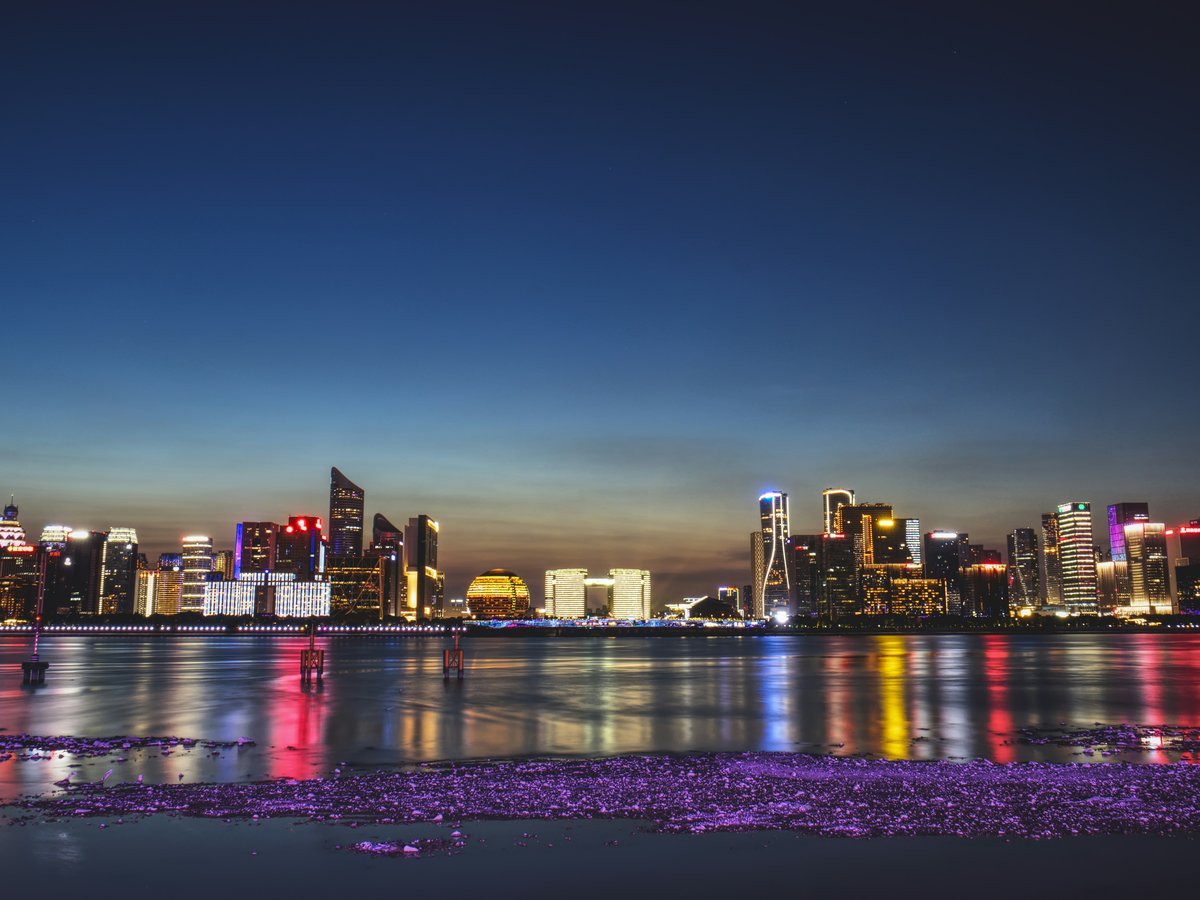
The Binjiang promenade runs along the south bank of the Qiantang River through Hangzhou's newer Binjiang District. It stretches for several kilometers with wide paved paths, public exercise stations, and unobstructed views of the Hangzhou skyline across the water. The promenade is used mostly by joggers and cyclists rather than tourists, which keeps it quiet even on weekends. Near the Fuxing Bridge area, you get a clear sightline toward the Qianjiang New City CBD towers. Evening views of the lit skyline reflected in the river are particularly good from this angle. Free and open at all hours. Metro Line 1 to Jiangling Road station puts you within a 10-minute walk.
Binjiang DistrictPromenade / Scenic Walk
Free events
-
West Lake Music Fountain (西湖音乐喷泉)
Nightly, approximately May through OctoberA synchronized water-and-light show on the lake surface near the Lakeside (Hubin) commercial area. The jets reportedly reach up to 40 meters at peak. The show runs multiple times per evening during warmer months, typically from around May through October. Crowds gather along the Hubin Road waterfront about 30 minutes before showtime to claim good sightlines. The exact schedule and song selection shift seasonally, so it is worth checking the Hangzhou tourism WeChat account for current times. Completely free from the lakeside promenade. The mist from the jets drifts over the nearest rows of spectators on breezy nights.
West Lake, Lakeside (Hubin) commercial area -
Qiantang River Tidal Bore (钱塘江大潮)
Annual peak around 18th of 8th lunar month (September or October); smaller bores visible monthlyOne of the largest tidal bores in the world. The wave can reach 3 to 4 meters in height during peak conditions. The strongest bore occurs around the 18th day of the 8th month in the Chinese lunar calendar, which usually falls in September or October. The sound arrives before the wave. A low roar builds for several minutes before the wall of water rounds the river bend. Primary viewing spots include Yanguan town, about 50 kilometers northeast of central Hangzhou, and several points along the Qiantang River within the city. Free from public banks and designated viewing areas. Yanguan gets extremely crowded on peak days, so city-side spots near the Binjiang promenade are less dramatic but more accessible.
Qiantang River, various public viewing points -
Prince Bay Park Tulip Display (太子湾公园郁金香展)
Late March to mid-April annuallyEvery spring, roughly late March through mid-April, Prince Bay Park fills with approximately 300,000 tulip bulbs across its 15-hectare grounds. Cherry blossoms in the park tend to peak around the same 2-week window. The combination draws enormous crowds. Weekend mornings can see queues at the park entrance, not for tickets but for pedestrian flow management. Weekday mornings before 9 AM are noticeably calmer. The tulip bed varieties rotate each year, so the color palette shifts from season to season. No admission charge at any point.
Prince Bay Park (太子湾公园), Nanshan Road -
Lotus Season at Quyuan Fenghe (曲院风荷荷花季)
Late June through August annuallyThe lotus ponds at Quyuan Fenghe reach full bloom from late June through August. Hundreds of lotus and water lily varieties fill the ponds, and the park sets up labeled displays identifying species during peak weeks. Early morning visits before 8 AM catch the flowers at their most open and the sweet, faintly peppery fragrance at its strongest. The zigzag wooden bridges through the lotus fields are the best vantage points. Free to enter throughout the season. By September the lotus seedpods replace the flowers, which has its own austere appeal.
Quyuan Fenghe (曲院风荷), West Lake Northwest -
Gongchen Bridge Canal Evenings (拱宸桥运河夜景)
Weekend evenings, approximately May through OctoberThe area around Gongchen Bridge and the Qiaoxi Historic Block draws informal evening activity on warm-weather nights, particularly on weekends from roughly May through October. Vendors set up along the canal towpath with snacks, handicrafts, and secondhand goods. The scale varies since this is not a formally organized festival. Browsing is free. Canal-side seating fills up quickly in summer. The crowd skews local, with more Hangzhou residents than tourists. The restored warehouse facades and bridge arches under warm lighting make the canal corridor photogenic after sunset.
Gongchen Bridge area, Gongshu District
What Looks Free But Is Not
A few prominent Hangzhou attractions sit close to the free West Lake zone but charge their own admission. Leifeng Pagoda, the reconstructed tower on the southern shore, costs 40 RMB. Lingyin Temple, one of the largest Buddhist temples in China, requires a 30 RMB ticket for the Feilai Feng scenic area and an additional 45 RMB for the temple grounds. The boat ride to Xiaoyingzhou island, where the Three Pools Mirroring the Moon motif from the 1 RMB banknote is located, runs 55 RMB per person. Xixi National Wetland Park, about 5 kilometers west of the lake, charges 80 RMB for its main scenic zone. Yue Fei Temple (Yue Wang Miao), on the northwest shore of West Lake, charges 25 RMB. The Liangzhu Archaeological Site Park, adjacent to the free Liangzhu Museum, is 60 RMB. All of these sit within walking distance of free areas, so it helps to know which gates have ticket booths before you walk up to them.
Free Transport and Getting Around Cheaply
Hangzhou's metro system currently has 12 lines and reaches the main tourist areas. A single ride costs 2 to 8 RMB depending on distance, which is not free but close to negligible. The city was one of the first in China to launch a large-scale public bike-sharing program, back in 2008. The original program offered the first 60 minutes free, though that policy has changed. Shared bikes from Hellobike and Meituan currently cost about 1.5 RMB per 15 minutes. For genuinely free movement, the West Lake loop and surrounding parks are compact enough to walk. The Lakeside commercial area to Su Causeway is about 2 kilometers. Baoshi Mountain to the China National Tea Museum via Beishan Road and Lingyin Road covers about 4 kilometers on foot. Most of the free attractions cluster within a 5-kilometer radius of the lake, so a full day of walking typically covers 12 to 18 kilometers.
Seasonal Timing for Free Activities
Hangzhou's climate is subtropical, and the season you visit significantly affects which free activities are comfortable. Spring, from late March through May, is the consensus best window. Temperatures range from 15 to 25 degrees Celsius, the tulips peak at Prince Bay Park, and the Longjing tea harvest begins in early April. Summer, June through August, brings temperatures above 35 degrees with heavy humidity. The lotus season at Quyuan Fenghe compensates somewhat, and Nine Creeks offers natural cooling under its forest canopy. Autumn, September through November, has mild weather and what many consider the best West Lake photography light. The tidal bore peaks in September or October. Maple leaves at Nine Creeks turn in late November. Winter, December through February, drops to 2 to 8 degrees with occasional freezing rain. West Lake under light snow is a classical Chinese aesthetic tradition, part of the Ten Scenes as Broken Bridge Remnant Snow, but comfort levels vary considerably. All the free museums provide climate-controlled alternatives on extreme days.
FAQ
Is West Lake in Hangzhou really completely free to visit?
Yes. Hangzhou removed all entrance fees around West Lake in 2002, and the policy has held since. The entire lakeshore, both causeways, all lakeside parks including Flower Harbor and Quyuan Fenghe, and the public pavilions are free. Specific structures within the scenic area do charge separately. Leifeng Pagoda is 40 RMB, Yue Fei Temple is 25 RMB, and the boat to Xiaoyingzhou island is 55 RMB. But the lake itself and the walking paths around it cost nothing at any time of day or year.
Do I need reservations for free museums in Hangzhou?
Most free museums in Hangzhou currently require advance reservations through their WeChat mini-programs. Zhejiang Provincial Museum, the China National Silk Museum, and Liangzhu Museum all use this system. The reservation process is typically in Chinese, which can be a barrier for foreign visitors without a Chinese phone number. A practical workaround is to ask your hotel reception to make the booking. Walking up without a reservation on a weekday morning sometimes works when capacity is not full, but it is not guaranteed. Bring your passport or ID for entry.
What is the best time of year for free activities in Hangzhou?
Late March through early May offers the widest range of comfortable free activities. The tulips peak at Prince Bay Park, the Longjing tea harvest starts, and daytime temperatures sit around 18 to 25 degrees Celsius. October and November are also strong, with mild weather, the tidal bore, and autumn foliage at Nine Creeks. July and August bring temperatures above 35 degrees with high humidity, which limits outdoor comfort but opens lotus season at Quyuan Fenghe. Winter visits cool down to 2 to 8 degrees, though the rare West Lake snowfall is considered one of the classical views.
Can I visit Hangzhou's free attractions without speaking Chinese?
Most major museums have English signage in their permanent exhibitions. Zhejiang Provincial Museum and Liangzhu Museum both offer English audio guides, sometimes for a small fee of 10 to 20 RMB. The West Lake scenic area has bilingual signs at major viewpoints. Language becomes more difficult with the reservation systems, which are mostly WeChat-based and in Chinese, on local buses outside the metro, and at smaller sites like the Xiling Seal Society. Translation apps handle most situations. Hangzhou hosted the 2023 Asian Games, and transit signage was upgraded to include English throughout the metro system as part of that preparation.
How many days do I need to cover all the free attractions in Hangzhou?
A thorough visit to the free attractions here takes 3 to 4 full days. Day 1 might cover the West Lake circuit, both causeways, Flower Harbor Park, and Baoshi Mountain. Day 2 could focus on the Longjing tea area and the Nine Creeks valley trail. Day 3 works for the Grand Canal corridor, the three free museums near Gongchen Bridge, and Hefang Street. A 4th day allows for Liangzhu Museum, which needs a half-day round trip, or for revisiting West Lake at sunrise or in evening light. Compressing into 2 days is possible but means skipping either the tea hills or the canal district entirely.
Are there free beaches or swimming spots in Hangzhou?
Hangzhou is not a coastal city, so there are no ocean beaches. Swimming in West Lake is officially prohibited, though you might see locals doing it near the Beishan Road shoreline early in the morning. The Qiantang River is not safe for swimming due to the tidal bore and strong currents. Nine Creeks has shallow stream crossings where people wade ankle-deep in summer, but it is more of a cooling-off spot than a swimming area. For actual swimming, public pools in Hangzhou typically charge 20 to 40 RMB per session. The nearest sandy beaches are on the Zhoushan Islands, roughly 200 kilometers east by car and ferry.
Last verified by automated review (v1.7.2) on . What is automated review?