Hangzhou stretches along the north bank of the Qiantang River, with West Lake sitting slightly west of center like an anchor pulling the whole city toward it. The oldest neighborhoods fan out from the lake's eastern and southern shores, while the modern business district, Qianjiang New City, sits about 5 kilometers east near the river. Across the Qiantang to the south, Binjiang has grown into a tech corridor that barely existed 15 years ago. The Grand Canal threads through Gongshu district in the north, connecting Hangzhou to its deeper history as a Song Dynasty capital. Most visitors plant themselves near West Lake and never cross the river, which is fair enough. But the residential neighborhoods a few metro stops out tend to offer better food, lower hotel rates, and a more honest picture of how 12 million people live here. The metro system currently runs 12 lines, so getting around rarely takes more than 30 minutes. Worth noting, Hangzhou was one of the first Chinese cities to go nearly cashless. You'll want Alipay loaded on your phone before you land.
Neighborhoods
-
Hubin (湖滨)
The eastern shore of West Lake, where the lakeside promenade meets the city grid. Plane trees line the walkways, and on weekday mornings the fog sits low enough that Baochu Pagoda on the north shore disappears entirely. By evening, the pedestrian strip along Hubin Road fills with families and couples. It feels unhurried for a district this central. The buildings are kept to around 6 stories here, a deliberate planning choice from the early 2000s that preserves sightlines to the surrounding hills.
- Best for
- First-time visitors, couples, anyone who wants West Lake at their doorstep without needing transit
- Key streets
- Hubin Road pedestrian zone runs the full eastern shore. Nanshan Road heads south toward Leifeng Pagoda and gets quieter past the Jingci Temple turnoff. Pinghai Road connects east to Wulin and has mid-range restaurants and the Intime department store.
-
Wushan / Hefang Street (吴山/河坊街)
South of the lake, Wushan Hill rises about 90 meters and gives you the best overhead view of the old city rooflines without paying for anything. Hefang Street runs east-west at its base, a pedestrian commercial street that dates to the Southern Song period, roughly 1138 onward. The eastern end is packed with souvenir stalls selling silk fans and Longjing tea of questionable origin. Mind you, the western end near Zhongshan Middle Road is calmer, with a traditional Chinese medicine museum and the Huqingyu Tang pharmacy, which has operated from that building since 1874. The air here smells like roasted chestnuts in autumn and osmanthus in late September.
- Best for
- History-focused travelers, families with older kids, budget stays in guesthouses along the smaller lanes
- Key streets
- Hefang Street itself, but also the narrower Dajing Lane running parallel to the south. Zhongshan Middle Road has some of Hangzhou's remaining Republican-era storefronts. Wushan Road climbs to the hilltop park.
-
Longjing Village / Meijiawu (龙井村/梅家坞)
West of the lake, the hills are terraced with tea bushes up to about 300 meters elevation. Longjing Village is the more famous of the two, smaller, and tends to fill with tour buses by mid-morning from March to May during picking season. Meijiawu sits in the next valley south and remains more of a working tea-farming settlement. The air is noticeably cooler here, maybe 3 to 4 degrees below the city center in summer. Paths between the villages wind through bamboo groves where the light filters green. It is quiet enough to hear cicadas clearly in July.
- Best for
- Tea enthusiasts, hikers, anyone escaping the summer heat, couples who want a rural feel 20 minutes from downtown
- Key streets
- Longjing Road winds up from the lake through the China National Tea Museum to the village. Meilingbei Road connects to Meijiawu. The walking path between the two villages takes about 45 minutes and passes through forest with no vehicle traffic.
-
Wulin / Yan'an Road (武林/延安路)
This is Hangzhou's commercial spine. Yan'an Road runs north-south from the lake to Wulin Square, and the blocks around the square hold the Tower department store, Hangzhou Theatre, and the highest foot traffic in the city. It is loud, dense with neon after dark, and smells like scallion pancakes and grilled squid from the street vendors along Tiyuchang Road. The architecture is a jumble. Soviet-influenced department stores from the 1960s sit next to glass-curtain towers from the 2010s. Not pretty, but honest. Wulin Square itself is a concrete expanse that fills with dancing aunties after 7pm most evenings.
- Best for
- Shoppers, business travelers, anyone who wants maximum restaurant density and metro connectivity
- Key streets
- Yan'an Road for retail. Tiyuchang Road (Stadium Road) runs east off Yan'an and has a concentration of Hangzhou-style restaurants. Fengqi Road intersects and heads east toward the canal district. Wulin Square anchors the north end.
-
Qianjiang New City / CBD (钱江新城)
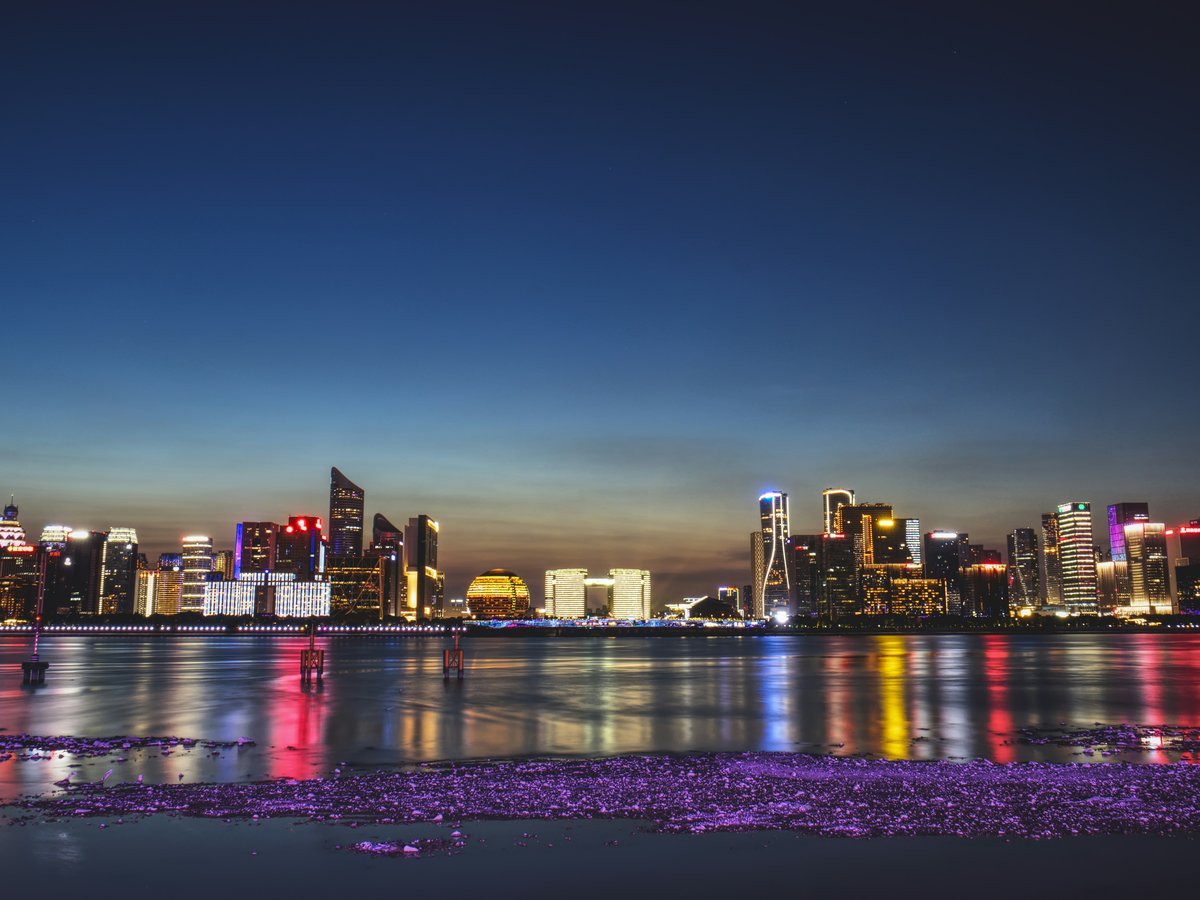
East of the old city, built on what was largely farmland until the mid-2000s. The Hangzhou Grand Theatre, shaped like a crescent moon, sits near the riverfront. The Civic Center's light show runs on the Qiantang River facades nightly at 7pm, 8pm, and 9pm during peak season. The scale is deliberately imposing. Wide boulevards, 200-meter towers, corporate lobbies in polished stone. It feels empty on weekends, which is a fair criticism. That said, the riverfront park along Qiantang River stretches about 3 kilometers and fills with runners at sunrise. Restaurants here lean toward hotel dining and chains. You will pay 150 to 300 yuan per person for a decent meal.
- Best for
- Business travelers, visitors who prefer modern hotels with international brands, anyone attending events at the Grand Theatre or conference centers
- Key streets
- Fuchun Road is the main east-west axis. Qianchao Road follows the river. Jianghui Road has the newer office towers and a few decent Cantonese restaurants near the Raffles City mall.
-
Gongshu / Grand Canal (拱墅/大运河)
The Grand Canal enters Hangzhou from the north, and the Gongshu stretch around Gongchen Bridge is where the canal-side warehouses have been converted into cafes and galleries since the UNESCO inscription in 2014. The China Knife, Scissors, and Fan Museum sits in a renovated workshop near the bridge. That is not a joke, it is genuinely interesting, and free to enter. The neighborhood north of the bridge retains its residential character. Wet markets open at 5am, mahjong tiles clatter from teahouses in the afternoon, and laundry hangs across alley lines between 1950s housing blocks. The canal water is brown and slow-moving. It smells faintly mineral on humid days.
- Best for
- Repeat visitors to Hangzhou, travelers interested in canal heritage, anyone looking for residential pricing (hotels here run 200 to 400 yuan per night versus 600 to 1200 near the lake)
- Key streets
- Xiaohezhi Street follows the canal and has the densest cluster of renovated canal-side buildings. Daguan Road runs north-south through the district center. Huzhou Street near the Gongchen Bridge metro stop (Line 1) has everyday noodle shops and fruit vendors.
-
Binjiang (滨江)
Across the Qiantang River from the old city, Binjiang is where Alibaba, NetEase, and Hikvision built their campuses. The district went from rice paddies to a tech hub in roughly 20 years. Buildings are new, streets are wide, and the population skews young. Lunch spots around the tech campuses serve 15 to 25 yuan set meals to office workers, and the quality tends to be high because competition is fierce. The riverfront on this side has a 6-kilometer cycling path, and the views back toward the old city skyline are better from here than from any paid observation deck. Traffic noise is constant. There is no pretending otherwise.
- Best for
- Tech workers, budget-conscious travelers who do not mind being a 15-minute metro ride from West Lake, joggers and cyclists
- Key streets
- Jianghui Road near the Alibaba campus. Xixing Road has local Zhejiang restaurants and a few craft beer bars that opened around 2022. Wensan Road's extension into Binjiang has milk tea shops every 30 meters, which seems excessive but accurately reflects demand.
-
Xixi Wetland Area (西溪湿地)
About 5 kilometers west of Wulin Square, Xixi is one of the few urban wetlands left in eastern China. The park covers roughly 11 square kilometers, and the residential neighborhoods around its eastern and southern edges feel suburban by Hangzhou standards. Low-rise apartments from the 2000s, tree-lined sidewalks, less honking. The wetland itself smells like damp earth and pond reeds, especially in the early morning when mist sits on the water. Persimmon trees line the internal paths, and in November the fruit hangs orange against grey skies. Boat rides through the interior waterways cost 60 yuan and last about an hour.
- Best for
- Families with young children, nature-focused travelers, anyone staying longer than 3 days who wants a quieter base
- Key streets
- Wenyi West Road marks the wetland's southern boundary and has cafes and convenience stores. Wuchang Avenue connects east to the city center. Zijingang Road near Zhejiang University's new campus has student-priced restaurants, most main dishes 12 to 20 yuan.
FAQ
Which Hangzhou neighborhood is best for a first visit of 3 to 4 days?
Hubin on the east shore of West Lake puts you within walking distance of the lake, Hefang Street, and the Wulin shopping district. Hotels here range from 400 to 1500 yuan per night. You can reach the Grand Canal, Longjing Village, and Xixi Wetland within 30 minutes by metro or taxi. Most of the city's major sights are in a 5-kilometer radius from the Hubin area, which makes it practical as a base even if you plan day trips to Lingyin Temple or the tea villages.
Is it worth staying across the Qiantang River in Binjiang?
If your budget is under 300 yuan per night, Binjiang has newer hotel stock at lower rates than anything near West Lake. The Line 1 metro crosses the river in about 12 minutes to Longxiang Bridge station near the lake. You lose the walkability to West Lake, but the riverside path on the Binjiang side is better for running and cycling. Evening food options around the tech campuses are solid and cheap, typically 20 to 40 yuan for a full meal. For trips under 3 days, the commute time probably is not worth it. For a week or longer, the savings add up.
How does Hangzhou's metro work for getting between neighborhoods?
Hangzhou Metro currently operates 12 lines with over 300 stations. Fares run 2 to 10 yuan based on distance. Alipay's transport QR code works at all turnstiles, so you do not need a physical card. Line 1 connects Xiaoshan Airport to the city center and crosses the river to Binjiang. Line 2 reaches Liangzhu in the northwest. For West Lake to the Grand Canal area, Line 1 from Longxiang Bridge to Fengqi Road takes 3 stops, about 6 minutes. Trains run from roughly 6am to 10:30pm, with some variation by line. Weekend services on the main lines sometimes extend to 11pm.
When is the best time of year to visit Hangzhou?
Late March through mid-April brings the Longjing tea harvest and cherry blossoms around Taiziwan Park. Temperatures sit between 12 and 22 degrees Celsius. Autumn, specifically late October through November, has clear skies and the osmanthus bloom that scents the entire lakeside. Summer, June through August, reaches 35 to 40 degrees with heavy humidity. West Lake is miserable at midday in July. Winter is mild by northern China standards, around 2 to 8 degrees in January, but the damp cold penetrates in a way that dry-cold Beijing at minus 10 somehow does not.
Are there neighborhoods to avoid in Hangzhou?
Hangzhou is broadly safe. The Chengzhan area around the main train station tends to be chaotic and overpriced for food, which is common for Chinese rail station districts. Xiaoshan's older industrial zones south of the river have limited appeal for visitors. Some budget hotels near the Jiubao area in the far east are cheap for a reason, with long commutes and few restaurants. None of these areas are dangerous, they are simply inconvenient and lack the character that makes the central and western neighborhoods worth exploring.
Last verified by automated review (v1.7.2) on . What is automated review?