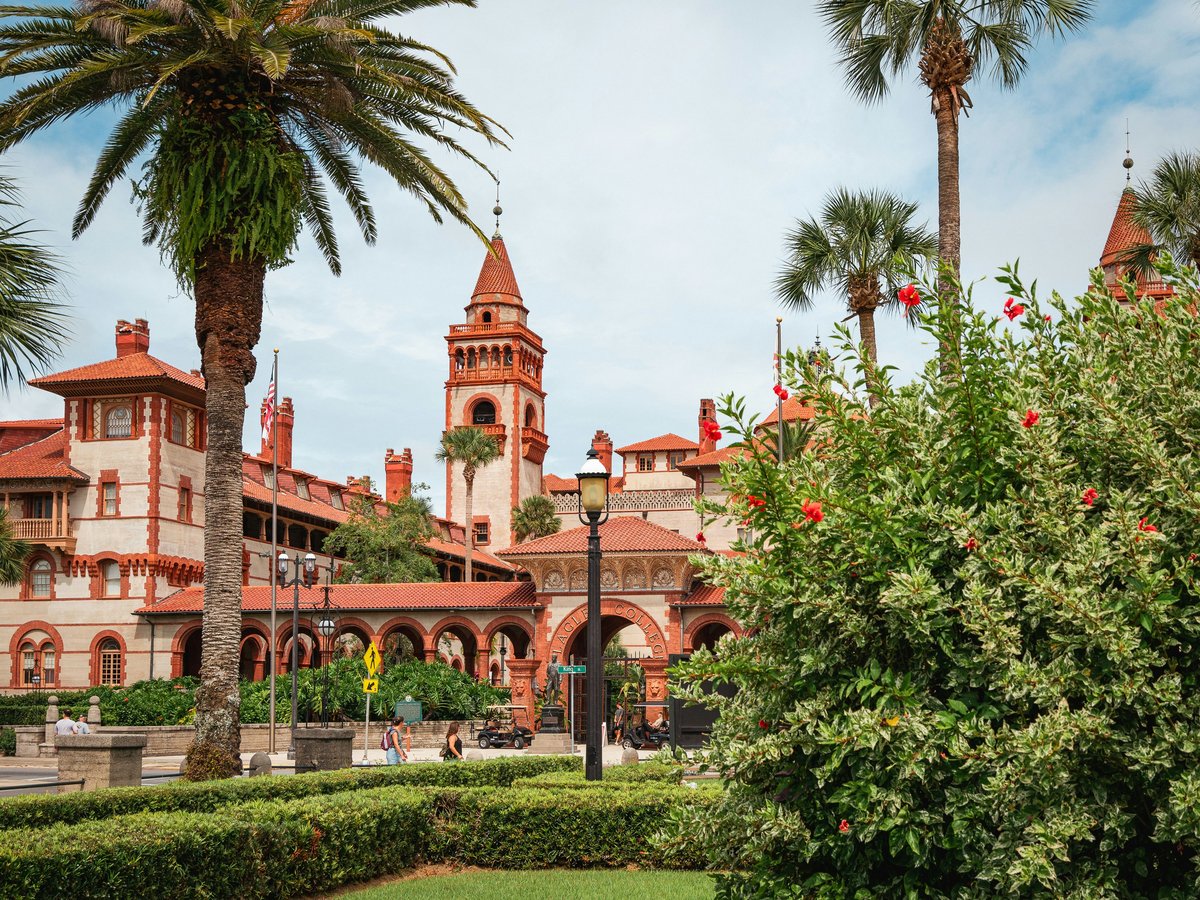
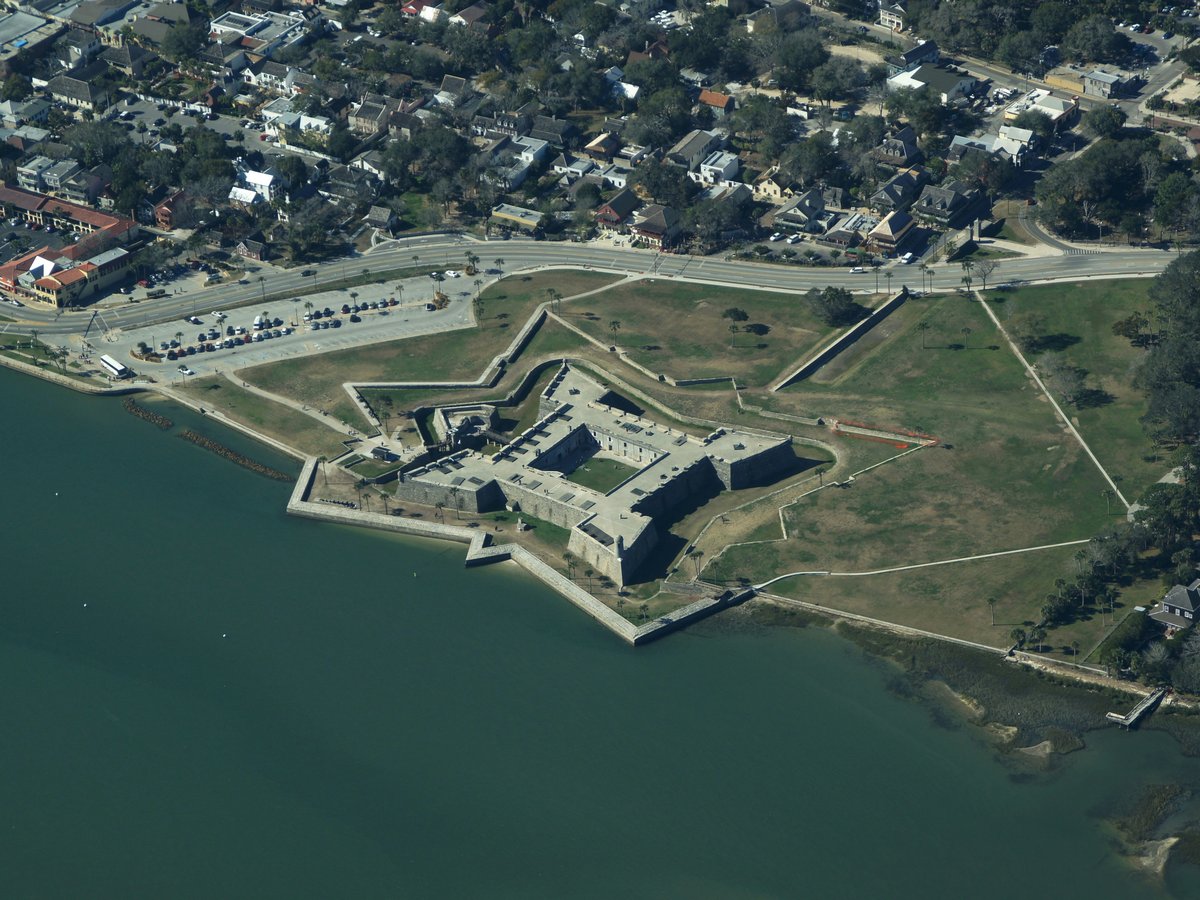
St. Augustine was founded in 1565 by Pedro Menéndez de Avilés, fifty-five years before the Pilgrims reached Plymouth, and the city has never stopped reminding visitors of that fact. The Castillo de San Marcos, a coquina fortress completed in 1695, still stands at the edge of Matanzas Bay, its walls pocked and salt-stained but structurally sound: coquina, a shellstone quarried from nearby Anastasia Island, absorbs cannonball impacts rather than shattering. That material sets the visual tone for the oldest continuously occupied European-established settlement in the United States: pale, sandy, faintly rough to the touch. The historic district is small enough to walk in an afternoon, organized around a Spanish colonial grid centering on the Plaza de la Constitución, where St. George Street begins its pedestrian stretch north past shops and restaurants in buildings that range from genuinely old to convincingly restored. The real architectural surprise is Henry Flagler's contribution: the former Hotel Ponce de León, now Flagler College, is a Spanish Renaissance Revival building from 1888 whose interior includes Tiffany stained glass and poured concrete walls that were experimental for the era. Across the street, Flagler's Hotel Alcazar became the Lightner Museum, worth an hour for the building alone. South of the historic core, Lincolnville is a neighborhood rooted in the post-Civil War era, where formerly enslaved people established one of the state's earliest free Black communities; it later became a staging ground for civil rights sit-ins in the 1960s. Cross the Bridge of Lions to Anastasia Island for the lighthouse, the beach, and a noticeably quieter pace. The city runs on Eastern time, and a summer visitor should expect afternoon heat that empties the streets by two, then an evening when stone and stucco cool and the patios along Avenida Menendez fill with people watching the bay go dark.
St. Augustine in photos



St. Augustine right now
Answers about St. Augustine
-
Airport to city
St. Augustine has no commercial airport. Fly into Jacksonville International (JAX), 50 miles north, and rent a car. The drive south on I-95 takes 50-55 minutes to downtown. Budget $40-65 per day for a midsize rental. Uber runs $55-80 for the same trip but leaves you without wheels for beaches 4 miles east and day trips along A1A.
Read the full answer → -
Best time to visit
March through May and October through November give you St. Augustine at its best. Temperatures sit in the 65-80°F range, humidity stays manageable, and you can walk St. George Street without the thick summer air that makes a 20-minute stroll past the coquina buildings feel twice as long. Azaleas bloom across Flagler College grounds by mid-March.
Read the full answer → -
Cost per day
St. Augustine costs roughly $65/day on a tight budget. That covers a $35 dorm bed at Pirate Haus Inn, $25 for food if you skip St. George Street, and free NPS sites like Fort Matanzas. Midrange sits around $175 with a hotel and restaurant meals. Parking in the historic district runs $15/day and catches most visitors off guard.
Read the full answer → -
Cultural etiquette
St. Augustine runs on relaxed Southern manners, not formal protocol. A 'hey, how are you' before any transaction goes a long way. Tip 18-20% at restaurants along St. George Street, cover shoulders inside the Cathedral Basilica on Cathedral Place, and never climb on the 340-year-old coquina walls at Castillo de San Marcos. The pace here is slow. Match it.
Read the full answer → -
Best day trips
Cumberland Island (145 km north, ferry from St. Marys) is the best single-day trip for couples. Wild horses graze among the Dungeness mansion ruins and the beach is often empty. For a shorter outing, Fort Matanzas sits 23 km south with a free ferry crossing and no crowds. Amelia Island works when you want a walkable town with good dinner options.
Read the full answer → -
Digital nomads
St. Augustine scores 5/10 for nomads. US-standard broadband at 100-300 Mbps in most rentals, but dedicated coworking is nearly nonexistent for a city of 15,000 residents. Monthly budget runs $2,800-3,500 with a furnished rental in Lincolnville or Anastasia Island. Reliable connectivity, weak nomad infrastructure. Jacksonville's coworking scene sits 40 miles north for days you need a proper desk.
Read the full answer → -
Family-friendly
St. Augustine is solidly family-friendly. The Alligator Farm (open since 1893, around $30 adult / $20 child) and Castillo de San Marcos ($15 adults, under 15 free) keep kids 3 and up engaged for hours. Most downtown sidewalks handle strollers, though paths near the bayfront can be uneven. Summer humidity above 80% means plan outdoor time before noon.
Read the full answer → -
Food culture
St. Augustine's food identity runs through the datil pepper, a habanero-class chile grown almost nowhere else in the U.S. Minorcan settlers likely brought it here around 1777, and it still turns up in the city's tomato-based clam chowder, grilled shrimp, and hot sauces. Fresh catch from Matanzas Inlet and a Southern seafood tradition fill in the rest.
Read the full answer → -
Getting around
Walk the 144-block historic district on foot. Everything between the Castillo de San Marcos and Flagler College sits within a 15-minute radius. For Anastasia Island beaches, 3 miles east across the Bridge of Lions, use Uber or Lyft. There is no public transit worth relying on. Park once at the Historic Downtown Garage on Cordova Street and leave the car.
Read the full answer → -
How to get there
Most visitors fly into Jacksonville International Airport (JAX), 80 km north of St. Augustine, then drive south on I-95 for about 55 minutes. Orlando International (MCO), 170 km south, is the better bet if you're connecting from outside the US. No commercial flights land in St. Augustine itself.
Read the full answer → -
Is it safe?
St. Augustine scores 7.8 out of 10 for solo-traveler safety (see the TTDI Solo-Safety Index). St. Johns County reports some of the lowest violent-crime rates in Florida, and the walkable historic district stays active and well-patrolled most evenings. Real risks are heat exhaustion, hurricane-season flooding, and limited transit beyond the pedestrian core. Emergency: 911.
Read the full answer → -
Layover guide
Yes, if your layover is 6 hours or longer. Jacksonville International Airport (JAX) sits about 60 minutes from St. Augustine by rideshare, with no public transit between them. Domestic connections skip immigration, so overhead is the drive plus 90 minutes for return security. A 6-8 hour window leaves 2-3 hours in the walkable historic district.
Read the full answer → -
LGBTQ-friendly
St. Augustine rates 6.5/10 for LGBTQ+ friendliness (sourced from TTDI's editorial rubric). The tourist core along St. George Street feels welcoming to same-sex couples, though Florida's state-level protections are thinner than you might expect. Annual Pride festivities run each June. For a bigger queer scene, Jacksonville sits 40 miles north on I-95.
Read the full answer → -
Where locals go
Locals in St. Augustine stay west of the Castillo and south of King Street. The Floridian on Spanish Street draws the breakfast crowd before 9am. Dog Rose Brewing on King Street fills with off-duty bartenders after 10pm on weeknights. Vilano Beach north of the inlet is the weekend default. Nobody local walks St. George Street willingly.
Read the full answer → -
Must-see
Castillo de San Marcos on the Matanzas Bay waterfront. The Spanish built this coquina fort in 1672, and it's the oldest masonry fortification in the continental United States. Walk the gun deck at 9am before tour groups arrive. Admission is $15, no reservation needed. The walls still carry the pockmarks of British cannonballs from 1702.
Read the full answer → -
Solo travel
St. Augustine works well for solo travel. The 20-block historic district is flat and walkable, solo diners face no stigma along St. George Street, and nightly ghost tours at $20-28 per person are the easiest day-1 social entry point in any small Florida city. The gap is transit to St. Augustine Beach, 6 miles east, where you'll need a rideshare or rental.
Read the full answer → -
This week
St. Augustine this week runs on a heat-avoidance schedule. Mornings before 10am belong to the Castillo de San Marcos and St. George Street, while afternoons go to air-conditioned museums. Saturday's farmers market at the Amphitheatre opens at 8:30am. Weekday mornings are best for Fort Matanzas, the Alligator Farm, and the bayfront restaurants. Weekends fill up fast.
Read the full answer → -
3-day itinerary
Day 1 covers the Historic District on foot. Castillo de San Marcos at 9 AM, Cathedral Basilica by 10:30, lunch at Columbia Restaurant on St. George Street, Lightner Museum and González-Alvarez House in the afternoon. Day 2 crosses to Anastasia Island for the 1874 lighthouse and Alligator Farm. Day 3 drives north to Fort Mose and south to Fort Matanzas. About 15 kilometres of walking total.
Read the full answer → -
What to avoid
Skip the $35 trolley tours when the entire historic district fits inside a 15-minute walk. Avoid St. George Street restaurants with laminated menus and hostesses waving you inside. The Fountain of Youth Archaeological Park charges $21 for sulfur-tasting water from a garden spigot. Most ghost tours recycle the same five stops.
Read the full answer → -
What to pack
Pack walking shoes with grip for St. Augustine's coquina cobblestones, which turn slick in summer rain. June through September averages 30-33°C with 80%+ humidity, so bring quick-dry clothing, SPF 50+ sunscreen, and a packable rain jacket for the near-daily afternoon storms. Bug repellent with DEET handles the mosquitoes near the salt marshes and Fort Mose.
Read the full answer → -
Where to stay
Stay in the Historic District between Cathedral Place and Castillo de San Marcos for a first visit. You're on foot to St. George Street, the bayfront, and most restaurants within 10 minutes. Budget $150-$280 for a B&B on Charlotte Street, $250-$400 at Casa Monica. St. Augustine Beach on Anastasia Island runs $120-$200 if you'd rather fall asleep to the sound of waves.
Read the full answer →
Deep guides for St. Augustine
-
St. Augustine With Kids: What Works
St. Augustine scores an 8.3 for family-friendliness, but the gap between an 8.3 and a 9.5 is where meltdowns happen. This guide maps the attractions that work with kids under 5, the marquee sight that is a trap, and the daily schedule that holds.
Read the guide → -
St. Augustine Restaurants: What's Worth It
Two tiers, six verdicts, ten addresses. The working food list for St. Augustine, scored by who should book, who should walk past, and what each room is actually for.
Read the guide →
Curated lists for St. Augustine
accommodation
-
Best boutique hotels
St. Augustine's accommodation inventory clusters tightly around the historic core and the barrier island beaches to the east, with Vilano Beach sitting just north of the inlet where the Tolomato River meets the Atlantic. The oldest city in the continental United States spreads its lodging across a compact grid: the pedestrian stretch of St. George Street anchors the downtown, while the Bridge of Lions connects to Anastasia Island and the beachside strips. Most visitors default to the St. George Street corridor for walkability, but the quieter stretches north of the Castillo de San Marcos and along the Vilano causeway offer lower nightly rates and easier parking. The city lacks a rail transit system; everything runs on car access and a modest downtown trolley loop. Choosing a neighborhood is less about transit connections and more about proximity to either the colonial-era landmarks or the open sand. Budget beds concentrate near the highway approaches on US-1, mid-range chains hold the beach crossings, and the few luxury options anchor to the Bayfront or the island shore. For a city this small, the accommodation spread still rewards picking the right pocket over the right brand.
See the picks → -
Best hostels
St. Augustine's accommodation map is compact. The historic district and its immediate surroundings hold nearly all the inventory worth booking; the city does not divide into distinct hotel quarters the way larger Florida destinations do. The colonial grid south of the Castillo de San Marcos, the bayfront along Avenida Menendez, and the approach roads converging on the city gates keep everything within a tight walking radius. Budget travelers will find the best value along San Marco Avenue and the motel strips south and west of the old town, where restored motor lodges line the approach to the historic core. St. George Street and its restaurants sit north through the city gate: close enough to walk, but far enough that nightly rates drop sharply from the bayfront boutiques. One neighborhood anchors the budget tier for travelers who want proximity to the colonial center without paying for a historic-district address.
See the picks → -
Where to stay
St. Augustine's hotel inventory clusters tightly around the Historic District and fans out toward the beaches, giving travelers a genuine choice between cobblestone sidewalks and sand. The oldest continuously occupied European settlement in the country wears its centuries in coquina walls and narrow lanes, and the accommodation reflects that range: restored motels with personality sit minutes from boutique inns behind garden courtyards. Vilano Beach draws families and sunrise swimmers, while the blocks around St. George Street hold the foot traffic and restaurant noise. Price tiers overlap more than you'd expect for a town this small; a budget bed with character can cost less than a fast-food dinner for two, and the luxury tier stays well under what Northeast Florida beach resorts charge for less interesting rooms. The real decision isn't how much to spend but whether you want to hear the Matanzas River from your window or wake up to traffic on A1A.
See the picks →
food
-
Best cafes
St. Augustine's cafe scene reads like a small city that has decided coffee is worth doing well. This is not a lattes-in-a-souvenir-cup town: the twelve counters below span the arterial strip along Ponce de Leon Boulevard, the tight blocks around downtown, the bridge crossing onto Anastasia, and the quieter side streets north of the plaza. Some open at 07:00 for the pre-work rush; some do not unlock the door until 09:00 and do not apologize for it. A few pull double duty, coffee by day, wine or a full bar by night, because the room is too well-designed to sit dark after 15:00. Skip the trolley-tour coffee stops that count on you not knowing better; use this list to find the counter where the barista knows the roast. Addresses run through the 32084 postal grid; every fact here traces to a public map or an official site. If you have one morning, start on Ponce de Leon; if you have three, work east and north from the plaza.
See the picks → -
Best restaurants
St. Augustine eats the way it lives, with one eye on the Matanzas and the other on the traffic coming off US-1. The kitchens worth a stranger's time cluster in three loose zones: the compact grid around Castillo Drive and Cordova Street where the fort marks the northern edge of the old town, the waterfront stretch along Avenida Menendez where the shrimp boats used to tie up, and the workaday corridor of Ponce de Leon Boulevard that carries the locals home. This list gathers 12 places across those zones, from a craft-focused hotel bar to a family Mexican room on San Marco Avenue, from a King Street breakfast counter that closes at 14:00 to a Village Inn that never really closes. Skip the theme-park pirate joints on the tourist grid; the rooms below are where residents eat when they have a choice, mapped to their coordinates and grounded in their own hours. Read them as a rotation, not a ranking: the seafood houses do one thing, the burger and barbecue rooms another, and the breakfast places a third that the rest of the day cannot copy.
See the picks →
Browse by traveler type
- For foodies
St. Augustine for foodies
- For families with kids
St. Augustine for families
- For digital nomads
St. Augustine for digital nomads
- For solo travelers
St. Augustine for solo travelers
- For couples
St. Augustine for couples
- For budget travelers
St. Augustine on a budget
- For first-timers
St. Augustine for first-time visitors
Book experiences in St. Augustine
 Free cancellation
 Sunset Cruise of St. Augustine
Cruise: 1.5 hours, free cancellation.
via Viator Free cancellation
 Wine Tasting Cruise in St. Augustine
Cruise: 1.5 hours, free cancellation.
via Viator Free cancellation
 Red Boat Tours - Dolphin Odyssey and Sightseeing Tour
Cruise: 2 hours, free cancellation.
via Viator Free cancellation
 St. Augustine Live Music Sail with Drinks & Sunset Option
Cruise: 1.8 hours, free cancellation.
via Viator Free cancellation
 Red Boat Tours - Adults-Only & Family Friendly BYOB Sunset Cruise
Cruise: 1.5 hours, free cancellation.
via Viator Free cancellation
 Adventure Boat Tours - Sunset Water Tour in St. Augustine
Cruise: free cancellation.
via Viator Free cancellation
 Dolphin, Manatee and Sea Turtle Kayak Adventure in St. Augustine
Cruise: 2 hours, free cancellation.
via Viator Free cancellation
 Night of Lights: #1 Party Boat in St. Augustine, FL
Cruise: 1.5 hours, free cancellation.
via Viator Free cancellation
 St. Augustine Dolphin Watch and Historical Harbor Sail
Cruise: 1.5 hours, free cancellation.
via ViatorBrowse by interest
Find a flight to St. Augustine
Live fares to St. Augustine appear here once cookies are accepted.
Last verified by automated review (v1.7.2) on . What is automated review?