St. Augustine was founded in 1565 by Pedro Menéndez de Avilés, 42 years before Jamestown and 55 before Plymouth. More than 460 years of Spanish, British, and American history tends to sit right in the open. The Cathedral Basilica has anchored Cathedral Place since 1797 and still welcomes visitors at no charge. Fort Matanzas National Monument, 14 miles south on A1A, remains entirely free, ferry ride included. You can walk the full length of St. George Street, step into the 18th-century chapel at St. Photios Greek Orthodox National Shrine, and watch the sun drop behind the Bridge of Lions from the bayfront seawall without spending anything. The city's oldest neighborhoods, Lincolnville and the colonial quarter around Aviles Street, are best explored on foot anyway. To be fair, the headline attractions like the Castillo de San Marcos do charge admission, currently $15 per adult. But most of what gives St. Augustine its particular atmosphere, the salt-weathered coquina walls, the narrow lanes, the afternoon light on Matanzas Bay, lives outside the ticket gates.
Free attractions
-
Fort Matanzas National Monument
This small coquina watchtower sits on Rattlesnake Island, about 14 miles south of downtown St. Augustine on A1A. The National Park Service operates a free ferry from the mainland visitor center to the fort, and there is no admission fee for either the visitor center exhibits or the fort itself. The tower was built by the Spanish between 1740 and 1742 to guard the southern approach to St. Augustine via the Matanzas Inlet. The visitor center runs a short film and ranger-led programs on a seasonal schedule. Surrounding grounds on the mainland side include a half-mile nature boardwalk through coastal hammock. You can hear the surf from the inlet side, and the marsh grass smells sharply of salt at low tide.
A1A South (Matanzas Inlet)National Monument -
Cathedral Basilica of St. Augustine
The Cathedral Basilica sits on Cathedral Place in the heart of the historic district. The current structure dates to 1797, though a parish church has stood on this site since 1565. Entry has been free since the parish was established, and the interior rewards a slow visit with painted ceiling murals from the post-1887 restoration. Afternoon light through the stained glass fills the nave with warm color, and the stone floor stays cool even in July. A donation box sits near the entrance, but there is no admission fee. Mass still runs on a regular schedule, so you might want to check service times if you are visiting for the architecture rather than worship.
Historic DistrictChurch / Historic Landmark -
St. Photios Greek Orthodox National Shrine
At 41 St. George Street, this shrine occupies the Avero House, a restored 18th-century building. The free museum inside tells the story of the Minorcan, Greek, and Italian colonists who arrived in New Smyrna in 1768 under Andrew Turnbull's failed indigo plantation. About 600 survivors walked to St. Augustine in 1777. The chapel on the second floor has Byzantine-style icons and the faint smell of beeswax candles. Mind you, the Avero House is small. A visit takes 20 to 30 minutes, but the exhibits pack in a piece of Florida history that most visitors have never heard of.
Historic DistrictMuseum / Shrine -
Flagler Memorial Presbyterian Church
Henry Flagler built this church in 1889 in memory of his daughter Jenny Louise, who had died the year before. The Venetian Renaissance exterior is striking from Valencia Street, but the interior is the real draw. The copper dome rises above the nave, and the acoustics are noticeably live. The church is open to visitors during daytime hours at no charge. It sits directly across from Flagler College, and the two buildings together give you a concentrated dose of Gilded Age architecture in a single block. The terra cotta detailing on the exterior has weathered to a warm ochre over 130-plus years.
Historic DistrictChurch / Historic Landmark -
Father Miguel O'Reilly House Museum
This small museum at 32 Aviles Street is operated by the Diocese of St. Augustine and has no admission charge. Father O'Reilly served as the parish priest during the Second Spanish Period, and the house dates to the late 18th century. The collection includes religious artifacts, colonial-era documents, and items related to the Catholic history of northeast Florida. Aviles Street itself has been called the oldest European-platted street in the country, and the museum sits in its quieter southern stretch. Donations go to the Diocese but are not required.
Historic DistrictMuseum -
Plaza de la Constitución
This public square at the east end of King Street has served as the civic center of St. Augustine since the Spanish colonial period. The current layout includes a public market pavilion, memorial monuments, and benches shaded by live oak trees. It sits between the Cathedral Basilica and the bayfront, which makes it a natural rest stop on any walk through the historic district. On Saturday mornings, a farmers market sets up under the market pavilion. Early mornings at the plaza are quiet, though by noon the tour groups fill the benches and the live oaks throw long shadows across the grass.
Historic DistrictPark / Public Square -
Old City Gates
The City Gate pillars at the north end of St. George Street mark the original entrance to the walled colonial town. The coquina pillars stand about 20 feet tall and are the only surviving fragment of the Cubo Line defensive wall system that once enclosed the city on its landward side. You walk through them on any stroll down St. George Street from the visitor center. Worth noting, the pillars sit next to the Castillo de San Marcos, so you can photograph both the fort and the gate from the same stretch of sidewalk along Castillo Drive.
Historic DistrictHistoric Landmark -
St. Augustine National Cemetery
At 104 Marine Street, this small national cemetery dates to 1842. It holds graves from the Seminole Wars, the Civil War, and later conflicts. Three coquina pyramids called the Dade Pyramids mark a mass grave from the Dade Massacre of 1835, one of the events that triggered the Second Seminole War. The cemetery is open daily during daylight hours at no charge. It is a quiet 15-minute visit, shaded by mature live oaks draped in Spanish moss. The grounds are maintained by the Department of Veterans Affairs.
South of Historic DistrictCemetery / Historic Site -
Treaty Park
This 66-acre county park at 1595 Wildwood Drive offers walking and jogging trails, a stocked fishing pond, playgrounds, and covered picnic pavilions. It sits about 4 miles west of the historic district, so it draws more locals than tourists. There is no admission fee, and the parking lot is free. The main loop trail runs about 1.5 miles through shaded oak hammock. Treaty Park tends to be cooler than the bayfront in summer, thanks to the dense canopy overhead.
West St. AugustinePark -
Lighthouse Park
The park grounds surrounding the St. Augustine Lighthouse on Red Cox Drive are free to visit, though the lighthouse museum and tower climb require a ticket, currently around $17 for adults. The park itself has a small playground, open grassy areas, and a view of the 165-foot tower from below. Salt Creek runs along the north side, and you can smell the marsh mud at low tide. Lighthouse Park makes a good picnic spot on Anastasia Island, about a 10-minute walk from the beach.
Anastasia IslandPark -
Francis Field
This open public green at 29 West Castillo Drive sits between the visitor information center and the Castillo de San Marcos. The city uses Francis Field for events like the Romanza Festivale in May, but on most days it functions as a quiet park with open grass and shade trees. Free parking nearby can be tricky on weekends, but the field itself costs nothing. It is the closest open green space to the old town's north entrance.
Historic DistrictPark
Free activities
-
Walk St. George Street end to end
St. George Street runs about 7 blocks from the Old City Gates south to the Plaza de la Constitución. The northern half is a pedestrian-only zone lined with shops, restaurants, and ice cream parlors. The southern half narrows and gets quieter past the intersection with Treasury Street. You will pass St. Photios Shrine, the Oldest Wooden Schoolhouse facade, and dozens of colonial-era building fronts. Weekday mornings before 10 a.m. have the lightest foot traffic. By noon the street smells like fudge and waffle cones from the candy shops near the Cathedral.
Historic DistrictWalking Route -
Aviles Street historic walk
Aviles Street runs parallel to St. George Street, one block west. It is narrower, quieter, and arguably older. Some historians consider it the oldest European-platted street in the United States, predating St. George Street by decades. The Father Miguel O'Reilly House Museum is here, along with several small galleries and the Ximenez-Fatio House, whose exterior is free to view though interior tours are ticketed. The street surface is rough tabby in places, and the building walls show exposed coquina. A walk from King Street to Bridge Street takes about 10 minutes without stops.
Historic DistrictWalking Route -
Bayfront Seawall promenade
The seawall runs along Avenida Menendez from the Bridge of Lions north past the Castillo de San Marcos to the City Marina. The walk covers about 1 mile and offers open views across Matanzas Bay to Anastasia Island. You get a clear look at the Castillo's east wall from the water side without paying admission. Late afternoon light turns the coquina a warm golden orange. Pelicans tend to line up on the seawall pylons, and you will likely spot dolphins in the bay if you walk slowly. Benches appear every hundred yards or so.
BayfrontWalking Route -
St. Augustine Beach
St. Augustine Beach on Anastasia Island has no beach entry fee. The main beach pavilion at A Street has public restrooms and outdoor showers. Parking in the nearby lots currently runs around $2.50 per hour, but free street parking is available on residential side streets a few blocks back from A1A Beach Boulevard. The sand is packed hard enough for walking and running. Water stays warm enough for swimming from about April through October. That said, wave conditions can get rough after tropical weather passes through.
Anastasia IslandBeach -
Vilano Beach
Vilano Beach sits on the north side of the St. Augustine Inlet, about 3 miles from the historic district via Vilano Road. It tends to be less crowded than St. Augustine Beach. Free parking is available near the Vilano Beach pier area. The beach is wide at low tide and has better shelling than the south beaches. You can walk the Vilano pier at no charge, and from the north end you can see the St. Augustine Lighthouse across the inlet.
Vilano BeachBeach -
Lincolnville Historic District walking
Lincolnville lies south of King Street and east of the San Sebastian River. The neighborhood was established in the 1860s by formerly enslaved people and became a center of the Civil Rights movement in St. Augustine during 1964. Dr. Martin Luther King Jr. stayed at a house on Central Avenue during the campaign. The ACCORD Civil Rights Museum on Bridge Street has a small admission fee, but walking the neighborhood streets, reading the historical markers, and seeing the buildings is free. The Excelsior School on Oneida Street, built in 1925, is one of the district's architectural highlights.
LincolnvilleWalking Route / Historic District -
Browse the St. Augustine Art Association gallery
The St. Augustine Art Association at 22 Marine Street has a free gallery open to the public. The association has been active since 1924, making it one of the oldest art organizations in Florida. Rotating exhibitions feature work by local and regional artists. The building itself, a former residence, has a porch overlooking a small garden. Gallery hours tend to run Tuesday through Saturday, though checking current times before the walk is a good idea.
South of Historic DistrictGallery
Free events
-
First Friday Art Walk
First Friday of each month, approximately 5 p.m. to 9 p.m.On the first Friday of each month, galleries in the historic district open their doors for a free evening art walk from roughly 5 p.m. to 9 p.m. The concentration of participating galleries runs along Aviles Street and the surrounding blocks. Some offer wine and light refreshments. The walk draws a mix of locals and visitors, and the atmosphere on Aviles Street shifts noticeably once the galleries light up after dark. The event has been running for over 15 years and currently draws 20-plus participating venues.
Aviles Street and surrounding historic district galleries -
Nights of Lights
Mid-November through late January, nightly from duskFrom mid-November through late January, the city drapes the historic district in roughly 3 million white LED lights. The display covers buildings along the bayfront, King Street, the Plaza de la Constitución, and the Bridge of Lions. Viewing is entirely free from any public street or sidewalk. The effect is strongest after 6 p.m., and the bayfront seawall is the most popular vantage point. National Geographic has named St. Augustine's Nights of Lights one of the top 10 holiday light displays in the world. Paid trolley tours exist, but walking the route on your own costs nothing and lets you linger.
Historic district, bayfront, Plaza de la Constitución -
St. Augustine Amphitheatre Farmers Market
Saturdays, approximately 8:30 a.m. to 12:30 p.m.The weekly farmers market at the St. Augustine Amphitheatre on A1A South runs Saturday mornings, typically 8:30 a.m. to 12:30 p.m. Browsing the 70-plus vendor stalls is free. You will find local produce, baked goods, prepared foods, crafts, and live acoustic music near the entrance. The amphitheatre parking lot is free during market hours. The smell of fresh bread and roasting coffee tends to hit you from the parking area. This market has been running since 2010 and draws a steady local crowd year-round.
St. Augustine Amphitheatre, 1340C A1A South -
Concerts at the Plaza
Select evenings in spring and fall, typically Thursdays or SaturdaysDuring spring and fall, the city hosts free outdoor concerts at the Plaza de la Constitución gazebo on select Thursday or Saturday evenings. Lineups have featured local and regional bands covering blues, Americana, and coastal rock. Seating is bring-your-own-chair on the plaza lawn. The city's events calendar posts current dates each season. Concerts typically start around 7 p.m. and run about 2 hours. The bayfront breeze keeps the plaza comfortable even in early fall when daytime temperatures still run in the 80s.
Plaza de la Constitución gazebo -
Romanza Festivale of Music and the Arts
May, multi-week festival with select free eventsThis multi-week festival runs through most of May and includes a mix of free and ticketed events. Free offerings have included outdoor concerts at Francis Field, art exhibitions, poetry readings, and historical talks at venues around the historic district. The festival has been held annually since 2012. The free events change each year, but there are usually several scattered across the 3 to 4 week run. Check the Romanza schedule when it posts in early spring.
Various venues in the historic district, including Francis Field
A Self-Guided Architecture Walk That Costs Nothing
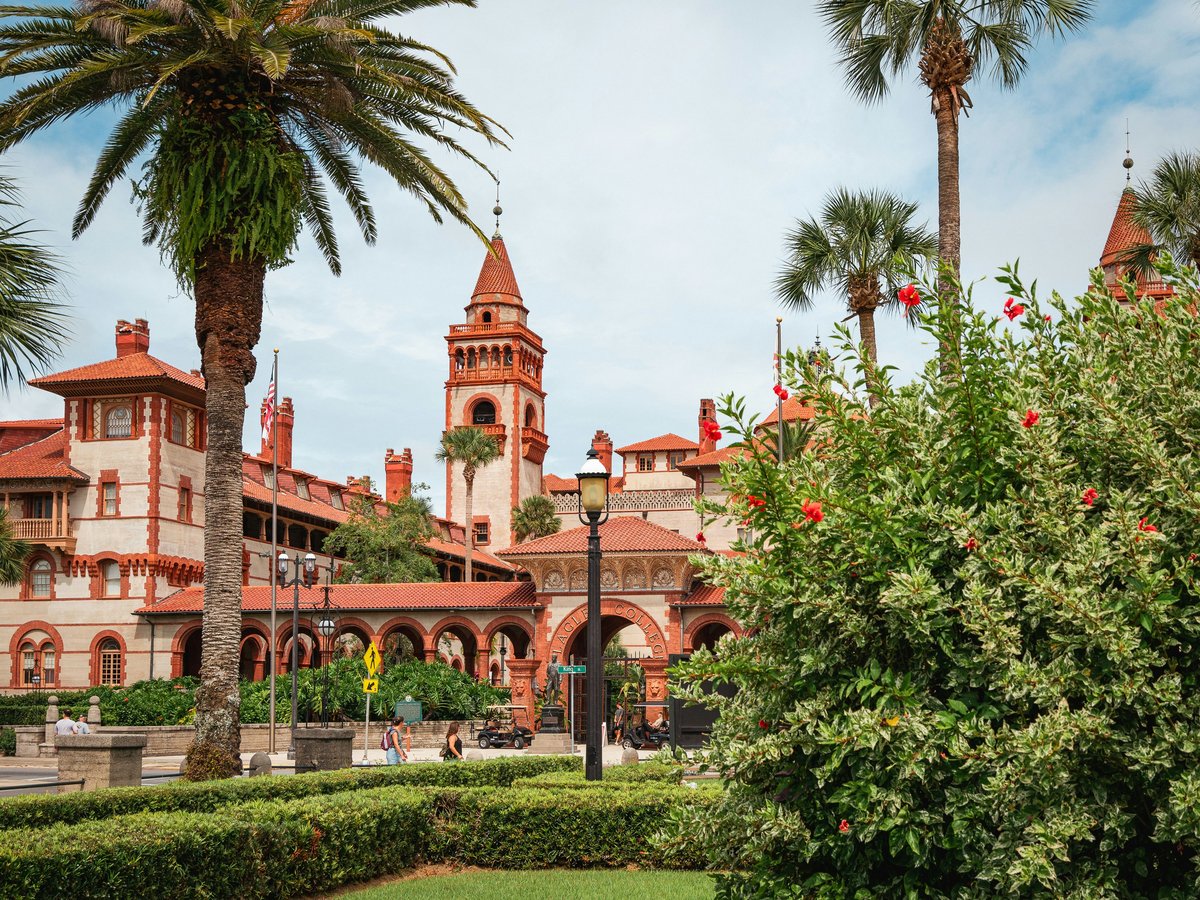
You can cover St. Augustine's 4 centuries of architecture in a single 2-mile loop. Start at the Old City Gates, built of coquina as part of the colonial Cubo Line defense system. Walk south on St. George Street to the Cathedral Basilica, finished in 1797. Turn west on King Street and you will see Flagler College, originally the Ponce de León Hotel, opened in January 1888 by Henry Flagler. The Spanish Renaissance Revival exterior has towers and red terra cotta roofing that photographs well in afternoon light. The college lobby has Tiffany stained-glass windows, but interior access requires a paid tour. From King Street, head south to Valencia Street for the Flagler Memorial Presbyterian Church. Then loop east to Aviles Street and walk north past the small galleries and the O'Reilly House Museum. End at the bayfront seawall for a view of the Bridge of Lions, a 1927 Mediterranean Revival drawbridge reconstructed in 2010. The whole loop takes about 90 minutes at a browsing pace. Every building on this route is free to view from the exterior, and 4 of them are free to enter.
Free Beaches Near St. Augustine
Northeast Florida's beaches run for miles in both directions from the St. Augustine Inlet. St. Augustine Beach on Anastasia Island is the closest to downtown, about a 15-minute drive across the Bridge of Lions. The sand is hard-packed, tan, and wide enough at low tide for beach soccer. Water temperatures sit around 68 to 72 degrees Fahrenheit in spring and reach the low 80s by August. Vilano Beach to the north has a different feel. It is smaller, less developed, and tends to draw surfers and fishermen rather than sunbathers. Free parking at the Vilano pier makes it the easier no-cost option. For a longer drive, Crescent Beach about 8 miles south of St. Augustine Beach offers a quieter stretch with free roadside parking along A1A. Mind you, summer afternoons on any of these beaches bring thunderstorms, usually between 2 p.m. and 5 p.m. Morning visits dodge both the heat and the lightning.
Practical Tips for a Zero-Budget Day
Free parking downtown is limited but not impossible. The parking garage on Cordova Street charges by the hour, but free 2-hour street parking exists on residential streets south of King Street in the Lincolnville area, about a 10-minute walk to St. George Street. The city lot near the St. Augustine Amphitheatre is free on non-event days. Water fountains are in short supply in the historic district, so bringing a refillable bottle saves $3 to $4 per purchase from the tourist shops. The hottest months, June through September, push afternoon temperatures above 90 degrees Fahrenheit with humidity near 80 percent. The best free-activity hours in summer run from 8 a.m. to noon, when the coquina buildings still hold some of the night's coolness and the stone sidewalks have not yet started radiating heat. Public restrooms are available at the visitor information center on Castillo Drive, the St. Augustine Beach pavilion, and inside the Cathedral Basilica. The visitor center on Castillo Drive also stocks free walking maps of the historic district.
FAQ
Is the Castillo de San Marcos free to visit?
The Castillo de San Marcos is a National Park Service site and currently charges $15 per adult for entry to the fort interior. Children 15 and under enter free. That said, the NPS designates several fee-free days each year, including Martin Luther King Jr. Day in January, the first day of National Park Week in April, National Public Lands Day in September, and Veterans Day on November 11. The bayfront seawall walk directly in front of the fort is always free and gives you a clear view of the coquina exterior walls from the water side.
Where can I park for free near the historic district?
Free street parking exists on residential streets in Lincolnville, south of King Street and east of Cordova Street. You will likely find spots on St. Francis Street, Bridge Street, or Oneida Street, all within a 10 to 15-minute walk of St. George Street. The St. Augustine Amphitheatre lot on A1A South is free on non-event days. Metered parking downtown currently runs about $2.50 per hour with a 3-hour limit. On Sundays, some metered spots have been free in past years, though this has varied, so check the signs posted at each meter.
Are the beaches in St. Augustine free to use?
St. Johns County does not charge a beach access fee. St. Augustine Beach, Vilano Beach, and Crescent Beach are all free to walk onto. Parking is the variable cost. The main beach lot near A Street at St. Augustine Beach currently charges around $2.50 per hour, but free parking is available on residential side streets a few blocks from A1A Beach Boulevard. Vilano Beach has a free lot near the pier. No lifeguard stations charge a fee. Bring your own towels and shade, since umbrella rentals at St. Augustine Beach currently run about $25 to $40 per day.
What is the best time of year to visit St. Augustine on a budget?
Late October through early December tends to be the sweet spot. Summer humidity breaks by then, with daytime temperatures around 70 to 75 degrees Fahrenheit. The Nights of Lights display begins in mid-November, which adds a major free attraction to the calendar. Hotel rates are lower than peak summer. To be fair, January through March has pleasant weather too, but spring break weeks in March push accommodation prices up across the board. Hurricane season runs June through November, with September and October being the statistically most active months.
Can I take a free walking tour of St. Augustine?
There is no regularly scheduled free walking tour of St. Augustine in the way some European cities offer them. Several companies run tip-based tours where you pay what you think the tour was worth. These tend to meet near the Old City Gates or the Plaza de la Constitución. The National Park Service rangers at the Castillo de San Marcos and Fort Matanzas offer free ranger talks on scheduled days, typically weekends during the cooler months. The self-guided architecture loop described above covers the same ground most paid tours cover, and a free walking map is available at the visitor center on Castillo Drive.
Is the St. Augustine Lighthouse free?
The St. Augustine Lighthouse and Maritime Museum charges admission, currently around $17 for adults. It is not free on any regular schedule. However, the surrounding Lighthouse Park grounds are free to visit, and you get a good view of the 165-foot tower from below without paying. The lighthouse has occasionally participated in Smithsonian Magazine's Museum Day in September, which offers free admission with a downloaded ticket for 2 people per household. Check the Museum Day website each August for participating venues.
Last verified by automated review (v1.7.2) on . What is automated review?