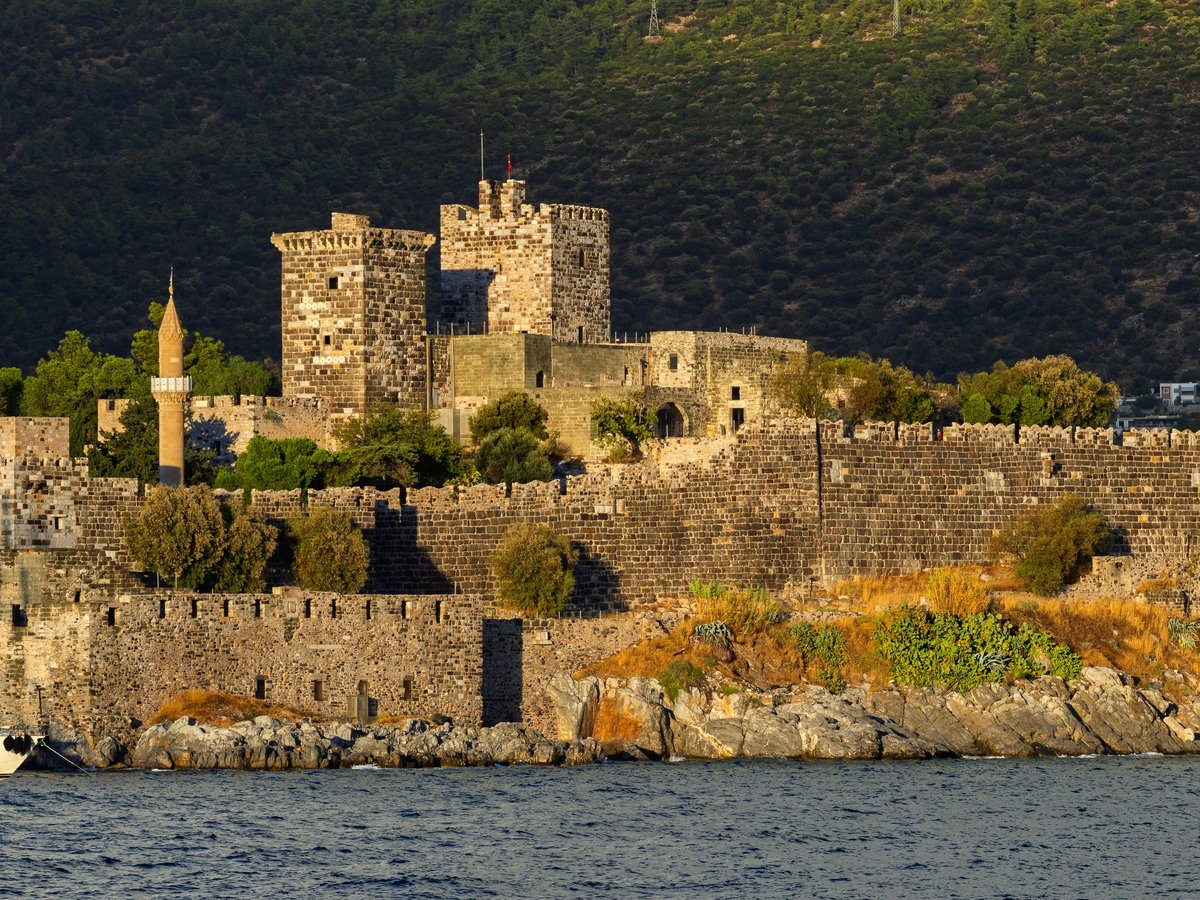
Bodrum sits on a dry, windswept peninsula where the Aegean meets southwestern Turkey. The Carians founded Halicarnassus here in 1099 BC, and the terrain they chose still defines the outdoor character of the place. Low hills of red pine, wild thyme, and maquis scrub slope down to rocky coves along the Aegean shoreline. Summer heat regularly pushes past 35°C from June through August, but the meltemi winds from the northwest keep the western beaches noticeably cooler than the sheltered eastern bays. By mid-September conditions ease into comfortable hiking and cycling weather. The peninsula covers roughly 650 square kilometers with more than a dozen distinct bays and villages, each with its own shoreline feel. Bodrum town wraps around a harbor anchored by a 16th-century Crusader castle, but the outdoor life extends along coastal paths, through dry hills behind the resort strip, and across the water toward the Greek island of Kos, which sits about 20 kilometers off the western shore.
Outdoor activities
-
Road Cycling on the Bodrum Peninsula
The peninsula's coastal road loops through Bitez, Ortakent, Gümüşlük, Yalıkavak, Gündoğan, and Türkbükü before circling back to Bodrum town. The terrain rolls with moderate climbs between villages, and the road surface is generally good tarmac. Morning rides before 10:00 avoid the worst heat and the tourist traffic. You'll find bike rental shops along Neyzen Tevfik Caddesi near the harbor. Some sections are shared with dolmuş traffic, particularly the stretch between Ortakent and Turgutreis.
- Difficulty
- Moderate
- Duration
- 3-5 hours for a full peninsula loop
- Best season
- April to June, September to November
-
Scuba Diving off the Bodrum Coast
Several dive operators run out of Bodrum harbor and Gümbet. The underwater terrain includes rocky reef walls, posidonia grass beds, and a handful of wreck sites in varying depths. Visibility tends to run 15-25 meters on calm days. Water temperatures range from about 16°C in February to 26°C in August. Most operators offer PADI certification courses and guided dives for beginners. The reefs east of the peninsula toward Karaada see less boat traffic and slightly better marine life.
- Difficulty
- Beginner to Advanced depending on site
- Duration
- Half-day for a two-dive trip
- Best season
- May to October
-
Windsurfing at Bitez Beach
Bitez sits on the south side of the peninsula in a wide, shallow bay that catches consistent afternoon thermals. Wind tends to build from late morning, reaching a reliable 15-20 knots by early afternoon on most summer days. The shallow entry and sandy bottom make it forgiving for beginners. Several rental and lesson outfits line the beach. Board and wetsuit hire typically runs a few hundred lira for a half-day session.
- Difficulty
- Beginner to Intermediate
- Duration
- 2-4 hours
- Best season
- June to September
-
Gulet Sailing Day Trips
Bodrum is the birthplace of the gulet, the broad-beamed wooden sailing vessel that fills the harbor. Day trips depart from the main marina most mornings around 10:00 and follow the coast to a sequence of swimming coves, typically stopping 3-4 times before returning by 17:00. Lunch on board is standard. Private gulet charters run from roughly 5,000 to 15,000 TRY per day depending on boat size and season. The boats head south toward Karaada or west along the peninsula coast.
- Difficulty
- Easy, no experience needed
- Duration
- Full day, roughly 7 hours
- Best season
- May to October
-
Stand-Up Paddleboarding in Bardakçı Bay
Bardakçı is a sheltered cove about a 10-minute walk west of Bodrum Castle. The bay faces south and stays calm most mornings before afternoon wind picks up. A couple of beach clubs rent SUP boards by the hour. The water is clear enough to see the rocky bottom in 3-4 meters of depth. Paddle east along the coast toward the castle walls for a good angle on the fortifications from the water. Mornings before 09:00 tend to be glassy.
- Difficulty
- Easy
- Duration
- 1-2 hours
- Best season
- April to October
Day hikes
-
Pedasa Ancient City Trail
Pedasa was a fortified Lelegian settlement perched on a hilltop above the modern village of Konacık, about 5 kilometers north of Bodrum center. The trail climbs through pine forest and maquis to Lelegian walls, cisterns, and a necropolis spread across the summit. The path is rocky and unsigned in places, so a GPS track helps. The ruins are unrestored, which gives them a quiet, overgrown quality that feels very different from the polished sites in town. Carry water. There is almost no shade on the upper slopes.
- Difficulty
- Moderate, with steep rocky sections near the summit
- Duration
- 2-3 hours round trip from Konacık
- Best season
- October to May, start before 08:00 in summer
-
Gümüşlük Coastal Walk and Rabbit Island
Gümüşlük village sits on the site of ancient Myndus, one of several Carian cities that dotted this peninsula. A flat coastal path leads from the village waterfront to Tavşan Adası, a small island you can reach by wading through knee-deep water. The crossing floods deeper in rough weather, so check conditions locally. The walk itself passes fish restaurants built right on the waterline. The island has scattered ancient wall fragments and a few cairns. Time it for sunset looking back toward the village from the island's western end.
- Difficulty
- Easy, flat terrain with a short wade crossing
- Duration
- 1-2 hours including the island
- Best season
- April to November
-
Carian Trail Section near Gökçeler
The long-distance Karia Yolu passes through the hills north and east of the Bodrum Peninsula. You can pick up a marked section from the Gökçeler area and follow it northeast through dry forest and farmland. The trail markers are painted red and white, following the European long-distance path convention. The terrain undulates between 200 and 500 meters elevation with views down to the coast. Some sections run along old stone farm walls and through abandoned olive groves. Carry a downloaded track, because mobile signal drops out in the valleys.
- Difficulty
- Moderate to Strenuous depending on section length
- Duration
- 4-6 hours for a reasonable day section
- Best season
- October to April
-
Gökçeler Canyon Walk
Gökçeler Canyon cuts into the hills about 12 kilometers northeast of Bodrum town. The route follows a seasonal streambed through a narrow gorge with rock walls on both sides. In spring the stream runs and wildflowers line the banks. By summer it dries up entirely. The path involves scrambling over boulders in the narrower sections. The canyon floor stays cooler than the surrounding hillsides, which makes it one of the more tolerable warm-weather walks if you start early. A few pools persist into May and can be deep enough to swim in.
- Difficulty
- Moderate, some boulder scrambling required
- Duration
- 3-4 hours round trip
- Best season
- March to May for water flow, year-round for the walk itself
Water activities
-
Sea Kayaking Along the Southern Peninsula Coast
Kayak operators run guided trips from Bitez or Gümbet along the south-facing coast toward coves between Ortakent and Akyarlar. The water is calm in the mornings, and you paddle past rocky headlands into bays accessible only from the sea. Some tours include snorkel stops over posidonia beds. A half-day guided trip typically costs around 1,500 to 2,500 TRY per person. The afternoon meltemi wind makes return legs harder, so morning departures are standard practice.
- Difficulty
- Easy to Moderate depending on wind conditions
- Duration
- 3-4 hours for a half-day guided trip
- Best season
- May to October
-
Swimming at Karaada (Black Island)
Karaada lies about 4 kilometers off Bodrum's south shore. Tour boats make the trip daily in summer, and the main draw is a hot mineral spring inside a cave on the island's north face. The water near the spring entrance feels noticeably warmer than the open Aegean. The island is uninhabited with no facilities, so bring what you need. Most boat trips include Karaada as the first of several swimming stops on a full-day route.
- Difficulty
- Easy, calm and sheltered water
- Duration
- 1-2 hours on the island as part of a boat trip
- Best season
- June to September
-
Snorkeling Around the Western Peninsula Coves
The rocky coves between Yalıkavak and Gümüşlük on the peninsula's west side tend to have the best underwater visibility and the least boat traffic. The seabed is a mix of rock, grass, and sand, with sea bream, wrasse, and octopus commonly visible. You can snorkel directly from shore at several of these bays without needing a boat. Bring your own mask and fins. Rental gear at beach clubs tends to be low quality. Water stays swimmable from late May through mid-October.
- Difficulty
- Easy
- Duration
- 1-3 hours
- Best season
- June to September for warmth, May and October for water clarity
-
Sailing Courses from Bodrum Marina
A few sailing schools operate out of the Milta marina and offer multi-day RYA or IYT certification courses on the Aegean. Local sailing conditions include moderate thermal winds, island channels between the Turkish coast and the Dodecanese, and generally sheltered waters. Week-long bareboat certification courses run from roughly 15,000 to 25,000 TRY. The proximity of the Greek islands makes for varied day-sailing routes once you are certified.
- Difficulty
- Beginner to Intermediate
- Duration
- 5-7 days for a certification course
- Best season
- April to October
Parks & gardens
-
Bodrum Castle Grounds
The Knights of St. John founded this fortification in 1522, and the grounds within its walls hold more green space than you might expect from a military structure. Mature trees shade the courtyards between the towers. Climb the ramparts for an unobstructed view across both bays that flank the harbor. The castle now houses the Museum of Underwater Archaeology. The interior gardens and stone pathways stay noticeably cooler than the town streets, which matters on a 35°C afternoon.
Highlights: Tower gardens, harbor views from the ramparts, shaded courtyards between the French and English towers
-
Mausoleum at Halicarnassus Archaeological Site
The remains of the tomb built around 350 BC for the Carian satrap Mausolus sit in an open excavation pit a few blocks uphill from the harbor. One of the original Seven Wonders of the Ancient World, the structure is largely gone, but the foundation outline and a few column fragments remain in place. The site is compact and takes about 30 minutes to walk through. Interpretive panels explain the original scale. A handful of olive trees provide some shade at the perimeter.
Highlights: Foundation outline of one of the Seven Wonders, scale model reconstruction, carved stone blocks in situ
-
Kumbahçe Bay Waterfront
FreeThe paved promenade along Kumbahçe Bay runs from the eastern side of the castle base toward Gümbet. Benches and a few strips of grass line the walkway, and it fills with locals in the evening once the heat drops. The bay itself is shallow enough for wading close to shore. Fish restaurants cluster at the eastern end near the small beach. It functions more as an urban waterfront corridor than a formal garden, but it is the main public green space in central Bodrum.
Highlights: Evening promenade with locals, castle views across the water, shallow swimming near the beach end
-
Milta Bodrum Marina Promenade
FreeThe marina waterfront runs along the western bay with a palm-lined walkway between the yacht berths and Neyzen Tevfik Caddesi. The palms provide midday shade, and a few patches of maintained garden separate the restaurants from the pedestrian path. The walk from the marina entrance to the castle gate takes about 15 minutes at a slow pace. Sunsets over the western bay from this stretch tend to be vivid, with Kos on the horizon.
Highlights: Palm-lined waterfront, sunset views toward the Greek islands, direct walking access to the castle
Practical tips
- Sun Protection and Heat
- Bodrum's latitude is about 37°N, and summer UV levels are intense. Bring SPF 50+ sunscreen, a wide-brimmed hat, and UV-rated sunglasses. On exposed trails like the Pedasa summit approach, there is almost no tree cover. Start hikes before 08:00 in July and August. Current mid-September temperatures sit around 23.9°C, which is far more manageable for sustained effort than the 35°C+ peaks of high summer.
- Hydration
- Carry at least 2 liters per person for any hike over 2 hours. There are no reliable water sources on the peninsula's hill trails. Tap water in Bodrum town is generally safe but tastes heavily chlorinated, so most people drink bottled. A 1.5-liter bottle from a market costs around 15-20 TRY. Electrolyte tablets help on hot days, particularly during cycling or extended hiking.
- Trail Conditions and Footwear
- Most trails on the Bodrum Peninsula are rocky and unimproved. Loose limestone and thorny scrub are common on the inland paths. Lightweight hiking shoes with ankle support and good grip are the minimum for anything beyond flat coastal walks. Sandals work for Gümüşlük and the waterfront promenades but not for the canyon or Pedasa. The Karia Yolu sections are marked but not maintained to a high standard, so carry a downloaded GPS track rather than relying on painted blazes alone.
- Currency and Costs
- The Turkish Lira currently trades at about 48.6 TRY per 1 USD. A full-day shared boat trip with lunch runs 400-800 TRY per person. Dive trips start around 1,500 TRY for a two-tank package. Most operators accept credit cards, but small beach rental outfits and rural trailhead parking often require cash. ATMs are plentiful in Bodrum town and the larger resort villages like Yalıkavak and Turgutreis.
- Safety and Solo Travel
- Bodrum scores 7.2 out of 10 for solo-traveler safety (see the TTDI Solo-Safety Index). The main risks outdoors are heat-related illness, dehydration, and twisted ankles on rocky terrain rather than personal security concerns. Mobile phone coverage drops out in some inland valleys and canyon sections. Tell someone your planned route if you are hiking solo in remote areas. Sea conditions can shift fast when the meltemi builds in the afternoon, so stay aware of wind changes when kayaking or swimming in open water.
- Getting Around the Peninsula
- Dolmuş minibuses connect Bodrum town to most peninsula villages at roughly 20-30 minute intervals during the day. A ride from Bodrum to Gümüşlük or Yalıkavak costs around 30-40 TRY. For early-morning hike starts or remote trailheads, a rental car or scooter is more practical. Beach cove parking fills up fast in July and August. Cycling between villages works but involves sharing the road with fast-moving traffic on some stretches between Ortakent and Turgutreis.
FAQ
What is the best time of year for outdoor activities in Bodrum?
The sweet spot for hiking and cycling is April through early June and September through November. Summer months work well for water activities but the heat makes extended time on exposed trails uncomfortable. Winter is mild by northern European standards but brings rain, which makes the canyon walks more interesting and the hill trails muddier. Wind conditions for sailing and windsurfing peak between June and September.
Can I hike near Bodrum without a guide?
The coastal walk at Gümüşlük and the Pedasa trail from Konacık are both straightforward enough for independent hikers with a GPS track or offline map. The Karia Yolu sections benefit from downloaded route files since signage can be inconsistent. The canyon walk at Gökçeler involves some route-finding between boulder sections. None of the trails described here currently require permits or guided access.
Is Bodrum suitable for a family outdoor trip?
Bodrum rates 6.8 out of 10 for family friendliness (see the TTDI Family-Friendliness Index). The shallow bays at Bitez and the Gümüşlük waterfront are manageable with children. Boat trips to swimming coves work well for families with kids over about 5 years old. The Pedasa hike and the canyon walk are better suited to older children and teenagers who can handle rocky, uneven terrain and carry their own water.
Where can I rent outdoor gear in Bodrum?
Dive shops and water sports operators along Neyzen Tevfik Caddesi and at Bitez beach rent snorkel gear, kayaks, SUP boards, and wetsuits. Bicycle rental is available near the marina. There is no dedicated hiking or climbing gear shop in Bodrum town itself. Bring your own boots, trekking poles, and technical clothing from home. Decathlon in Muğla, about 2 hours inland by car, is the nearest large outdoor retailer.
How rough is the sea around the Bodrum Peninsula for kayaking and swimming?
The Aegean around the peninsula is generally calm in the mornings. The meltemi builds from the northwest through the afternoon and can create choppy conditions on exposed western and southern shores. Bays on the eastern side stay calmer when the wind runs. Winter storms can make the sea rough for days at a stretch. Water temperature ranges from about 16°C in the coldest months to 26°C in late summer.
Are the ancient ruin sites near Bodrum worth visiting for the outdoor experience alone?
The trail to the Lelegian settlement at Pedasa gives you scrubland hillside, coastal panoramas, and a quiet mountaintop, with ancient walls and cisterns as a bonus. The Gümüşlük walk is flatter and ends with a wade to Tavşan Adası. Both sites are unrestored and uncrowded, which makes them feel more like outdoor excursions than museum visits. To be fair, the archaeological interest is modest compared to the major sites in town, but the walking is the real reward.
Last verified by automated review (v1.7.2) on . What is automated review?