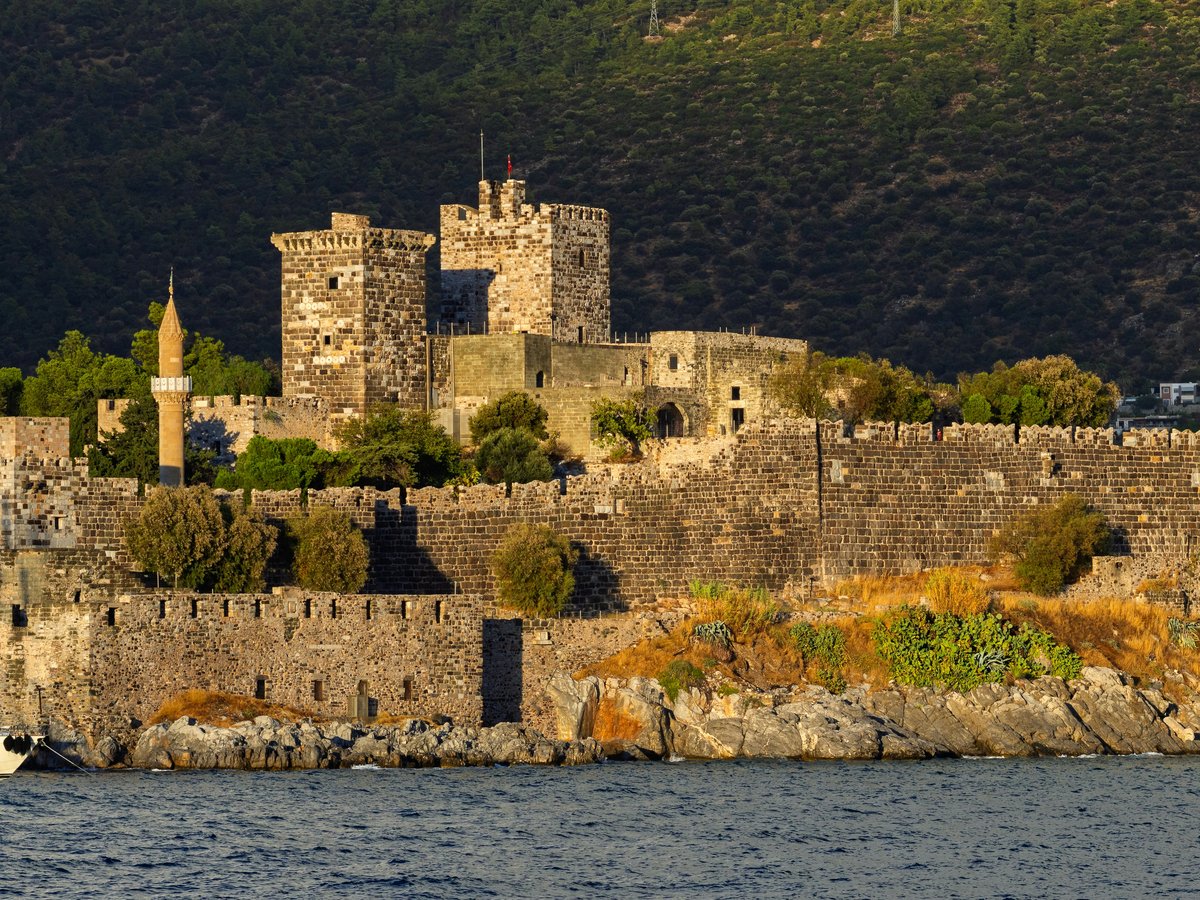
Bodrum sits on a peninsula where the Aegean meets the Turkish Riviera, and the town's nightlife has been pulling Istanbul's cultural class south since the 1980s. The Castle of St. Peter, built by the Knights Hospitaller starting around 1402, still anchors the harbor skyline, and after dark its floodlit walls frame the bars along Neyzen Tevfik Caddesi on the marina side and the Bar Street strip on Cumhuriyet Caddesi to the east. Dinner rarely starts before 9 PM here, which pushes bar traffic to 11 PM or later, and clubs such as Halikarnas The Club peak between 1 and 3 AM, with the last tables on summer weekends not clearing until first light. The Turkish meyhane tradition runs deep in Bodrum: evenings of rakı and meze set the pace, and plenty of people are still at the table at 2 AM with no plans to go on to a club. Gümbet, 3 km west, handles the cheap and loud end of the night, while Türkbükü and Yalıkavak on the north coast take the expensive end. June and September draw more Istanbulites and Ankara weekenders, and July and August bring the international wave, especially to Gümbet and the luxury bays to the north.
Bars in Bodrum
Bodrum's bar scene splits along geographic lines. The marina side runs along Neyzen Tevfik Caddesi, where cocktail places look across the harbor toward the castle: Küba Bar has long been one of the main stops on that stretch, operating as a restaurant until around midnight and shifting into a bar after. Marina Yacht Club, further along the same street, puts live bands on its waterfront terrace most summer nights. A well-made cocktail here might run 400 to 600 TRY, though prices move with the season and with how ambitious the venue is. On the other side of the castle, Hadigari has been pouring drinks under its walls since 1974, and its terrace gives one of the closest views of the floodlit towers anywhere in town. Bodrum does the meyhane-bar hybrid particularly well. You sit down at 9 PM for grilled octopus and a double rakı, and by midnight you're four rounds deep while a singer works through Anatolian folk songs on a bağlama in the corner, charcoal smoke from the harbor grills drifting over the tables until the kitchens close around 1 AM. In Bodrum's meyhane world the line between restaurant and bar is blurry by design, so a table booked for dinner is often a table for the whole night. Rooftop terraces have multiplied across the town center over the past several years, and the better ones face north toward the harbor. Mid-September evenings usually stay in the low-to-mid 20s °C, so you can sit outside in a t-shirt past midnight. Turkish wine has gained ground in Bodrum: bottles from Thrace and Cappadocia appear on most wine lists, and a glass of Kalecik Karası or Öküzgözü tends to run 150 to 250 TRY. Gümbet, 3 km west of the center, leans louder and cheaper, drawing the younger crowd and budget travelers, with beer priced closer to half what a marina terrace charges. Efes Pilsen remains the default beer order across Bodrum. Wikivoyage keeps a broader list of the town's drinking spots at https://en.wikivoyage.org/wiki/Bodrum#Drink.
Clubs and Dance Floors
Bodrum's club scene runs almost entirely outdoors, and serious clubbing is a summer sport: the season stretches from late May to mid-October. The headline venue is Halikarnas The Club, which has occupied its spot on Kumbahçe bay at the far end of Cumhuriyet Caddesi, east of the castle, since 1979, and the open-air dance floor and laser shows made it Turkey's best-known club for decades. Entry fees apply on peak-season nights, and the dance floor rarely fills before 1 AM. In recent seasons the Marine Club Catamaran has run as a floating club, boarding near the harbor and heading out into the bay at around 1 AM, which means anyone who misses departure has to wait for it to return. Floating venues change operators often, so check that it is running before you plan around it. International DJs pass through in July and August, usually playing house and techno. By the small hours, most Bodrum dance floors switch to Türkçe pop, the melodic, vocal-driven strain of Turkish pop music. Dress codes vary by venue tier. The upscale spots around Yalıkavak Marina and Palmarina expect collared shirts and closed shoes for men, and some refuse shorts after 10 PM. On Bar Street and at Halikarnas, clean casual is the standard: sneakers are fine, but flip-flops might get you turned away. Saturday draws the biggest crowds. Friday and Thursday have grown as Istanbul weekend-flight arrivals shifted earlier in the week, though many clubs scale back sharply or close outside June to September. In April, Bodrum's nightlife shrinks to a handful of year-round bars near the harbor. Entry is informal by European standards. Some venues run face control at the door, especially the beach clubs in Türkbükü such as Macakızı. On busy weekend nights in central Bodrum, door staff tend to care more about capacity than exclusivity.
Live Music After Dark
Live music in Bodrum runs along two lines. The meyhane singer works solo with a bağlama or electric saz, threading through Turkish folk songs and fasıl standards while the crowd claps along over another round of rakı, and you'll find these performers most nights Wednesday through Saturday at restaurants and bar-restaurants across the town center. The second tradition is the summer concert. The ancient theatre of Halicarnassus was built in the Hellenistic era for a city founded around 1099 BC, carved into the hillside above the town, and it still hosts touring acts from June through September, with a bill that mixes Turkish pop stars, jazz ensembles and the occasional international rock act. The bigger names sell out weeks in advance. Sound carries well in the open limestone bowl, and the seats look straight down to the floodlit harbor and the castle. For a smaller room, Mavi Bar on Cumhuriyet Caddesi has been a Bodrum fixture for decades, a narrow whitewashed bar where Turkish rock and blues bands squeeze into one corner and the crowd spills out into the lane on summer weekends. Marina Yacht Club on Neyzen Tevfik Caddesi runs bands on its harbor terrace through the season, mostly covers and Turkish pop. Turkish fasıl music, the Ottoman-rooted ensemble style built around violin, kanun and oud, still has a foothold in restaurants near the harbor, and Thursday and Friday are the strongest nights for it. The quality varies: some nights the musicians play intricate makam progressions with real skill, and on others it sounds more like background music with a rhythm section. Jazz has a small but steady presence in Yalıkavak, where restaurants around the marina host trios and quartets through the high season, and on still nights the sound carries across the water past the moored yachts.
Nightlife neighborhoods
-
Barlar Sokağı (Bar Street, Cumhuriyet Caddesi)
Bodrum's original party strip runs east from the castle along Cumhuriyet Caddesi and Dr. Alim Bey Caddesi, a narrow pedestrian lane lined with bars on both sides, each doorway playing its own track so that the sound overlaps from about 10 PM. From June through August the crowd skews young and international. The lane ends at Kumbahçe bay, where Halikarnas The Club takes over after 1 AM. The ruins of the Mausoleum at Halicarnassus, built around 350 BC and one of the Seven Wonders of the Ancient World, are a 10-minute walk uphill from the strip.
- Best for
- First-time visitors, groups looking for a crawl-friendly strip, anyone who wants 15 or more bars within a 200-meter walk
- Standouts
- Halikarnas The Club (open-air club since 1979, at the Kumbahçe end of the strip); Mavi Bar (small live-music bar for Turkish rock and blues); Hadigari (bar under the castle walls since 1974)
-
Gümbet
The peninsula's budget-party annex sits about 3 km west of Bodrum center. Beach bars start playing from mid-afternoon, and once the sun goes down the street behind the beachfront fills with package-holiday groups. It is looser and louder than central Bodrum, with more neon and less pretense: on a peak-season night you'll hear more English and Russian than Turkish. Dolmuş minibuses and taxis link it to the center in about 10 minutes.
- Best for
- Budget travelers, the under-30 crowd, anyone who wants to go from the beach to the bar without changing locations
- Standouts
- Bar names along the Gümbet strip change most seasons, so walk the beachfront and the parallel street behind it and pick the busiest terrace
-
Yalıkavak
The marina-driven upscale end of the Bodrum peninsula sits about 18 km northwest of the town center. Restaurants and cocktail terraces around Yalıkavak Marina (branded Palmarina) draw Istanbul's professional class and European yacht owners, and people come here to talk over dinner more than to dance. The wine lists tend to be serious, and the bills climb accordingly.
- Best for
- Couples, the over-35 crowd, anyone looking for a quieter but expensive evening on the Aegean
- Standouts
- The restaurant and bar terraces around Yalıkavak Marina (Palmarina), where jazz trios play through the high season
-
Türkbükü
This small bay, about 15 km north of Bodrum center, has been the see-and-be-seen destination for Turkish celebrities and wealthy Istanbulites since the 1990s. Beach clubs double as evening venues, so by 8 PM the daytime lounging has turned into nightlife. Face control at the door is standard, and the wooden decks sit right on the water with the Bodrum hills rising behind.
- Best for
- Splurge nights, celebrity-spotting, anyone comfortable in high-spend places with door selection
- Standouts
- Macakızı (hotel beach club whose deck parties have defined the bay for years; expect minimum spends in July and August)
-
Bitez
About 5 km west of Bodrum center, Bitez draws a quieter crowd than the town's main strips. Beach bars serve cocktails and wine through the evening, and on weekends in July and August you'll sometimes catch acoustic guitar sets. Tangerine orchards line the hillside behind Bitez beach, and in summer the steady afternoon breeze makes the bay a windsurf base by day.
- Best for
- Couples and small groups, windsurf and kitesurf types, anyone who finds Bar Street overwhelming
Safety after dark
Bodrum rates 7.2 out of 10 for solo-traveler safety (see the TTDI Solo-Safety Index), and that score reflects what the town feels like after dark. The center is walkable, Cumhuriyet Caddesi and Neyzen Tevfik Caddesi are well lit, and most nightlife sits in areas with steady foot traffic, but the backstreets away from the harbor and the cobblestone lanes around the old town get dark and uneven underfoot. Taxis are the standard late-night option, so agree a fare before you get in or insist on the meter; the BiTaksi app operates in Bodrum and cuts out the haggling. Drink spiking is uncommon but not unheard of in the more tourist-heavy bars around Gümbet and Bar Street, so keep your glass in hand in crowded venues and don't leave drinks unattended. Bodrum's LGBTQ+ friendliness score is 3.5 out of 10 (from TTDI's editorial rubric), and same-sex public affection draws unwanted attention outside the few openly queer-friendly spaces in town. Scams run toward overcharging rather than anything threatening: check your bill at the end of the night, especially at places that don't display prices. Wikivoyage covers more safety advice at https://en.wikivoyage.org/wiki/Bodrum#Stay_safe.
Practical tips
- Currency
- The Turkish lira sits at approximately 48.6 TRY to 1 USD as of September 2026, and cards are widely accepted at marina-area venues and larger establishments. Smaller bars off the main strips may be cash-only, so carry some lira when you head away from the waterfront. ATMs cluster around the marina and along the main commercial streets in the town center.
- Tipping
- Rounding up or leaving 10 percent on a bar tab is standard in Bodrum; at sit-down meyhane-style places, 10 to 15 percent is the norm for table service. Leaving nothing on a Bodrum tab is noticed.
- Dress code
- Pack for two different Bodrums: the town center and Gümbet require nothing beyond clean casual, but the marina restaurants and clubs in Yalıkavak and Türkbükü enforce smarter dress codes, especially later in the evening.
- Cover charges and minimums
- Most bars in Bodrum don't charge a cover, but some of the larger waterfront clubs, Halikarnas The Club among them, add entry fees on peak-season nights, often with a drink included. The upscale beach clubs in Türkbükü may require a minimum spend rather than a flat door charge.
- Drinking customs
- Rakı is drunk with cold water and ice alongside food, never as a shot, and the mixture turns milky white, which locals call aslan sütü, or lion's milk. Public drunkenness is frowned upon outside the party-oriented zones, and Turkish drinking culture is more moderate than in much of Southern Europe.
FAQ
What time does nightlife start in Bodrum?
Bodrum follows the Turkish tradition of late dining, so bar traffic doesn't pick up until restaurants wind down near midnight, and clubs fill from there and run into the early morning hours. Arriving before the dinner crowd disperses means a near-empty dance floor.
Is Bodrum nightlife seasonal?
Bodrum in August and Bodrum in February feel like two different towns. The core season runs from late spring through early autumn, with peak summer weeks drawing the biggest crowds and the highest prices, and many waterfront clubs and beach bars close entirely through winter. A handful of year-round bars in the town center keep going, but the energy drops off considerably once temperatures and tourist numbers fall.
Can I get around Bodrum at night without a car?
Within the town center, walking covers most nightlife areas comfortably. Reaching the peninsula's outlying bays and marinas at night requires a taxi or ride-hailing app, and the dolmuş minibus services run later during peak season but tend to stop sometime after midnight. Wikivoyage has a useful overview of local transport options at https://en.wikivoyage.org/wiki/Bodrum#Get_around.
What should I drink in Bodrum?
Rakı is the local spirit, an anise-flavored Turkish liquor traditionally served alongside food rather than on its own. Efes is the default beer across Turkey, and Turkish wine has improved over the past decade, with domestic bottles from western and central Anatolian vineyards holding up well alongside imports.
Do I need to speak Turkish to go out in Bodrum?
English is widely understood in the main nightlife areas, particularly along the marina and in Gümbet, and staff at tourist-oriented bars typically speak enough English to handle orders and bills. In more local spots away from the center, a few phrases in Turkish go a long way. Phone translation apps handle menus and drink lists at Turkish-only venues.
Last verified by automated review (v1.7.2) on . What is automated review?