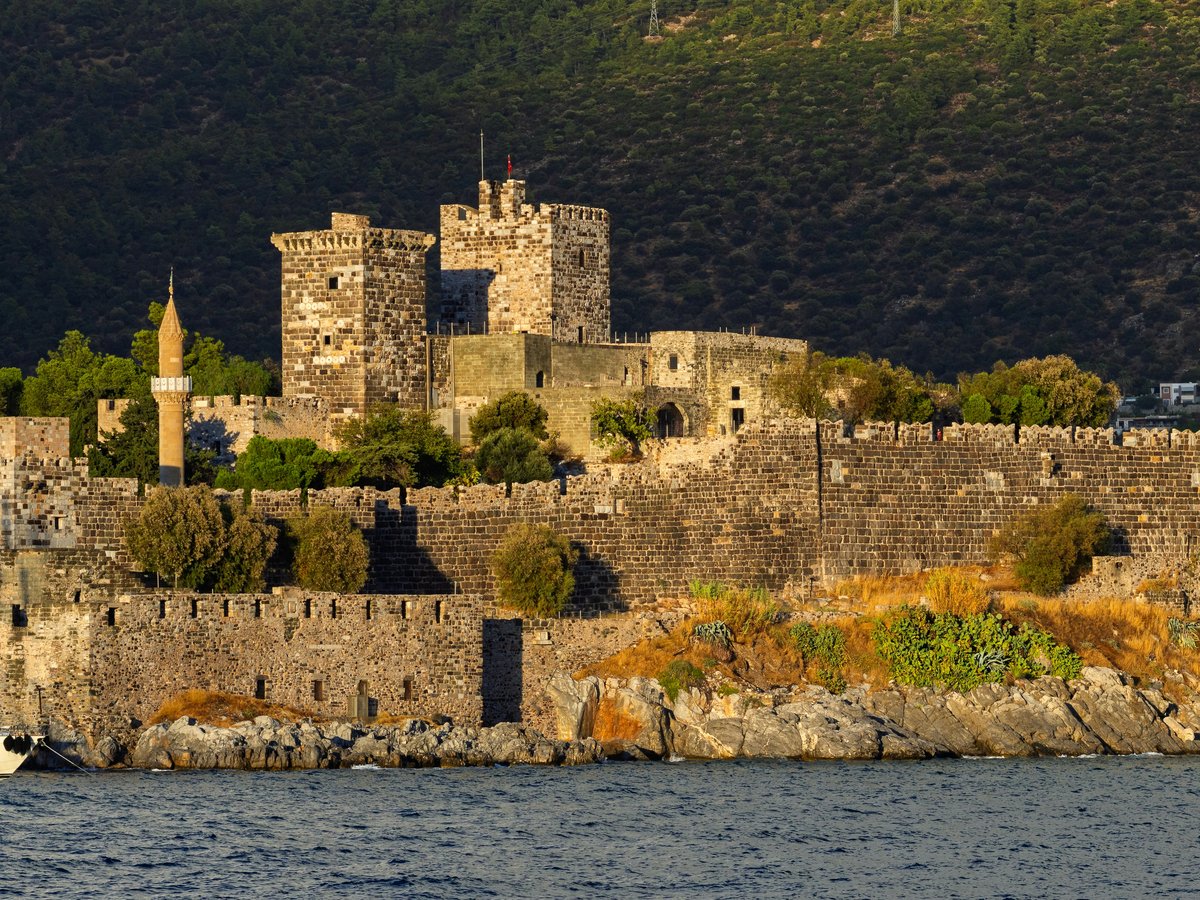
Bodrum occupies the site of Halicarnassus, a city the Carians and Greeks founded around 1099 BC. The town sits on a peninsula between two bays, with the castle headland splitting the harbor in half. Nearly 3,000 years of settlement left ruins, fortification walls, and a theatre carved into the slopes above town, most of it open to the public at no cost. The waterfront walk from the marina to Kumbahçe takes about 20 minutes at an easy pace. Tuesday's open-air pazar fills several blocks with produce, dried herbs, and textiles, all free to browse. Public beaches at Gümbet and Bitez sit a short dolmuş ride from the center. Bodrum scores 7.2 out of 10 for solo-traveler safety (see the TTDI Solo-Safety Index), a reassuring number when you are climbing Tepecik's stepped lanes alone after dark. Mid-September evenings have been settling near 24°C with humidity around 78%, warm and heavy enough that the charcoal-and-salt smell from Kumbahçe's fish restaurants drifts across the water.
Free attractions
-
Myndos Kapısı (Myndos Gate)
The sole surviving gate of the ancient Halicarnassus fortification walls, built under Mausolus in the 4th century BC. The stonework still rises several meters above the modern road. Alexander the Great laid siege to this entrance in 334 BC. Free to visit at any hour, and the surrounding stretch of wall fragments gives a sense of the city's original perimeter.
Western Bodrumlandmark -
Antik Tiyatro (Ancient Theatre of Halicarnassus)
A 4th-century-BC Greek theatre cut into the hillside north of the town center, restored in the 1970s. It faces south over the harbor, and on clear days you can see Kos, roughly 4 km across the strait, from the upper rows. Free to visit on non-event days. The morning light is best for photographs, and the theatre tends to be quiet before 10:00 on weekdays.
Kıbrıs Şehitleri Caddesi arealandmark -
Bodrum Değirmenleri (Bodrum Windmills)
A row of white stone windmills along the ridge between Bodrum center and Gümbet. Most were built in the 18th century to mill grain for the peninsula's villages. The hilltop path is free and offers roughly 270 degrees of Aegean coastline. Sunset turns the water copper from up here, and the breeze off the sea makes it one of the cooler spots in town during August.
Gümbet ridgeviewpoint -
Kumbahçe Parkı
The public waterfront green space at the eastern curve of the harbor. Mature shade trees, benches facing the water, and a direct sightline across to the castle. Fishermen work the shoreline here in the early morning, and the park fills with families after dinner. Free at all hours.
Kumbahçepark -
Tepecik Mahallesi
Bodrum's oldest residential quarter, climbing the steep hillside behind the castle. Whitewashed houses, bougainvillea spilling over stone walls, narrow stepped lanes, and terraced gardens where locals grow figs and citrus. The higher terraces look straight down at the marina. Free to wander, though the steps are uneven and some sections are steep enough to need a handrail that is not there.
Tepecikhistoric quarter and green space -
Bardakçı Koyu
A sheltered cove tucked between the Bodrum center headland and the Gümbet shoreline. The hillside has walking paths through low scrub and pine. Public access to the water is free, though a few platforms on the rocks charge for sunbed rentals. The water tends to be calmer and clearer here than at the main town beaches.
Bardakçıcove and green space -
Bodrum Sualtı Arkeoloji Müzesi (Museum of Underwater Archaeology)
Housed inside Bodrum Castle, this museum charges admission on regular days. Turkey's Ministry of Culture and Tourism opens all state museums free of charge on May 18 each year for International Museum Day, and on the first days of Ramazan Bayramı and Kurban Bayramı. The collection holds Bronze Age shipwreck cargo, amphorae, and glass finds recovered from the Aegean seabed.
Castle districtmuseum (free on specific days) -
Zeki Müren Sanat Müzesi (Zeki Müren Arts Museum)
The former Bodrum residence of Zeki Müren, one of Turkey's most recognized performers, who lived here until his death in 1996. The house museum displays his stage costumes, vinyl records, and personal instruments. Admission is normally paid, but it follows the same national free-day calendar as other state museums.
Central Bodrummuseum (free on specific days)
Free activities
-
Bodrum Pazarı (Tuesday Market)
Every Tuesday, a large open-air market fills the streets near the bus station with stalls selling olives, honey, dried oregano, leather bags, cotton towels, and seasonal fruit. Browsing costs nothing, and the produce prices give a useful sense of local cost of living. The market runs from early morning until about 17:00. Arrive before 09:00 for the best selection and fewer crowds.
Çarşı (town center)market -
Neyzen Tevfik Caddesi harbor promenade
The main waterfront road curves along the western bay from Milta Marina toward the castle. It is named after Neyzen Tevfik, the satirist and ney player born in Bodrum in 1879. The walk is flat, shaded in parts by palms, and passes fishing boats, cafe terraces, and the occasional stray cat stretched across a mooring line. No charge. The route is at its best after 18:00 when the heat drops.
Western baywalking route -
Gümbet Halk Plajı (Gümbet Public Beach)
A sandy public beach about 2.5 km west of Bodrum center, reachable by dolmuş in under 10 minutes. The sand is free and the water stays shallow and warm through September. Sunbed rentals are paid, but a towel on the free sand works fine. Public shower facilities near the beach entrance are free.
Gümbetbeach -
Halicarnassus wall-trace walk
Fragments of the ancient city walls survive in several places between Myndos Kapısı and the eastern hillside. You can walk a rough route along the old fortification line through residential streets, spotting ancient masonry built into garden walls and house foundations. No signs mark the full circuit, so a downloaded map helps. Free, and it takes about 90 minutes at a slow pace.
Variouswalking route -
Bitez Plajı (Bitez Beach)
About 6 km west of the center, Bitez Bay has a long public shoreline backed by mandarin orchards. The beach is popular with windsurfers in the afternoon when the meltemi picks up. Free access to the sand. The tangerine groves behind the beach make for a shaded walk when the midday sun is overhead, and you can smell the fruit from the road in October.
Bitezbeach -
Gümüşlük causeway to Tavşan Adası (Rabbit Island)
The fishing village of Gümüşlük, about 18 km west of Bodrum center, sits on the ruins of ancient Myndus. A submerged stone causeway connects the shore to Tavşan Adası. You can wade across when the water is low, usually ankle to knee depth in calm conditions. Remnants of the Myndus city wall are visible near the shoreline. Free to walk, and the village has a handful of waterfront fish restaurants for after.
Gümüşlükwalking route and ruins
Free events
-
Municipal open-air concerts (Belediye Konserleri)
Summer months (June through August), frequency varies by yearBodrum municipality stages free outdoor concerts through the summer season, typically featuring Turkish folk and pop musicians. Schedules appear on the belediye's notice boards and social media channels about a week before each performance. Attendance is free, seating is first-come.
Public squares and waterfront areas in Bodrum center -
Bayram public celebrations
National and religious holidays (dates vary annually for Bayram)On national and religious holidays, including April 23, August 30, October 29, and the opening days of Ramazan and Kurban Bayramı, Bodrum's harbor area hosts free public gatherings with live music, folk dance performances, and food stalls. The castle is lit in the Turkish colors on the evenings of major holidays.
Harbor area and main public squares -
Gallery exhibition openings
Summer season, with openings rotating among galleries roughly weeklySeveral small galleries in the old town and along the marina host opening receptions for new shows through the summer season. These typically offer free entry and some provide complimentary tea. The gallery scene tends to peak in July and August when the seasonal population reaches its highest.
Old town streets and marina district
Public beaches on the peninsula
Turkey's coastline law guarantees public access to the sea, which means every beach on the Bodrum peninsula has a free-access section, even where private clubs dominate the shoreline. Gümbet's public stretch sits at the western end of the bay. Bitez has the widest free sand, along the mandarin-orchard side of the cove. Yahşi Plajı, about 15 km south in Ortakent, offers a quieter alternative with a long public section and shallow water that suits children. Turgutreis, 20 km west, has a broad municipal beach with free showers. Mind you, free beach means the sand and the water. Sunbeds and umbrellas at any of these typically run 150 to 300 TRY per set, roughly 3 to 6 USD at September 2026 rates. Bring a towel and you avoid that cost entirely. The water at Bardakçı Koyu tends to be the clearest within walking distance of the center.
Major sites with paid admission
Two of Bodrum's most prominent historical sites require paid tickets on normal visiting days. The Knights Hospitaller completed Bodrum Castle by 1522. It now holds the Underwater Archaeology Museum and charges a standard Ministry of Culture admission fee. The Mausoleum at Halicarnassus was built around 350 BC as one of the Seven Wonders of the Ancient World. The archaeological site is ticketed today and presents column fragments and foundation stones in an open-air enclosure. Both follow the national free-day schedule for state museums, so a well-timed visit costs nothing. That said, even from outside, the castle dominates the harbor skyline, and you can see its towers from nearly anywhere along the waterfront.
Getting around for free or nearly free
Bodrum's town center is compact enough to cover on foot. The walk from the otogar to the castle takes about 15 minutes. Tepecik adds elevation but not distance. For beaches beyond walking range, the dolmuş system runs minibuses along fixed routes for a few lira per ride. Gümbet is the closest beach route, roughly 10 minutes from the center. Bitez and Ortakent-Yahşi run on separate lines from the same station. Fares have been running about 25 to 40 TRY depending on distance. If you are staying for several days, walking between Bodrum center, Gümbet, and the windmill ridge is a practical option. The path over the windmill hill takes about 35 minutes and saves the fare in both directions.
Sources
This guide draws on the Wikivoyage Bodrum destination article (https://en.wikivoyage.org/wiki/Bodrum), including the sections on getting in (https://en.wikivoyage.org/wiki/Bodrum#Get_in), getting around (https://en.wikivoyage.org/wiki/Bodrum#Get_around), sightseeing (https://en.wikivoyage.org/wiki/Bodrum#See), food (https://en.wikivoyage.org/wiki/Bodrum#Eat), nightlife (https://en.wikivoyage.org/wiki/Bodrum#Drink), safety (https://en.wikivoyage.org/wiki/Bodrum#Stay_safe), and practical information (https://en.wikivoyage.org/wiki/Bodrum#Cope). The currency conversion uses a rate of 1 USD = 48.5964 TRY, observed on September 11, 2026. Weather data from Open-Meteo was recorded on September 13, 2026. City scores are from TTDI's editorial rubric.
FAQ
Can I visit Bodrum Castle and the Mausoleum for free?
On normal days, both require a paid ticket. They follow Turkey's national free-museum-day calendar, with a handful of opportunities each year. The holiday-linked dates shift annually, so check the Ministry of Culture's schedule before planning a trip around a free entry day. The Underwater Archaeology Museum entry above names the specific occasions.
Are Bodrum's beaches free to use?
Every beach on the peninsula has a free public-access section by law. The sand and the sea cost nothing. Sunbed and umbrella rentals are the paid part, typically 150 to 300 TRY per set. Bring your own towel and you pay nothing beyond the dolmuş fare to get there.
Is Bodrum suitable for families on a budget?
Bodrum scores 6.8 out of 10 for family friendliness (see the TTDI Family-Friendliness Index). The shallow water at Gümbet and Bitez works well for small children. The Ancient Theatre and the windmill walks are stroller-unfriendly due to steep, uneven ground, so plan those outings for older kids or leave the stroller behind.
How LGBTQ+ friendly is Bodrum?
Bodrum scores 3.5 out of 10 for LGBTQ+ friendliness (sourced from TTDI's editorial rubric). The town is more relaxed than much of Turkey, with an established arts and nightlife scene, but public displays of affection between same-sex couples still draw attention outside the bar district. Worth noting that legal protections for LGBTQ+ people in Turkey remain limited.
Is Bodrum a good base for digital nomads?
Bodrum scores 6.8 out of 10 for digital-nomad suitability (sourced from TTDI's editorial rubric). Wi-Fi in cafes along the marina is generally reliable, and several co-working-friendly spots have opened in recent years. The main limitation is that the town largely shuts down outside summer season, reducing cafe and social options from November through April.
What is the best time of year to visit Bodrum for free activities?
May through October gives the warmest weather and the fullest calendar of free municipal events. September tends to offer the best balance of warm water, lower accommodation prices, and fewer visitors than July or August. The Tuesday market runs year-round, and the outdoor archaeological sites are accessible in every season.
Last verified by automated review (v1.7.2) on . What is automated review?