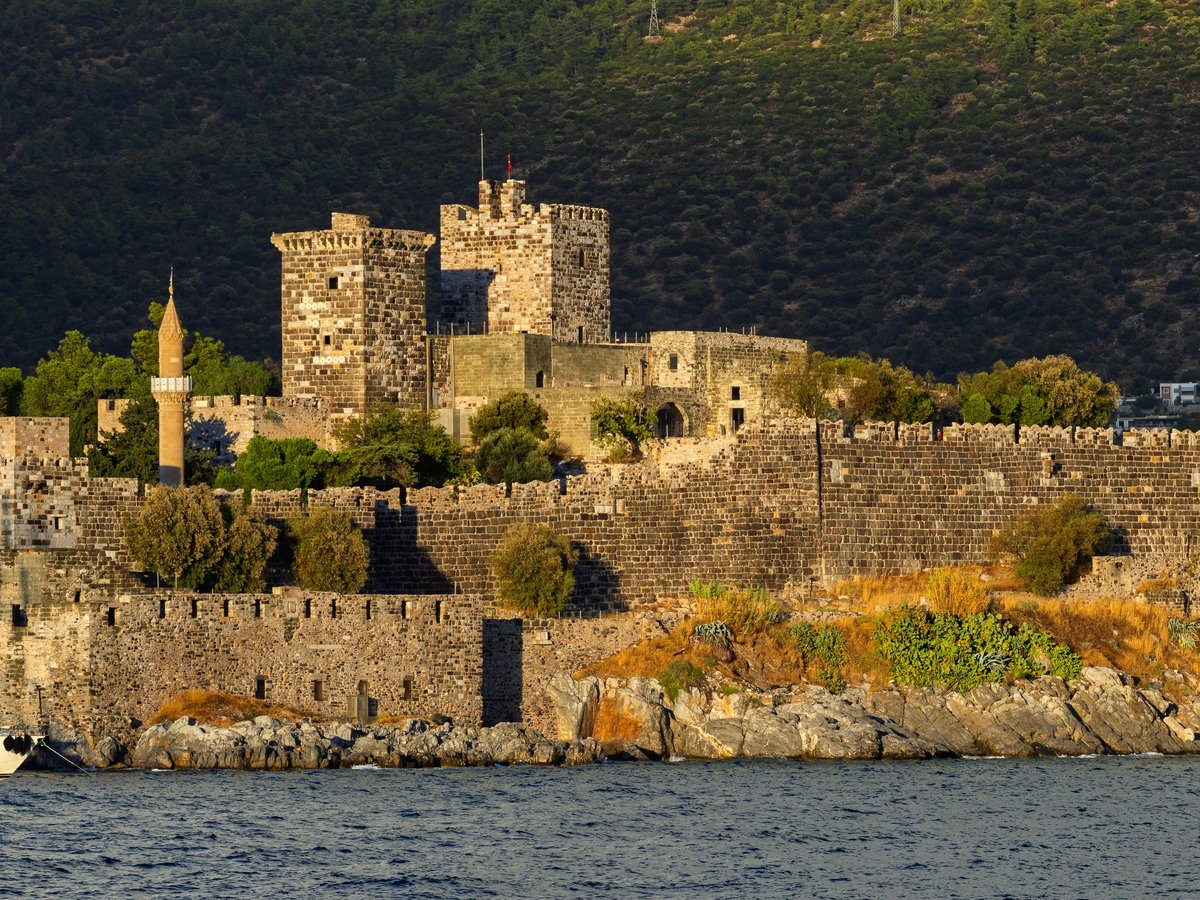
What's the must-see thing in Bodrum?
Bodrum Castle, the Knights Hospitaller fortress completed in 1522 on the harbor's central promontory. It holds the Museum of Underwater Archaeology, with Bronze Age shipwreck finds recovered from the Aegean seabed. Arrive when gates open at 8:30am, before midday heat and tour groups crowd the narrow stone corridors.
The castle sits on a rocky promontory between Bodrum's two harbors, visible from nearly every rooftop terrace in the town center. The Knights of St. John built it over the 15th century, pulling marble and carved Greek reliefs straight from the Mausoleum ruins up the hill to finish the walls. You can still spot those recycled fragments sitting flush alongside Crusader masonry. The underwater archaeology collection inside holds Bronze Age cargo pulled from the seabed off Cape Uluburun, including finds from a wreck dated to roughly 1300 BC. The glass hall displaying the Uluburun pieces stays cool even when outside temperatures push past 31°C in September. Entry runs about 400 TRY, roughly 8 USD at current rates. Allow 90 minutes. The east tower's rooftop terrace catches a salt breeze off the marina and gives you a direct sightline to Kos, the Greek island 20 km across the strait.
The Mausoleum at Halicarnassus is the reason Bodrum appears in any history book. Built in 350 BC as a tomb for the Persian satrap Mausolus, it stood an estimated 45 meters tall and gave English the word 'mausoleum'. Worth noting, what you'll find today is an open-air foundation pit and a handful of column drums. Charles Newton shipped the best sculptural fragments to the British Museum in 1857. That said, the site still earns the walk. Standing at ground level in the excavation, you can trace the 38-by-32-meter footprint and read panels reconstructing the original four-tiered structure. The site sits a 10-minute uphill walk from the castle, on a residential street. Entry is around 200 TRY. Spend 30 minutes, and go in the morning when surrounding pine trees throw shade across the stone. By afternoon the exposed white marble radiates enough heat to feel through your shoes.
Bodrum's ancient theater, cut into the hillside above the Mausoleum, dates to the 4th century BC when the city was still Halicarnassus. The stone seats held roughly 13,000 spectators and face southwest over the peninsula and the Aegean. On a clear September evening the sunset hits the water at around 19:15, and the warm limestone under your hands still carries the day's heat. The theater is free and rarely crowded. From the top row you can see the castle, both harbors, and the silhouette of Kos across the water. All three sites sit within a 15-minute walking triangle. Start at the castle when it opens, walk uphill to the Mausoleum, then continue another 5 minutes to the theater. You'll finish the circuit before the worst heat, typically by 11am.
Skip the Myndos Gate unless you have a specific interest in Hellenistic fortification walls. It sits on the western edge of town, about 2 km from the castle, and the walk there passes through residential blocks with little shade. The gate takes 5 minutes to see. Your afternoon is better spent at the fishing harbor on the west side of the castle, where the boats come in around 16:00 and the restaurants along Cumhuriyet Caddesi grill the catch within the hour. The smell of charring levrek and the sound of ice being shoveled over crates is the most honest version of Bodrum you'll get. For the east marina, expect boat-tour touts calling to you every 30 meters. If you want a boat day, the Kara Ada trip runs about 600 TRY per person, departs at 10:30, and the hot springs on the island's south face smell strongly of sulfur.
The top three
Bodrum Castle
The castle overlooking both harbors holds the region's most significant archaeological collection and defines Bodrum's skyline. Everything else in the town center radiates from it, making it the natural starting point for any first visit.
Mausoleum at Halicarnassus
One of the Seven Wonders of the Ancient World. Only the foundation pit survives, but standing in the excavation for half an hour grounds you in why Bodrum mattered to the ancient Mediterranean.
Ancient Theater of Halicarnassus
Free entry, rarely crowded, and a short uphill walk from the Mausoleum. The highest public vantage point over the peninsula, with both harbors and the Greek islands visible from the top row.
Verified attractions
Sourced from Wikidata and OpenStreetMap: each entry links to its authoritative page.
-
Mausoleum at Halicarnassus
museumone of the Seven Wonders of the Ancient World
View on Wikidata -
Halicarnassus
archaeological siteancient Greek city in Caria, present day Bodrum in Turkey
View on Wikidata -
Bodrum Castle
castlefortification
View on Wikidata -
Myndus
archaeological siteancient city of Caria in modern-day Turkey
View on Wikidata -
Asclepeion of Kos
archaeological siteAsclepeion in Kos Municipality, Greece
View on Wikidata -
Caryanda
archaeological siteancient city of Caria in modern-day Turkey
View on Wikidata -
Bargylia
archaeological siteancient city of Caria in modern-day Turkey
View on Wikidata -
Archaeological Museum of Kos
museummuseum in Greece
View on Wikidata -
HMS Eclipse
archaeological site1934 E-class destroyer
View on Wikidata -
Neratzia
castlecastle in Kos, Greece
View on Wikidata -
Ancient Theatre of Halicarnassus
archaeological siteancient Greek theatre of Halicarnassos, altered in Roman times, in Bodrum, Turkey
View on Wikidata -
HMS Dulverton
archaeological site1941 Hunt-class destroyer
View on Wikidata -
Ancient agora of Kos
archaeological siteView on Wikidata -
Madnasa
archaeological siteancient Greek archaeological site in Turkey
View on Wikidata -
Pedasa
archaeological siteancient city of Caria in modern-day Turkey
View on Wikidata -
Termera
archaeological siteancient city of Caria in modern-day Turkey
View on Wikidata -
Amynanda
archaeological siteancient city of Caria in modern-day Turkey
View on Wikidata -
Ancient Odeon of Kos
theaterancient Roman odeon in Kos, Greece
View on Wikidata -
Casa Romana
museumRestored Roman villa in the city of Kos (Κως) on the Greek island of Kos (Κω)
View on Wikidata -
Neapolis
archaeological siteancient city of Caria in modern-day Turkey
View on Wikidata -
Syangela
archaeological siteancient city of Caria in modern-day Turkey
View on Wikidata -
Telmessos
archaeological siteancient city of Caria in modern-day Turkey
View on Wikidata -
Theangela
archaeological siteancient city of Caria in modern-day Turkey
View on Wikidata -
Ancient stadium of Kos
monumentView on Wikidata -
Bodrum District Stadium
stadiumstadium in Bodrum, Turkey
View on Wikidata -
Church of Agia Paraskevi (Kos)
churchchurch building in Kos Municipality, Greece
View on Wikidata -
West Archeological Site
archaeological siteView on Wikidata
Last verified by automated review (v1.7.2) on . What is automated review?