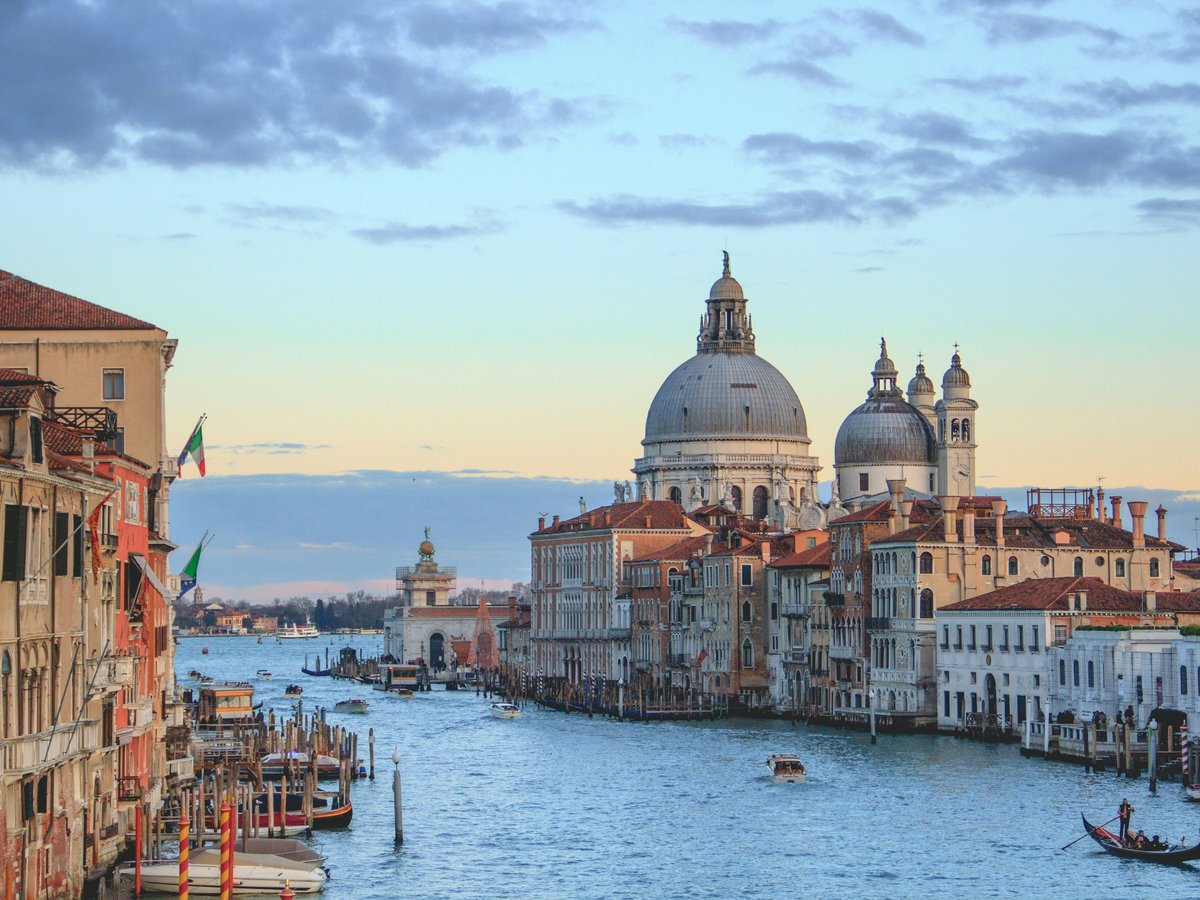
What should I pack for Venice?
Rubber-soled walking shoes that grip wet marble. Venice has no wheeled transport. Every route crosses stepped stone bridges, and the major churches turn away bare shoulders and exposed knees. Bring a bag you can carry over your shoulder, not roll. Pack a universal power adapter for Italian outlets. Skip sunscreen and umbrellas. Both cost less at any Venetian farmacia.
Shop the packing list (16 items)The single most important thing you'll pack for Venice is your shoes. You need rubber-soled walking shoes with actual grip, because you'll cross wet marble and Istrian stone on roughly 400 bridges, most with steps and no ramps. The surface gets slick after rain or when morning fog lifts off the Venetian Lagoon. Venice has zero cars, zero bikes, zero scooters. Every meter between Piazzale Roma and your hotel is on foot. That also means your luggage goes over those same bridges, so ditch the hard-shell roller and bring a backpack or soft duffel you can shoulder-carry. Dragging a wheeled suitcase from Santa Lucia station to a hotel in Cannaregio, maybe 15 minutes of walking, will feel like 45. You'll hear the thud-thud-thud of rollers on bridge steps all across Dorsoduro after every train arrival.
St Mark's Basilica, the Frari, and Santa Maria della Salute all require covered knees, covered shoulders, and no hats. The guards at St Mark's will send you to the back of a 40-minute line in July if you show up in shorts. Pack one pair of lightweight long pants and a scarf or light cardigan you can throw over a tank top. Italy uses Type L electrical plugs, three round pins in a line, at 230V. Your US two-prong might fit some older Italian outlets, but newer sockets reject it. Bring a universal adapter, not a simple European round-pin, because Type L differs from the standard Europlug. Leave any 110V-only hair tools at home unless you pack a voltage converter, which tends not to be worth the weight for a 5-10 day trip.
Venice in late July means temperatures around 27-32°C with humidity that the lagoon makes feel heavier than inland Florence or Rome. You'll want 3-4 lightweight tops you can wash in a hotel sink and dry overnight, because the salt air and sweat cycle through them fast. One packable rain jacket handles the afternoon thunderstorms that roll in 3-4 days a week from June through August. If you're visiting between October and February, the equation changes. Acqua alta, the periodic lagoon flooding, sends 10-30 cm of seawater across Piazza San Marco and the lower fondamente. Waterproof boots or the plastic overshoes that vendors near Rialto sell for 10-15 EUR become non-negotiable when the warning sirens sound. Winter temperatures drop to 2-8°C with a damp cold that gets into your bones faster than a dry 0°C in Milan.
Skip packing sunscreen, mosquito repellent, and umbrellas. Any Venetian farmacia stocks Italian-made sunscreen from Bilboa or Angstrom for 8-12 EUR, often better formulations than US drugstore brands. Mosquito repellent matters here more than most Italian cities because the lagoon breeds them aggressively from June through September. Autan spray runs about 6 EUR. Compact umbrellas show up in every tabaccheria for 5-8 EUR the moment rain starts. Venice's tap water is safe and tastes clean, piped from the mainland since 1884. Fill a reusable bottle at any of the public drinking fountains scattered across the sestieri rather than paying 2.50-3 EUR per small bottle at a bar near San Marco.
Essentials
- Rubber-soled walking shoes with grip for wet marble and stone bridge steps Shop
- Shoulder-carry bag (backpack or soft duffel, not a wheeled roller) Shop
- Universal power adapter for Italian Type L outlets (230V, three round pins) Shop
- Lightweight long pants for church dress codes at St Mark's, the Frari, and Santa Maria della Salute Shop
- Light scarf or cardigan for covering shoulders at churches Shop
- Portable phone charger (Google Maps navigation drains battery by mid-afternoon on a full walking day) Shop
- Reusable water bottle (Venice tap water is safe, public fountains in every sestiere) Shop
- Compact packable rain jacket Shop
- 3-4 quick-dry lightweight tops Shop
- Small crossbody bag or front-pocket wallet (vaporetto stops and San Marco crowds attract pickpockets) Shop
Seasonal extras
- Summer (Jun-Aug): wide-brim hat for shadeless bridges and open campi Shop
- Summer (Jun-Aug): swimsuit for the beach at Lido di Venezia, a 15-minute vaporetto ride from San Marco Shop
- Winter (Oct-Feb): waterproof boots or shoe covers for acqua alta flooding Shop
- Winter (Oct-Feb): thermal base layer for 2-8°C damp cold off the lagoon Shop
- Winter (Oct-Feb): warm insulating mid-layer and windproof outer shell Shop
- Spring/Autumn: medium-weight jacket for 10-16°C evenings on the water Shop
Buy on arrival
- Sunscreen (Bilboa or Angstrom at any farmacia, 8-12 EUR, higher SPF formulations than US brands)
- Mosquito repellent (Autan spray, ~6 EUR at any farmacia, essential June-September)
- Umbrella (5-8 EUR at any tabaccheria, not worth the suitcase space)
- Acqua alta plastic overshoes (10-15 EUR from vendors near Rialto and San Marco, Oct-Feb only)
- Paracetamol and cold medicine (Tachipirina brand, 4-6 EUR, widely stocked)
Last verified by automated review (v1.7.2) on . What is automated review?