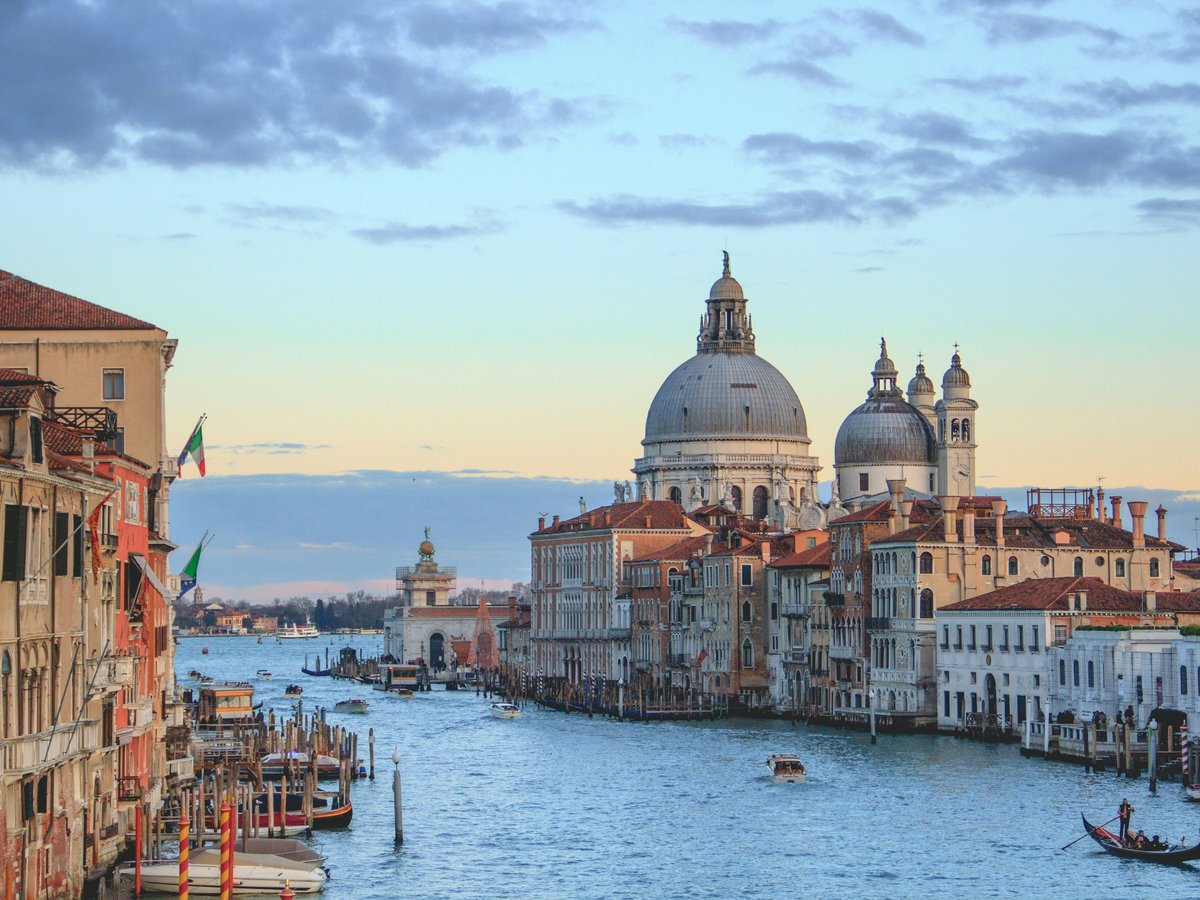
Venice is divided into six sestieri, the historic districts that have organized city life since the 12th century. They fan out from both sides of the Grand Canal in an arrangement that feels less like a planned grid and more like a conversation between water and stone that went on for 800 years. San Marco and San Polo sit roughly at the center, connected by the Rialto Bridge. Cannaregio stretches north toward the train station and the old Jewish Ghetto. Castello pulls east toward the Arsenale and the quieter reaches near Sant'Elena. Dorsoduro curves along the southern edge facing the Giudecca Canal, and Santa Croce occupies the northwestern corner near Piazzale Roma, where cars and buses stop because they have to. The Giudecca, a long sliver of an island across the water, is technically its own thing. Worth noting, the house numbering system in Venice runs sequentially through an entire sestiere rather than by street, so an address like Cannaregio 3842 tells you roughly which district but almost nothing about which alley. Navigation here is largely a matter of following yellow signs toward major landmarks and accepting that you will get lost. That is not a metaphor. You will physically, genuinely get lost, probably within 40 minutes of arriving.
Neighborhoods
-
San Marco
The drawing room of Venice. Piazza San Marco pulls about 60,000 visitors on a peak summer day, and the density near the Basilica can feel like rush hour on the Tokyo Metro. But step 3 minutes north toward Campo Santo Stefano or south toward Campo San Maurizio and the crowds thin noticeably. The architecture here is the grandest in the city. Procuratie Vecchie and Procuratie Nuove frame the piazza with 500 years of arcaded symmetry. At night, after the day-trippers leave on the 6pm trains, the square gets genuinely quiet. You can hear the orchestra at Caffè Florian from 50 meters away.
- Best for
- First-time visitors who want proximity to the Basilica, Palazzo Ducale, and the major museums. Couples willing to pay a premium for a room with a view over the basin toward San Giorgio Maggiore.
- Key streets
- Piazza San Marco itself, the Mercerie (the old shopping corridor connecting San Marco to Rialto), Campo Santo Stefano for an evening aperitivo, Calle Larga XXII Marzo for high-end retail, and the waterfront Riva degli Schiavoni heading east toward Castello.
-
Dorsoduro
Dorsoduro tends to feel like what people imagine Venice should be before they arrive. The Zattere promenade runs along the southern waterfront facing the Giudecca, and on clear afternoons the light bouncing off the canal surface turns everything a warm gold that makes you understand why Turner painted here. The area around Campo Santa Margherita is likely the closest Venice gets to a proper neighborhood square with daily life. Students from Ca' Foscari university fill the benches by late afternoon, and the bars stay open past midnight. It is noisier than you might expect from a city with no cars. The Peggy Guggenheim Collection sits in her unfinished 18th-century palazzo on the Grand Canal, and the Gallerie dell'Accademia holds the definitive collection of Venetian painting, with Bellini and Titian and Tintoretto hung in rooms that still smell faintly of old wood.
- Best for
- Art lovers, university-age travelers who want nightlife that does not feel manufactured, and anyone who wants walkable access to serious museums without sleeping directly in the San Marco crush.
- Key streets
- Campo Santa Margherita for the student bar scene and morning fish market, the Zattere waterfront for long walks and gelato at Nico (their gianduiotto is a frozen praline block served in whipped cream, about 3.50 EUR), Calle della Toletta for small bookshops, and Rio Terà Antonio Foscarini connecting the Accademia bridge area to the interior.
-
San Polo
San Polo is the smallest sestiere by area but possibly the densest in terms of things happening per square meter. The Rialto Market has operated on the same spot since 1097, and the fish market (Pescheria) still opens at dawn Tuesday through Saturday under a neo-Gothic loggia from 1907. By 8am, restaurant buyers are picking through crates of moeche (soft-shell crabs, seasonal, roughly late March and October) and schie (tiny grey lagoon shrimp). The neighborhood narrows into tight calli behind the market where you'll find old-school bacari, the Venetian equivalent of tapas bars. The Basilica dei Frari holds Titian's Assumption of the Virgin, a 7-meter altarpiece that still stops people mid-step when they turn the corner inside the nave. Campo San Polo, the second-largest square in Venice after San Marco, hosts outdoor cinema screenings in summer.
- Best for
- Food-focused travelers who want to eat where Venetians eat, visitors interested in Gothic and Renaissance church art, and anyone who likes waking up early enough to see a working market.
- Key streets
- Ruga Rialto and Ruga Vecchia San Giovanni for the market approach, Campo San Polo for evening strolling, Calle dei Saoneri and the alleys around Campo San Tomà for less-trafficked bacari. The area between the Frari and the Scuola Grande di San Rocco (Tintoretto's ceiling cycle, 56 paintings, took him 23 years) is walkable in about 4 minutes.
-
Cannaregio
Cannaregio holds roughly a third of Venice's remaining resident population, something like 15,000 people, and it shows. The laundry hangs between buildings on lines stretched across alleys. Fondamenta della Misericordia, a long canal-side street in the northern part, has become something of a local bar strip, with places like Paradiso Perduto and Al Timon pulling a younger Venetian crowd. The southern section along Strada Nova (one of the few streets in Venice wide enough to feel like a proper street) gets heavy foot traffic from the train station, but 2 blocks north the tourist density drops sharply. The Jewish Ghetto, established in 1516 as the first in Europe, occupies a small island-within-the-island. The buildings here are notably taller than elsewhere in Venice, some reaching 7 stories, because the restricted community built upward when they could not build outward. The ceilings inside are correspondingly low.
- Best for
- Budget-conscious travelers (Cannaregio has more 2-star hotels and guesthouses than any other sestiere), visitors arriving by train who want walkable accommodation, and anyone who wants a residential rhythm rather than a museum-hopping schedule.
- Key streets
- Fondamenta della Misericordia and Fondamenta degli Ormesini for evening drinks, Strada Nova for the main pedestrian artery, Campo dei Mori (look for the 13th-century stone merchant figures embedded in the building facades), and the Ghetto Nuovo square with its Holocaust memorial and the Museo Ebraico.
-
Castello
Castello is the largest sestiere and it behaves like two different neighborhoods joined at the hip. The western stretch near San Marco has the expensive hotels on Riva degli Schiavoni and the permanent foot traffic flowing toward the Basilica. But past the Arsenale, the old naval shipyard where Venice built its war fleet at a peak rate of one galley per day in the 16th century, the city thins out dramatically. Via Garibaldi, the widest street in Venice, has a genuine neighborhood market most mornings and a handful of places where a spritz still costs 3 EUR. The eastern tip at Sant'Elena is almost suburban. You'll see kids on bicycles there, which is disorienting in Venice. During odd-numbered years, the Biennale takes over the Giardini and the Arsenale from roughly May through November, and the Castello end of the city fills with an international art crowd.
- Best for
- Repeat visitors looking for residential quiet, Biennale attendees, families who need a park (Giardini is Venice's only major green space, about 5 hectares), and travelers who do not mind a 15-minute walk to San Marco in exchange for considerably lower hotel prices.
- Key streets
- Riva degli Schiavoni for the waterfront promenade, Via Garibaldi for daily life and cheap lunches, Campo Santa Maria Formosa (a beautiful square that stays relatively calm), the Arsenale walls along Fondamenta dell'Arsenale, and the park walkways in the Giardini della Biennale.
-
Santa Croce
Santa Croce is where Venice's pedestrian reality meets its vehicular logistics. Piazzale Roma, the bus terminal and car park, sits at the western edge, and most visitors pass through without stopping. That is a mild loss, because the interior of Santa Croce, particularly the area around Campo San Giacomo dell'Orio, has a calm domestic quality that is hard to find elsewhere in the city center. The campo itself slopes slightly, the church dates to the 9th century with 12th-century columns likely taken from Byzantium, and the surrounding alleys have a few genuinely local restaurants where the waiter might not speak English. The neighborhood is not beautiful in the way San Marco is beautiful. It is more workmanlike, with less marble and more brick. The fondaco (warehouse) tradition still shows in the building proportions.
- Best for
- Travelers prioritizing convenience to the bus and train connections at Piazzale Roma, visitors on tighter budgets who want a central base without the San Marco markup, and anyone who finds that too much marble gives them a headache.
- Key streets
- Campo San Giacomo dell'Orio for the neighborhood center, Fondamenta del Megio along the small canal, and the route toward San Polo via Campo San Boldo. The Natural History Museum (Museo di Storia Naturale) inside the 13th-century Fontego dei Turchi on the Grand Canal is here, and it is better than you would expect.
-
Giudecca
The Giudecca sits across the wide Giudecca Canal, maybe 300 meters from Dorsoduro, connected by the number 2 and 4.1 vaporetto lines (about a 5-minute ride from the Zattere stop). It was historically working-class and industrial. The Molino Stucky, a massive brick flour mill from 1895 that dominated the western skyline, is now a Hilton, which tells you something about the trajectory. But much of the island still feels uncommitted to tourism. The waterfront facing north toward the main island has some of the best unobstructed views in Venice, and during Festa del Redentore in July (third Saturday, typically around July 19-20), a temporary pontoon bridge connects the Giudecca to Dorsoduro and the entire city turns out for the fireworks. The population is likely under 5,000 now, down from roughly 15,000 in the 1950s.
- Best for
- Travelers who want to sleep somewhere quiet and do not mind a short vaporetto commute, visitors who prize waterfront views over walkability, and architecture enthusiasts (Palladio's Il Redentore church, 1577-1592, is here).
- Key streets
- Fondamenta San Giacomo on the north side for the view back toward Venice, the area around the Redentore church, and the waterfront walkway along Fondamenta delle Zitelle heading east. The western end near the Hilton is less interesting.
FAQ
Which Venice neighborhood is best for first-time visitors?
San Marco is the conventional choice because the Basilica, Palazzo Ducale, and the main vaporetto stops are all within a 5-minute walk. That said, Dorsoduro gives you nearly equal access (the Accademia bridge crosses to San Marco in about 8 minutes on foot) with lower hotel prices and a better evening atmosphere around Campo Santa Margherita. If your visit is 3 nights or fewer, staying somewhere central saves you significant commute time on the vaporetti, which run on 10-15 minute intervals.
Is it worth staying on the Giudecca or Lido instead of the main island?
The Giudecca works if you want quiet evenings and do not mind a 5-minute vaporetto ride. Hotel prices there tend to run 25-40% below comparable San Marco or Dorsoduro options. The Lido is a different proposition entirely. It is a long barrier island with a beach resort character, about 15 minutes by vaporetto from San Marco. During the Venice Film Festival in late August and early September it fills up completely. Outside of that window, it might feel disconnected from what you came to Venice for.
Where should I stay in Venice on a budget?
Cannaregio consistently has the lowest nightly rates among the central sestieri, with guesthouses and 2-star hotels along the streets north of Strada Nova starting around 80-100 EUR per night in shoulder season (April, early May, October). Santa Croce near Piazzale Roma is another option in a similar range. Castello east of the Arsenale also trends cheaper, though the walk to San Marco from the Via Garibaldi area takes 15-20 minutes.
How do neighborhoods in Venice connect without cars or buses?
You walk, or you take the vaporetto (water bus). An ACTV 7-day pass currently costs 65 EUR and covers unlimited rides on all regular lines. The city is about 4 km end to end, so walking from the train station in Cannaregio to the Giardini in eastern Castello takes roughly 45 minutes if you do not stop and do not get lost. You will stop, and you will get lost. Budget extra time. The traghetto, a standing-only gondola ferry that crosses the Grand Canal at several points, costs 2 EUR per crossing and saves long detours to the nearest bridge.
What are the quietest neighborhoods in Venice for a relaxing stay?
Eastern Castello beyond the Arsenale, particularly the Sant'Elena and San Pietro areas, is as close to suburban quiet as Venice gets. The Giudecca is similarly calm after the last vaporetto crowds thin out around 9pm. Northern Cannaregio along Fondamenta de la Sensa has a residential hush during the day. Mind you, Venice's baseline noise is already lower than most cities since there is no car traffic. The loudest thing you will hear at night in most neighborhoods is someone's television through an open window, or the slap of water against stone.
Which neighborhood has the best food scene in Venice?
San Polo around the Rialto Market is the strongest concentration of genuine bacari (Venetian wine bars serving cicheti). All'Arco, Do Mori (open since 1462), and Cantina Do Spade are all within a 3-minute walk of each other. Dorsoduro has strong sit-down options near the Zattere. Cannaregio's Fondamenta della Misericordia strip mixes bars and restaurants at more local-friendly prices. For seafood specifically, the restaurants along Via Garibaldi in Castello tend to source from the same Rialto market suppliers but charge less for the same fish because the foot traffic is lower.
Last verified by automated review (v1.7.2) on . What is automated review?