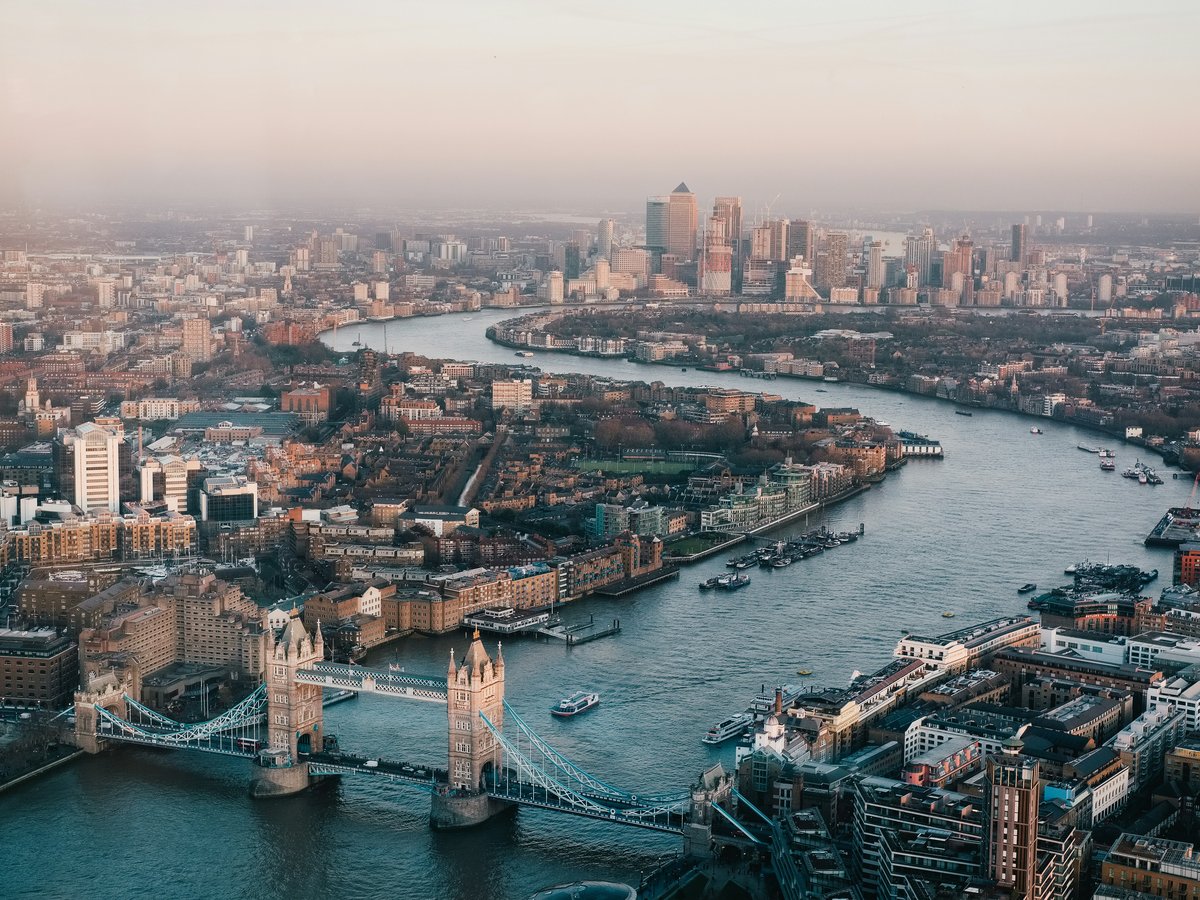
London sits in the Thames basin, a broad, low-lying stretch of clay and gravel that somehow ended up holding one of the world's largest cities, and roughly 3,000 parks. The Thames itself cuts right through everything, tidal and brown and surprisingly full of life if you look closely. What catches people off guard is how quickly the city gives way to genuine countryside. You can be on a packed Tube at nine in the morning and standing in ancient beech woodland by half ten. The weather is, well, English: mild and damp for most of the year, rarely genuinely cold, rarely genuinely hot, and always keeping you guessing. Pack layers. The upside of all that drizzle is that green spaces stay impossibly lush well into autumn. Spring and early summer tend to be the sweet spot for outdoor pursuits, though London's parks are worth visiting year-round. The air smells different once you cross into Richmond Park or Hampstead Heath: woodsmoke in winter, cut grass in June, fox musk at dusk if you're paying attention.
Outdoor activities
-
Road cycling along the Thames from Greenwich to the Thames Barrier
A flat, paved route that follows the south bank of the Thames eastward from Greenwich towards the Thames Barrier. You'll pass the old Royal Naval College and ride alongside working wharves and industrial heritage. The path surface is mostly good tarmac, though there are a few bumpy sections near Woolwich where tree roots have lifted the asphalt. Allow time to stop at the Barrier itself: the steel cowls are genuinely striking up close, especially when the light catches them late in the afternoon.
- Difficulty
- Easy
- Duration
- 1-2 hours round trip
- Best season
- April through October
-
Bouldering and climbing at the Castle Climbing Centre, Stoke Newington
Housed in a converted Victorian water pumping station (the kind of building London has a knack for repurposing) the Castle has been a fixture of the city's climbing scene since the mid-1990s. The outdoor walls are good for warming up, but the real draw is the internal lead walls and extensive bouldering area. Chalk dust hangs in the air, the rubber-mat smell is permanent, and the routes get reset regularly enough to keep things interesting. Day passes available without membership.
- Difficulty
- All levels: routes from V0 to V10+
- Duration
- 2-3 hours typical session
- Best season
- Year-round (indoor facility)
-
Mountain biking on Swinley Forest trails, Bracknell
About 45 minutes by train from Waterloo to Bracknell, then a short ride to the forest. The trail network runs through Forestry England land: mostly sandy soil under pine canopy, which means it drains well and rides reasonably even after rain. Red-graded trails have some decent berms and drop-offs. Nothing extreme, but proper singletrack that'll keep an intermediate rider honest. The café at the car park does a solid bacon roll.
- Difficulty
- Moderate (red-graded trails)
- Duration
- Half day including travel
- Best season
- Year-round, though autumn and winter can get muddy on connecting fire roads
-
Running the Parkrun at Bushy Park, Teddington
One of the original Parkrun venues: this is where the whole movement started back in 2004. The course does a loop through Bushy Park, mostly flat on a mix of tarmac paths and grass. Deer graze nearby and seem completely indifferent to the Saturday morning crowd. It's free, timed, and happens every Saturday at 9 AM. Registration is online beforehand. The post-run coffee culture is half the point.
- Difficulty
- Easy to moderate depending on your pace
- Duration
- 20-40 minutes for the 5K
- Best season
- Year-round
-
Open-water swimming at Hampstead Heath Ponds
Three bathing ponds on Hampstead Heath (men's, women's, and mixed) fed by the River Fleet and surrounded by willow and old oak. The water is dark, cool even in high summer, and there's a slight peaty taste if you accidentally swallow any. Swimming here in early morning with mist still on the surface is one of those quietly remarkable London experiences. Lifeguards on duty during opening hours. Expect the water temperature to sit around 18-20°C at peak summer, dropping to single digits in winter. A small but dedicated community swims year-round.
- Difficulty
- Moderate: cold water acclimatisation needed outside summer
- Duration
- 1 hour visit including changing
- Best season
- June through September for comfortable temperatures; winter for the hardy
-
Trail running on the Capital Ring
London's 78-mile walking route broken into 15 sections, and most of them run well too. The Highgate to Stoke Newington stretch passes through Parkland Walk (a disused railway line now thick with buddleia and birdsong) and feels surprisingly wild for Zone 3. Surfaces vary from paved path to packed earth. You can cherry-pick sections and use the Tube to get back. The whole thing links parks and green corridors in a way that reveals how much of London is connected greenery once you step off the main roads.
- Difficulty
- Easy to moderate per section
- Duration
- 1.5-3 hours per section depending on pace
- Best season
- Spring and autumn: cooler temperatures and fewer crowds on narrower sections
Day hikes
-
Box Hill circular via Stepping Stones, Surrey
Take the train from Waterloo to Dorking, then walk to the famous stepping stones across the River Mole: they're exactly what they sound like, large flat stones in the riverbed, and after heavy rain they sit underwater so you might get wet feet. The climb up Box Hill through the woodland is steady rather than steep, gaining about 130 metres. The views from the top look north across the Weald, and on a clear day you can see for miles. The route loops back through juniper scrub and chalk grassland. The café at the summit is National Trust and does a decent scone. This section of the North Downs Way was used as the cycling road race course in the 2012 Olympics.
- Difficulty
- Moderate: one sustained climb, well-marked paths
- Duration
- 3-4 hours for the 6-mile circular
- Best season
- Late spring for wildflowers on the chalk grassland, autumn for beech colour
-
Seven Sisters cliff walk, East Sussex
Train from Victoria or London Bridge to Seaford, then a flat walk along the Cuckmere River to the coast, where the chalk cliffs begin. The Seven Sisters are a series of undulating chalk downs that dip and rise along the coastline: the cumulative ascent is more than you'd expect from looking at a map, likely around 250 metres over the full traverse. The white chalk against the sea is striking, and the turf underfoot feels springy and close-cropped by sheep. Finish at Birling Gap or push on to Beachy Head. Be mindful of the cliff edges: erosion is constant and the chalk can crumble without warning. The wind picks up considerably on exposed sections.
- Difficulty
- Moderate to strenuous: repeated steep ascents and descents, exposure to wind
- Duration
- 4-6 hours depending on finish point, covering 8-13 miles
- Best season
- May through September: wildflowers peak in June, but autumn is quieter and the light tends to be better for photography
-
Ridgeway National Trail: Ivinghoe Beacon section, Buckinghamshire
The northeastern end of the Ridgeway, Britain's oldest road, finishes at Ivinghoe Beacon with views across the Vale of Aylesbury. Train to Tring, then walk along the chalk ridge. The going is mostly open grassland on top of the Chiltern escarpment, with some woodland sections. Red kites circle overhead: they've been reintroduced here and are now common. The Beacon itself is an Iron Age hill fort site and the panorama from the top takes in several counties. It's an out-and-back unless you arrange transport, but the Tring to Ivinghoe section covers about 7 miles one way.
- Difficulty
- Easy to moderate: gentle gradients on well-defined chalk paths
- Duration
- 3-5 hours for the out-and-back from Tring
- Best season
- April through October: chalk paths get slippery when wet in winter
-
Thames Path: Richmond to Hampton Court
A flat riverside walk that follows the Thames upstream from Richmond through Twickenham to Hampton Court Palace. You'll pass through Marble Hill Park, alongside Eel Pie Island (a proper eccentric Thames island with a history of jazz clubs and boat-builders) and eventually reach Bushy Park and the palace itself. Herons fish from the banks, rowers pass in eights, and the whole thing has a genteel, slightly timeless quality. The towpath surface is mostly good, though there are some muddy stretches near Ham after rain. Worth timing your arrival at Hampton Court for a look at the Tudor kitchens.
- Difficulty
- Easy: flat, paved or packed earth throughout
- Duration
- 2.5-3.5 hours for the roughly 8-mile walk
- Best season
- Year-round, though spring and summer are best for the gardens at Hampton Court
-
Leith Hill and surrounding woodland, Surrey
The highest point in southeast England at 294 metres: modest by any standard, but the views from the tower on top extend to the English Channel on clear days. Train to Dorking or Holmwood, then up through mixed woodland on well-marked paths. The forest here is old (oak, Scots pine, and birch) and the undergrowth includes rhododendron that flowers in late May and early June. The approach from the south through Friday Street is particularly good: a hamlet with a pub and a small lake that sits in a steep-sided valley. The descent can be slippery on clay soil after rain.
- Difficulty
- Moderate: total ascent around 200 metres from the nearest station
- Duration
- 4-5 hours for an 8-10 mile circular from Holmwood station
- Best season
- Late May for rhododendron, October for autumn colour
-
Ashridge Estate circular, Hertfordshire
About an hour from Euston to Berkhamsted, then a walk up into the Ashridge Estate: 5,000 acres of chalk downland and ancient woodland managed by the National Trust. The Bridgewater Monument stands at the high point and you can climb the 172 steps for views over the Chilterns. The woodland paths wind through beech and oak, and in late October the colour here rivals anything in the country. Fallow deer are present but shy. The terrain is rolling rather than steep, with well-maintained paths and occasional boardwalks over wetter sections. A circular from Berkhamsted covers around 8 miles with about 150 metres of cumulative ascent.
- Difficulty
- Easy to moderate: rolling terrain, well-maintained paths
- Duration
- 3-4 hours for the 8-mile circular
- Best season
- Late October for autumn colour, April-May for bluebells
Water activities
-
Kayaking on the Thames from Richmond to Teddington
The stretch between Richmond and Teddington Lock is tidal but relatively sheltered, and several operators rent sit-on-top kayaks and Canadian canoes from the Richmond riverbank during summer months. The current is manageable at slack tide but you do need to check tide times: paddling against a strong ebb is hard work and not much fun. Herons stand in the shallows, cormorants dry their wings on posts, and the river has a distinctly green, weedy smell in high summer. Going upstream toward Teddington Lock gets you away from the busier sections. Worth noting that you share the water with rowers, pleasure boats, and the occasional swan family that will stare you down without blinking.
- Difficulty
- Easy at slack tide, moderate on a flowing tide
- Duration
- 2-3 hours for a return paddle
- Best season
- May through September: operators typically run April to October
-
Stand-up paddleboarding on the Regent's Canal
Several outfits run SUP sessions on the Regent's Canal, typically launching from Paddington Basin or near Camden Lock. The canal is flat, obviously, so it's a forgiving surface for beginners. What makes it interesting is the perspective: you're gliding past houseboats, under brick bridges, alongside the back gardens of Regent's Park. The water is not pristine, to be fair, so falling in is to be avoided. Sessions usually include a board, paddle, and buoyancy aid. Early morning sessions before the towpath fills with cyclists are the quietest.
- Difficulty
- Easy: flat water, guided sessions available
- Duration
- 1.5-2 hours for a typical session
- Best season
- April through October
-
Wild swimming at Beckenham Place Park lake
South London's newest wild swimming spot, opened in 2019 in a restored 18th-century lake in Beckenham Place Park. The lake is spring-fed and surprisingly clear for London. It's a managed swim area with lifeguards, a pontoon, and a roped-off section, so it's a good entry point if you're new to open water. The water temperature follows the seasons honestly: warm enough to be pleasant from June through early September, bracing in spring and autumn, and genuinely cold through winter though hardy swimmers do keep going. The bottom is silty so you'll feel mud between your toes. Changing facilities are basic but functional.
- Difficulty
- Easy: managed site with lifeguards during sessions
- Duration
- Swim sessions typically 1-2 hours
- Best season
- June through September for the most comfortable water temperatures
-
Sailing and dinghy racing at the Welsh Harp Reservoir, Brent
The Welsh Harp (properly called the Brent Reservoir) sits in northwest London and has been home to sailing clubs since the 1950s. The reservoir is about a mile long and hosts dinghy racing through the season. Several clubs offer taster sessions and courses for beginners. The wind can be fickle, blocked by surrounding trees and buildings, which makes it a decent training ground for learning to read gusts. The reservoir is also a Site of Special Scientific Interest for its birdlife: great crested grebes, herons, and overwintering snipe among others. You're sailing while birdsong carries across the water from the reed beds.
- Difficulty
- Beginner to intermediate depending on conditions
- Duration
- Half day for a taster session, full day for courses
- Best season
- April through October: racing season runs roughly March to November
-
Rowing on the Serpentine, Hyde Park
The Serpentine Lido sits in the centre of Hyde Park and you can hire rowing boats and pedalos from the boathouse on the south bank. It's gentle rather than adventurous (the lake is about 40 acres and shallow) but there's something genuinely relaxing about rowing across it with the park stretching out on all sides and the sound of traffic dropping away. The water has a particular grey-green colour and the geese maintain a territorial presence near the boathouse. On hot summer weekends the area gets busy, so weekday mornings are better if you want some space.
- Difficulty
- Easy: recreational rowing on flat water
- Duration
- 30 minutes to 1 hour
- Best season
- April through October: boathouse hours are seasonal
Parks & gardens
-
Richmond Park
FreeAt roughly 2,500 acres, Richmond Park is London's largest enclosed park and still feels genuinely rural in places. Red and fallow deer roam freely (around 630 of them) and in autumn the stags rutting is a proper spectacle, all clashing antlers and bellowing that carries across the grassland. The Isabella Plantation, tucked into the southwest corner, is a woodland garden that peaks in late April when the azaleas go off. There are also Neolithic burial mounds near the centre of the park, quietly sitting there while joggers and cyclists loop past.
Highlights: Isabella Plantation azalea season (late April-May), King Henry's Mound viewpoint toward St Paul's Cathedral, ancient oak trees some estimated at 750 years old, deer rutting season in October
-
Hampstead Heath
Free790 acres of rolling grassland, ancient woodland, and swimming ponds sitting on a ridge of sandy heath in north London. The Heath resists tidiness: paths fork without signposts, brambles crowd the edges, and you can genuinely lose your bearings for a few minutes in the wilder eastern sections. Parliament Hill gives you a wide view south across the London skyline, and on clear days you can pick out landmarks from Crystal Palace to Canary Wharf. The soil is sandy enough that it drains well, so even after heavy rain the main paths stay passable.
Highlights: Parliament Hill viewpoint, three bathing ponds, Kenwood House and its Vermeer, Hill Garden and Pergola (a crumbling Edwardian pergola that feels like a secret), ancient hedgerows in the east
-
Kew Gardens
Three hundred acres of living plant collections, glasshouses, and landscaped grounds along the Thames at Richmond. The Palm House (that great curving iron-and-glass structure from the 1840s) still feels like stepping into another century. Humid, warm, the smell of damp earth and tropical growth even in January. The Temperate House is the larger of the two and holds plants from every temperate zone on earth. The treetop walkway through the woodland canopy is worth doing for the perspective shift alone. Mind you, Kew is a working research institution as much as a garden, so the labelling and organisation tends to be thorough rather than decorative.
Highlights: Palm House, Temperate House, treetop walkway, the Great Pagoda, bluebell woods in spring, autumn colour along the lake
-
Regent's Park and Primrose Hill
FreeRegent's Park proper has formal rose gardens (over 12,000 roses across 400 varieties that peak in June) and sports pitches and a boating lake. But the real draw for a visitor wanting green space is walking north through the park to Primrose Hill, which gives you one of the most recognisable views across central London. The summit is only about 63 metres above sea level but it feels higher, and on bonfire night the hill fills up with people watching fireworks pop across the whole city. The park itself sits on London Clay, so it gets heavy underfoot in winter.
Highlights: Queen Mary's Gardens rose collection (peak June), Primrose Hill summit view, open-air theatre in summer, the boating lake, London Zoo borders the north edge
-
Greenwich Park
FreeOne of the oldest enclosed Royal Parks, sitting on a hill above the Thames with views north to Canary Wharf and the Isle of Dogs. The Royal Observatory marks the Prime Meridian: you can stand with one foot in each hemisphere if you want the photo, though the actual line runs through a slightly different spot depending on which GPS datum you trust. The park has a formal flower garden, a deer enclosure, and ancient sweet chestnut trees that were likely planted in the 1660s. Walking downhill toward the river through the avenue of trees is one of those London moments that earns itself.
Highlights: Royal Observatory and Prime Meridian line, panoramic view from the top of the hill, 17th-century sweet chestnut avenue, Queen's House at the base of the park, deer enclosure
-
Epping Forest
FreeAbout 6,000 acres of ancient woodland stretching from Manor Park in east London up into Essex. This is proper old forest: hornbeam and beech pollards that have been managed since at least medieval times, some of the trees with trunks twisted into shapes that look almost deliberate. The forest floor is thick with wood anemone in spring and the light through the canopy in October is something else. Parts of it feel remote enough that it's hard to believe you're within the M25. Horse riders, mountain bikers, dog walkers, and occasional orienteering groups all share the trails.
Highlights: Iron Age earthworks at Loughton Camp and Ambresbury Banks, Queen Elizabeth's Hunting Lodge (a Tudor timber-framed building you can still visit), the Lost Pond, ancient pollard beech groves near High Beach
Practical tips
- Layering for London weather
- London's weather shifts fast: morning fog can burn off into warm sun by noon, or a clear sky can turn to drizzle in twenty minutes. A lightweight waterproof shell that packs down small is worth more than any other single item. Merino base layers work well for active days because they regulate temperature and don't smell terrible after hours of walking. Cotton is a poor choice once you're sweating or rained on.
- Sun protection
- People underestimate the UV in English summers because the temperature stays moderate. You can burn on an overcast June day: the cloud cover in London is often thin enough to let UV through while blocking the heat that would remind you to apply sunscreen. SPF 30 minimum from April through September, and a cap with a brim for long ridge walks on the South Downs or Chilterns where shade is scarce.
- Water and hydration
- London's tap water is safe and good enough, so carry a refillable bottle and top up from public fountains in the Royal Parks or ask at any café. For day hikes outside the city, fill up before you leave the station: trail water sources are not reliable and not all villages along walking routes have public taps. A litre per person for a 3-hour walk is sensible, more in summer.
- Footwear for trails
- For in-city parks and towpaths, decent trainers with some grip are fine. For day hikes on chalk or clay (and the Surrey Hills and Chilterns are largely chalk and clay) lightweight hiking shoes with proper tread make a real difference when the surface gets wet. Clay in particular turns into a skating rink after rain. Waterproof boots are not strictly necessary in summer but from October to March they'll save you from cold, soggy feet on every outing.
- Trail conditions and access
- Most day hikes from London use public rights of way and National Trail sections, so access is legally protected and generally well-signposted. That said, chalk paths on the North Downs and South Downs get chalky-slippery when wet, and clay sections in woodland can be ankle-deep mud from November through February. The Ordnance Survey app or a 1:25,000 Explorer map is worth having; phone signal drops out in Surrey and Chiltern valleys more often than you'd expect for being so close to London.
- Getting to trailheads by train
- Almost every worthwhile day hike from London is accessible by train: Southeastern, Southern, and South Western Railway services reach the North Downs, South Downs, Chilterns, and Surrey Hills within 40-70 minutes. Buy a return ticket and check weekend engineering works before you go, because replacement bus services can add an hour to your journey and don't always stop near the trailhead. An off-peak return to Dorking or Tring currently costs around eight to twelve pounds.
FAQ
Is London a good city for outdoor activities?
It is, though it takes people by surprise. There are roughly 3,000 parks within the city, the Thames Path runs 184 miles from source to sea, and genuinely wild countryside is within an hour by train in three directions. The climate is mild enough to be outdoors year-round: it rarely drops below freezing or rises above 30°C. You won't get big mountains, but for walking, cycling, swimming, and paddling, the variety is hard to match for a city this size.
When is the best time of year for outdoor activities around London?
Late April through October covers the widest range of activities. May and June tend to have the longest days and the best wildflower displays on chalk grassland walks. July and August are warmest for swimming and water sports but can be crowded. September and October bring softer light, autumn colour, and fewer people on trails. Winter is quieter still: the parks are at their most atmospheric, and the swimming ponds at Hampstead Heath have a devoted cold-water community that keeps going through the year.
Do I need a car to reach good hiking from London?
Not at all. The train network connects London to excellent walking country within an hour. Dorking and Box Hill, Tring and the Ridgeway, Seaford for the Seven Sisters, Berkhamsted for Ashridge: all reachable by direct train. The London LOOP and Capital Ring are walking routes entirely within Greater London accessible by Tube and bus. A car is only really useful if you want to reach the more remote parts of the North or South Downs where stations are sparse.
Is it safe to swim in London's outdoor swimming spots?
The managed sites (Hampstead Heath ponds, Beckenham Place Park lake, the Serpentine Lido) all have lifeguards during sessions and monitored water quality. They're as safe as any managed outdoor swimming. The Thames itself is a different matter: the tidal sections through central London have strong currents, cold water, and boat traffic, and swimming there is strongly discouraged by the Port of London Authority. Non-tidal sections upstream are swimmable in places but require local knowledge of currents and water quality.
What gear do I need for a day hike from London?
Keep it straightforward: comfortable walking shoes with decent grip, a waterproof jacket, a water bottle, a phone with offline maps or an OS paper map, snacks, and sunscreen from April to September. You don't need specialist hiking gear for the Surrey Hills or Chilterns: these are rolling hills with well-marked paths, not alpine terrain. In winter, add a warm layer and a hat. The single most important item is proper footwear: clay and chalk paths get treacherous when wet, and trainers without grip will let you down.
Are the Royal Parks safe for running and cycling early in the morning?
Generally yes. The major Royal Parks (Hyde Park, Richmond Park, Regent's Park, Greenwich Park) are popular with runners and cyclists at all hours during daylight. Richmond Park opens at 7 AM in summer and 7:30 AM in winter; Hyde Park is open from 5 AM. The paths are well-maintained and shared with other users, so watch your speed on a bike around pedestrians. In Richmond Park, keep a respectful distance from the deer: at least 50 metres, especially during rutting season in October when the stags are territorial and unpredictable.
Outdoor experiences in London
 Free cancellation
 Moriarty's Game: The Professor's Invitation by HiddenCity
Outdoor experience: free cancellation.
via Viator Free cancellation
 Speedboat 'Tower RIB Blast' from Tower Millennium Pier - 20 minutes
Outdoor experience: 20 minutes, free cancellation.
via Viator Free cancellation
 Thames Rockets Sunset London Speedboat Experience
Outdoor experience: 50 minutes, free cancellation.
via Viator Free cancellation
 Summit Ally Pally
Outdoor experience: 1 hour, free cancellation.
via Viator Free cancellation
 Rocket Rebel London Speedboat Experience
Outdoor experience: 50 minutes, free cancellation.
via ViatorLast verified by automated review (v1.7.2) on . What is automated review?