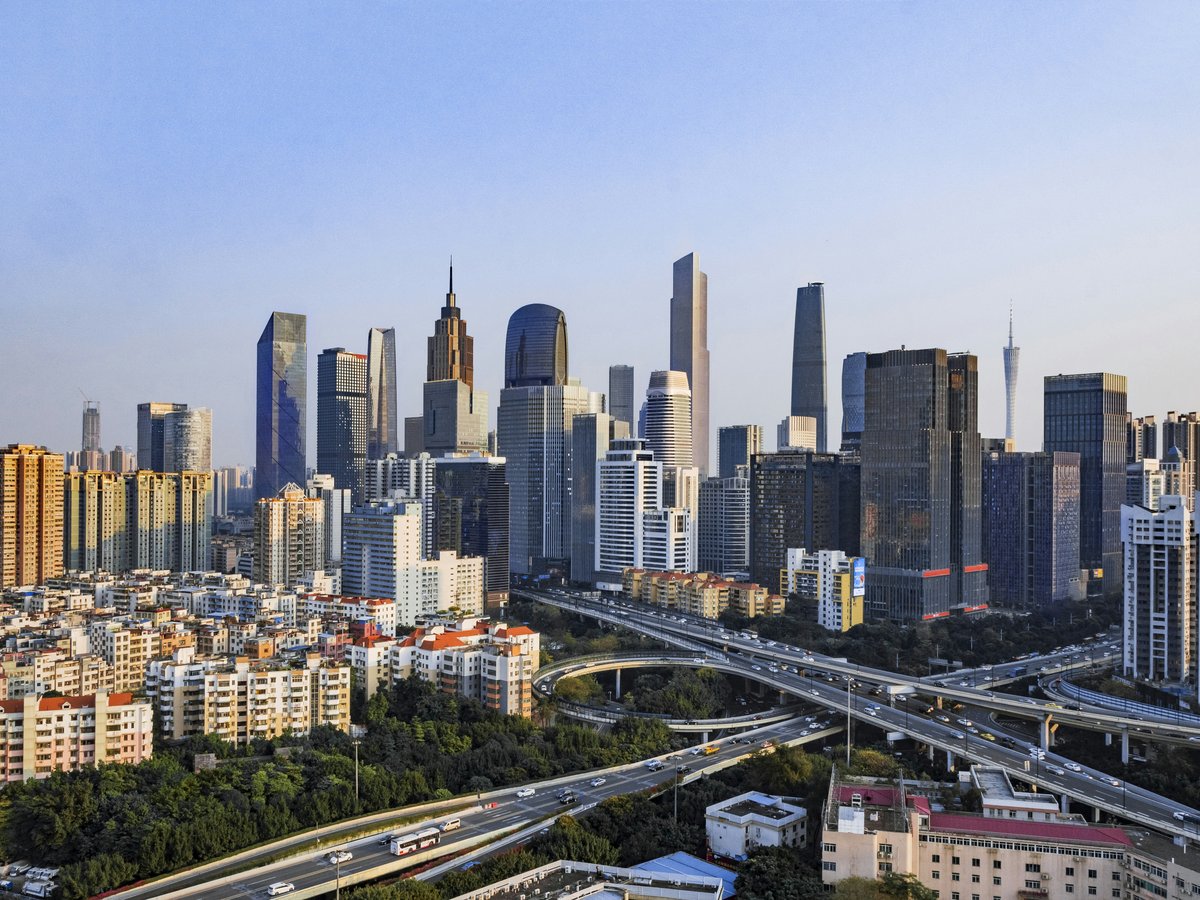
Guangzhou sprawls along the Pearl River, and the water still serves as the best compass for getting oriented. The old districts of Yuexiu and Liwan hug the north bank, packed tight with lanes where char siu smoke hangs in the air every 20 meters from about 6 AM. Tianhe grew east of the old core into the modern commercial district. Glass office blocks run along Tianhe Road for roughly 3 kilometers. South of the river, Haizhu holds the Pazhou exhibition grounds and the city's tallest structure. Panyu lies further south, suburban and spread out, anchored by theme parks and a university island. Metro Lines 1, 2, and 3 connect all of these zones within 30 to 40 minutes on most routes. Mid-September weather currently sits at 25.7°C with 89% humidity under clear skies, and you feel the moisture on your skin the moment you surface from a metro exit. At roughly 6.71 CNY to the US dollar, a 30 CNY bowl of wonton noodles runs about 4.50 USD.
Neighborhoods
-
Yuexiu
Yuexiu is the administrative and historic heart of Guangzhou, dense and loud in the way that a district carrying 34,000 residents per square kilometer tends to be. Sacred Heart Cathedral has stood on Yide Road since 1888, its twin Gothic spires still visible above the wholesale market blocks. Yuexiu Park covers 86 hectares to the north and holds the Five Rams Statue, the city's symbol. Sun Yat-sen Memorial Hall sits at the park's southern edge, octagonal and blue-tiled. Yuexiushan Stadium, built in 1950 on the park's hillside, still hosts local football matches on sticky evenings when you can smell the damp grass from the concrete stands. Beijing Road runs about 1 kilometer east as the main pedestrian shopping street. Glass panels set into the pavement reveal excavated road surfaces from the Song and Ming dynasties, lit from below so you can see worn stone flags and old drainage channels. The food leans old-school Cantonese, with dim sum parlors scattered through the lanes north of Beijing Road that have been open since the 1940s.
- Best for
- First-time visitors, history lovers, and budget travelers. Hotels near Beijing Road start around 250 to 400 CNY per night for a clean 3-star room.
- Key streets
- Beijing Road for pedestrian shopping, Yide Road through the wholesale dried-goods quarter, Zhongshan Lu as the main east-west artery, and Wende Road for old bookshops mixed with food stalls
-
Dongshan
Dongshan sits in the eastern part of Yuexiu District, technically merged into it in 2005, but locals still treat it as its own neighborhood. The area around Dongshan Kou station on Metro Line 1 is defined by Republican-era garden villas from the 1920s and 1930s, low-rise yellow and red brick houses behind wrought-iron gates. Roughly a dozen of these yangfang along Qiming Road and its side streets now operate as independent cafes, vintage shops, and small galleries. The pace in Dongshan drops compared to the main roads in Yuexiu's western half. You might walk 3 or 4 blocks on Shuyin Road hearing nothing but someone's radio through an open window. Old camphor trees along Meihua Road throw deep shade in summer afternoons, and the light filters down in patches on the brick walkways. Mind you, rents here have climbed since about 2018, with a ground-floor cafe lease on Qiming Road reportedly running 4 to 5 times what it cost a decade ago.
- Best for
- Photographers, cafe culture fans, and couples looking for a quieter base. Hotels are limited in Dongshan itself, so most visitors stay in central Yuexiu and walk over or take 1 metro stop.
- Key streets
- Shuyin Road for villa architecture and shade, Meihua Road for quiet residential walks, and Qiming Road for the cafe and boutique cluster
-
Liwan (Xiguan)
Liwan is old Guangzhou at its loudest and most flavorful. The Xiguan quarter in the southern part of the district preserves traditional Cantonese architecture at a street-walking scale. Qilou, the covered arcade-style shophouses with columns sheltering the sidewalk, line stretches of Shangxiajiu Pedestrian Street and Enning Road. Chen Clan Ancestral Hall, completed in 1894 on Zhongshan Qi Road, works as both a folk art museum and one of the finest surviving examples of southern Chinese decorative architecture, its roof ridges depicting Cantonese opera scenes in colored ceramic. Shangxiajiu stays busy from about 10 AM through midnight, loud and thick with the smell of roast goose fat and sesame balls once the snack vendors fire up after 4 PM. Enning Road has been through a slow renovation since roughly 2007, with old Xiguan mansions restored alongside Yongqing Fang, a lane of creative studios and tea shops. The produce markets around Duobao Road still trade live fish and stacked crates of lychee in season, the concrete floors slick with meltwater from ice bins.
- Best for
- Food-focused travelers, architecture fans, and budget shoppers. Guesthouses near Changshou Road metro sit among the cheapest in central Guangzhou, with rooms starting around 150 to 200 CNY per night.
- Key streets
- Shangxiajiu Pedestrian Street for the main shopping and snack corridor, Enning Road and Yongqing Fang for restored Xiguan mansions, Duobao Road for wet markets, and Longjin Road for traditional Cantonese restaurant rows
-
Shamian Island
Shamian Island is a 900-meter sandbar in the Pearl River, connected to Liwan by two short bridges. It served as a European trading concession from 1861, and the colonial architecture remains largely intact. About 150 European-style buildings line the island's boulevards, mostly French and British in design, with shuttered windows and wrought-iron balconies overhead. Motor traffic on Shamian is restricted. The loudest sound on a weekday afternoon might be the click of a camera shutter or wind through the banyan canopy. On weekends, wedding photographers take over Shamian Dajie, the main east-west street, posing couples against the colonial facades from morning until dusk. Banyan trees older than most of the buildings arch over the walkways and drop aerial roots that brush the tops of park benches. A few cafes and small restaurants occupy restored ground floors, but Shamian functions more as a 2-hour walk than a dining destination.
- Best for
- Couples, photographers, and anyone needing a quiet afternoon off the main Guangzhou grid. Not ideal as a base, since hotel options on the island amount to 2 or 3 properties.
- Key streets
- Shamian Dajie for the main east-west boulevard under the banyans, Shamian Nanjie for the south-facing waterfront path, and the small stone park at the island's western tip
-
Tianhe
Tianhe is where Guangzhou makes its money. The district's rise started with Tianhe Stadium, built in 1987 for the 6th National Games and still anchoring the Tianhe Sports Center complex at the intersection of Tianhe Road and Tiyu Xi Road. Tianhe Road runs east from the stadium through several kilometers of shopping malls. Teem Mall, Grandview Mall, and Taikoo Hui (opened 2011) sit within a 15-minute walk of each other. Guangdong Olympic Center, completed in 2001 about 7 kilometers north in the Aoyuan area, handles larger events. Dapeng International Plaza, finished in 2006, adds another high-rise to the district's skyline. At street level, Tianhe is polished granite, air conditioning, and the hum of escalators. The restaurant scene along Tiyu Dong Road and south of Taikoo Hui leans international, heavy on Japanese izakayas and Korean BBQ spots with a handful of Western steakhouses between them.
- Best for
- Business travelers, shoppers, and anyone wanting international dining within walking distance. Mid-range hotels along Tianhe Road run 400 to 700 CNY per night, with luxury options near Taikoo Hui reaching 1,200 CNY and above.
- Key streets
- Tianhe Road for the mall corridor, Tiyu Xi Road and Tiyu Dong Road for restaurants and nightlife near the stadium, and the underground pedestrian network beneath Tiyu Zhongxin station
-
Zhujiang New Town
Zhujiang New Town is the newest piece of central Guangzhou, built on reclaimed land along the Pearl River's north bank east of the old Tianhe core. The two asymmetric shells of Guangzhou Opera House, designed by Zaha Hadid and opened in 2010, sit at the district's eastern edge facing the water. Bank of Guangzhou Tower, completed in 2012, rises a few blocks west. Haixinsha Island, a narrow strip between the two river banks, connects to the Opera House area by pedestrian bridge and hosts open-air events during the cooler months from November through February. Guangdong Museum and Guangzhou Library face each other across Huacheng Avenue, the landscaped central boulevard. At night, the Pearl River-facing towers run a synchronized LED light show that reflects off the water in shifting colors. That said, Zhujiang New Town carries a somewhat sterile weekday feel. The wide sidewalks stay empty until office workers surface around 6 PM.
- Best for
- Architecture enthusiasts, museum visitors, and travelers who prefer newer luxury hotels. The district's 5-star properties, including the Four Seasons and the W Hotel, sit within walking distance of the waterfront.
- Key streets
- Huacheng Avenue for the museum row and central green, Zhujiang Dong Road for waterfront dining, and the pedestrian bridge to Haixinsha Island for evening views across to the south bank
-
Haizhu
Haizhu District covers the south bank of the Pearl River, and Canton Tower, opened in 2010, is the landmark that pins the area in most visitors' mental maps. The tower reaches 600 meters including its antenna mast and dominates the south-bank skyline. Immediately east, the Pazhou area holds the Canton Fair exhibition complex, which pulls tens of thousands of trade buyers twice a year in April and October. Away from these two anchors, Haizhu turns residential and surprisingly green. Haizhu Wetland Park covers roughly 1,100 hectares in the district's center, with boardwalks through dense vegetation and birdwatching hides. Binjiang Dong Road runs along the north-facing riverfront with a long promenade, food stalls, and views back across to the north bank's towers. The area around Jiangnan Xi metro station, further west, still feels like 1990s Guangzhou, with small tailoring shops, sidewalk produce sellers, and the warm, slightly sour smell of fermenting tofu from the wet markets along Nanhua Zhong Road.
- Best for
- Repeat visitors who want local neighborhood life, families heading to the wetland park, and trade-fair attendees staying near Pazhou. Hotels near Canton Tower tend to run 300 to 600 CNY per night.
- Key streets
- Binjiang Dong Road for the riverfront promenade, Jiangnan Dadao for local markets, Changgang Road for Cantonese restaurant clusters near the district's western end, and the boardwalk loops inside Haizhu Wetland Park
-
Panyu
Panyu District lies south of Haizhu, roughly 40 minutes from the city center by metro, and feels like a different city entirely. Chimelong Tourist Resort anchors the entertainment zone with a safari park, a water park, and the Chimelong International Circus. University Town occupies Xiaoguwei Island in the Pearl River, home to 10 universities and the Guangzhou Higher Education Mega Center Central Stadium. Shawan Ancient Town, about 15 kilometers west of Chimelong, dates back over 800 years to the Song dynasty and still preserves Ming and Qing architecture along Anningxi Street. Panyu is spread out, and you need buses, metro, or taxis between these places. The food here leans toward Shunde-influenced Cantonese cooking, which tends to run slightly sweeter and more delicate than what you find north of the river. A clay-pot rice bowl at the stalls near Shawan's main square costs 25 to 30 CNY and arrives with a crackling crust of scorched rice at the bottom.
- Best for
- Families with kids heading to Chimelong, day-trippers with an interest in Song-dynasty towns, and anyone curious about Shunde-style Cantonese food. Budget hotels near Chimelong start around 200 to 350 CNY per night.
- Key streets
- Anningxi Street in Shawan for Ming and Qing architecture, the Chimelong resort perimeter roads, and the campus ring roads on Xiaoguwei Island for cycling
FAQ
Where should I stay on a first visit to Guangzhou?
Yuexiu puts you closest to the historic core, with Beijing Road, old dim sum institutions, and Metro Lines 1 and 2 all within walking distance. Accommodation prices in Yuexiu sit at the lower end of the central Guangzhou range. If you prefer modern surroundings, Tianhe along Tianhe Road has international restaurants and newer hotel stock. To be fair, either district works as a base for covering the rest of the city by metro. Gongyuanqian station, on both Line 1 and Line 2, makes a practical pivot point between the two areas.
Is Guangzhou safe for solo travelers?
Guangzhou scores 6.5 out of 10 for solo-traveler safety (see the TTDI Solo-Safety Index). The metro system runs until about 11 PM on most lines and feels well-monitored. Petty theft sometimes occurs in crowded areas like Shangxiajiu and around Guangzhou Railway Station, so keep valuables in a front pocket at those spots. Streets in Yuexiu and Liwan thin out quickly after midnight, while Tianhe stays busier later. Worth noting, English signage is limited outside hotels and major malls, so a translation app loaded offline helps considerably.
How family-friendly is Guangzhou?
Guangzhou rates 7.2 out of 10 for family friendliness (see the TTDI Family-Friendliness Index). Chimelong Safari Park in Panyu is the biggest draw for younger kids, and the wetland park in Haizhu works well for a quieter half-day outdoors. Most restaurants accommodate families without fuss. Dim sum is practical for picky eaters because you can point at dishes on the cart rather than deciphering a menu. Summer heat and humidity tire small children fast, so plan indoor time in air-conditioned malls during the 1 PM to 4 PM window.
Is Guangzhou welcoming for LGBTQ+ travelers?
Guangzhou scores 3.0 out of 10 for LGBTQ+ friendliness (sourced from TTDI's editorial rubric). Public displays of affection between same-sex couples tend to draw stares, particularly outside Tianhe. A few LGBTQ+-friendly bars exist around the Tianhe nightlife strip, but they keep a low profile. There are no legal protections for LGBTQ+ individuals in China, and social attitudes in Guangdong, while somewhat more relaxed than parts of northern China, still lean conservative overall.
Which neighborhood has the best traditional Cantonese food?
Liwan's Xiguan quarter likely has the strongest claim, with some of the oldest continuously operating dim sum restaurants in the city and evening snack vendors that set up along the pedestrian streets after dark. Panyu runs second, particularly around Shawan, where Shunde-influenced dishes lean sweeter and more delicate. Yuexiu has depth along its northern lanes, especially for morning congee and rice-noodle rolls. Tianhe is stronger for international food than for traditional Cantonese cooking.
Is Guangzhou a good base for digital nomads?
Guangzhou scores 3.8 out of 10 for digital-nomad suitability (sourced from TTDI's editorial rubric). Cafe wifi works reasonably well in Tianhe and Dongshan, but dedicated coworking spaces are fewer than in Shenzhen or Bangkok. The city's economy leans toward manufacturing and trade rather than tech, so the remote-worker community stays smaller. Visa logistics for extended stays are more involved than at Southeast Asian nomad hubs. That said, monthly rent for a studio apartment in Tianhe currently starts around 3,000 to 4,000 CNY, lower than comparable neighborhoods in Shenzhen or Shanghai.
Last verified by automated review (v1.7.2) on . What is automated review?