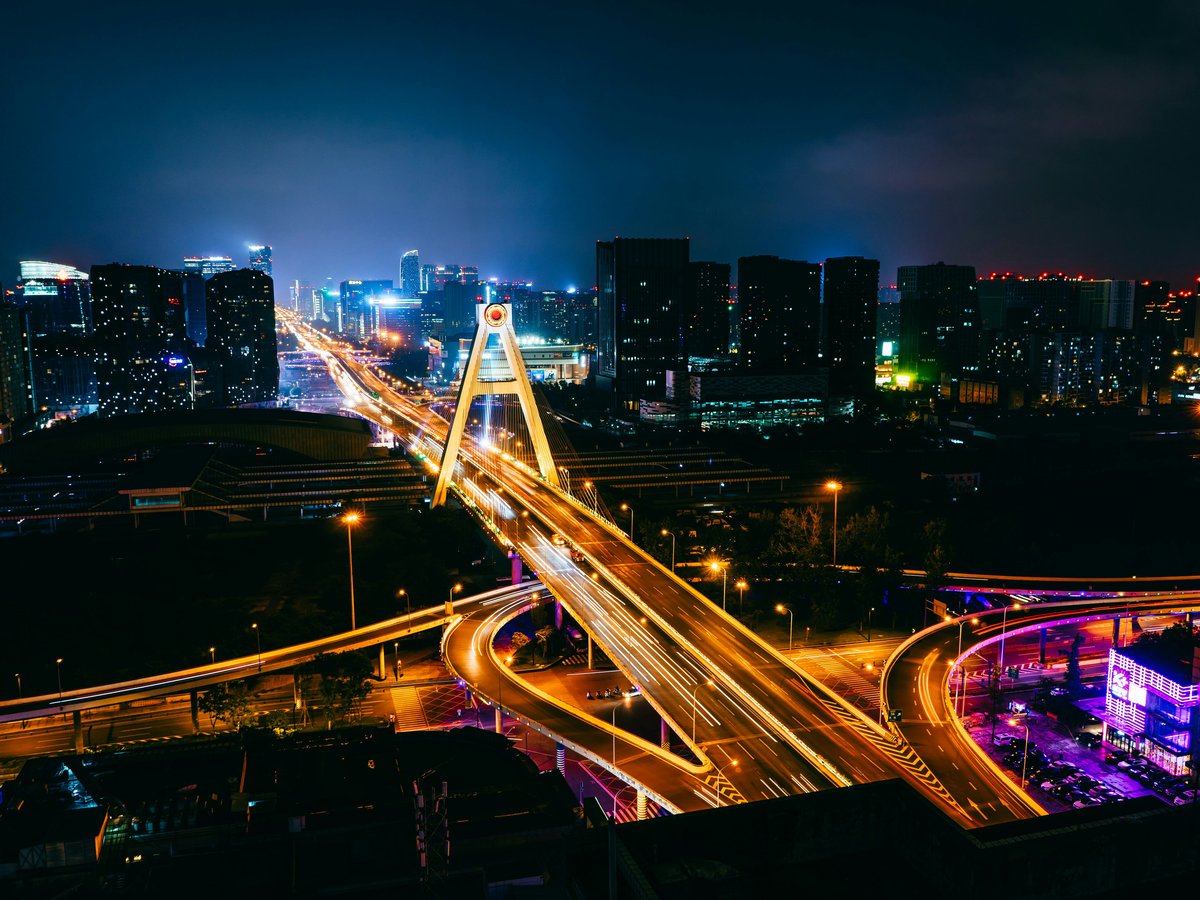
Chengdu sits at roughly 500 meters above sea level on the western rim of the Sichuan Basin, where rice paddies and rapeseed fields give way to the first ridgelines of the Qionglai Mountains. The Fu River and Jin River thread through the urban core, flanked by ginkgo-lined walkways where residents practice taiji sword forms before 7 AM on most mornings. To the west, peaks above 5,000 meters in the Qionglai range stand less than 150 km from the city center. To the east, the Longquan hills rise to about 1,000 meters and turn pink with peach blossoms each March. The city averages fewer than 50 genuinely sunny days per year, and the basin air currently reads 23.1°C with 78% humidity in mid-September, which is fairly typical. That persistent overcast keeps summer highs moderate compared to Chongqing roughly 300 km downstream, making the city surprisingly tolerable for cycling and trail running from May through October. Within 90 minutes of downtown, you can reach a Taoist sacred mountain, forested gorges with seasonal whitewater, or an irrigation system from the 3rd century BC that still diverts the Min River across the plain.
Outdoor activities
-
Cycling the Tianfu Greenway
The Tianfu Greenway system connects parks, wetlands, and neighborhoods across greater Chengdu through hundreds of kilometers of paved, vehicle-separated cycling paths. The main loop circling the city's third ring road covers roughly 100 km and passes through Jincheng Lake Park, Guixi Ecological Park, and several wetland corridors. Bike-share docks from Meituan and Hello Bike appear every few hundred meters along major sections, costing around 1.5 CNY per 30 minutes. The terrain is flat and the lanes are wide enough that you rarely compete with pedestrians before 10 AM on weekends. You'll catch jasmine scent along the southern stretches near Shuangliu in spring, and the ginkgo sections turn golden in late November.
- Difficulty
- Easy
- Duration
- 2 to 6 hours depending on distance
- Best season
- March to May, September to November
-
Mountain Biking in the Longquan Hills
The Longquan range rises along Chengdu's eastern fringe, with the highest point reaching about 1,051 meters. The hills are laced with farm roads and single-track trails through bamboo groves, tangerine orchards, and pine forest. Local cycling clubs organize group rides most weekends, typically departing from Longquanyi town at the range's western base. Decent mountain bikes rent for 100 to 200 CNY per day from shops near the Longquanyi metro terminus on Line 2. The trails are mostly packed earth and gravel that turns slick after rain, so dry-weather days are significantly better. Expect 400 to 600 meters of climbing on a typical loop.
- Difficulty
- Moderate
- Duration
- 3 to 5 hours
- Best season
- March to May, September to November
-
Skiing at Xiling Snow Mountain
Xiling Snow Mountain sits about 95 km west of Chengdu's center and runs a ski resort from December through March. The slopes sit at roughly 2,200 meters elevation with around 7 runs graded from beginner to intermediate. Equipment rental is available on site, and the drive from central Chengdu takes about 2.5 hours via the Chengya Expressway. Temperatures at the resort hover between negative 5 and positive 5°C during the season. Worth noting, Sichuan snowfall tends toward wet and icy rather than dry powder, so conditions suit carved turns more than deep-snow riding. The resort also offers snowshoeing and sledding for non-skiers.
- Difficulty
- Beginner to intermediate
- Duration
- Full day
- Best season
- December to March
-
Trail Running along the Fu River
The paved path following the Fu River extends about 15 km through central Chengdu, from the northern suburbs past the Wenshu Monastery neighborhood down to the confluence with the Jin River near Hejiangting. The route is flat, shaded by camphor and banyan trees, and wide enough to avoid most pedestrian traffic before 8 AM. Air quality in the basin can be poor from November through February, so checking the AQI before heading out for a hard effort is worth building into habit. The Chengdu Hash House Harriers group meets regularly for trail runs that sometimes extend into the foothills east of town.
- Difficulty
- Easy
- Duration
- 1 to 2 hours
- Best season
- March to May, September to November
-
Birdwatching at Qinglong Lake Wetland
Qinglong Lake Wetland Park in Chengdu's eastern suburbs preserves a sizable freshwater marsh and lakeshore habitat. Over 200 bird species have been recorded across the Chengdu plain, including several egret species, various kingfishers, and wintering waterfowl that arrive from November onward. The lake's reed beds and shallow margins are most productive for sightings during the cooler months. Binoculars and the MacKinnon field guide to Chinese birds are sufficient equipment. Entry is free. Early mornings along the eastern shore path tend to yield the best variety, particularly between November and February when migratory visitors outnumber the resident species.
- Difficulty
- Easy
- Duration
- 2 to 4 hours
- Best season
- November to February
Day hikes
-
Mount Qingcheng Front Mountain
The front face of Mount Qingcheng is a UNESCO World Heritage Site about 68 km northwest of central Chengdu. The trail from the main gate to Laojun Pavilion at the 1,260-meter summit climbs around 800 meters through forest thick with cryptomeria and fern. The path is almost entirely stone-stepped, well maintained, and shaded. A cable car covers the upper section for those who prefer it. Taoist temples appear at intervals along the route, and the forest smells of cedar and damp moss. Admission is around 80 CNY. The Chengdu-Dujiangyan intercity rail reaches Qingchengshan Station in roughly 40 minutes from Xipu Station.
- Difficulty
- Moderate (continuous stone steps)
- Duration
- 4 to 5 hours round trip
- Best season
- March to May, September to November
-
Mount Qingcheng Back Mountain
The back mountain is wilder and less developed than the front, with trails leading through waterfalls, moss-covered gorges, and small farm settlements. The main route from Tai'an town up to Baiyun Temple gains about 1,200 meters and takes 5 to 7 hours for a full loop. The path alternates between well-stepped stone sections and rougher dirt track. Admission runs about 20 CNY. Guesthouses in Tai'an town offer basic rooms for 100 to 200 CNY per night if you want to split the effort across 2 days. Carry a headlamp, because the forest canopy is dense enough to darken the trail well before sunset.
- Difficulty
- Moderate to strenuous
- Duration
- 5 to 7 hours (full loop)
- Best season
- April to October
-
Longquan Mountains Peach Blossom Valley
The Longquan range along Chengdu's eastern edge includes low hills latticed with peach and plum orchards that turn solid pink in March and early April. The walking is gentle, rarely exceeding 200 meters of elevation gain on any loop. Public transit from downtown reaches the foot of the range, and local buses or taxis cover the remaining distance to the orchards. The trails are informal, following orchard edges and village lanes through farmland. A typical circuit takes 2 to 3 hours. Bring cash for roadside fruit stalls selling fresh peaches at harvest time.
- Difficulty
- Easy
- Duration
- 2 to 3 hours
- Best season
- March to April for blossom season, also pleasant October to November
-
Dujiangyan Irrigation Park to Erwang Temple
The ancient irrigation works at Dujiangyan sit 55 km northwest of Chengdu and share a rail connection with the Qingcheng mountain area. A walking route through the scenic park connects the Fish Mouth Levee, the Flying Sands Weir, and the Bottle Neck Channel before climbing to Erwang Temple on the hill above. The loop covers about 5 km with minimal elevation gain. The roar of the Min River through the diversion structures fills the air along the lower sections. Admission to the scenic area costs around 80 CNY. This pairs well with a morning on the Taoist mountain nearby if you start early enough.
- Difficulty
- Easy
- Duration
- 2 to 3 hours
- Best season
- Year-round; spring meltwater makes the river most impressive from April to June
-
Jiguanshan
Jiguanshan National Forest Park sits about 90 km west of Chengdu near the town of Chongzhou. The highest point reaches roughly 2,600 meters, and the main trail follows a creek valley through old-growth forest for about 8 km before opening into subalpine meadows. Expect to share the trail with local mushroom foragers in summer. The round trip gains about 1,000 meters of elevation, with no cable car and no paved steps. The trailhead is accessible by car from the Chengya Expressway, and the drive takes around 2 hours. Start early, because afternoon cloud and drizzle build reliably from May through September.
- Difficulty
- Strenuous
- Duration
- 6 to 8 hours round trip
- Best season
- May to October; wildflower meadows peak June to August
Water activities
-
Whitewater Rafting at Hongkou
The Hongkou section of the Baishuihe River near Dujiangyan offers Class II to III rapids during summer, roughly June through September. The commercial rafting run covers about 6 km and takes around 2 hours on the water. Several outfitters operate from the staging area in Hongkou town, with prices typically between 150 and 250 CNY per person depending on the operator and day of week. The water runs cold even in August, fed by mountain snowmelt and rain. Life vests and helmets are provided. The drive from central Chengdu takes about 90 minutes.
- Difficulty
- Moderate (Class II to III rapids)
- Duration
- 2 to 3 hours on water, plus travel
- Best season
- June to September
-
Boating on Sancha Lake
Sancha Lake is a reservoir about 55 km southeast of Chengdu in the Jianyang area. The lake covers roughly 27 square kilometers and holds 113 small islands scattered across its surface. Boat tours, kayak rentals, and fishing are available from the main dock area. Kayak rentals run about 80 to 150 CNY per hour. The water is calm and suitable for beginners who have never paddled before. The hills around the shoreline are low and covered with pine. Weekend crowds at the main dock can be heavy from May through October, so weekday visits tend to be more relaxed.
- Difficulty
- Easy
- Duration
- Half day
- Best season
- April to October
-
Hot Springs near Qingcheng Mountain
Natural hot spring resorts cluster around the Qingcheng Mountain area and the Dujiangyan corridor. Water temperatures at the spring facilities range from 38 to 45°C. The outdoor pools sit against forested slopes, and steam rises visibly in cool weather. Expect developed resort facilities with changing rooms, food service, and soaking pools at various temperatures. Day-use prices range from 100 to 300 CNY depending on the property. Winter soaking, when cool air meets the hot surface water, might be the most satisfying time.
- Difficulty
- Easy
- Duration
- 2 to 4 hours
- Best season
- Year-round, especially November to March
-
Stream Wading on Qingcheng Back Mountain
The gorge streams along the back mountain trails near Tai'an offer shallow wading spots during summer. The water is cold, clear, and flows over smooth river stones. Local families spread picnic blankets along the creek banks on summer weekends. This is informal, not a guided or ticketed activity. Bring water shoes or sandals with solid grip, because the rocks are slippery when wet. Depth rarely exceeds knee level at the accessible spots. Stream sounds amplify in the narrow gorges and block out everything else. Avoid wading after heavy rain, when currents can strengthen without warning.
- Difficulty
- Easy
- Duration
- 1 to 2 hours (typically combined with a hike)
- Best season
- June to August
Parks & gardens
-
Du Fu Thatched Cottage
This park and museum in western Chengdu commemorates the Tang Dynasty poet Du Fu, who lived on this spot from 759 to 765 AD and composed over 240 poems during his stay. The grounds span about 24 acres of bamboo groves, lotus ponds, and thatched-roof reconstructions. The bamboo walkways feel cool even in August, and birdsong mixes with occasional guqin recordings piped through garden speakers. Visit early morning before tour groups fill the paths, or in late afternoon when the light slants across the pond surfaces. Admission runs about 50 CNY.
Highlights: Thatched-roof hall reconstructions, bamboo-canopied paths, lotus pond reflections, Tang Dynasty poetry inscribed on stone tablets
-
People's Park
FreeChengdu's most central green space sits near Tianfu Square, where a statue of Mao Zedong erected in 1968 still presides over the city's main plaza. The park is free and thick with morning activity. Bamboo chairs at the Heming Tea House fill by 10 AM with locals sipping covered-bowl gaiwan tea for 20 to 30 CNY per cup. A matchmaking corner draws parents who pin handwritten profiles of their unmarried children to display boards. Ear-cleaning practitioners wander the paths offering their services for about 30 CNY.
Highlights: Heming Tea House bamboo seating and gaiwan tea, matchmaking corner, ear-cleaning practitioners, central lake with pedal boats
-
Wangjianglou Park
FreeA bamboo-themed park on the south bank of the Jin River, Wangjianglou honors Tang-era poet Xue Tao. Over 150 bamboo varieties grow here, from tall moso bamboo to thin ornamental species that click together in the wind. The four-story River Viewing Tower dates to the Qing Dynasty and overlooks the water below. Mahjong players occupy the shaded pavilions most afternoons, and the clatter of tiles drifts across the paths. On a typical afternoon, you'll count more occupied mahjong tables than empty benches.
Highlights: Qing Dynasty river-viewing tower, 150-plus bamboo species, riverside mahjong pavilions, quiet paths along the Jin River
-
Chengdu Research Base of Giant Panda Breeding
Founded in 1987, this conservation facility in northern Chengdu holds over 200 pandas, both giant and red. The base is operated by the Chengdu municipal government as a breeding and research center rather than a conventional zoo. Pandas are most active during the 8:30 to 10 AM feeding window, when audible bamboo crunching carries from the enclosures. The grounds include extensive walking paths through naturalized habitat, so plan for at least 3 hours on foot. Admission runs around 55 CNY for adults, and an internal shuttle covers the full circuit for an additional fee.
Highlights: Morning panda feeding sessions, red panda enclosures, bamboo forest walking trails, seasonal nursery viewing for panda cubs
-
Huanhuaxi Park
FreeAdjacent to the poet's memorial in western Chengdu, Huanhuaxi Park follows a stream that feeds into the Jin River. The 32-hectare grounds connect to the broader greenway network and are free to enter. Willow branches trail into the water, and osmanthus fragrance fills the air from September through October. Wetland sections host herons and kingfishers year-round. Between 6 and 8 AM, the paths fill with group dancers, erhu players, and taiji practitioners. Most of the morning groups wrap up by 8:30 AM, when the paths open to joggers and visitors with strollers.
Highlights: Poetry wall with classical Chinese verses, wetland boardwalks for birding, osmanthus groves in autumn, morning exercise groups
-
Baihuatan Park
FreeA compact riverside park along the Jin River in western Chengdu, Baihuatan is worth the walk for its bonsai collection, which includes specimens shaped over many decades. Morning visitors are mostly elderly locals doing calligraphy on the pavement with water-dipped brushes, the characters evaporating as fast as they form. Cherry and plum blossoms bring crowds from late February through March. The central pond reflects traditional pavilions, and the grounds connect by riverside path to the larger green spaces further upstream.
Highlights: Bonsai garden with mature specimens, water-brush calligraphy practitioners, plum and cherry blossom displays from late February, pavilion reflections on the central pond
Practical tips
- Sun Protection
- Despite Chengdu's famous overcast skies, UV levels can reach moderate to high between May and September. Cloud cover filters direct glare but does not eliminate UV-B exposure. SPF 30-plus sunscreen and a brimmed hat are worth carrying on any hike above 1,000 meters, where the UV index rises noticeably. Mountain trails offer intermittent shade, but exposed ridgeline sections on higher peaks provide none. Reapply after sweating through humid stretches.
- Hydration and Water
- The basin's persistent humidity means you lose moisture faster than you feel it. Carry at least 1.5 liters per person for any hike over 3 hours. Tap water in Chengdu is not safe to drink without boiling. Convenience stores like FamilyMart and local chains sell 500 ml bottles for 2 to 3 CNY, roughly 0.30 to 0.45 USD at the current rate of about 6.71 CNY per dollar. Small shops at mountain rest stops charge 5 to 10 CNY per bottle.
- Footwear and Rain Gear
- City greenway cycling and flat riverside walks need normal athletic shoes. Mountain day hikes call for proper footwear with ankle support, as stone steps turn slick after rain and back-trail sections become muddy. Pack a lightweight rain jacket from May through October. Afternoon showers materialize fast in the mountains, sometimes without warning. Trekking poles help on the relentless stone stairways of the Taoist mountain circuits, where descent is harder on knees than ascent.
- Trail Conditions and Navigation
- Most trails near Chengdu are well maintained and signed in Chinese, with occasional English signage at popular scenic areas. AllTrails coverage of Chinese trails is sparse. The Chinese app Liangbuliangbu provides GPS tracks and user-submitted route maps for Sichuan trails and is more reliable for local navigation. Cell signal holds strong on developed mountain routes but drops on the back trails and at more remote peaks. Download an offline map before any hike beyond the main tourist circuits.
- Getting to Trailheads
- The Chengdu metro reaches the city edges, but most mountain trailheads require either the Chengdu-Dujiangyan intercity rail line or a car. DiDi, the standard ride-hailing app, works well for one-way drops, though finding a return ride from remote trailheads can mean a wait. For the eastern foothills, the metro extends close enough that a short taxi or bus ride finishes the trip. Budget roughly 200 to 400 CNY for a round-trip DiDi to the western mountain trailheads from central Chengdu.
- Air Quality
- Sichuan basin geography traps pollution, particularly from November through February. Check the AQI on aqicn.org or a local air quality app before committing to strenuous outdoor effort. Readings above 150 make hard exercise inadvisable, and winter inversions can push the index above 200. Spring and autumn tend to offer the cleanest air in the basin. If you have respiratory sensitivities, carry a KN95 mask for bad-air days and consider shifting to higher-altitude hikes above the inversion layer.
FAQ
Is Chengdu safe for solo outdoor activities?
Chengdu scores 7.2 out of 10 for solo-traveler safety (see the TTDI Solo-Safety Index). Popular trails and the greenway network see enough foot traffic that you'll rarely feel isolated. More remote routes like Jiguanshan and the back mountain see fewer visitors, so share your itinerary with someone and keep your phone charged. Petty theft is uncommon on trails, though watch your belongings at crowded scenic area entrances.
What is the best time of year for outdoor activities around Chengdu?
September through November and March through May offer the mildest temperatures and lowest rainfall. Summer is warm, humid, and interrupted by afternoon thunderstorms, though the long days and green mountains have their appeal. Winter stays mild in the basin but grey, with persistent fog at lower elevations. The western slopes open for skiing from December onward. Peach blossoms in the eastern hills peak in late March.
Can I rent outdoor gear in Chengdu?
Several outdoor gear shops in the Temple of Marquis Wu neighborhood rent camping equipment, trekking poles, and packs. Decathlon has multiple Chengdu locations for affordable purchases. For cycling, the city's bike-share networks cover flat routes, but mountain biking requires specialty shop rentals near the eastern foothills or the Tianfu Software Park area. Climbing gear rental is limited; contact local climbing gyms through WeChat for availability.
Do I need permits for hiking near Chengdu?
Most popular trails operate on an entrance ticket system at the scenic area gate. The Taoist mountain, the irrigation park, and the western ski area are all ticketed without requiring separate hiking permits. More remote areas approaching the Tibetan Plateau and the Siguniang Mountain zone may require additional permits depending on the route. Check with local tour operators or the relevant scenic area office when planning anything beyond established day-hike trails.
Are outdoor activities around Chengdu suitable for families with children?
Chengdu rates 7.2 out of 10 for family friendliness (see the TTDI Family-Friendliness Index). The greenway system is flat and stroller-accessible on its paved sections. The panda conservation base in northern Chengdu has internal transport and shaded paths manageable for children. The front Taoist mountain offers a cable car that bypasses the steepest stair sections. Sancha Lake's calm water suits family boating. Most scenic areas have restroom facilities, though carrying tissue is wise.
How much should I budget for a day of outdoor activities?
Scenic area entrance tickets typically range from 20 to 90 CNY depending on the site. Cable cars add 30 to 50 CNY, water and trail snacks run 10 to 30 CNY, and transport costs vary by distance and method. A full day of cycling on the urban greenway might total under 15 CNY in bike-share fees. A reasonable single-person budget for one day sits between 100 and 500 CNY depending on the activity, which works out to roughly 15 to 75 USD at current exchange rates.
Last verified by automated review (v1.7.2) on . What is automated review?